Myanmar Wood Pellets Market Summary
The myanmar wood pellets market was estimated at USD 484 Million in 2025 and is projected to reach USD 656 Million by 2032, growing at a CAGR of 5.0% from 2026 to 2032.
Myanmar Wood Pellets Market Year-wise Growth Rate and Key Drivers
This graph highlights how the Myanmar Wood Pellets Market has steadily grown over the past five years, supported by major growth factors.
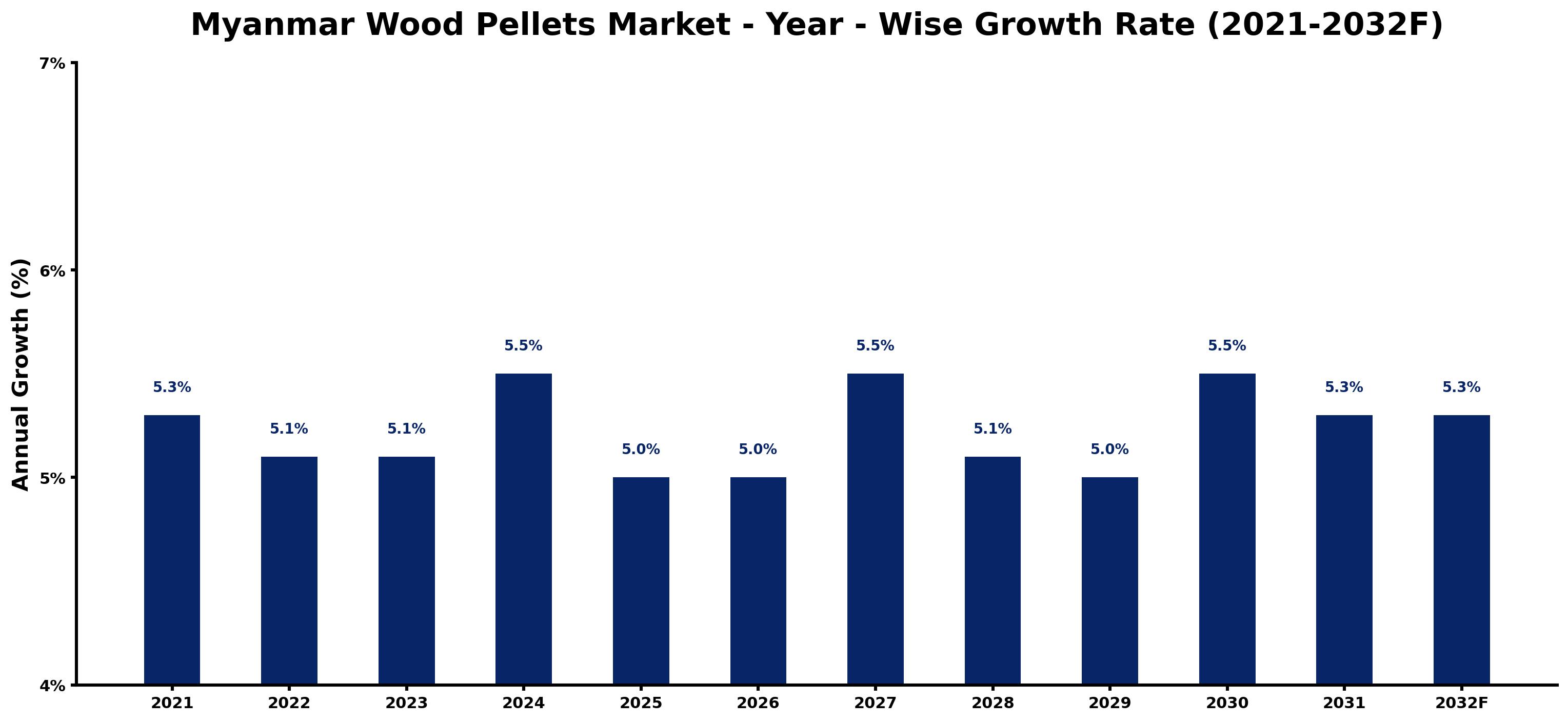
The table below presents the year wise growth rates along with the key drivers influencing the market
| Year | Growth Rate | Major Drivers |
| 2021 | 5.3% | Initial interest in sustainable energy sources creates early market engagement opportunities. |
| 2022 | 5.1% | Local businesses experiment with wood pellets, leading to reduced operational costs. |
| 2023 | 5.1% | Consumer awareness of climate change boosts preference for renewable energy solutions. |
| 2024 | 5.5% | Increased foreign investment in Myanmar emphasizes sustainable forest management practices. |
| 2025 | 5.0% | Local production facilities emerge, enhancing supply chain resilience and job creation. |
| 2026 | 5.0% | Partnerships between international NGOs and local farmers promote sustainable wood sourcing. |
| 2027 | 5.5% | Regional energy shortages motivate exploration of alternative biomass energy solutions. |
| 2028 | 5.1% | Digital platforms facilitate market access for small-scale wood pellet producers. |
| 2029 | 5.0% | Consumer preferences shift towards eco-friendly heating options, encouraging pellet stove sales. |
| 2030 | 5.5% | Expansion of rural electrification projects leads to a rise in wood pellet consumption. |
| 2031 | 5.3% | Research into advanced pellet production techniques enhances overall market efficiency. |
| 2032 | 5.3% | Export opportunities grow as neighboring countries seek reliable renewable energy supplies. |
Note - Market size estimations and growth projections presented in this report are based on 6Wresearch's advanced forecasting approach, validated with industry datasets as of June 2026.
Myanmar Wood Pellets Market Synopsis
The Myanmar Wood Pellets Market is projected to reach 5.0% and witness significant growth during the forecast period (2026-2032). This growth trajectory can be attributed to various factors including the increasing demand for renewable energy sources, particularly in the context of rising environmental concerns and regulatory frameworks that promote biomass energy. Wood pellets, known for their high thermal efficiency and low emissions, are increasingly utilized in energy generation and various industrial applications such as industrial boilers and furnaces.
Myanmar Wood Pellets Market Growth Drivers
Several factors are driving the expansion of the Myanmar Wood Pellets Market. Primarily, the shift towards renewable energy sources is propelling demand as stakeholders seek alternatives to fossil fuels. Increasing energy needs in industrial sectors are leading to heightened adoption of wood pellets for their efficiency and reduced environmental footprint.
- Strong government support for renewable energy initiatives has stimulated investments in biomass technologies.
- Growing awareness among consumers regarding sustainability is prompting a shift away from traditional fuel sources.
- The poultry feed sector's demand for byproducts derived from wood pellets is contributing to market growth.
- The rising cost of fossil fuels is encouraging industries to seek cost-effective, renewable alternatives.
- Technological advancements in pellet production are enhancing the efficiency and capacity of wood pellet manufacturing.
Myanmar Wood Pellets Market Trends and Opportunities
The Myanmar Wood Pellets Market is characterized by several emerging trends that present significant opportunities for stakeholders. As energy policies increasingly emphasize sustainability, the demand for wood pellets is set to expand. The market is witnessing a shift towards more efficient production practices, which may further enhance the viability of wood pellets as an energy source.
- Innovative production techniques are expected to lower costs and enhance product quality, attracting more users.
- Integration of technology in supply chain management is set to improve distribution efficiency and reduce overheads.
- Partnerships between local producers and international companies could lead to knowledge transfer and enhanced operational capabilities.
- Community-based bioenergy projects are gaining traction, creating localized markets for wood pellets.
- Increased participation of small and medium-sized enterprises in the wood pellet production landscape is anticipated, fostering competitive pricing.
Myanmar Wood Pellets Market Challenges and Restraints
Despite its growth potential, the Myanmar Wood Pellets Market faces several challenges. Stringent regulations from the government around product quality can pose hurdles for manufacturers, while the availability of alternative energy sources may provide competition to wood pellets.
- Compliance with evolving government regulations can increase operational costs for producers.
- The fluctuating prices of raw materials could impact the cost-effectiveness of wood pellet production.
- Dependence on weather conditions for biomass sourcing can lead to supply chain disruptions.
- Limited consumer awareness regarding the benefits of wood pellets compared to fossil fuels can hinder market penetration.
- Competition from alternative renewable energy sources, including solar and wind, may restrict market growth rates.
Myanmar Wood Pellets Market Government Investment and Initiatives
The Myanmar government has taken active measures to bolster the renewable energy sector, particularly through various initiatives aimed at promoting biomass alternatives. Investments in infrastructure supporting wood pellet production and distribution have been prioritized to enable greater accessibility to this energy source.
- Implementation of favorable policies and incentive programs are encouraging domestic production of wood pellets.
- Public funding aimed at research and development in biomass technologies supports industry advancement.
- Government partnerships with international organizations are facilitating knowledge sharing and technical expertise in biomass energy.
- Regulatory frameworks are being established to ensure the sustainability and quality of biomass resources, including wood pellets.
- Community engagement initiatives are promoting local biomass projects that utilize wood pellets for energy generation.
Myanmar Wood Pellets Market Latest Developments (May 2025 - June 2026)
During the period from May 2025 to June 2026, the Myanmar Wood Pellets Market has experienced notable developments that influence its trajectory. The local and international landscape in the sector has seen increased collaboration as stakeholders explore new avenues for resource optimization and market penetration.
- Enhanced governmental initiatives have focused on providing technical assistance and financial backing to wood pellet producers.
- Awareness campaigns executed by various organizations have aimed at educating consumers on the benefits of switching to biomass energy.
- Research institutions and universities have been increasingly involved in developing improved pellet production technologies.
- Emerging startups in the wood pellet sector have attracted attention from investors, signaling robust entrepreneurial activity.
- The sector has reported increased participation in international biomass conferences, fostering global connections and knowledge exchange.
Myanmar Wood Pellets Market - Key Attractiveness of the Report
- 10 Years of Market Numbers
- Historical Data Starting from 2022 to 2025
- Base Year: 2025
- Forecast Data until 2032
- Key Performance Indicators Impacting the Market
- Major Upcoming Developments and Projects
Key Highlights of the Report:
- Myanmar Wood Pellets Market Outlook
- Market Size of Myanmar Wood Pellets Market, 2025
- Forecast of Myanmar Wood Pellets Market, 2032F
- Historical Data and Forecast of Myanmar Wood Pellets Revenues & Volume for the Period 2022-2032F
- Myanmar Wood Pellets Market Trend Evolution
- Myanmar Wood Pellets Market Drivers and Challenges
- Myanmar Wood Pellets Price Trends
- Myanmar Wood Pellets Porter's Five Forces
- Myanmar Wood Pellets Industry Life Cycle
- Historical Data and Forecast of Myanmar Wood Pellets Market Revenues & Volume By Types for the Period 2022-2032F
- Historical Data and Forecast of Myanmar Wood Pellets Market Revenues & Volume By Hardwood for the Period 2022-2032F
- Historical Data and Forecast of Myanmar Wood Pellets Market Revenues & Volume By Softwood for the Period 2022-2032F
- Historical Data and Forecast of Myanmar Wood Pellets Market Revenues & Volume By Applications for the Period 2022-2032F
- Historical Data and Forecast of Myanmar Wood Pellets Market Revenues & Volume By Power Plants for the Period 2022-2032F
- Historical Data and Forecast of Myanmar Wood Pellets Market Revenues & Volume By Residential Heating for the Period 2022-2032F
- Historical Data and Forecast of Myanmar Wood Pellets Market Revenues & Volume By Commercial Heating for the Period 2022-2032F
- Historical Data and Forecast of Myanmar Wood Pellets Market Revenues & Volume By Combined Heat and Power (CHP) for the Period 2022-2032F
- Myanmar Wood Pellets Import Export Trade Statistics
- Market Opportunity Assessment By Types
- Market Opportunity Assessment By Applications
- Myanmar Wood Pellets Top Companies Market Share
- Myanmar Wood Pellets Competitive Benchmarking By Technical and Operational Parameters
- Myanmar Wood Pellets Company Profiles
- Myanmar Wood Pellets Key Strategic Recommendations






































