Myanmar Wooden Furniture Market Size, Share & Growth Rate
The Myanmar Wooden Furniture Market was estimated at USD 478 Million in 2025 and is projected to reach USD 664 Million by 2032, growing at a CAGR of 4.8% from 2026 to 2032. This growth trajectory is primarily driven by the flourishing real estate and hospitality sectors within Myanmar, as well as a rising consumer inclination towards sustainable and aesthetically appealing furniture options. The fusion of traditional craftsmanship with modern design continues to elevate the market's appeal, meeting both domestic and international demand.
Myanmar Wooden Furniture Market Growth Rate Analysis (2021-2032)
The Myanmar wooden furniture market continues to see notable growth, with annual increases of 5.9% in 2021 and a slight dip to 5.3% in 2022 attributed to supply chain challenges and fluctuating demand. However, a rebound ensued, as evidenced by 5.6% growth in 2023 and 5.7% in 2024. The trend stabilizes around this range, with 5.8% projected for 2031. Driving this growth are rising consumer preferences for sustainable, locally-sourced products and increased investment in digitalization within the sector. Additionally, improvements in infrastructure and a growing middle class are fostering an environment conducive to expanded production and sales, albeit with slight fluctuations reflective of broader economic conditions.
Myanmar Wooden Furniture Market Year-wise Growth Rate and Key Drivers
This graph highlights how the Myanmar Wooden Furniture Market has steadily grown over the past five years, supported by major growth factors.
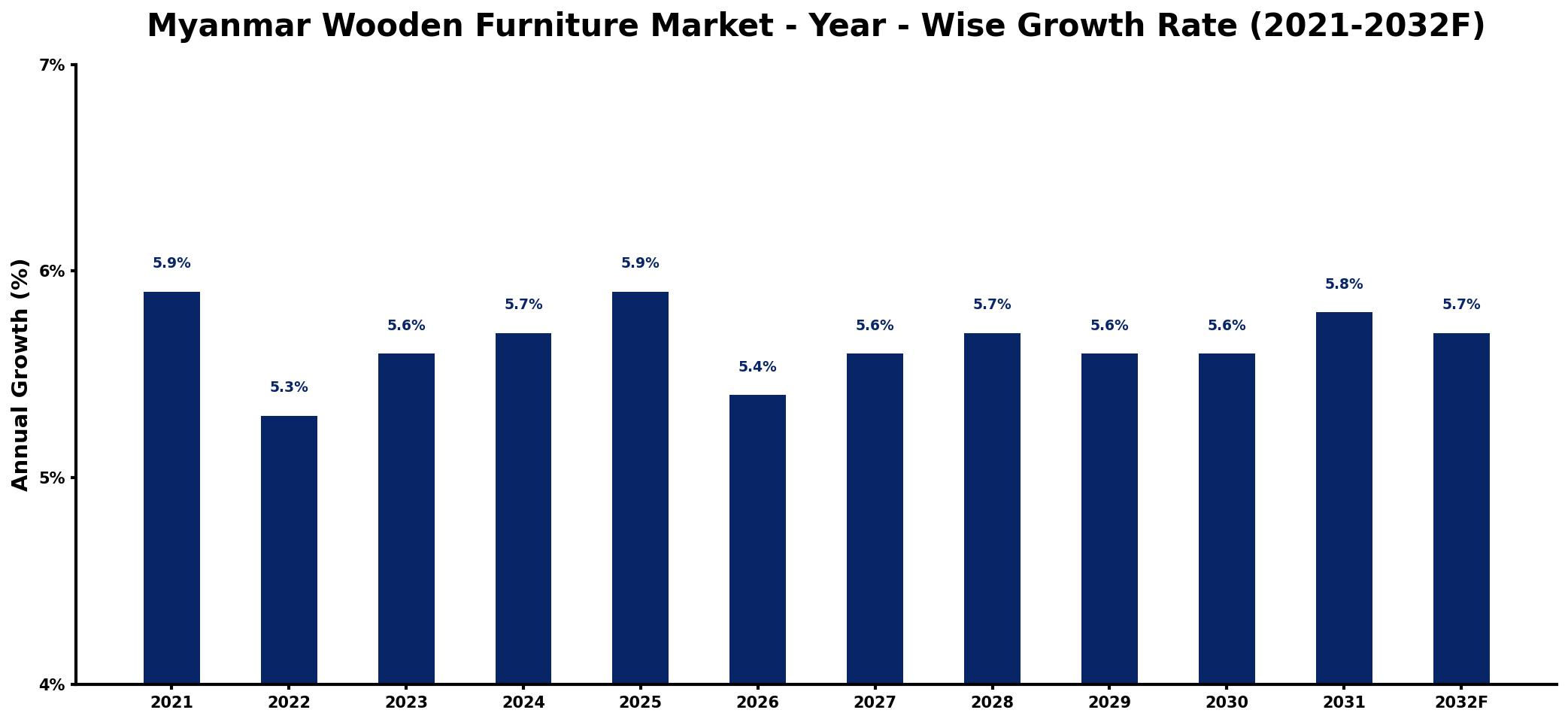
The table below presents the year‑wise growth rates along with the key drivers influencing the market
| Year | Growth Rate | Major Drivers |
| 2021 | 5.9% | Rising consumer spending patterns |
| 2022 | 5.3% | Growing urbanization and migration |
| 2023 | 5.6% | Increased disposable income levels |
| 2024 | 5.7% | Expansion of housing developments |
| 2025 | 5.9% | Emerging design trends popularity |
| 2026 | 5.4% | Sustainable materials demand rise |
| 2027 | 5.6% | Boost in online retail sales |
| 2028 | 5.7% | Strengthened export market presence |
| 2029 | 5.6% | Technological advancements in manufacturing |
| 2030 | 5.6% | Enhanced domestic production capacity |
| 2031 | 5.8% | Government incentives for investments |
| 2032 | 5.7% | Growing interest in customization |
Note: Market size estimations and growth projections presented in this report are based on 6Wresearch's proprietary forecasting methodology, utilizing the latest available industry data, government publications, and primary research inputs.
Myanmar Wooden Furniture Market Synopsis
In Myanmar, the demand for wooden furniture is not merely a trend; it reflects a deep-rooted cultural appreciation for fine craftsmanship using premium hardwoods like teak and mahogany. These materials, known for their durability and beauty, position Myanmar's wooden furniture market as a unique player on the global stage, attracting both local consumers and international buyers.
Furthermore, the local woodworking traditions blend seamlessly with contemporary design aesthetics. This duality allows manufacturers to cater to varied tastes, from rustic and traditional to sleek and modern, positioning Myanmar's furniture products as versatile solutions for diverse environments.
Myanmar Wooden Furniture Market Key Takeaways
- The market is experiencing robust growth driven by increasing demand for quality furniture in residential and commercial sectors.
- Local hardwoods, particularly teak and padauk, are central to the market's value proposition.
- The government's supportive policies aim to enhance the sustainability and quality of furniture production.
- Emerging trends indicate a shift towards eco-friendly practices and innovative designs.
- Investment opportunities abound in enhancing manufacturing techniques and tapping into international markets.
Evaluation of Restraints in Myanmar Wooden Furniture Market
Despite its promising growth potential, the Myanmar Wooden Furniture Market faces significant challenges. High costs associated with quality raw materials pose a persistent barrier for manufacturers aiming to compete effectively. Additionally, the need for advanced manufacturing techniques to improve efficiency and product quality remains a pressing concern. Fluctuating demand from the home and office furniture sectors further complicates market dynamics, while regulatory compliance and quality control measures add layers of complexity that can deter potential investments.
Myanmar Wooden Furniture Market Trends
The current landscape of the Myanmar Wooden Furniture Market is shaped by several notable trends. One key trend is the increasing consumer preference for sustainable and environmentally friendly furniture options. This shift is prompting manufacturers to adopt eco-friendly production practices, utilizing sustainably sourced wood. Additionally, the blending of traditional craftsmanship with modern design elements is gaining traction, appealing to a younger demographic that values both aesthetics and heritage.
Another emerging trend is the growing popularity of custom-made furniture solutions. As consumers seek personalized products that reflect their individual style, manufacturers are adapting by offering bespoke designs and tailored services. This trend not only enhances customer satisfaction but also opens avenues for higher profit margins.
Myanmar Wooden Furniture Market Opportunities
The Myanmar Wooden Furniture Market is rife with genuine growth and investment opportunities. The expansion of the real estate sector, especially in urban areas, signals a rising demand for both residential and commercial furniture. Furthermore, as tourism continues to grow, particularly in hospitality, there is a substantial opportunity for manufacturers to create high-quality furniture for hotels and resorts. The push towards sustainable practices also presents avenues for innovation and differentiation, allowing brands to capture the growing eco-conscious consumer base.
Government Initiatives in the Myanmar Wooden Furniture Market
The Myanmar government plays a pivotal role in promoting the wooden furniture market through various initiatives. Policies have been established to encourage the use of sustainable wood sources, thereby ensuring the long-term viability of the country's timber resources. Additionally, there are incentives for furniture manufacturers to innovate in design and production methods. The government also aims to set standards for furniture safety and durability, enhancing the overall quality of the market while promoting local craftsmanship and design excellence on an international scale.
Future Insights of the Myanmar Wooden Furniture Market
Looking ahead to 2026-2032, the Myanmar Wooden Furniture Market is poised for continued growth. As consumer preferences evolve towards high-quality, sustainable products, manufacturers who adapt to these trends are likely to flourish. The real estate and hospitality industries are expected to remain strong drivers of demand, while ongoing government support for sustainable practices will further bolster market confidence. With the right blend of innovation and tradition, the market can successfully navigate its challenges and seize new opportunities.
Myanmar Wooden Furniture Market Latest Developments (2025 - 2026)
Recent developments in the Myanmar Wooden Furniture Market indicate a growing emphasis on sustainable practices. Manufacturers are increasingly exploring eco-friendly materials and production methods in response to rising consumer demand for sustainability. Additionally, collaborations between local artisans and designers are becoming more common, fostering innovation while preserving traditional craftsmanship. This trend aligns with global movements towards ethical consumerism, positioning Myanmar's wooden furniture as a competitive offering in international markets.
Myanmar Wooden Furniture Market - Key Attractiveness of the Report
- 10 Years of Market Numbers
- Historical Data Starting from 2022 to 2025
- Base Year: 2025
- Forecast Data until 2032
- Key Performance Indicators Impacting the Market
- Major Upcoming Developments and Projects
Key Highlights of the Report:
- Myanmar Wooden Furniture Market Outlook
- Market Size of Myanmar Wooden Furniture Market, 2025
- Forecast of Myanmar Wooden Furniture Market, 2032
- Historical Data and Forecast of Myanmar Wooden Furniture Revenues & Volume for the Period 2022-2032F
- Myanmar Wooden Furniture Market Trend Evolution
- Myanmar Wooden Furniture Market Drivers and Challenges
- Myanmar Wooden Furniture Price Trends
- Myanmar Wooden Furniture Porter's Five Forces
- Myanmar Wooden Furniture Industry Life Cycle
- Historical Data and Forecast of Myanmar Wooden Furniture Market Revenues & Volume By Type for the Period 2022-2032F
- Historical Data and Forecast of Myanmar Wooden Furniture Market Revenues & Volume By Hardwood for the Period 2022-2032F
- Historical Data and Forecast of Myanmar Wooden Furniture Market Revenues & Volume By Softwood for the Period 2022-2032F
- Historical Data and Forecast of Myanmar Wooden Furniture Market Revenues & Volume By Material for the Period 2022-2032F
- Historical Data and Forecast of Myanmar Wooden Furniture Market Revenues & Volume By Plywood for the Period 2022-2032F
- Historical Data and Forecast of Myanmar Wooden Furniture Market Revenues & Volume By Laminates for the Period 2022-2032F
- Historical Data and Forecast of Myanmar Wooden Furniture Market Revenues & Volume By MDF for the Period 2022-2032F
- Historical Data and Forecast of Myanmar Wooden Furniture Market Revenues & Volume By Other Materials for the Period 2022-2032F
- Historical Data and Forecast of Myanmar Wooden Furniture Market Revenues & Volume By Product for the Period 2022-2032F
- Historical Data and Forecast of Myanmar Wooden Furniture Market Revenues & Volume By Bedroom for the Period 2022-2032F
- Historical Data and Forecast of Myanmar Wooden Furniture Market Revenues & Volume By Seating for the Period 2022-2032F
- Historical Data and Forecast of Myanmar Wooden Furniture Market Revenues & Volume By Kitchen for the Period 2022-2032F
- Historical Data and Forecast of Myanmar Wooden Furniture Market Revenues & Volume By Other Products for the Period 2022-2032F
- Historical Data and Forecast of Myanmar Wooden Furniture Market Revenues & Volume By Application for the Period 2022-2032F
- Historical Data and Forecast of Myanmar Wooden Furniture Market Revenues & Volume By Residential for the Period 2022-2032F
- Historical Data and Forecast of Myanmar Wooden Furniture Market Revenues & Volume By Commercial for the Period 2022-2032F
- Historical Data and Forecast of Myanmar Wooden Furniture Market Revenues & Volume By Distribution Channel for the Period 2022-2032F
- Historical Data and Forecast of Myanmar Wooden Furniture Market Revenues & Volume By Offline for the Period 2022-2032F
- Historical Data and Forecast of Myanmar Wooden Furniture Market Revenues & Volume By Online for the Period 2022-2032F
- Myanmar Wooden Furniture Import Export Trade Statistics
- Market Opportunity Assessment By Type
- Market Opportunity Assessment By Material
- Market Opportunity Assessment By Product
- Market Opportunity Assessment By Application
- Market Opportunity Assessment By Distribution Channel
- Myanmar Wooden Furniture Top Companies Market Share
- Myanmar Wooden Furniture Competitive Benchmarking By Technical and Operational Parameters
- Myanmar Wooden Furniture Company Profiles
- Myanmar Wooden Furniture Key Strategic Recommendations






































