Myanmar Wooden Toys Market Size, Share & Growth Rate
The Myanmar Wooden Toys Market was estimated at USD 460 Million in 2025 and is projected to reach USD 624 Million by 2032, growing at a CAGR of 4.5% from 2026 to 2032. This growth trajectory is fueled by a rising consumer preference for eco-friendly, safe, and durable toys. Parents are increasingly valuing the educational and developmental benefits that wooden toys offer, driving demand in a market where artisanal craftsmanship meets contemporary parenting values.
Myanmar Wooden Toys Market Year-wise Growth Rate and Key Drivers
This graph highlights how the Myanmar Wooden Toys Market has steadily grown over the years, supported by major growth factors.
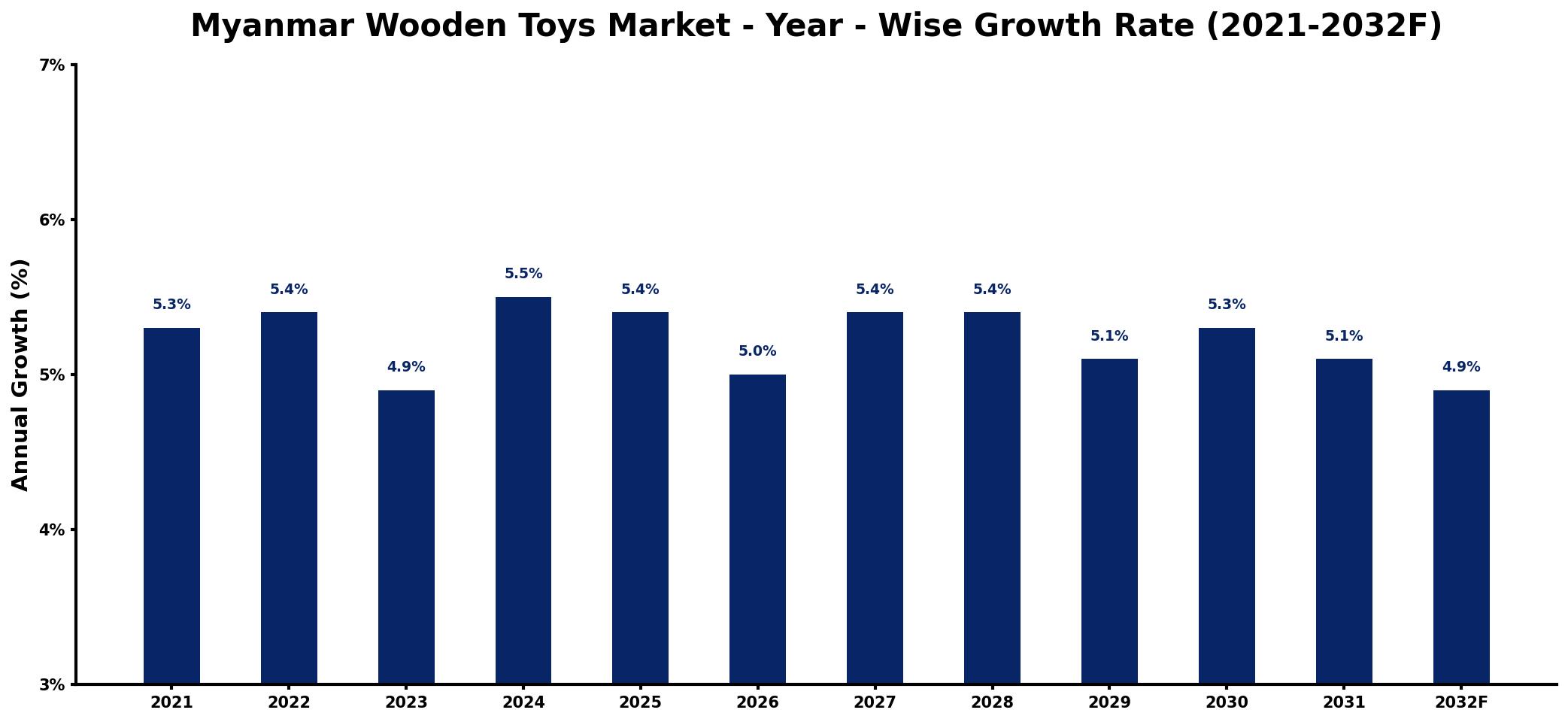
The table below presents the year‑wise growth rates along with the key drivers influencing the market
| Year | Growth Rate | Major Drivers |
| 2021 | 5.3% | Increase in local craftsmanship interest |
| 2022 | 5.4% | Rising consumer preference for sustainability |
| 2023 | 4.9% | Growing online retail platforms availability |
| 2024 | 5.5% | Expansion of regional export markets |
| 2025 | 5.4% | Increased investment in manufacturing facilities |
| 2026 | 5.0% | Strengthening of local supply chains |
| 2027 | 5.4% | Surge in eco-friendly product initiatives |
| 2028 | 5.4% | Growth in family-oriented leisure activities |
| 2029 | 5.1% | Boost in educational institution partnerships |
| 2030 | 5.3% | strengthening underlying market demand |
| 2031 | 5.1% | increased domestic production output |
| 2032 | 4.9% | Growing awareness of child development |
Note: Market size estimations and growth projections presented in this report are based on 6Wresearch's proprietary forecasting methodology, utilizing the latest available industry data, government publications, and primary research inputs.
Myanmar Wooden Toys Market Synopsis
In Myanmar, the wooden toys market stands out for its artisanal quality and commitment to sustainability. Each toy reflects a blend of cultural heritage and contemporary design, appealing to a growing demographic that prioritizes both aesthetics and ethical production.
The demand for wooden toys is bolstered by increasing awareness among parents regarding the safety and environmental impact of children's products. Educational institutions are also recognizing the benefits of incorporating wooden toys into early childhood development programs, further enhancing their market presence.
Myanmar Wooden Toys Market Key Takeaways
- Handcrafted wooden toys provide an eco-friendly alternative to plastic toys, gaining favor among environmentally-conscious parents.
- The market thrives on growing awareness regarding the developmental benefits of wooden toys for children.
- Artisanal craftsmanship plays a significant role in product differentiation and value addition.
- Government policies favor sustainable sourcing, which supports market growth and enhances consumer trust.
- Innovations in design are attracting a younger audience and keeping the market dynamic and relevant.
Evaluation of Restraints in Myanmar Wooden Toys Market
While the Myanmar Wooden Toys Market shows significant promise, it is constrained by a few key factors. The high cost of quality raw materials can deter manufacturers from maintaining consistent production levels. Furthermore, the market faces pressure from alternative toy materials, which often come with lower price points. Regulatory compliance can also pose challenges, as manufacturers must navigate stringent safety standards to ensure product quality. These factors collectively create a challenging environment for market growth and profitability.
Myanmar Wooden Toys Market Trends
Emerging trends in the Myanmar Wooden Toys Market highlight a shift towards customization and personalization. Parents are seeking toys that reflect their children's interests and preferences, leading manufacturers to explore tailored designs. Additionally, there is a growing trend towards online sales channels, making it easier for consumers to access a wider variety of products.
Sustainability remains at the forefront of consumer consciousness, pushing manufacturers to innovate with environmentally friendly practices and materials. The trend of integrating educational concepts into toy design is also gaining momentum, as parents increasingly look for toys that support learning through play.
Myanmar Wooden Toys Market Opportunities
The Myanmar Wooden Toys Market is ripe with opportunities for growth and investment. The rising demand for eco-friendly products presents a chance for companies to expand their product lines to include more sustainable options. Additionally, exploring international markets could yield substantial benefits, as the global trend towards natural toys continues to gain traction. Collaborations with educational institutions and awareness campaigns highlighting the advantages of wooden toys could further stimulate market demand.
Government Initiatives in the Myanmar Wooden Toys Market
The government of Myanmar has taken steps to promote the wooden toys market by incentivizing the use of sustainably sourced materials and non-toxic finishes. Initiatives aimed at preserving traditional craftsmanship are also crucial, as they not only enhance product quality but also support local artisans. Regulatory standards for safety and design compliance are being developed to ensure that products meet both domestic and international safety requirements, thereby bolstering consumer confidence.
Future Insights of the Myanmar Wooden Toys Market
Looking ahead, the Myanmar Wooden Toys Market is poised for steady growth from 2026 to 2032. As consumer awareness continues to rise regarding the educational benefits and safety of wooden toys, manufacturers are likely to innovate further, keeping pace with changing preferences. The synergy between traditional craftsmanship and modern aesthetics will be crucial in attracting both local and international markets, ensuring the sector's resilience in an evolving landscape.
Myanmar Wooden Toys Market Latest Developments (2025 - 2026)
Recent developments in the Myanmar Wooden Toys Market reflect a growing emphasis on sustainability and innovation. Artisans are increasingly experimenting with new designs and eco-friendly finishes, appealing to a more environmentally conscious consumer base. Furthermore, local toy fairs and exhibitions have gained popularity, providing a platform for manufacturers to showcase their products and connect directly with consumers.
Myanmar Wooden Toys Market - Key Attractiveness of the Report
- 10 Years of Market Numbers
- Historical Data Starting from 2022 to 2025
- Base Year: 2025
- Forecast Data until 2032
- Key Performance Indicators Impacting the Market
- Major Upcoming Developments and Projects
Key Highlights of the Report:
- Myanmar Wooden Toys Market Outlook
- Market Size of Myanmar Wooden Toys Market, 2025
- Forecast of Myanmar Wooden Toys Market, 2032
- Historical Data and Forecast of Myanmar Wooden Toys Revenues & Volume for the Period 2022-2032F
- Myanmar Wooden Toys Market Trend Evolution
- Myanmar Wooden Toys Market Drivers and Challenges
- Myanmar Wooden Toys Price Trends
- Myanmar Wooden Toys Porter's Five Forces
- Myanmar Wooden Toys Industry Life Cycle
- Historical Data and Forecast of Myanmar Wooden Toys Market Revenues & Volume By Product Type for the Period 2022-2032F
- Historical Data and Forecast of Myanmar Wooden Toys Market Revenues & Volume By Educational Toys for the Period 2022-2032F
- Historical Data and Forecast of Myanmar Wooden Toys Market Revenues & Volume By Construction Toys for the Period 2022-2032F
- Historical Data and Forecast of Myanmar Wooden Toys Market Revenues & Volume By Musical Toys for the Period 2022-2032F
- Historical Data and Forecast of Myanmar Wooden Toys Market Revenues & Volume By Game Toys for the Period 2022-2032F
- Historical Data and Forecast of Myanmar Wooden Toys Market Revenues & Volume By Dolls & Miniatures for the Period 2022-2032F
- Historical Data and Forecast of Myanmar Wooden Toys Market Revenues & Volume By Automotive Toys for the Period 2022-2032F
- Historical Data and Forecast of Myanmar Wooden Toys Market Revenues & Volume By Pretend Play Toys for the Period 2022-2032F
- Historical Data and Forecast of Myanmar Wooden Toys Market Revenues & Volume By Wood Type for the Period 2022-2032F
- Historical Data and Forecast of Myanmar Wooden Toys Market Revenues & Volume By Softwood for the Period 2022-2032F
- Historical Data and Forecast of Myanmar Wooden Toys Market Revenues & Volume By Hardwood for the Period 2022-2032F
- Historical Data and Forecast of Myanmar Wooden Toys Market Revenues & Volume By Age Group for the Period 2022-2032F
- Historical Data and Forecast of Myanmar Wooden Toys Market Revenues & Volume By Below 1 Year for the Period 2022-2032F
- Historical Data and Forecast of Myanmar Wooden Toys Market Revenues & Volume By Age 1-3 for the Period 2022-2032F
- Historical Data and Forecast of Myanmar Wooden Toys Market Revenues & Volume By Age 3-5 for the Period 2022-2032F
- Historical Data and Forecast of Myanmar Wooden Toys Market Revenues & Volume By Age 5-12 for the Period 2022-2032F
- Historical Data and Forecast of Myanmar Wooden Toys Market Revenues & Volume By Age 12+ for the Period 2022-2032F
- Historical Data and Forecast of Myanmar Wooden Toys Market Revenues & Volume By Distribution Channel for the Period 2022-2032F
- Historical Data and Forecast of Myanmar Wooden Toys Market Revenues & Volume By Online for the Period 2022-2032F
- Historical Data and Forecast of Myanmar Wooden Toys Market Revenues & Volume By Offline for the Period 2022-2032F
- Myanmar Wooden Toys Import Export Trade Statistics
- Market Opportunity Assessment By Product Type
- Market Opportunity Assessment By Wood Type
- Market Opportunity Assessment By Age Group
- Market Opportunity Assessment By Distribution Channel
- Myanmar Wooden Toys Top Companies Market Share
- Myanmar Wooden Toys Competitive Benchmarking By Technical and Operational Parameters
- Myanmar Wooden Toys Company Profiles
- Myanmar Wooden Toys Key Strategic Recommendations






































