Myanmar Workplace Safety Market Size & Growth Rate (2026-2032)
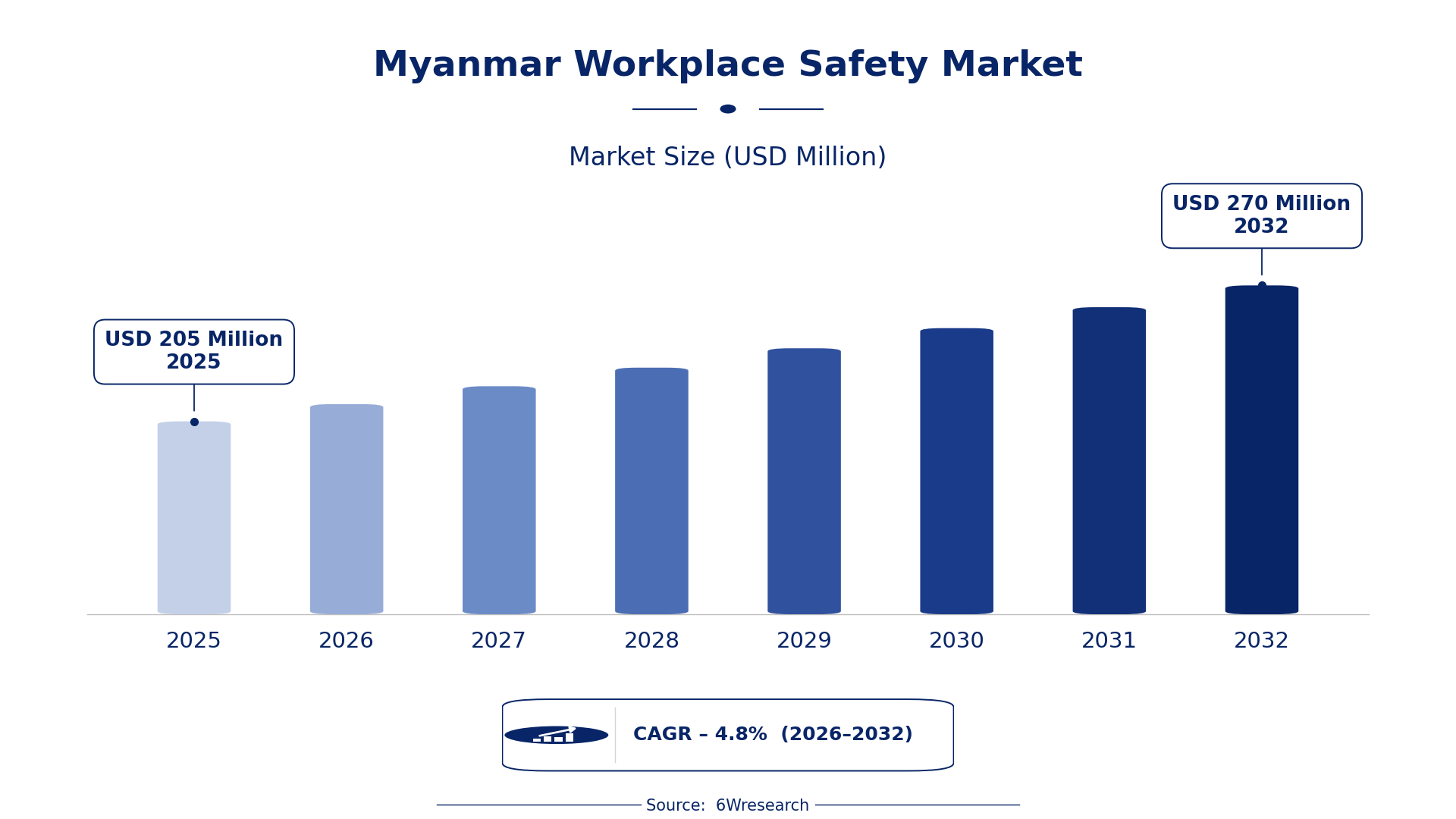
The Myanmar Workplace Safety Market was estimated at USD 205 Million in 2025 and is projected to reach USD 270 Million by 2032, growing at a CAGR of 4.8% from 2026 to 2032.
Myanmar Workplace Safety Market Synopsis
The Myanmar Workplace Safety Market is on a clear upward trajectory, fueled by heightened awareness surrounding occupational health and safety. Recent government regulations are pushing industries to adopt safer practices, making compliance a priority for many businesses.
In addition to regulatory compliance, there's a growing emphasis on employee well-being across various sectors. Industries such as manufacturing, construction, and healthcare are particularly focused on integrating advanced safety solutions, signaling a significant shift toward proactive safety management in Myanmar.
Myanmar Workplace Safety Market Year-wise Growth Rate and Key Drivers
This graph illustrates the annual growth rates of the Myanmar Workplace Safety Market from 2021 to 2032, highlighting a steady upward trajectory and projected expansion over the forecast period.
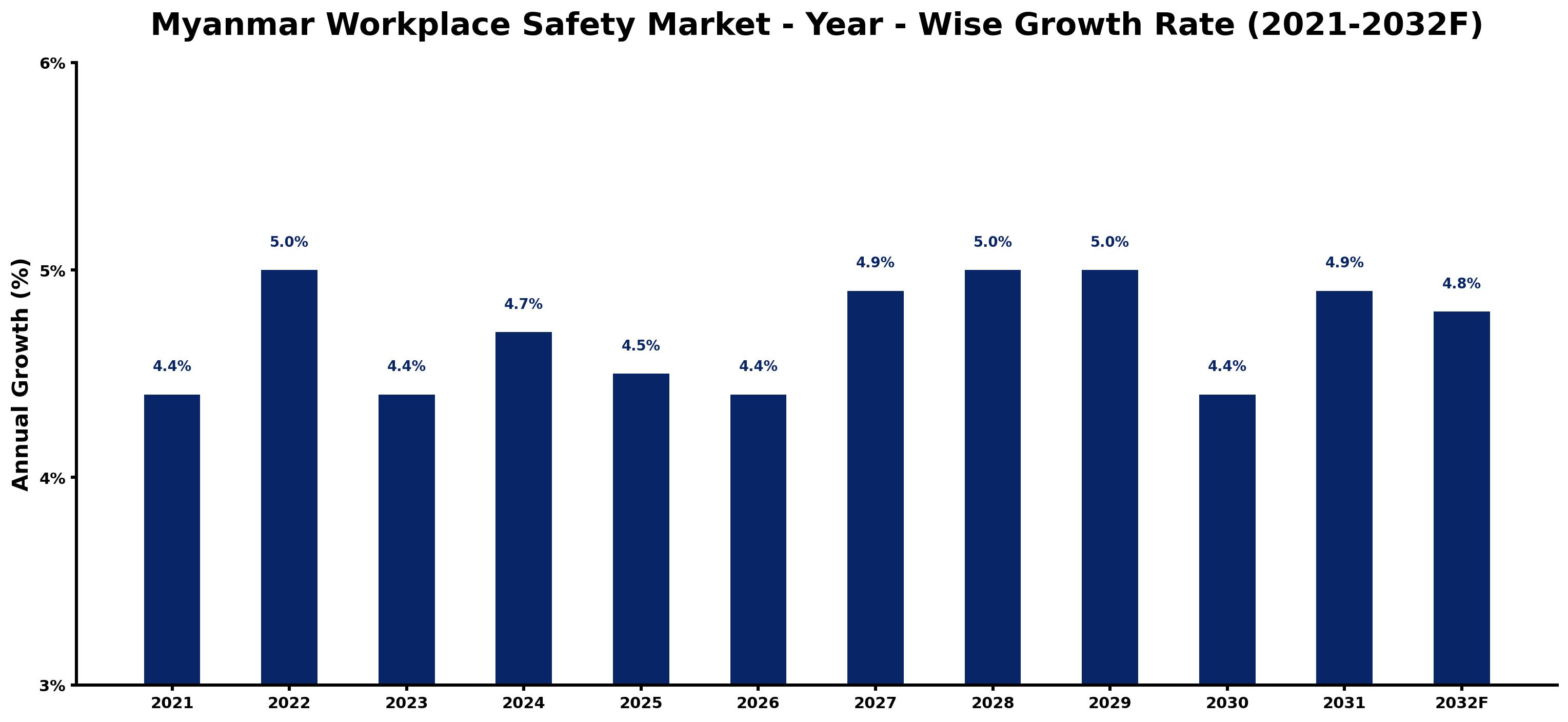
The table below presents the year‑wise growth rates along with the key drivers influencing the market
| Year | Growth Rate | Major Drivers |
| 2021 | 4.4% | New labor laws promoting enhanced workplace safety standards |
| 2022 | 5.0% | Increased foreign investment necessitating improved safety compliance |
| 2023 | 4.4% | Government workshops on occupational health and safety regulations |
| 2024 | 4.7% | Rise in industries adopting safety training programs |
| 2025 | 4.5% | Local NGOs advocating for improved worker safety measures |
| 2026 | 4.4% | Focus on minimizing workplace accidents through strict regulations |
| 2027 | 4.9% | Emergence of local safety certification programs boosting awareness |
| 2028 | 5.0% | Partnerships with international organizations for safety best practices |
| 2029 | 5.0% | Growing workforce prioritizing safe working environments |
| 2030 | 4.4% | Increased penalties for safety violations promoting compliance |
| 2031 | 4.9% | Development of localized safety equipment tailored for industries |
| 2032 | 4.8% | Rising awareness of mental health impacts on workplace safety |
Note: Market size estimations and growth projections presented in this report are based on 6Wresearch's proprietary forecasting methodology, utilizing the latest available industry data, government publications, and primary research inputs.
Myanmar Workplace Safety Market Key Takeaways
Below are some of the specific key takeaways from the market, including:
- Government regulations are driving the implementation of workplace safety standards.
- Investments in training programs are on the rise as companies prioritize employee safety.
- The market is witnessing a shift towards sustainable and eco-friendly safety practices.
- Advanced technology, including digital safety management systems, is gaining traction.
- Significant opportunities exist in personal protective equipment (PPE) distribution.
Evaluation of Restraints in Myanmar Workplace Safety Market
Despite growth, several factors hold back the Myanmar Workplace Safety Market. A notable challenge is the inconsistency in the enforcement of existing safety regulations, which often leads to complacency among employers. Limited access to quality training and equipment further compounds the issue, particularly in rural areas where industries are rapidly expanding. Additionally, a shortage of skilled safety professionals creates gaps in effective risk management. Addressing these issues is essential for fostering a culture of safety that aligns with international standards.
Myanmar Workplace Safety Market Trends
The demand for comprehensive safety solutions is increasing, driven by companies looking to enhance their safety protocols. There's a notable trend towards adopting advanced safety equipment, including high-quality personal protective gear. Companies are also emphasizing digital solutions such as safety management software, which streamlines compliance tracking and incident reporting.
Another emerging trend involves integrating sustainability into safety practices. Organizations are increasingly seeking eco-friendly products, such as biodegradable PPE, reflecting a growing commitment to environmental responsibility alongside worker safety.
Myanmar Workplace Safety Market Opportunities
Investment prospects in the Myanmar Workplace Safety Market are abundant. Safety training services present a lucrative opportunity as companies aim to educate their workforce on best practices. Furthermore, the demand for quality PPE is set to surge as regulatory scrutiny increases. Additionally, there's a growing need for occupational health services, offering another pathway for businesses to cater to employee wellness.
Government Initiatives in the Myanmar Workplace Safety Market
Government policy is currently shaping the Myanmar Workplace Safety Market through enhanced regulations and oversight. The introduction of the Occupational Safety and Health Law aims to establish a framework for safety across various industries, while the enforcement of the Factories Act lays the groundwork for safe working conditions. This shift emphasizes the critical importance of compliance as Myanmar progresses toward more stringent safety standards.
- A recent initiative in 2025 focused on revising the Occupational Safety and Health Law to better protect workers in high-risk sectors.
- Currently, the Directorate of Industrial Supervision and Inspection is conducting workshops to educate businesses about new compliance requirements.
- A planned regulatory review expected in 2026 will introduce stricter penalties for non-compliance in workplace safety standards.
- As part of ongoing efforts, a national campaign launched in late 2025 aims to raise awareness about the importance of occupational health and safety.
Future Insights of the Myanmar Workplace Safety Market
Looking ahead to 2026-2032, the Myanmar Workplace Safety Market is set for notable expansion. As the industrial landscape evolves, so too does the focus on safety compliance and employee welfare. The government's increasing commitment to regulatory enforcement will likely create a more supportive environment for safety investments. Furthermore, the integration of innovative technologies—such as IoT and AI—will play a crucial role in shaping future safety protocols.
Myanmar Workplace Safety Market Latest Developments
Recent developments in the Myanmar Workplace Safety Market indicate a clear commitment to enhancing safety standards. Companies are increasingly investing in advanced technologies and training initiatives to mitigate risks associated with workplace injuries.
- A partnership established in early 2025 between local industries and international safety organizations aims to improve workplace safety practices through shared training resources.
- A program launched in late 2025 focuses on distributing state-of-the-art PPE to rural industries, addressing the need for safer equipment in less-accessible areas.
- Currently underway, a digital safety management system is being trialed by several manufacturing firms, aimed at simplifying compliance reporting.
- Set to launch in mid-2026, a national health and safety competition seeks to encourage businesses to develop innovative safety protocols.
Myanmar Workplace Safety Market - Key Attractiveness of the Report
- 10 Years of Market Numbers
- Historical Data Starting from 2022 to 2025
- Base Year: 2025
- Forecast Data until 2032
- Key Performance Indicators Impacting the Market
- Major Upcoming Developments and Projects
Key Highlights of the Report:
- Myanmar Workplace Safety Market Outlook
- Market Size of Myanmar Workplace Safety Market, 2025
- Forecast of Myanmar Workplace Safety Market, 2032
- Historical Data and Forecast of Myanmar Workplace Safety Revenues & Volume for the Period 2022-2032F
- Myanmar Workplace Safety Market Trend Evolution
- Myanmar Workplace Safety Market Drivers and Challenges
- Myanmar Workplace Safety Price Trends
- Myanmar Workplace Safety Porter's Five Forces
- Myanmar Workplace Safety Industry Life Cycle
- Historical Data and Forecast of Myanmar Workplace Safety Market Revenues & Volume By Component for the Period 2022-2032F
- Historical Data and Forecast of Myanmar Workplace Safety Market Revenues & Volume By Hardware for the Period 2022-2032F
- Historical Data and Forecast of Myanmar Workplace Safety Market Revenues & Volume By Software for the Period 2022-2032F
- Historical Data and Forecast of Myanmar Workplace Safety Market Revenues & Volume By Services for the Period 2022-2032F
- Historical Data and Forecast of Myanmar Workplace Safety Market Revenues & Volume By Application for the Period 2022-2032F
- Historical Data and Forecast of Myanmar Workplace Safety Market Revenues & Volume By Incident for the Period 2022-2032F
- Historical Data and Forecast of Myanmar Workplace Safety Market Revenues & Volume By Emergency Management for the Period 2022-2032F
- Historical Data and Forecast of Myanmar Workplace Safety Market Revenues & Volume By Asset Tracking for the Period 2022-2032F
- Historical Data and Forecast of Myanmar Workplace Safety Market Revenues & Volume By PPE Detection for the Period 2022-2032F
- Historical Data and Forecast of Myanmar Workplace Safety Market Revenues & Volume By System for the Period 2022-2032F
- Historical Data and Forecast of Myanmar Workplace Safety Market Revenues & Volume By Environmental Health and Safety for the Period 2022-2032F
- Historical Data and Forecast of Myanmar Workplace Safety Market Revenues & Volume By Access Control and Surveillance System for the Period 2022-2032F
- Historical Data and Forecast of Myanmar Workplace Safety Market Revenues & Volume By Real Time Location Monitoring for the Period 2022-2032F
- Historical Data and Forecast of Myanmar Workplace Safety Market Revenues & Volume By Others for the Period 2022-2032F
- Historical Data and Forecast of Myanmar Workplace Safety Market Revenues & Volume By Deployment Mode for the Period 2022-2032F
- Historical Data and Forecast of Myanmar Workplace Safety Market Revenues & Volume By On-premise for the Period 2022-2032F
- Historical Data and Forecast of Myanmar Workplace Safety Market Revenues & Volume By Cloud for the Period 2022-2032F
- Historical Data and Forecast of Myanmar Workplace Safety Market Revenues & Volume By End User for the Period 2022-2032F
- Historical Data and Forecast of Myanmar Workplace Safety Market Revenues & Volume By Energy and Utilities for the Period 2022-2032F
- Historical Data and Forecast of Myanmar Workplace Safety Market Revenues & Volume By Construction and Engineering for the Period 2022-2032F
- Historical Data and Forecast of Myanmar Workplace Safety Market Revenues & Volume By Chemical and Materials for the Period 2022-2032F
- Historical Data and Forecast of Myanmar Workplace Safety Market Revenues & Volume By Government and Defense for the Period 2022-2032F
- Historical Data and Forecast of Myanmar Workplace Safety Market Revenues & Volume By Healthcare for the Period 2022-2032F
- Historical Data and Forecast of Myanmar Workplace Safety Market Revenues & Volume By Food and Beverages for the Period 2022-2032F
- Historical Data and Forecast of Myanmar Workplace Safety Market Revenues & Volume By Others for the Period 2022-2032F
- Myanmar Workplace Safety Import Export Trade Statistics
- Market Opportunity Assessment By Component
- Market Opportunity Assessment By Application
- Market Opportunity Assessment By System
- Market Opportunity Assessment By Deployment Mode
- Market Opportunity Assessment By End User
- Myanmar Workplace Safety Top Companies Market Share
- Myanmar Workplace Safety Competitive Benchmarking By Technical and Operational Parameters
- Myanmar Workplace Safety Company Profiles
- Myanmar Workplace Safety Key Strategic Recommendations






































