Myanmar Zinc Sulphate Market Size, Share & Growth Rate
The Myanmar Zinc Sulphate Market was estimated at USD 421 Million in 2025 and is projected to reach USD 562 Million by 2032, growing at a CAGR of 4.2% from 2026 to 2032. This growth is driven primarily by the increasing adoption of zinc sulphate in agriculture, where it is crucial for enhancing crop yields and quality amid rising soil nutrient deficiencies. Additionally, the expansion of the livestock sector, coupled with government initiatives aimed at boosting agricultural productivity, further fuels demand for zinc sulphate across multiple applications.
Myanmar Zinc Sulphate Market Year-wise Growth Rate and Key Drivers
This graph highlights how the Myanmar Zinc Sulphate Market has steadily grown over the years, supported by major growth factors.
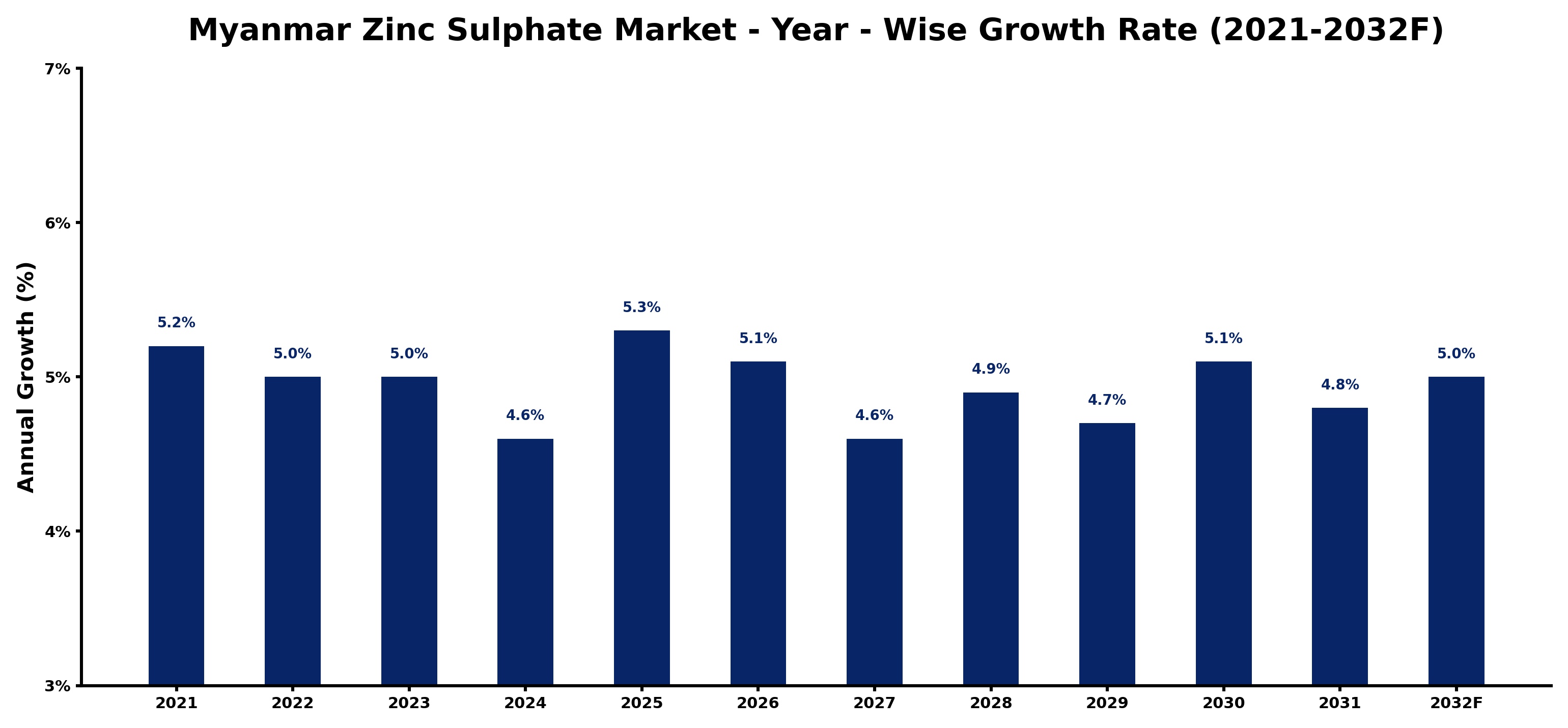
The table below presents the year‑wise growth rates along with the key drivers influencing the market
| Year | Growth Rate | Major Drivers |
| 2021 | 5.2% | Increased agricultural demand for nutrients |
| 2022 | 5.0% | Rising awareness of soil health |
| 2023 | 5.0% | Expansion of organic farming practices |
| 2024 | 4.6% | Government support for fertilizer usage |
| 2025 | 5.3% | Growing livestock farming sector needs |
| 2026 | 5.1% | Enhanced crop yield expectations rising |
| 2027 | 4.6% | Sustainable farming practices gaining traction |
| 2028 | 4.9% | Increased investment in agricultural technology |
| 2029 | 4.7% | Rising exports of agricultural products |
| 2030 | 5.1% | Improved distribution networks for fertilizers |
| 2031 | 4.8% | Consumer preference for quality produce |
| 2032 | 5.0% | Research advancements in crop nutrition |
Note - Market size estimations and growth projections presented in this report are based on 6Wresearch’s advanced forecasting approach, validated with industry datasets as of June 2026.
Myanmar Zinc Sulphate Market Synopsis
Currently, the most significant force shaping the Myanmar Zinc Sulphate Market is the urgent need for sustainable agricultural practices. As farmers seek effective solutions to combat soil deficiencies, the role of zinc sulphate as a vital micronutrient becomes increasingly critical. This focus not only promotes crop health but also aligns with global goals for food security and environmental sustainability.
In addition, the growing awareness of the importance of trace minerals in animal husbandry plays a crucial role in market dynamics. As the livestock industry expands, so too does the demand for zinc sulphate in animal feed formulations, which supports healthy growth and addresses dietary deficiencies in livestock. This dual focus on agriculture and livestock is integral to the market's development.
Myanmar Zinc Sulphate Market Key Takeaways
- Rising demand for zinc sulphate in agricultural applications enhances crop nutrition.
- Significant growth in the livestock sector drives increased usage in animal feed.
- Government policies support zinc sulphate production, enhancing local market access.
- Challenges remain in sourcing high-quality raw materials and production technologies.
- Regulatory compliance and market competition affect overall industry growth.
Evaluation of Restraints in Myanmar Zinc Sulphate Market
Despite the promising outlook, the Myanmar Zinc Sulphate Market faces several restraints that could impede growth. A primary concern is the availability of high-quality raw materials, which can often be limited or subject to price fluctuations, affecting production costs and margins. Additionally, the need for advanced production technologies may create barriers for smaller manufacturers lacking the necessary capital or expertise. The presence of alternative chemical solutions also adds competitive pressure, potentially diverting demand away from zinc sulphate. Furthermore, adhering to regulatory standards for product quality can be challenging, affecting compliance for local producers.
Myanmar Zinc Sulphate Market Trends
Current trends in the Myanmar Zinc Sulphate Market highlight a shift towards organic farming practices, where the demand for natural fertilizers and micronutrient solutions is on the rise. Additionally, innovations in production processes, including more efficient methods of synthesizing zinc sulphate, are emerging as key focal points. This shift not only enhances product quality but also responds to increasing regulatory pressures for sustainability and environmental responsibility.
Myanmar Zinc Sulphate Market Opportunities
The Myanmar Zinc Sulphate Market presents a range of growth opportunities, particularly in expanding agricultural initiatives aimed at sustainable practices. Investments in research and development to optimize zinc sulphate formulations for specific crop types can enhance market penetration. Moreover, partnerships between local producers and agricultural cooperatives could lead to increased awareness and adoption of zinc sulphate as a viable solution for soil fertility and livestock health, positioning this sector for robust growth.
Government Initiatives in the Myanmar Zinc Sulphate Market
The Myanmar government plays a supportive role in the development of the Zinc Sulphate Market through various initiatives. This includes promoting the mining and processing of zinc ores, which is essential for securing local raw materials. Additionally, the government regulates environmental impacts associated with zinc sulphate manufacturing, ensuring that production practices align with sustainability goals. Efforts to facilitate market access for domestically produced zinc sulphate across agricultural, pharmaceutical, and chemical sectors are also notable.
Future Insights of the Myanmar Zinc Sulphate Market
Looking ahead to 2026-2032, the Myanmar Zinc Sulphate Market is poised for significant transformation driven by increased agricultural productivity and health considerations. The ongoing focus on micronutrient solutions to counter soil deficiencies will remain paramount, particularly in light of global food security challenges. As technological advancements continue to enhance production efficiency and product quality, the market is expected to witness a steady uptick in both local and export demand, positioning it as a key player in the regional agricultural landscape.
Myanmar Zinc Sulphate Market Latest Developments (May 2025 - June 2026)
In recent months, the Myanmar Zinc Sulphate Market has seen a flurry of activity as producers explore innovative production techniques to enhance product quality. Concurrently, there is a growing emphasis on aligning with international quality standards, which is vital for market competitiveness. Additionally, strategic collaborations between agricultural stakeholders and zinc sulphate manufacturers are being forged to facilitate the integration of this essential micronutrient into local farming practices, signaling a positive trend in market dynamics.
Myanmar Zinc Sulphate Market - Key Attractiveness of the Report
- 10 Years of Market Numbers
- Historical Data Starting from 2022 to 2025
- Base Year: 2025
- Forecast Data until 2032
- Key Performance Indicators Impacting the Market
- Major Upcoming Developments and Projects
Key Highlights of the Report:
- Myanmar Zinc Sulphate Market Outlook
- Market Size of Myanmar Zinc Sulphate Market, 2025
- Forecast of Myanmar Zinc Sulphate Market, 2032
- Historical Data and Forecast of Myanmar Zinc Sulphate Revenues & Volume for the Period 2022-2032F
- Myanmar Zinc Sulphate Market Trend Evolution
- Myanmar Zinc Sulphate Market Drivers and Challenges
- Myanmar Zinc Sulphate Price Trends
- Myanmar Zinc Sulphate Porter's Five Forces
- Myanmar Zinc Sulphate Industry Life Cycle
- Historical Data and Forecast of Myanmar Zinc Sulphate Market Revenues & Volume By Type for the Period 2022-2032F
- Historical Data and Forecast of Myanmar Zinc Sulphate Market Revenues & Volume By Zinc Sulphate Anhydrous for the Period 2022-2032F
- Historical Data and Forecast of Myanmar Zinc Sulphate Market Revenues & Volume By Zinc Sulphate Hexahydrate for the Period 2022-2032F
- Historical Data and Forecast of Myanmar Zinc Sulphate Market Revenues & Volume By Zinc Sulphate Heptahydrate for the Period 2022-2032F
- Historical Data and Forecast of Myanmar Zinc Sulphate Market Revenues & Volume By Zinc Sulphate Monohydrate for the Period 2022-2032F
- Historical Data and Forecast of Myanmar Zinc Sulphate Market Revenues & Volume By Application for the Period 2022-2032F
- Historical Data and Forecast of Myanmar Zinc Sulphate Market Revenues & Volume By Agrochemicals for the Period 2022-2032F
- Historical Data and Forecast of Myanmar Zinc Sulphate Market Revenues & Volume By Chemicals for the Period 2022-2032F
- Historical Data and Forecast of Myanmar Zinc Sulphate Market Revenues & Volume By Pharmaceuticals for the Period 2022-2032F
- Historical Data and Forecast of Myanmar Zinc Sulphate Market Revenues & Volume By Synthetic Fibers for the Period 2022-2032F
- Historical Data and Forecast of Myanmar Zinc Sulphate Market Revenues & Volume By Water Treatment for the Period 2022-2032F
- Historical Data and Forecast of Myanmar Zinc Sulphate Market Revenues & Volume By Others for the Period 2022-2032F
- Myanmar Zinc Sulphate Import Export Trade Statistics
- Market Opportunity Assessment By Type
- Market Opportunity Assessment By Application
- Myanmar Zinc Sulphate Top Companies Market Share
- Myanmar Zinc Sulphate Competitive Benchmarking By Technical and Operational Parameters
- Myanmar Zinc Sulphate Company Profiles
- Myanmar Zinc Sulphate Key Strategic Recommendations






































