Namibia Marine Vessel Market (2026-2032) | Segmentation, Size, Growth, Forecast, Revenue, Outlook, Share, Companies, Industry, Value, Analysis & Trends
Market Forecast By Type (Commercial Vessel, Passenger Ship, LNG/LPG Carrier, Special Purpose Vessel), By System (Marine Engine, Sensor System, Control System, Electrical System, Auxiliary System, Communication System), By End-use (Original Equipment Manufacturer (OEM), Aftermarket) And Competitive Landscape
| Product Code: ETC4988905 | Publication Date: Nov 2023 | Updated Date: Mar 2026 | Product Type: Market Research Report | |
| Publisher: 6Wresearch | Author: Shubham Padhi | No. of Pages: 60 | No. of Figures: 30 | No. of Tables: 5 |
Namibia Marine Vessel Market Size Growth Rate
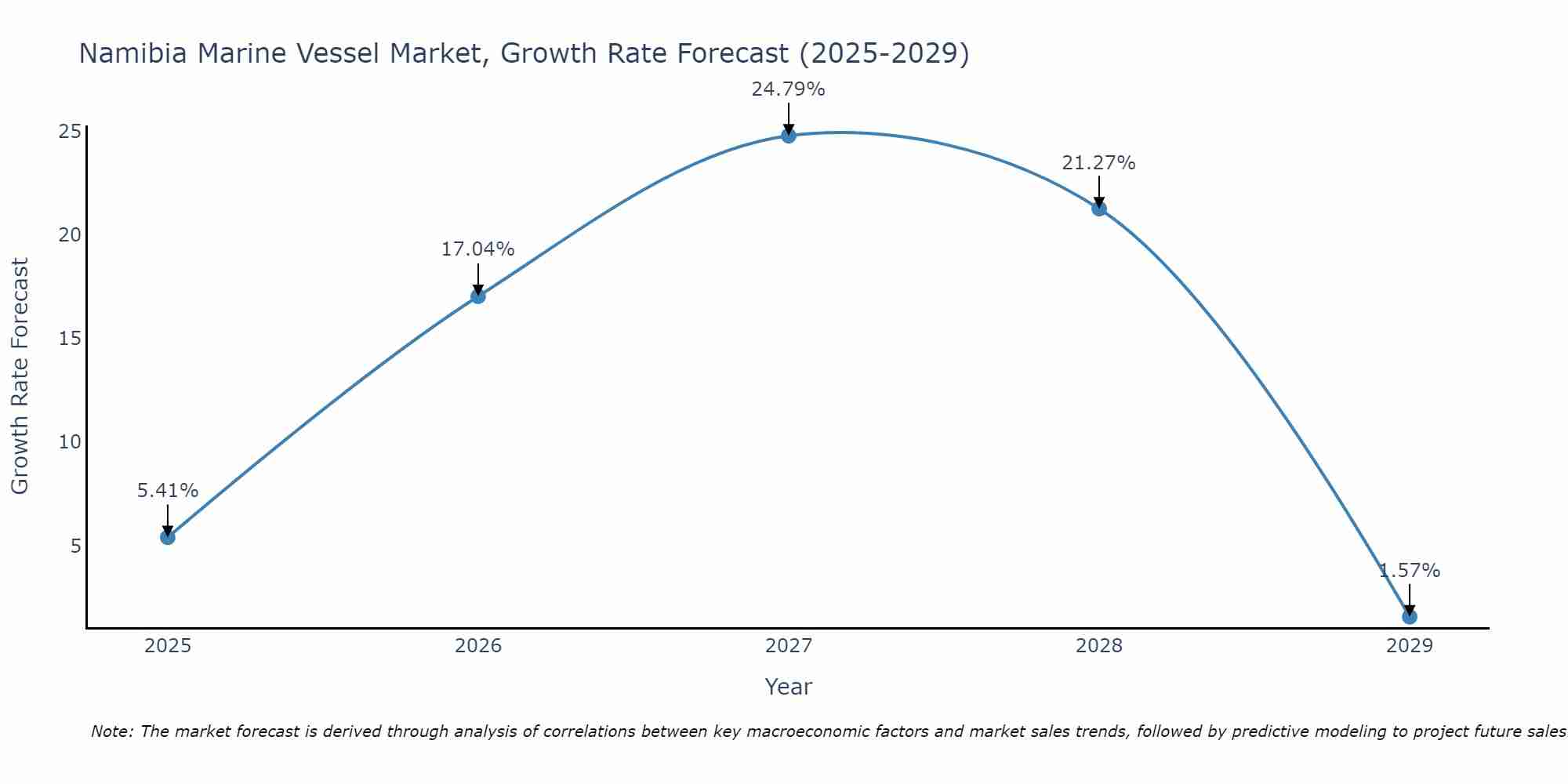
The Namibia Marine Vessel Market is projected to witness mixed growth rate patterns during 2025 to 2029. Starting at 5.41% in 2025, the market peaks at 24.79% in 2027, and settles at 1.57% by 2029.
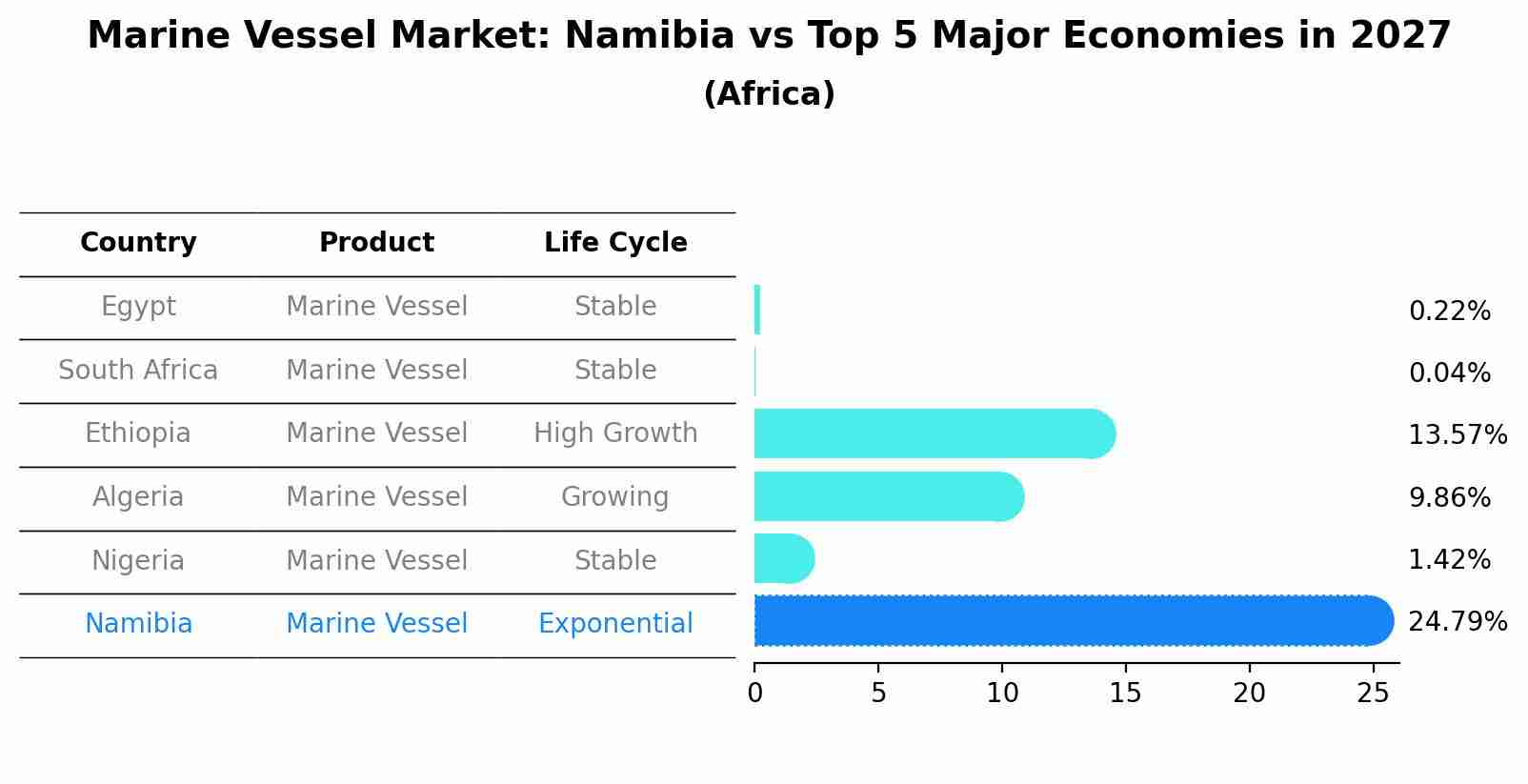
Marine Vessel Market: Namibia vs Top 5 Major Economies in 2027 (Africa)
In the Africa region, the Marine Vessel market in Namibia is projected to expand at a exponential growth rate of 24.79% by 2027. The largest economy is Egypt, followed by South Africa, Ethiopia, Algeria and Nigeria.
Namibia Marine Vessel Market Growth Rate
According to 6Wresearch internal database and industry insights, the Namibia Marine Vessel Market is expected to grow at a compound annual growth rate (CAGR) of 6.4% during the forecast period (2026-2032).
Topics Covered in the Namibia Marine Vessel Market Report
Namibia Marine Vessel Market report thoroughly covers the market by type, system, and end-use. The report provides a detailed analysis of ongoing market trends, opportunities/high-growth areas, and market drivers that will help stakeholders align strategies based on current and future market dynamics.
Namibia Marine Vessel Market Highlights
| Report Name | Namibia Marine Vessel Market |
| Forecast period | 2026-2032 |
| CAGR | 6.4% |
| Growing Sector | Offshore Support Vessels (OSV) |
Namibia Marine Vessel Market Synopsis
Namibia Marine Vessel Market is projected to obtain transformative growth in the forthcoming years, backed by the burgeoning offshore oil and gas sector and the national push toward becoming a regional maritime logistics hub. Apart from this, the discovery of light oil in the Orange Basin has catalyzed the need for highly specialized offshore support vessels, while the development of the Walvis Bay port infrastructure supports a broader fleet of commercial cargo ships. Also, the Namibia marine vessel market growth is underpinned by Namibia's "Harambee Prosperity Plan II," which emphasizes the "Blue Economy" as a core pillar for sustainable industrialization.
Evaluation of Growth Drivers in Namibia Marine Vessel Market
Below are some major drivers and their influence on the market dynamics:
| Drivers | Primary Segment Affected | Why It Matters (Evidence) |
| Oil & Gas Discoveries | Special Purpose Vessels | Major players like Shell and TotalEnergies are transitioning from exploration to appraisal, requiring more PSVs and AHTS vessels. |
| Port Expansion Projects | Commercial Vessels | The recent expansion of the Walvis Bay container terminal increases the frequency of feeder vessel traffic. |
| Green Hydrogen Ambitions | LNG/LPG Carriers | Namibia’s plans to export ammonia and hydrogen necessitate a future fleet of specialized gas carriers. |
| Fisheries Sector Renewal | Commercial Vessel | As the government mandates local value addition, the demand for modern trawlers with onboard processing grows. |
| Maritime Security Needs | Special Purpose Vessels | Increased offshore activity requires enhanced coastal patrol and search-and-rescue (SAR) vessel capabilities. |
Namibia Marine Vessel Market is anticipated to register growth, reaching a CAGR of 6.4% during the forecast period (2026-2032). Driven by strategic positioning of Namibia along the Atlantic trade route and the rapid maturation of its offshore energy sector, the market growth is expected to maintain a steady growth in the upcoming years. On the other hand, the expansion of ship repair and maintenance facilities (syncrolifts) at Walvis Bay has created high-demand environments for advanced marine systems and aftermarket services, making Namibia a leading choice for international maritime engineering firms seeking African integration.
Evaluation of Restraints in the Namibia Marine Vessel Market
Below are some major restraints and their influence on the market dynamics:
| Restraints | Primary Segment Affected | What This Means (Evidence) |
| High Acquisition Costs | LNG/LPG Carriers | Massive capital required for gas carriers often leads to dependence on international leasing rather than local ownership. |
| Skills Gap | System (Control/Sensor) | Limited local certified marine engineers for advanced electronic systems surges maintenance lead times. |
| Global Steel Fluctuations | OEM End-use | Fluctuations in global steel prices impact the pricing and delivery schedules of new build orders. |
| Regulatory Barriers | Commercial Vessels | Firm IMO 2030 decarbonization targets require costly engine retrofits that some local operators struggle to finance. |
Namibia Marine Vessel Market Challenges
Despite of favorable growth outlook, the Namibia marine vessel industry is anticipated to navigate hurdles related to the high dependency on foreign technology and components, which leaves the market vulnerable to exchange rate fluctuations. Apart from this, the inadequate depth of certain secondary ports restricts the operational versatility of larger commercial vessels, concentrating market activity solely around Walvis Bay and Lüderitz. On the other side, there is intense competition from established maritime hubs like South Africa (Cape Town) remains a challenge for Namibia’s burgeoning ship repair and aftermarket sector.
Namibia Marine Vessel Market Trends
Some of the trends shaping the landscape of the Namibia Marine Vessel Market are:
- Decarbonization of Fishing Fleets: Increasing adoption of hybrid-propulsion systems among local fishing companies to reduce fuel costs and meet export-driven sustainability labels.
- Autonomous Monitoring Systems: Large-scale cargo operators are integrating AI-driven sensor systems for real-time hull performance monitoring and fuel optimization.
- Digitalization of Port Services: The implementation of "Smart Port" technology in Walvis Bay is driving the demand for vessels equipped with advanced communication and automated docking systems.
- Focus on Multipurpose OSVs: Transitioning toward vessels that can handle multiple offshore tasks—from seismic support to subsea construction—to maximize asset utilization.
Investment Opportunities in the Namibia Marine Vessel Market
Substantial investment opportunities in the Namibia Marine Vessel Market include:
- Offshore Support Infrastructure - Building local centres for the repair and maintenance of offshore supply vessels servicing the orange basin projects.
- Marine System Retrofitting - Providing upgrades and compliance solutions for local fleets with the installation of scrubbers and ballast water treatment systems in compliance with IMO regulations.
- Training and Simulation Centres - Investing in maritime training centres to teach local technicians about the latest marine engine technologies and controls to guarantee long-term service contracts.
Top 5 Leading Players in Namibia Marine Vessel Market
Below is a list of companies operating in the Namibia Marine Vessel Market:
1. Namdock
| Company Name | Namdock |
| Established Year | 2006 |
| Headquarters | Walvis Bay, Namibia |
| Official Website | - |
The premier ship repair yard in Namibia, Namdock provides extensive dry-docking and engineering services, acting as a critical hub for the repair of commercial and special purpose vessels.
2. Namport
| Company Name | Namport |
| Established Year | 1994 |
| Headquarters | Walvis Bay, Namibia |
| Official Website | Click Here |
While a port authority, Namport operates a diverse fleet of tugs, pilot boats, and dredgers, serving as a major procurer of marine vessels and advanced navigation systems.
3. Wärtsilä
| Company Name | Wärtsilä |
| Established Year | 1834 |
| Headquarters | Helsinki, Finland (Active in Namibia) |
| Official Website | Click Here |
A global leader in smart technologies and complete lifecycle solutions for the marine market, providing engines and propulsion systems for Namibia’s offshore and commercial sectors.
4. Caterpillar Marine
| Company Name | Caterpillar Marine |
| Established Year | 1925 |
| Headquarters | Irving, Texas, USA (Distributed by Barloworld Namibia) |
| Official Website | Click Here |
A dominant supplier of marine engines and auxiliary power systems for the Namibian fishing and offshore support fleets through local dealership networks.
5. Damen Shipyards Group
| Company Name | Damen Shipyards Group |
| Established Year | 1927 |
| Headquarters | Gorinchem, Netherlands (Active Partner) |
| Official Website | Click Here |
A key exporter of vessels to Namibia, Damen provides standardized, high-quality tugs, workboats, and offshore support vessels designed for African maritime conditions.
Namibia Marine Vessel Market: Government Initiatives
Namibia’s government has a national policy for its blue economy (i.e., natural resources in the ocean). The policy (2022-2030) aims to modernise the country’s coastal shipping fleet to be sustainable when extracting resources. At the same time, the Ministry of Works and Transport has a maritime transport masterplan that provides financial incentives for local companies who register their vessels and invest in environmentally friendly or "green" maritime technologies. Additionally, as part of its SME Development Strategy, the government promotes the assembly of small-scale marine ancillary products in Namibia instead of importing products from other countries.
Future Insights of the Namibia Marine Vessel Market
Namibia Marine Vessel Market will be heavily influenced by country’s overall maritime economic development. The growing flow of trade, the expansion of Namibia’s ports, the requirement for sustainable development, and the emergence of additional commercial opportunities will all continue to drive the development of the country’s maritime economy. Namibia’s location on the Atlantic Ocean with Walvis Bay and Lüderitz functioning as major maritime shipping centres will provide opportunities for future use and growth of the maritime sector as larger numbers of vessels use Namibia’s ports. As a result, demand for marine vessels and infrastructure will continue to increase in Namibia’s growing maritime economy.
Market Segmentation Analysis
The report offers a comprehensive study of the following market segments and their leading categories:
By Type – Commercial Vessel to Lead the Market
Commercial Vessel segment is projected to hold the dominant position in this industry. This is driven by the steady growth in international trade and the consistent demand for cargo ships and fishing trawlers, which form the backbone of Namibia's export-oriented economy. The dominance is further reinforced by the high frequency of feeder vessel traffic required to connect Walvis Bay to major global shipping lanes.
By System – Marine Engine to Lead the Market
According to Vasu, Senior Research Analyst, 6Wresearch, Marine Engine segment is anticipated to dominate the Namibia marine vessel market share due to the continuous need for power in both new builds and the extensive repowering of the aging domestic fishing fleet. Engines are the highest-value component within any marine vessel, and the move toward more fuel-efficient, low-emission propulsion systems ensures a constant demand for high-performance OEM units and specialized maintenance.
By End-use – Aftermarket to Lead the Market
Aftermarket segment is expected to remain the dominant end-use category. Given Namibia’s strategic location as a repair hub between Europe and the East, the volume of service, maintenance, and replacement parts for passing fleets exceeds new vessel procurement. The presence of specialized dry-docks in Walvis Bay ensures that the aftermarket for sensors, control systems, and engine parts remains the primary revenue driver.
Key Attractiveness of the Report
- 10 Years of Market Numbers
- Historical Data Starting from 2022 to 2025
- Base Year: 2025
- Forecast Data until 2032
- Key Performance Indicators Impacting the Market
- Major Upcoming Developments and Projects
Key Highlights of the Report:
- Namibia Marine Vessel Market Outlook
- Market Size of Namibia Marine Vessel Market, 2025
- Forecast of Namibia Marine Vessel Market, 2032
- Historical Data and Forecast of Namibia Marine Vessel Revenues & Volume for the Period 2022-2032F
- Namibia Marine Vessel Market Trend Evolution
- Namibia Marine Vessel Market Drivers and Challenges
- Namibia Marine Vessel Price Trends
- Namibia Marine Vessel Porter`s Five Forces
- Namibia Marine Vessel Industry Life Cycle
- Historical Data and Forecast of Namibia Marine Vessel Market Revenues & Volume By Type for the Period 2022-2032F
- Historical Data and Forecast of Namibia Marine Vessel Market Revenues & Volume By Commercial Vessel for the Period 2022-2032F
- Historical Data and Forecast of Namibia Marine Vessel Market Revenues & Volume By Passenger Ship for the Period 2022-2032F
- Historical Data and Forecast of Namibia Marine Vessel Market Revenues & Volume By LNG/LPG Carrier for the Period 2022-2032F
- Historical Data and Forecast of Namibia Marine Vessel Market Revenues & Volume By Special Purpose Vessel for the Period 2022-2032F
- Historical Data and Forecast of Namibia Marine Vessel Market Revenues & Volume By System for the Period 2022-2032F
- Historical Data and Forecast of Namibia Marine Vessel Market Revenues & Volume By Marine Engine for the Period 2022-2032F
- Historical Data and Forecast of Namibia Marine Vessel Market Revenues & Volume By Sensor System for the Period 2022-2032F
- Historical Data and Forecast of Namibia Marine Vessel Market Revenues & Volume By Control System for the Period 2022-2032F
- Historical Data and Forecast of Namibia Marine Vessel Market Revenues & Volume By Electrical System for the Period 2022-2032F
- Historical Data and Forecast of Namibia Marine Vessel Market Revenues & Volume By Auxiliary System for the Period 2022-2032F
- Historical Data and Forecast of Namibia Marine Vessel Market Revenues & Volume By Communication System for the Period 2022-2032F
- Historical Data and Forecast of Namibia Marine Vessel Market Revenues & Volume By End-use for the Period 2022-2032F
- Historical Data and Forecast of Namibia Marine Vessel Market Revenues & Volume By Original Equipment Manufacturer (OEM) for the Period 2022-2032F
- Historical Data and Forecast of Namibia Marine Vessel Market Revenues & Volume By Aftermarket for the Period 2022-2032F
- Namibia Marine Vessel Import Export Trade Statistics
- Market Opportunity Assessment By Type
- Market Opportunity Assessment By System
- Market Opportunity Assessment By End-use
- Namibia Marine Vessel Top Companies Market Share
- Namibia Marine Vessel Competitive Benchmarking By Technical and Operational Parameters
- Namibia Marine Vessel Company Profiles
- Namibia Marine Vessel Key Strategic Recommendations
Market Covered
The report offers a comprehensive study of the following market segments:
By Type
- Commercial Vessel
- Passenger Ship
- LNG/LPG Carrier
- Special Purpose Vessel
By System
- Marine Engine
- Sensor System
- Control System
- Electrical System
- Auxiliary System
- Communication System
By End-use
- Original Equipment Manufacturer (OEM)
- Aftermarket
Namibia Marine Vessel Market (2026-2032) : FAQs
Namibia Marine Vessel Market is anticipated to register at CAGR of 6.4% during the forecast period 2026-2032.
Some reasons for growth include growing offshore oil and gas exploration, increased fishing industry activities, and government investments in port infrastructure and maritime security.
Some common restraints are high initial investment required for vessels, a shortage of skilled maritime professionals, and regulatory complexities regarding vessel certifications.
Major trends are the rise of eco-friendly vessels, technological advancements in maritime systems, and surging demand for special-purpose vessels for offshore energy exploration.
6Wresearch actively monitors the Namibia Marine Vessel Market and publishes its comprehensive annual report, highlighting emerging trends, growth drivers, revenue analysis, and forecast outlook. Our insights help businesses to make data-backed strategic decisions with ongoing market dynamics. Our analysts track relevent industries related to the Namibia Marine Vessel Market, allowing our clients with actionable intelligence and reliable forecasts tailored to emerging regional needs.
Yes, we provide customisation as per your requirements. To learn more, feel free to contact us on sales@6wresearch.com
| 1 Executive Summary |
| 2 Introduction |
| 2.1 Key Highlights of the Report |
| 2.2 Report Description |
| 2.3 Market Scope & Segmentation |
| 2.4 Research Methodology |
| 2.5 Assumptions |
| 3 Namibia Marine Vessel Market Overview |
| 3.1 Namibia Country Macro Economic Indicators |
| 3.2 Namibia Marine Vessel Market Revenues & Volume, 2022 & 2032F |
| 3.3 Namibia Marine Vessel Market - Industry Life Cycle |
| 3.4 Namibia Marine Vessel Market - Porter's Five Forces |
| 3.5 Namibia Marine Vessel Market Revenues & Volume Share, By Type, 2022 & 2032F |
| 3.6 Namibia Marine Vessel Market Revenues & Volume Share, By System, 2022 & 2032F |
| 3.7 Namibia Marine Vessel Market Revenues & Volume Share, By End-use, 2022 & 2032F |
| 4 Namibia Marine Vessel Market Dynamics |
| 4.1 Impact Analysis |
| 4.2 Market Drivers |
| 4.3 Market Restraints |
| 5 Namibia Marine Vessel Market Trends |
| 6 Namibia Marine Vessel Market Segmentations |
| 6.1 Namibia Marine Vessel Market, By Type |
| 6.1.1 Overview and Analysis |
| 6.1.2 Namibia Marine Vessel Market Revenues & Volume, By Commercial Vessel, 2022-2032F |
| 6.1.3 Namibia Marine Vessel Market Revenues & Volume, By Passenger Ship, 2022-2032F |
| 6.1.4 Namibia Marine Vessel Market Revenues & Volume, By LNG/LPG Carrier, 2022-2032F |
| 6.1.5 Namibia Marine Vessel Market Revenues & Volume, By Special Purpose Vessel, 2022-2032F |
| 6.2 Namibia Marine Vessel Market, By System |
| 6.2.1 Overview and Analysis |
| 6.2.2 Namibia Marine Vessel Market Revenues & Volume, By Marine Engine, 2022-2032F |
| 6.2.3 Namibia Marine Vessel Market Revenues & Volume, By Sensor System, 2022-2032F |
| 6.2.4 Namibia Marine Vessel Market Revenues & Volume, By Control System, 2022-2032F |
| 6.2.5 Namibia Marine Vessel Market Revenues & Volume, By Electrical System, 2022-2032F |
| 6.2.6 Namibia Marine Vessel Market Revenues & Volume, By Auxiliary System, 2022-2032F |
| 6.2.7 Namibia Marine Vessel Market Revenues & Volume, By Communication System, 2022-2032F |
| 6.3 Namibia Marine Vessel Market, By End-use |
| 6.3.1 Overview and Analysis |
| 6.3.2 Namibia Marine Vessel Market Revenues & Volume, By Original Equipment Manufacturer (OEM), 2022-2032F |
| 6.3.3 Namibia Marine Vessel Market Revenues & Volume, By Aftermarket, 2022-2032F |
| 7 Namibia Marine Vessel Market Import-Export Trade Statistics |
| 7.1 Namibia Marine Vessel Market Export to Major Countries |
| 7.2 Namibia Marine Vessel Market Imports from Major Countries |
| 8 Namibia Marine Vessel Market Key Performance Indicators |
| 9 Namibia Marine Vessel Market - Opportunity Assessment |
| 9.1 Namibia Marine Vessel Market Opportunity Assessment, By Type, 2022 & 2032F |
| 9.2 Namibia Marine Vessel Market Opportunity Assessment, By System, 2022 & 2032F |
| 9.3 Namibia Marine Vessel Market Opportunity Assessment, By End-use, 2022 & 2032F |
| 10 Namibia Marine Vessel Market - Competitive Landscape |
| 10.1 Namibia Marine Vessel Market Revenue Share, By Companies, 2025 |
| 10.2 Namibia Marine Vessel Market Competitive Benchmarking, By Operating and Technical Parameters |
| 11 Company Profiles |
| 12 Recommendations |
| 13 Disclaimer |
Global Go To Market Strategy - 2030
Export potential enables firms to identify high-growth global markets with greater confidence by combining advanced trade intelligence with a structured quantitative methodology. The framework analyzes emerging demand trends and country-level import patterns while integrating macroeconomic and trade datasets such as GDP and population forecasts, bilateral import–export flows, tariff structures, elasticity differentials between developed and developing economies, geographic distance, and import demand projections. Using weighted trade values from 2020–2024 as the base period to project country-to-country export potential for 2030, these inputs are operationalized through calculated drivers such as gravity model parameters, tariff impact factors, and projected GDP per-capita growth. Through an analysis of hidden potentials, demand hotspots, and market conditions that are most favorable to success, this method enables firms to focus on target countries, maximize returns, and global expansion with data, backed by accuracy.
By factoring in the projected importer demand gap that is currently unmet and could be potential opportunity, it identifies the potential for the Exporter (Country) among 190 countries, against the general trade analysis, which identifies the biggest importer or exporter.
To discover high-growth global markets and optimize your business strategy:
Click Here
Request Primary Research & Report
- Single User License$ 1,995
- Department License$ 2,400
- Site License$ 3,120
- Global License$ 3,795

Leadership Perspectives from Industry Events
Search
6Wresearch in the News
 Forbes
Citing 6Wresearch analytics to map global infrastructure and pharmaceutical industry trajectories.
 Bloomberg Law
Direct syndication of 6Wresearch's macro data points, capturing complex supply chain shifts.
 Reuters
Tracking industrial manufacturing adjustments and electronic security ecosystem scaling.
 Mint
Mint
Utilizing deep-tech sector market sizing to analyze global automation and robotics.
 The Economic Times
Anchoring features on industrial IoT growth metrics and connected smart-grid devices.
 Business Standard
Featuring strategic evaluations of Advanced Driver Assistance Systems (ADAS) and AI road safety.
 The Hindu
Spotlighting core commercial metrics ranging from unmanned aerial vehicles (UAVs) to consumer durables.
 Financial Express
Anchoring quarterly reviews on cross-border real estate tech and structural hardware manufacturing.
 Yahoo Finance
Syndicating the tracker's $30.1 billion untapped-market findings, spotlighting Japan, the US and China as India's top new-potential importers.
 India Today
Carrying the release on smartphones leading India's export potential to $94 billion by 2031, per 6WExportGTM data.
 Dailyhunt
Distributing the tracker findings to its regional readership, framing India's export diversification into Japan and Mexico.
 PR Newswire Original release
Publishing the full India Export Attractiveness Tracker 2026, detailing new trade corridors across iron ore, LCVs and pharmaceuticals.
 The Industrial
Highlighting the tracker's read on India's semiconductor ambitions and long-term chip-assembly export potential.
 PTI News
Reporting on the $66.81 billion pharmaceuticals export opportunity flagged in the tracker, amid looming US generic-drug tariffs.
 Tribune India
Covering the tracker's tariff-versus-regulation analysis across India's mature export markets in the US, China and UAE.
 ANI News
Amplifying the report's findings on polished diamonds, refined petroleum and medicines as India's core export engines.
 International Business Magazine
Covering the report's insight into how AEB, blind spot detection, and driver monitoring are reshaping India's ADAS market.
 Focus Gaming News
Highlighting the research forecast for Egypt's gambling market, projecting steady growth through 2032.
Thought Leadership and Analyst Meet





Our Clients








Latest Reports
- Austria X-ray Imaging Devices Market (2026-2032)
- Armenia X-ray Imaging Devices Market (2026-2032)
- Antigua and Barbuda X-ray Imaging Devices Market (2026-2032)
- Angola X-ray Imaging Devices Market (2026-2032)
- Andorra X-ray Imaging Devices Market (2026-2032)
- Albania X-ray Imaging Devices Market (2026-2032)
- Afghanistan X-ray Imaging Devices Market (2026-2032)
- United States (US) X-ray Imaging Devices Market (2026-2032)
- United Kingdom (UK) X-ray Imaging Devices Market (2026-2032)
- United Arab Emirates (UAE) X-ray Imaging Devices Market (2026-2032)
Industry Events and Analyst Meet

EV India Expo 2026

HIMTEX 2026

India Refining Summit 2026

India EV Show 2026

EV tech India Expo 2026
Whitepaper
- Middle East & Africa Commercial Security Market Click here to view more.
- Middle East & Africa Fire Safety Systems & Equipment Market Click here to view more.
- GCC Drone Market Click here to view more.
- Middle East Lighting Fixture Market Click here to view more.
- GCC Physical & Perimeter Security Market Click here to view more.


