Nepal AC Power Sources Market Size, Share & Growth Rate
The Nepal AC Power Sources Market was estimated at USD 376 Million in 2025 and is projected to reach USD 527 Million by 2032, growing at a CAGR of 4.9% from 2026 to 2032. This robust growth trajectory is primarily driven by a surge in industrialization and urbanization, alongside ongoing infrastructural developments throughout the country. The relentless pursuit for reliable and uninterrupted electricity across residential, commercial, and industrial sectors underscores this market's potential.
Nepal AC Power Sources Market Year-wise Growth Rate and Key Drivers
This graph highlights how the Nepal AC Power Sources Market has steadily grown over the years, supported by major growth factors.
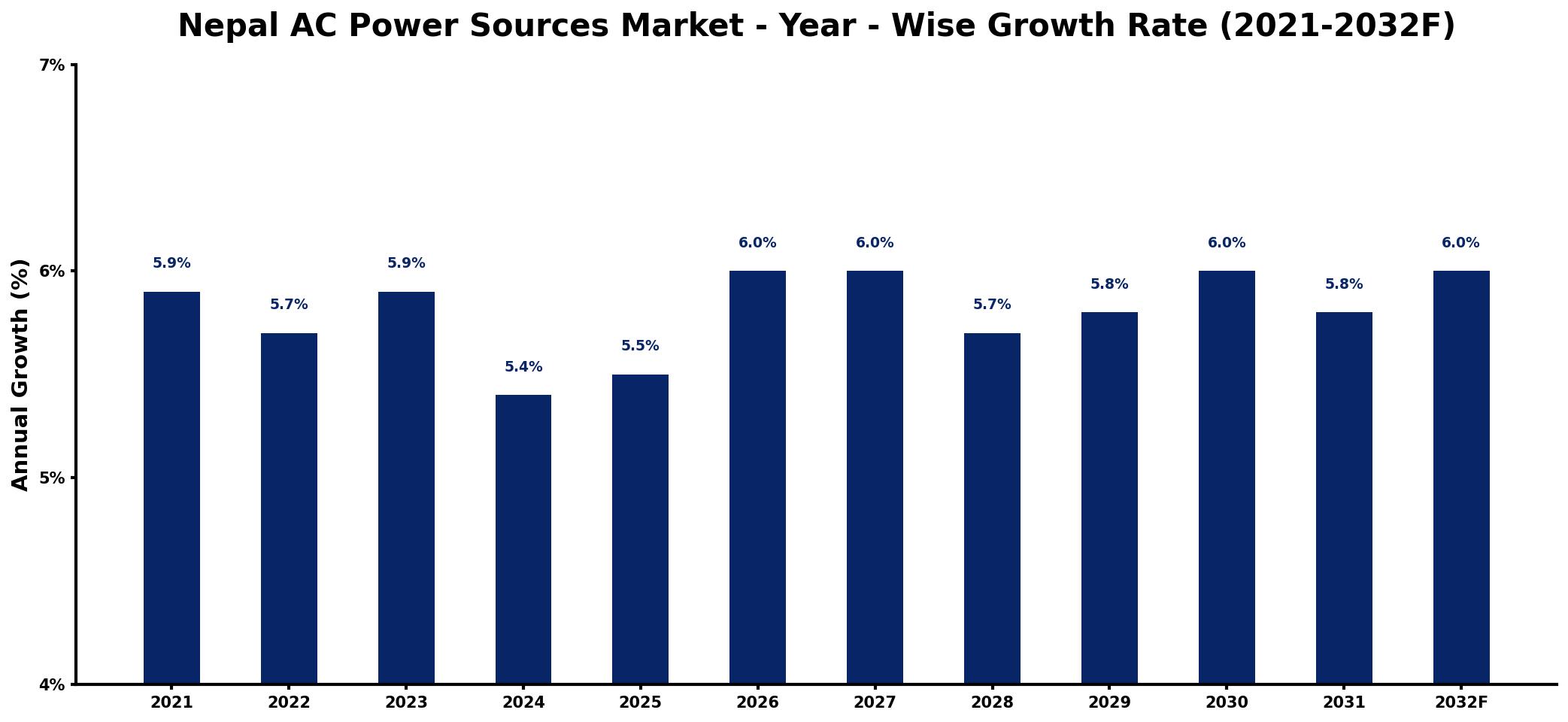
The table below presents the year‑wise growth rates along with the key drivers influencing the market
| Year | Growth Rate | Major Drivers |
| 2021 | 5.9% | Renewable energy investment growth |
| 2022 | 5.7% | Urbanization driving electricity demand |
| 2023 | 5.9% | Technological advancements in efficiency |
| 2024 | 5.4% | Government incentives for innovation |
| 2025 | 5.5% | Rising industrial energy consumption |
| 2026 | 6.0% | Increased residential energy adoption |
| 2027 | 6.0% | Infrastructure upgrades enhancing reliability |
| 2028 | 5.7% | Expansion of electric vehicle market |
| 2029 | 5.8% | Growing awareness of sustainability |
| 2030 | 6.0% | Enhanced grid connectivity initiatives |
| 2031 | 5.8% | Rising tourism boosting energy needs |
| 2032 | 6.0% | Diversification of energy generation methods |
Note: Market size estimations and growth projections presented in this report are based on 6Wresearch's proprietary forecasting methodology, utilizing the latest available industry data, government publications, and primary research inputs.
Nepal AC Power Sources Market Synopsis
A significant force shaping the Nepal AC Power Sources Market is the increasing demand for reliable energy solutions amidst frequent power outages. As the population becomes more urbanized, the reliance on consistent electricity for both daily needs and industrial operations grows, amplifying the urgency for dependable AC power sources.
Simultaneously, government initiatives aimed at improving electricity access, especially in rural areas, are contributing to an expanding market. This alignment of socio-economic development with energy needs is creating a compelling landscape for growth in the AC power sources segment.
Nepal AC Power Sources Market Key Takeaways
- The market is driven by the urgent need for reliable and uninterrupted electricity supply across all sectors.
- Investment in renewable energy sources like solar power is gaining momentum, reflecting a commitment to sustainability.
- Government policies are increasingly focusing on enhancing energy access, particularly in rural regions.
- Technological advancements are making AC power sources more efficient and cost-effective.
- Geographical challenges continue to pose significant barriers to infrastructure development and reliability.
Evaluation of Restraints in Nepal AC Power Sources Market
The Nepal AC Power Sources Market faces notable restraints primarily due to the country's challenging geography and insufficient infrastructure. The rugged terrain complicates the establishment of a robust and extensive power grid, leading to inconsistent electricity supply and persistent outages. Moreover, outdated infrastructure and inadequate investments further exacerbate these issues, creating significant barriers for both suppliers and consumers in accessing affordable and reliable power solutions. Addressing these limitations will necessitate considerable investment in modernizing the power sector and developing sustainable energy solutions.
Nepal AC Power Sources Market Trends
The market is increasingly gravitating towards renewable energy solutions, with solar power systems and battery storage technologies gaining popularity among consumers and businesses alike. This trend aligns with Nepal's ambition to reduce dependence on fossil fuels, fostering a cleaner and more sustainable energy landscape. Additionally, the integration of smart grid technologies is becoming more prevalent, aimed at optimizing energy management and distribution, further solidifying the shift towards innovative power solutions.
Nepal AC Power Sources Market Opportunities
There are promising investment opportunities within the Nepal AC Power Sources Market, especially in renewable energy sectors such as solar and wind power. Given the country's abundant solar resources, investing in solar energy projects can yield significant returns. Furthermore, modernization efforts in existing power infrastructure present another lucrative avenue for investors looking to enhance grid reliability and efficiency while addressing the growing electricity demands of the population.
Government Initiatives in the Nepal AC Power Sources Market
The government of Nepal is actively promoting policies that favor renewable energy and improve energy efficiency across the board. With ambitious targets to enhance the share of renewable energy in the overall energy mix, policies encourage investments in solar and wind power projects through incentives, subsidies, and tax breaks. Additionally, efforts are underway to stabilize and enhance the existing power grid, ensuring compliance with energy efficiency standards while fostering a more sustainable power sector.
Future Insights of the Nepal AC Power Sources Market
Looking ahead to 2026-2032, the Nepal AC Power Sources Market is poised for steady growth fueled by increasing urbanization, infrastructure development, and government efforts to expand electricity access in rural areas. The rising adoption of renewable energy solutions is expected to further catalyze this growth, creating new opportunities for investment and innovation. As technological advancements continue to evolve, the focus on sustainability will shape the markets trajectory, leading to more efficient and eco-friendly power solutions.
Nepal AC Power Sources Market Latest Developments (2025 - 2026)
Recent developments within the Nepal AC Power Sources Market highlight a push towards integrating advanced technologies to enhance power distribution systems. Innovative projects focused on upgrading grid infrastructure and implementing energy management systems are gaining traction. Additionally, the growing collaboration between the government and private sectors is paving the way for substantial investments in renewable energy initiatives, reflecting a commitment to address the pressing energy needs of the population.
Nepal AC Power Sources Market - Key Attractiveness of the Report
- 10 Years of Market Numbers
- Historical Data Starting from 2022 to 2025
- Base Year: 2025
- Forecast Data until 2032
- Key Performance Indicators Impacting the Market
- Major Upcoming Developments and Projects
Key Highlights of the Report:
- Nepal AC Power Sources Market Outlook
- Market Size of Nepal AC Power Sources Market, 2025
- Forecast of Nepal AC Power Sources Market, 2032
- Historical Data and Forecast of Nepal AC Power Sources Revenues & Volume for the Period 2022-2032F
- Nepal AC Power Sources Market Trend Evolution
- Nepal AC Power Sources Market Drivers and Challenges
- Nepal AC Power Sources Price Trends
- Nepal AC Power Sources Porter's Five Forces
- Nepal AC Power Sources Industry Life Cycle
- Historical Data and Forecast of Nepal AC Power Sources Market Revenues & Volume By Phase Type for the Period 2022-2032F
- Historical Data and Forecast of Nepal AC Power Sources Market Revenues & Volume By Single-phase for the Period 2022-2032F
- Historical Data and Forecast of Nepal AC Power Sources Market Revenues & Volume By Three-phase for the Period 2022-2032F
- Historical Data and Forecast of Nepal AC Power Sources Market Revenues & Volume By Modulation Type for the Period 2022-2032F
- Historical Data and Forecast of Nepal AC Power Sources Market Revenues & Volume By PWM for the Period 2022-2032F
- Historical Data and Forecast of Nepal AC Power Sources Market Revenues & Volume By Linear for the Period 2022-2032F
- Historical Data and Forecast of Nepal AC Power Sources Market Revenues & Volume By Application for the Period 2022-2032F
- Historical Data and Forecast of Nepal AC Power Sources Market Revenues & Volume By Aerospace for the Period 2022-2032F
- Historical Data and Forecast of Nepal AC Power Sources Market Revenues & Volume By Defense & Government Services for the Period 2022-2032F
- Historical Data and Forecast of Nepal AC Power Sources Market Revenues & Volume By Energy for the Period 2022-2032F
- Historical Data and Forecast of Nepal AC Power Sources Market Revenues & Volume By Wireless Communication & Infrastructure for the Period 2022-2032F
- Historical Data and Forecast of Nepal AC Power Sources Market Revenues & Volume By Consumer Electronics & Appliances for the Period 2022-2032F
- Historical Data and Forecast of Nepal AC Power Sources Market Revenues & Volume By Others for the Period 2022-2032F
- Nepal AC Power Sources Import Export Trade Statistics
- Market Opportunity Assessment By Phase Type
- Market Opportunity Assessment By Modulation Type
- Market Opportunity Assessment By Application
- Nepal AC Power Sources Top Companies Market Share
- Nepal AC Power Sources Competitive Benchmarking By Technical and Operational Parameters
- Nepal AC Power Sources Company Profiles
- Nepal AC Power Sources Key Strategic Recommendations






































