Nepal Aerosol Market Size, Share & Growth Rate
The Nepal Aerosol Market was estimated at USD 299 Million in 2025 and is projected to reach USD 410 Million by 2032, growing at a CAGR of 4.6% from 2026 to 2032. This growth trajectory is primarily fueled by increasing consumer demand for personal care products, particularly aerosol deodorants and air fresheners, as well as rising urbanization and disposable incomes. Furthermore, the growing awareness surrounding hygiene and eco-friendly products is propelling the market forward, making it a compelling area for investment.
Nepal Aerosol Market Year-wise Growth Rate and Key Drivers
This graph highlights how the Nepal Aerosol Market has steadily grown over the years, supported by major growth factors.
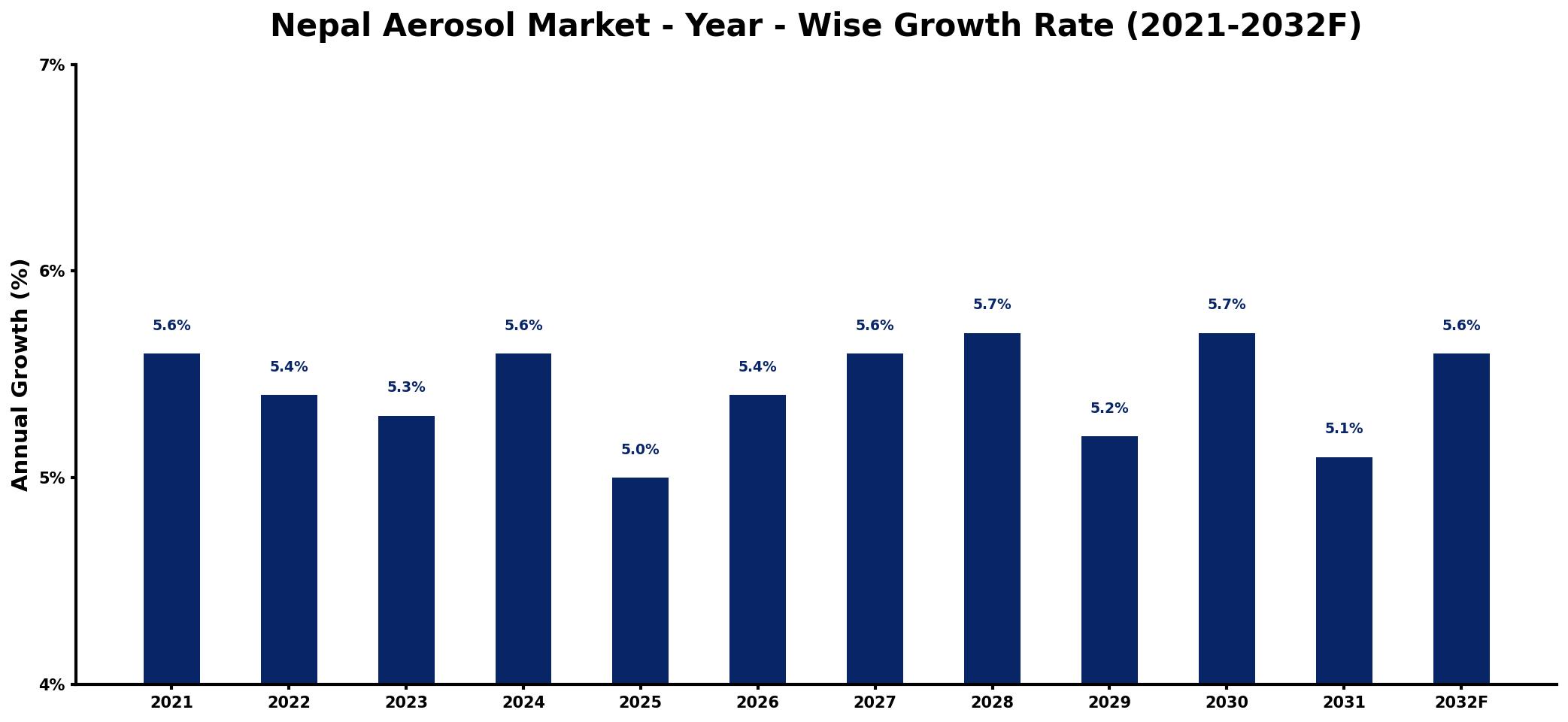
The table below presents the year‑wise growth rates along with the key drivers influencing the market
| Year | Growth Rate | Major Drivers |
| 2021 | 5.6% | increased consumer awareness campaigns |
| 2022 | 5.4% | growing demand in personal care |
| 2023 | 5.3% | rising popularity of home cleaning |
| 2024 | 5.6% | expansion of retail distribution channels |
| 2025 | 5.0% | increased investment in production facilities |
| 2026 | 5.4% | growth in eco-friendly product offerings |
| 2027 | 5.6% | rising demand in industrial applications |
| 2028 | 5.7% | growing downstream application demand |
| 2029 | 5.2% | increased focus on health standards |
| 2030 | 5.7% | improved processing technologies adoption |
| 2031 | 5.1% | increased marketing and advertising efforts |
| 2032 | 5.6% | stronger distribution network expansion |
Note: Market size estimations and growth projections presented in this report are based on 6Wresearch's proprietary forecasting methodology, utilizing the latest available industry data, government publications, and primary research inputs.
Nepal Aerosol Market Synopsis
The strongest force shaping the Nepal Aerosol Market is the surge in consumer awareness about personal hygiene and the desire for convenience in product usage. As urban lifestyles evolve, the demand for aerosol products such as deodorants, air fresheners, and insect repellents has significantly increased, compelling manufacturers to innovate continuously.
Additionally, the market is witnessing a growing trend towards eco-friendly formulations, with consumers showing an inclination towards natural and organic products. This shift is aligned with rising environmental concerns, prompting brands to adapt their offerings to meet these evolving preferences.
Nepal Aerosol Market Key Takeaways
- The market is witnessing a substantial demand for personal care aerosol products, significantly deodorants and air fresheners.
- Eco-friendly and sustainable product offerings are becoming critical differentiators among competing brands.
- Urbanization and increasing disposable income are key drivers of market growth.
- Distribution is diversified through supermarkets, convenience stores, and the burgeoning online retail sector.
- Regulatory compliance regarding product safety and packaging is essential for market entry and reputation.
Evaluation of Restraints in Nepal Aerosol Market
While the Nepal Aerosol Market is poised for growth, several restraints are impacting its full potential. A significant challenge is the limited awareness regarding aerosol products in rural areas, which hampers penetration. Additionally, the lack of stringent regulatory frameworks can lead to inconsistencies in product quality and safety, affecting consumer trust. Furthermore, high tariffs on imported aerosol components restrict innovation and supply chain efficiency. The presence of counterfeit products also undermines genuine brands, posing a serious concern for consumer safety and market integrity.
Nepal Aerosol Market Trends
Current trends in the Nepal Aerosol Market reveal a strong consumer preference for convenient, easy-to-use products. The transition towards eco-friendly options is more pronounced, as consumers are increasingly prioritizing sustainability. This has prompted manufacturers to focus on innovation, particularly in packaging and formulation. Additionally, the rise of e-commerce is reshaping distribution dynamics, making aerosol products more accessible to a broader audience.
Nepal Aerosol Market Opportunities
The Nepal Aerosol Market presents numerous investment opportunities, especially in the sectors of personal care, household cleaning, and automotive aerosol products. The growing interest in sustainable product lines can serve as a lucrative avenue for new entrants and existing players looking to expand their portfolios. Collaborations with local brands may also facilitate faster market penetration and consumer acceptance. Overall, the demand for innovative and eco-friendly aerosol products indicates a clear opportunity for profitable investment in this vibrant market.
Government Initiatives in the Nepal Aerosol Market
The Nepalese government plays a significant role in regulating the aerosol market to ensure product safety and consumer protection. The Department of Drug Administration (DDA) is responsible for overseeing the registration of aerosol products, ensuring they meet the established safety and efficacy standards. Regulations surrounding labeling and packaging are enforced to promote transparency and inform consumers effectively. These initiatives aim to maintain quality standards while facilitating responsible market growth.
Future Insights of the Nepal Aerosol Market
Looking ahead to 2026-2032, the Nepal Aerosol Market is expected to continue its upward trajectory, driven by increasing consumer preferences for convenience and hygiene. The emphasis on eco-friendly products will likely shape the future landscape of the market, compelling brands to invest in sustainable practices and innovative technologies. Despite potential regulatory challenges, the market is set for continued growth, offering significant potential for investors and manufacturers alike.
Nepal Aerosol Market Latest Developments (2025 - 2026)
In recent months, the Nepal Aerosol Market has seen a shift towards sustainable packaging solutions as brands look to meet changing consumer preferences. Many companies are launching campaigns focusing on eco-friendly products, driven by increasing public awareness about environmental issues. Additionally, the expansion of e-commerce platforms is enhancing product availability, allowing brands to reach a wider audience, particularly in urban areas.
Nepal Aerosol Market - Key Attractiveness of the Report
- 10 Years of Market Numbers
- Historical Data Starting from 2022 to 2025
- Base Year: 2025
- Forecast Data until 2032
- Key Performance Indicators Impacting the Market
- Major Upcoming Developments and Projects
Key Highlights of the Report:
- Nepal Aerosol Market Outlook
- Market Size of Nepal Aerosol Market, 2025
- Forecast of Nepal Aerosol Market, 2032
- Historical Data and Forecast of Nepal Aerosol Revenues & Volume for the Period 2022-2032F
- Nepal Aerosol Market Trend Evolution
- Nepal Aerosol Market Drivers and Challenges
- Nepal Aerosol Price Trends
- Nepal Aerosol Porter's Five Forces
- Nepal Aerosol Industry Life Cycle
- Historical Data and Forecast of Nepal Aerosol Market Revenues & Volume By Material for the Period 2022-2032F
- Historical Data and Forecast of Nepal Aerosol Market Revenues & Volume By Steel for the Period 2022-2032F
- Historical Data and Forecast of Nepal Aerosol Market Revenues & Volume By Aluminum for the Period 2022-2032F
- Historical Data and Forecast of Nepal Aerosol Market Revenues & Volume By Others for the Period 2022-2032F
- Historical Data and Forecast of Nepal Aerosol Market Revenues & Volume By Type for the Period 2022-2032F
- Historical Data and Forecast of Nepal Aerosol Market Revenues & Volume By Bag-In-Valve for the Period 2022-2032F
- Historical Data and Forecast of Nepal Aerosol Market Revenues & Volume By Standard for the Period 2022-2032F
- Historical Data and Forecast of Nepal Aerosol Market Revenues & Volume By Application for the Period 2022-2032F
- Historical Data and Forecast of Nepal Aerosol Market Revenues & Volume By Personal Care for the Period 2022-2032F
- Historical Data and Forecast of Nepal Aerosol Market Revenues & Volume By Household for the Period 2022-2032F
- Historical Data and Forecast of Nepal Aerosol Market Revenues & Volume By Automotive & Industrial for the Period 2022-2032F
- Historical Data and Forecast of Nepal Aerosol Market Revenues & Volume By Food for the Period 2022-2032F
- Historical Data and Forecast of Nepal Aerosol Market Revenues & Volume By Paints for the Period 2022-2032F
- Historical Data and Forecast of Nepal Aerosol Market Revenues & Volume By Medical for the Period 2022-2032F
- Historical Data and Forecast of Nepal Aerosol Market Revenues & Volume By Others for the Period 2022-2032F
- Nepal Aerosol Import Export Trade Statistics
- Market Opportunity Assessment By Material
- Market Opportunity Assessment By Type
- Market Opportunity Assessment By Application
- Nepal Aerosol Top Companies Market Share
- Nepal Aerosol Competitive Benchmarking By Technical and Operational Parameters
- Nepal Aerosol Company Profiles
- Nepal Aerosol Key Strategic Recommendations






































