Nepal Apiculture Market Size, Share & Growth Rate
The Nepal Apiculture Market was estimated at USD 335 Million in 2025 and is projected to reach USD 470 Million by 2032, growing at a CAGR of 5.0% from 2026 to 2032. This impressive trajectory is primarily driven by increasing consumer awareness regarding the health benefits of honey and the environmental significance of bee populations in agriculture. Coupled with favorable climatic conditions and a diverse flora, these factors position the Nepal Apiculture Market for sustained growth in both domestic and international arenas.
Nepal Apiculture Market Year-wise Growth Rate and Key Drivers
This graph highlights how the Nepal Apiculture Market has steadily grown over the years, supported by major growth factors.
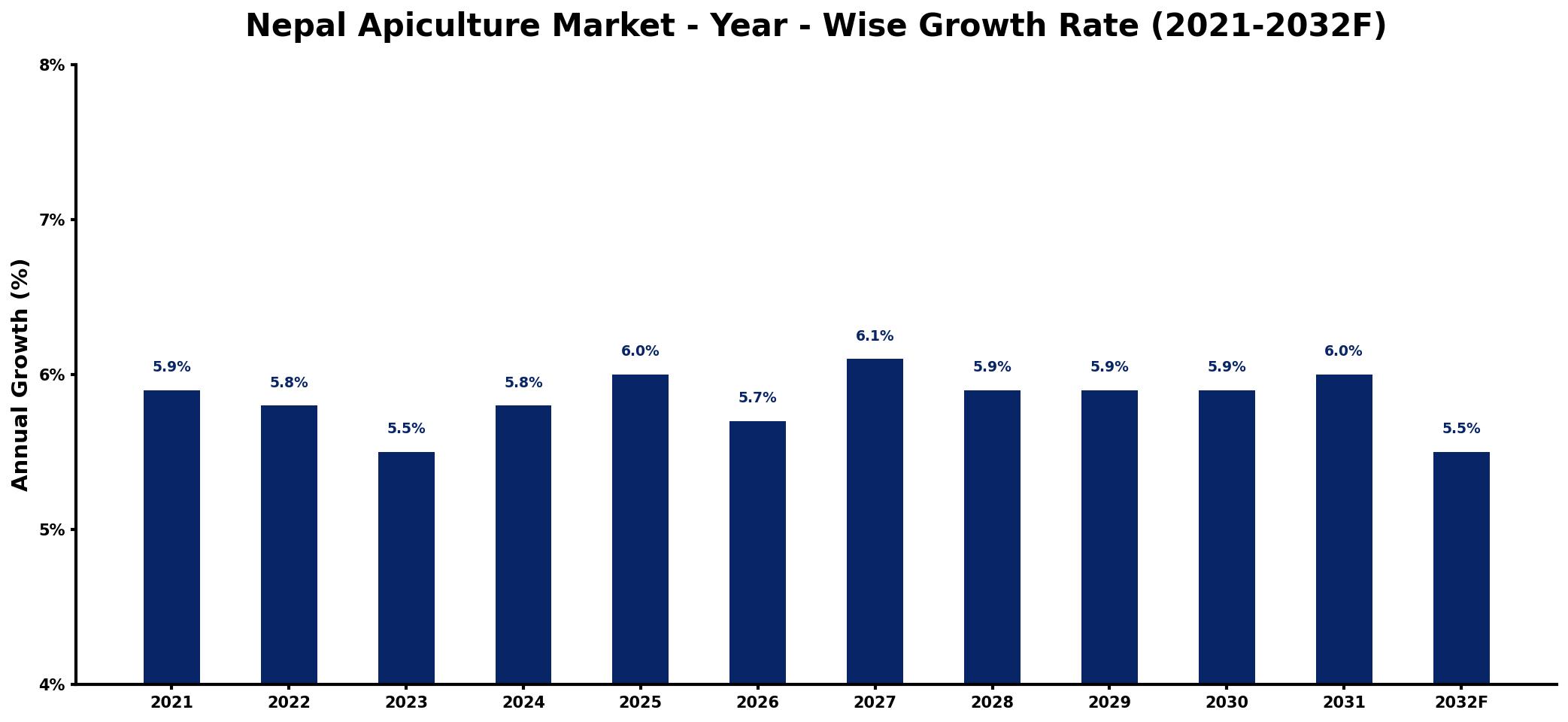
The table below presents the year‑wise growth rates along with the key drivers influencing the market
| Year | Growth Rate | Major Drivers |
| 2021 | 5.9% | Rising consumer health awareness |
| 2022 | 5.8% | Increased domestic honey consumption |
| 2023 | 5.5% | Growing organic farming initiatives |
| 2024 | 5.8% | Expansion of beekeeping training programs |
| 2025 | 6.0% | Surge in export opportunities |
| 2026 | 5.7% | Strengthening local farmer cooperatives |
| 2027 | 6.1% | Investments in sustainable practices |
| 2028 | 5.9% | Enhanced distribution networks established |
| 2029 | 5.9% | Popularity of natural sweeteners rising |
| 2030 | 5.9% | Growing interest in biodiversity conservation |
| 2031 | 6.0% | Government support for rural development |
| 2032 | 5.5% | Emerging market for bee products |
Note: Market size estimations and growth projections presented in this report are based on 6Wresearch's proprietary forecasting methodology, utilizing the latest available industry data, government publications, and primary research inputs.
Nepal Apiculture Market Synopsis
The Nepal apiculture market is witnessing a surge in interest, fueled by growing health consciousness and a burgeoning demand for organic products. While traditional beekeeping has long dominated, modern techniques and innovations are beginning to transform the industry, enhancing productivity and honey quality. Looking ahead, the market is poised for robust expansion as more stakeholders recognize its potential.
However, this growth is tempered by several challenges that the industry faces, including disease outbreaks and infrastructure limitations. Nevertheless, the increasing global demand for natural honey presents significant opportunities for Nepals apiculturists to capitalize on their unique floral biodiversity.
Nepal Apiculture Market Key Takeaways
- The market is driven by rising health awareness and consumer preference for natural products.
- Small-scale beekeepers are gradually adopting modern techniques to enhance honey production.
- Opportunities exist in value-added products like beeswax and propolis.
- Government initiatives aim to bolster beekeeping practices and improve product quality.
- Technological advancements are paving the way for improved efficiency and productivity in beekeeping.
Evaluation of Restraints in Nepal Apiculture Market
Despite its growth potential, the Nepal apiculture market faces several constraints. Limited access to modern beekeeping technologies and a lack of adequate training hinder small-scale producers from optimizing their operations. Inadequate infrastructure for honey processing and storage further complicates market entry for local beekeepers. The inconsistent quality of honey and insufficient market linkages impede access to higher-value markets. Additionally, climate change poses significant risks to bee populations and their habitats, requiring urgent attention from stakeholders.
Nepal Apiculture Market Trends
Emerging trends in the Nepal Apiculture Market reflect a significant shift towards sustainable practices. As consumers increasingly opt for organic and natural products, beekeepers are embracing environmentally friendly methods of honey production. Technological innovations, such as hive monitoring devices and beekeeping apps, are becoming integral tools that enhance efficiency. Furthermore, the expansion of online marketplaces is facilitating better access to consumers both domestically and internationally, thereby increasing market reach for local producers.
Nepal Apiculture Market Opportunities
The landscape of the Nepal Apiculture Market is ripe with investment opportunities. Investors are encouraged to explore the establishment of modern bee farms and honey processing facilities, taking advantage of the countrys rich biodiversity. Moreover, the rising global demand for organic honey creates avenues for export, enhancing market competitiveness. Value-added products such as royal jelly and propolis are also gaining traction, further diversifying potential revenue streams for local beekeepers.
Government Initiatives in the Nepal Apiculture Market
The government of Nepal is actively supporting the apiculture sector through various initiatives aimed at boosting productivity and ensuring quality. The Department of Agriculture has introduced comprehensive guidelines for beekeeping practices, focusing on the construction of hives and honey extraction methods. Additionally, training programs and financial support mechanisms are in place to enhance the skills of beekeepers. Initiatives promoting organic practices and certification are designed to align local production with international standards, thereby increasing global market accessibility.
Future Insights of the Nepal Apiculture Market
Looking forward to 2026-2032, the Nepal Apiculture Market is set to benefit from the increasing global appetite for organic and sustainably sourced honey. The unique environmental conditions of Nepal, alongside traditional practices, present a promising backdrop for growth. However, addressing challenges such as climate change and infrastructure gaps will be crucial. With strategic support and investment, the apiculture sector has the potential to significantly contribute to the national economy while enhancing the livelihoods of rural communities.
Nepal Apiculture Market Latest Developments (2025 - 2026)
Recent developments in the Nepal Apiculture Market reflect a growing emphasis on sustainable practices and technological integration. Beekeeping workshops focusing on modern methods have gained popularity, encouraging more farmers to enter the industry. Additionally, increased collaboration among stakeholders is fostering better market linkages and improving overall quality standards. Efforts to expand exports of honey and related products are also underway, aiming to enhance the visibility of Nepali honey in international markets.
Nepal Apiculture Market - Key Attractiveness of the Report
- 10 Years of Market Numbers
- Historical Data Starting from 2022 to 2025
- Base Year: 2025
- Forecast Data until 2032
- Key Performance Indicators Impacting the Market
- Major Upcoming Developments and Projects
Key Highlights of the Report:
- Nepal Apiculture Market Outlook
- Market Size of Nepal Apiculture Market, 2025
- Forecast of Nepal Apiculture Market, 2032
- Historical Data and Forecast of Nepal Apiculture Revenues & Volume for the Period 2022-2032F
- Nepal Apiculture Market Trend Evolution
- Nepal Apiculture Market Drivers and Challenges
- Nepal Apiculture Price Trends
- Nepal Apiculture Porter's Five Forces
- Nepal Apiculture Industry Life Cycle
- Historical Data and Forecast of Nepal Apiculture Market Revenues & Volume By Product Type for the Period 2022-2032F
- Historical Data and Forecast of Nepal Apiculture Market Revenues & Volume By Honey for the Period 2022-2032F
- Historical Data and Forecast of Nepal Apiculture Market Revenues & Volume By Beeswax for the Period 2022-2032F
- Historical Data and Forecast of Nepal Apiculture Market Revenues & Volume By Live-bees for the Period 2022-2032F
- Historical Data and Forecast of Nepal Apiculture Market Revenues & Volume By Others for the Period 2022-2032F
- Historical Data and Forecast of Nepal Apiculture Market Revenues & Volume By Application for the Period 2022-2032F
- Historical Data and Forecast of Nepal Apiculture Market Revenues & Volume By Medical for the Period 2022-2032F
- Historical Data and Forecast of Nepal Apiculture Market Revenues & Volume By Food Beverages for the Period 2022-2032F
- Historical Data and Forecast of Nepal Apiculture Market Revenues & Volume By Cosmetics for the Period 2022-2032F
- Historical Data and Forecast of Nepal Apiculture Market Revenues & Volume By Others for the Period 2022-2032F
- Nepal Apiculture Import Export Trade Statistics
- Market Opportunity Assessment By Product Type
- Market Opportunity Assessment By Application
- Nepal Apiculture Top Companies Market Share
- Nepal Apiculture Competitive Benchmarking By Technical and Operational Parameters
- Nepal Apiculture Company Profiles
- Nepal Apiculture Key Strategic Recommendations






































