Nepal Architectural Hardware Market Summary
The nepal architectural hardware market was estimated at USD 1424 Million in 2025 and is projected to reach USD 2040 Million by 2032, growing at a CAGR of 6.3% from 2026 to 2032.
Nepal Architectural Hardware Market Year-wise Growth Rate and Key Drivers
This graph highlights how the Nepal Architectural Hardware Market has steadily grown over the past five years, supported by major growth factors.
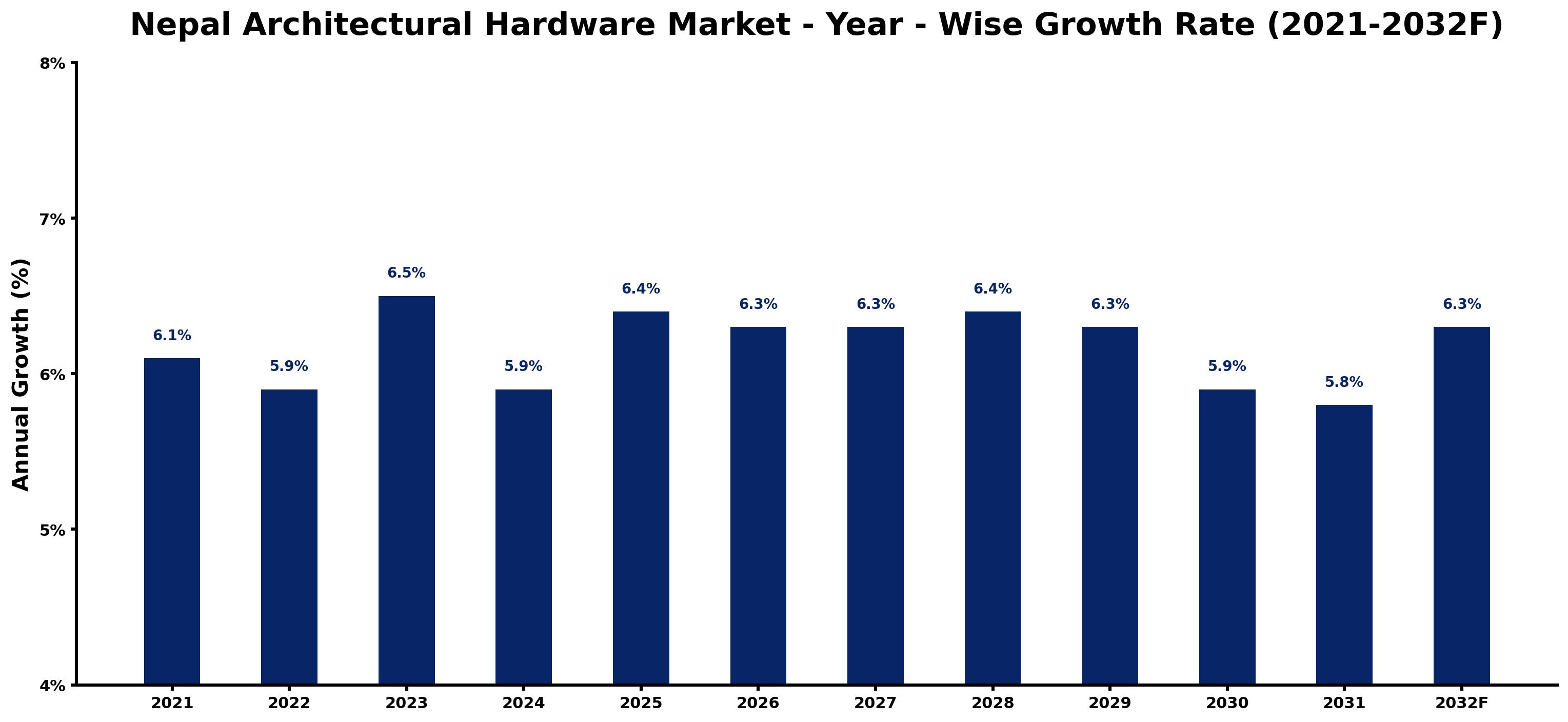
The table below presents the year wise growth rates along with the key drivers influencing the market
| Year | Growth Rate | Major Drivers |
| 2021 | 6.1% | Construction projects in urban areas saw a clear uptick in architectural hardware demands. |
| 2022 | 5.9% | Infrastructure development initiatives focused on improving connectivity led to hardware investments. |
| 2023 | 6.5% | Increased foreign investments stimulated the construction industry, enhancing hardware market potential. |
| 2024 | 5.9% | Shifts toward contemporary architectural designs necessitated innovative hardware solutions across projects. |
| 2025 | 6.4% | Local craftsmen began to incorporate new materials, diversifying the hardware available in the market. |
| 2026 | 6.3% | Sustainable building practices gained traction, emphasizing eco-friendly architectural hardware options. |
| 2027 | 6.3% | Consumer preferences shifted towards aesthetic hardware designs, aligning with global architectural trends. |
| 2028 | 6.4% | Emerging small-scale manufacturers began to enter the market, fostering healthy competition and innovation. |
| 2029 | 6.3% | Technological integration in construction improved efficiency, driving demand for advanced hardware solutions. |
| 2030 | 5.9% | Renovation projects in older urban areas created consistent opportunities for architectural hardware companies. |
| 2031 | 5.8% | Collaborations between local firms and international brands expanded product offerings in the market. |
| 2032 | 6.3% | Market maturity led to consolidation, as key players focused on quality and customer satisfaction. |
Note - Market size estimations and growth projections presented in this report are based on 6Wresearch's advanced forecasting approach, validated with industry datasets as of June 2026.
Nepal Architectural Hardware Market Synopsis
The Nepal Architectural Hardware Market is projected to reach 6.3% and witness significant growth during the forecast period (2026-2032). This expansion is primarily attributed to the rapid urbanization within Nepal, a surge in construction activities, and an increased demand for aesthetically pleasing interior design elements. The market encompasses a variety of products, including door handles, locks, hinges, and knobs, with both domestic and international manufacturers striving to secure a competitive edge. As consumer preferences lean towards innovative and stylish hardware designs, the market is expected to undergo transformative changes.
Nepal Architectural Hardware Market Growth Drivers
Several factors are catalyzing the growth of the Nepal Architectural Hardware Market. These include:
- Urbanization is fueling residential and commercial construction projects, leading to higher demand for various architectural hardware products. As more people migrate to urban areas, the need for housing and infrastructure development grows.
- A heightened focus on aesthetic design is prompting architects and builders to incorporate modern and stylish hardware into their projects, thereby elevating the overall value of properties.
- The increasing emphasis on security in residential and commercial spaces is driving the demand for advanced locking mechanisms and associated hardware, aligning with consumer expectations of safety.
- Technological advancements in architectural hardware, such as smart locks and integrated security systems, are attracting consumers seeking convenience and enhanced security.
- The trend towards sustainable building practices is resulting in a rising preference for eco-friendly materials, pushing manufacturers to innovate in order to meet these demands.
Nepal Architectural Hardware Market Trends and Opportunities
The landscape of the Nepal Architectural Hardware Market is evolving, characterized by notable trends and opportunities:
- There is a growing demand for customized solutions that meet specific design needs and preferences, which indicates a shift towards personalization in architectural hardware.
- Market participants are increasingly adopting sustainable manufacturing processes, utilizing materials such as stainless steel and brass, which align with environmentally responsible practices.
- The integration of smart technologies in hardware products is gaining traction, offering innovative solutions that resonate with tech-savvy consumers.
- A high emphasis on interior design aesthetics is encouraging manufacturers to create sleek, modern designs that appeal to contemporary sensibilities.
- The potential for investment in high-quality hardware products is on the rise, driven by an active renovation market as homeowners and businesses look to enhance their spaces.
Nepal Architectural Hardware Market Challenges and Restraints
The Nepal Architectural Hardware Market faces several challenges that could impact its growth trajectory:
- The proliferation of counterfeit products creates significant challenges for consumers, eroding trust in genuine brands and potentially compromising safety.
- A lack of standardization in product quality leads to confusion among consumers, making it difficult to distinguish reliable products from subpar alternatives.
- Limited consumer awareness about the advantages of high-quality hardware materials poses a barrier, as many still gravitate towards lower-priced, lower-quality options.
- Fragmented distribution channels hinder effective market access for various manufacturers, complicating supply chain logistics and market penetration.
- Addressing these challenges will require concerted efforts towards educational initiatives and regulatory measures to ensure quality and safety within the market.
Nepal Architectural Hardware Market Government Investment and Initiatives
Government initiatives are instrumental in shaping the Nepal Architectural Hardware Market. Policies encouraging local manufacturing aim to reduce reliance on imports, with tariff reductions on raw materials and production machinery acting as incentives for domestic producers. Furthermore, efforts to streamline the licensing and certification processes for manufacturers emphasize the importance of maintaining quality standards across the sector. The government is also promoting sustainable practices, urging companies to employ eco-friendly methods in their manufacturing processes. Collectively, these initiatives strive to create a competitive and sustainable market environment, advantageous for both manufacturers and consumers.
Nepal Architectural Hardware Market Latest Developments (May 2025 - June 2026)
Recent developments in the Nepal Architectural Hardware Market reflect ongoing trends and evolving consumer preferences. There has been an uptick in the introduction of innovative products that incorporate smart technology, catering to a tech-savvy consumer base. Manufacturers are increasingly focused on sustainable materials and eco-friendly practices, aligning their offerings with global environmental standards. This period has also seen a rise in collaborative efforts among industry stakeholders to strengthen quality control measures and mitigate the challenges posed by counterfeit products. These trends are setting the stage for a more robust market landscape as the construction sector continues to grow.
Nepal Architectural Hardware Market - Key Attractiveness of the Report
- 10 Years of Market Numbers
- Historical Data Starting from 2022 to 2025
- Base Year: 2025
- Forecast Data until 2032
- Key Performance Indicators Impacting the Market
- Major Upcoming Developments and Projects
Key contributors include increased urbanization, rising construction activities, and a growing demand for stylish and secure architectural hardware products.
The market contends with counterfeit products, lack of standardization, and limited consumer awareness regarding quality, among other challenges.
Government initiatives focus on promoting local production, sustainability, and regulatory measures to ensure quality standards, which benefit the overall market.
The market is expected to grow steadily between 2026 and 2032, driven by urbanization, increasing construction activities, and a demand for innovative products.
Key Highlights of the Report:
- Nepal Architectural Hardware Market Outlook
- Market Size of Nepal Architectural Hardware Market, 2025
- Forecast of Nepal Architectural Hardware Market, 2032F
- Historical Data and Forecast of Nepal Architectural Hardware Revenues & Volume for the Period 2022-2032F
- Nepal Architectural Hardware Market Trend Evolution
- Nepal Architectural Hardware Market Drivers and Challenges
- Nepal Architectural Hardware Price Trends
- Nepal Architectural Hardware Porter's Five Forces
- Nepal Architectural Hardware Industry Life Cycle
- Historical Data and Forecast of Nepal Architectural Hardware Market Revenues & Volume By Application for the Period 2022-2032F
- Historical Data and Forecast of Nepal Architectural Hardware Market Revenues & Volume By Doors for the Period 2022-2032F
- Historical Data and Forecast of Nepal Architectural Hardware Market Revenues & Volume By Windows for the Period 2022-2032F
- Historical Data and Forecast of Nepal Architectural Hardware Market Revenues & Volume By Furniture for the Period 2022-2032F
- Historical Data and Forecast of Nepal Architectural Hardware Market Revenues & Volume By Shower for the Period 2022-2032F
- Historical Data and Forecast of Nepal Architectural Hardware Market Revenues & Volume By End-user for the Period 2022-2032F
- Historical Data and Forecast of Nepal Architectural Hardware Market Revenues & Volume By Commercial for the Period 2022-2032F
- Historical Data and Forecast of Nepal Architectural Hardware Market Revenues & Volume By Industrial for the Period 2022-2032F
- Historical Data and Forecast of Nepal Architectural Hardware Market Revenues & Volume By Residential for the Period 2022-2032F
- Nepal Architectural Hardware Import Export Trade Statistics
- Market Opportunity Assessment By Application
- Market Opportunity Assessment By End-user
- Nepal Architectural Hardware Top Companies Market Share
- Nepal Architectural Hardware Competitive Benchmarking By Technical and Operational Parameters
- Nepal Architectural Hardware Company Profiles
- Nepal Architectural Hardware Key Strategic Recommendations






































