Nepal Auto Parts And Accessories Market Size, Share & Growth Rate
The Nepal Auto Parts And Accessories Market was estimated at USD 280 Million in 2025 and is projected to reach USD 365 Million by 2032, growing at a CAGR of 3.9% from 2026 to 2032. This growth trajectory is driven by the increasing demand for vehicles as disposable incomes rise, alongside ongoing infrastructure development. The burgeoning automotive sector, coupled with a burgeoning interest in vehicle customization and technological advancements, further fuels the demand for high-quality auto parts and accessories.
Nepal Auto Parts And Accessories Market Year-wise Growth Rate and Key Drivers
This graph highlights how the Nepal Auto Parts And Accessories Market has steadily grown over the years, supported by major growth factors.
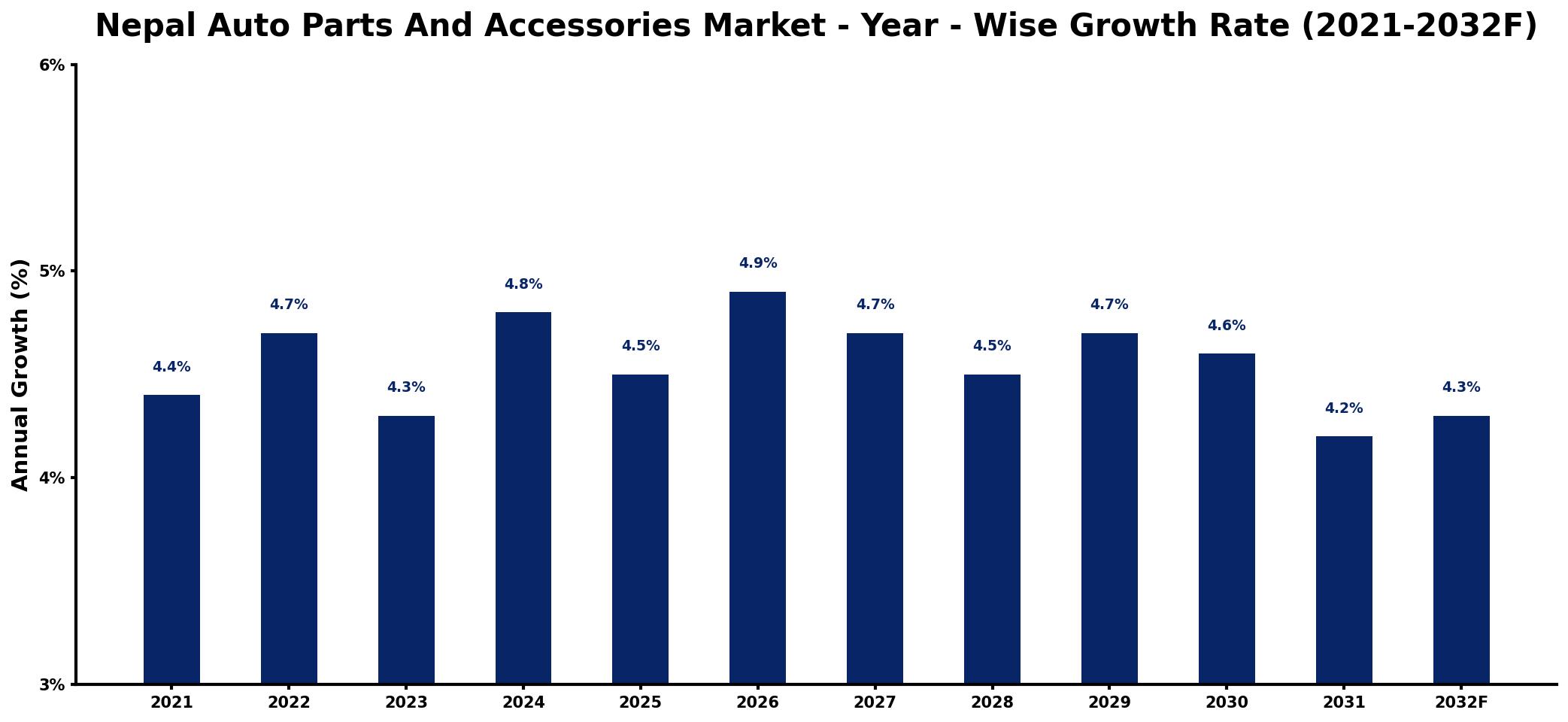
The table below presents the year‑wise growth rates along with the key drivers influencing the market
| Year | Growth Rate | Major Drivers |
| 2021 | 4.4% | Rising consumer disposable income trends |
| 2022 | 4.7% | Increased vehicle ownership rates |
| 2023 | 4.3% | Growing demand for sustainable solutions |
| 2024 | 4.8% | enhanced product quality standards |
| 2025 | 4.5% | Technological advancements in manufacturing |
| 2026 | 4.9% | Increase in foreign investments influx |
| 2027 | 4.7% | Rising e-commerce market penetration |
| 2028 | 4.5% | Strengthened distribution network efficiency |
| 2029 | 4.7% | growing regional consumption patterns |
| 2030 | 4.6% | Surge in electric vehicle adoption |
| 2031 | 4.2% | Increased focus on safety regulations |
| 2032 | 4.3% | Expansion of financing options availability |
Note: Market size estimations and growth projections presented in this report are based on 6Wresearch's proprietary forecasting methodology, utilizing the latest available industry data, government publications, and primary research inputs.
Nepal Auto Parts And Accessories Market Synopsis
The Nepal Auto Parts and Accessories Market is witnessing a significant expansion fueled by a robust increase in vehicle ownership across the nation. The demand for engine components, body parts, and various aftermarket accessories is on the rise, reflecting a shift in consumer behavior toward enhanced vehicle performance and customization.
In addition to conventional auto parts, there is a notable surge in demand for advanced technological products, such as smart car accessories and eco-friendly parts. This diversification in product offerings is essential as both OEMs and aftermarket suppliers adapt to meet the evolving preferences of Nepali consumers.
Nepal Auto Parts And Accessories Market Key Takeaways
- Robust market growth driven by rising vehicle ownership and disposable incomes.
- Significant demand for aftermarket parts indicates a shift towards vehicle customization.
- Increasing interest in eco-friendly and sustainable automotive solutions among consumers.
- Challenges such as counterfeit products and limited domestic manufacturing remain prevalent.
- Strategic partnerships and product innovation are crucial for long-term success.
Evaluation of Restraints in Nepal Auto Parts And Accessories Market
Despite its promising growth, the Nepal Auto Parts and Accessories Market faces several restraints. The heavy reliance on imports due to minimal domestic manufacturing capability escalates costs and introduces supply chain vulnerabilities. Additionally, the proliferation of counterfeit products not only undermines genuine brands but also poses safety risks to consumers. The lack of robust consumer awareness regarding quality auto parts further complicates market dynamics, while insufficient regulatory frameworks facilitate the circulation of substandard products, stifling overall industry advancement.
Nepal Auto Parts And Accessories Market Trends
Several trends are currently shaping the Nepal Auto Parts and Accessories Market. There is an increasing inclination toward aftermarket parts as vehicle owners seek to personalize their cars with unique accessories. Furthermore, the rising adoption of eco-friendly components, particularly electric vehicle parts, is indicative of a broader shift towards sustainability. Consumers are now prioritizing quality and reliability, favoring certified products over cheaper alternatives. Moreover, the integration of smart technologies in accessories is gaining traction, showcasing a market keen on innovation.
Nepal Auto Parts And Accessories Market Opportunities
This market offers a wealth of investment opportunities, particularly for those looking to capitalize on the growing automotive sector. As demand for high-quality replacement parts and innovative accessories rises, investing in distribution networks and specialized repair centers presents significant potential. Additionally, the government's push towards electric vehicles highlights opportunities for ventures focusing on sustainable auto parts and charging infrastructure. Understanding market nuances and consumer preferences will be pivotal in seizing these emerging opportunities.
Government Initiatives in the Nepal Auto Parts And Accessories Market
Government policies aimed at bolstering the Nepal Auto Parts and Accessories Market focus on enhancing domestic production capabilities and reducing import dependency. Tariffs and duties on imported auto parts have been implemented to incentivize local manufacturing. Furthermore, the government provides support for research and development efforts in the automotive sector, facilitating a favorable business environment. Initiatives that encourage the use of eco-friendly materials and technology in auto part manufacturing reflect a commitment to sustainability and long-term market growth.
Future Insights of the Nepal Auto Parts And Accessories Market
The future of the Nepal Auto Parts and Accessories Market is bright, characterized by expected steady growth. The increasing vehicle ownership coupled with infrastructure improvements is set to bolster demand. As more consumers lean towards customization, the aftermarket segment will likely expand significantly. The government's promotion of electric vehicles will also shape future demand for innovative auto parts tailored for sustainability. Overall, as the market adapts to these dynamics, it presents abundant opportunities for manufacturers and investors alike.
Nepal Auto Parts And Accessories Market Latest Developments (2025 - 2026)
Recent developments in the Nepal Auto Parts and Accessories Market indicate a proactive shift towards innovation and quality assurance. Stakeholders are increasingly focusing on enhancing their product offerings, particularly in the eco-friendly and technologically advanced segments. Additionally, there is a notable emphasis on developing strategic partnerships to mitigate challenges related to supply chain and counterfeit products. This collaborative approach aims to create a more resilient and consumer-oriented market.
Nepal Auto Parts And Accessories Market - Key Attractiveness of the Report
- 10 Years of Market Numbers
- Historical Data Starting from 2022 to 2025
- Base Year: 2025
- Forecast Data until 2032
- Key Performance Indicators Impacting the Market
- Major Upcoming Developments and Projects
Key Highlights of the Report:
- Nepal Auto Parts And Accessories Market Outlook
- Market Size of Nepal Auto Parts And Accessories Market, 2025
- Forecast of Nepal Auto Parts And Accessories Market, 2032
- Historical Data and Forecast of Nepal Auto Parts And Accessories Revenues & Volume for the Period 2022-2032F
- Nepal Auto Parts And Accessories Market Trend Evolution
- Nepal Auto Parts And Accessories Market Drivers and Challenges
- Nepal Auto Parts And Accessories Price Trends
- Nepal Auto Parts And Accessories Porter's Five Forces
- Nepal Auto Parts And Accessories Industry Life Cycle
- Historical Data and Forecast of Nepal Auto Parts And Accessories Market Revenues & Volume By Product for the Period 2022-2032F
- Historical Data and Forecast of Nepal Auto Parts And Accessories Market Revenues & Volume By Driveline & Powertrain for the Period 2022-2032F
- Historical Data and Forecast of Nepal Auto Parts And Accessories Market Revenues & Volume By Interiors & Exteriors for the Period 2022-2032F
- Historical Data and Forecast of Nepal Auto Parts And Accessories Market Revenues & Volume By Electronics for the Period 2022-2032F
- Historical Data and Forecast of Nepal Auto Parts And Accessories Market Revenues & Volume By Bodies & Chassis for the Period 2022-2032F
- Historical Data and Forecast of Nepal Auto Parts And Accessories Market Revenues & Volume By Wheel & Tires for the Period 2022-2032F
- Historical Data and Forecast of Nepal Auto Parts And Accessories Market Revenues & Volume By Others for the Period 2022-2032F
- Historical Data and Forecast of Nepal Auto Parts And Accessories Market Revenues & Volume By Application for the Period 2022-2032F
- Historical Data and Forecast of Nepal Auto Parts And Accessories Market Revenues & Volume By OEMs for the Period 2022-2032F
- Historical Data and Forecast of Nepal Auto Parts And Accessories Market Revenues & Volume By Aftermarket for the Period 2022-2032F
- Nepal Auto Parts And Accessories Import Export Trade Statistics
- Market Opportunity Assessment By Product
- Market Opportunity Assessment By Application
- Nepal Auto Parts And Accessories Top Companies Market Share
- Nepal Auto Parts And Accessories Competitive Benchmarking By Technical and Operational Parameters
- Nepal Auto Parts And Accessories Company Profiles
- Nepal Auto Parts And Accessories Key Strategic Recommendations






































