Nepal Automotive Aftermarket Market Size, Share & Growth Rate
The Nepal Automotive Aftermarket Market was estimated at USD 204 Million in 2025 and is projected to reach USD 269 Million by 2032, growing at a CAGR of 4.0% from 2026 to 2032. This steady growth trajectory is attributed to rising vehicle ownership driven by urbanization and improved economic conditions. As disposable income increases, vehicle owners are more inclined to invest in aftermarket products that enhance performance and aesthetics, further fueling the market's expansion.
Nepal Automotive Aftermarket Market Year-wise Growth Rate and Key Drivers
This graph highlights how the Nepal Automotive Aftermarket Market has steadily grown over the years, supported by major growth factors.
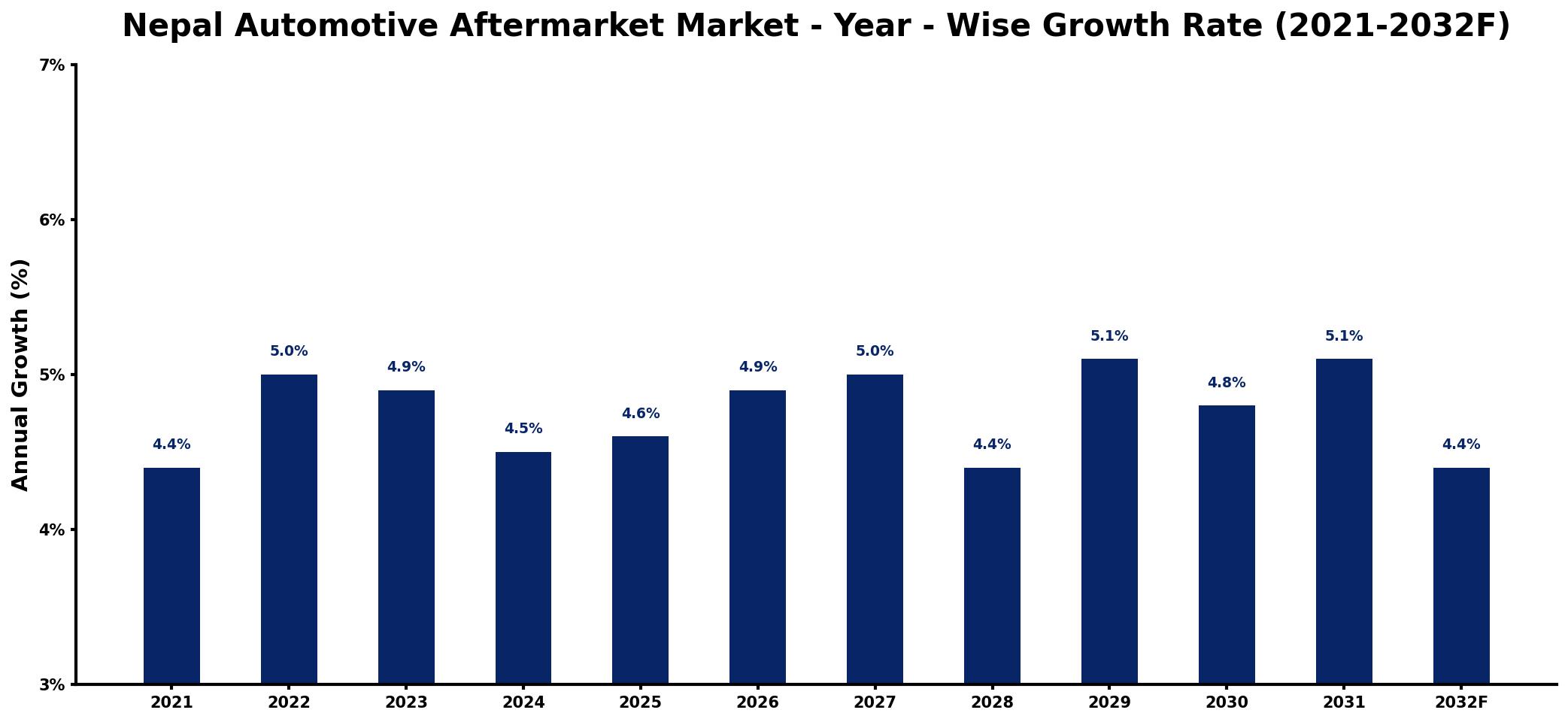
The table below presents the year‑wise growth rates along with the key drivers influencing the market
| Year | Growth Rate | Major Drivers |
| 2021 | 4.4% | Rising consumer disposable income levels |
| 2022 | 5.0% | Increased vehicle ownership rates |
| 2023 | 4.9% | Growing demand for vehicle servicing |
| 2024 | 4.5% | Expansion of urban infrastructure projects |
| 2025 | 4.6% | Surge in online retail platforms |
| 2026 | 4.9% | Increase in foreign investment inflow |
| 2027 | 5.0% | Growth in logistics and transportation |
| 2028 | 4.4% | Rise in vehicle maintenance awareness |
| 2029 | 5.1% | Development of renewable energy solutions |
| 2030 | 4.8% | rising infrastructure development spending |
| 2031 | 5.1% | increased capital investment inflows |
| 2032 | 4.4% | growing regional consumption patterns |
Note: Market size estimations and growth projections presented in this report are based on 6Wresearch's proprietary forecasting methodology, utilizing the latest available industry data, government publications, and primary research inputs.
Nepal Automotive Aftermarket Market Synopsis
The Nepal Automotive Aftermarket is marked by a burgeoning demand for vehicle maintenance and customization products. With an increase in the number of vehicles on the roads, consumers are seeking solutions that not only ensure optimal vehicle performance but also reflect personal style. This dynamic landscape offers a wide array of products, including spare parts, lubricants, and accessories.
As digital platforms gain traction, more consumers are turning to online marketplaces for convenience in purchasing aftermarket products. This shift enhances the accessibility of products and services, making it easier for consumers to cater to their specific automotive needs. The convergence of these factors positions the Nepal Automotive Aftermarket for a robust growth phase.
Nepal Automotive Aftermarket Market Key Takeaways
- The market is experiencing robust growth fueled by increased vehicle ownership and disposable income.
- Customization trends are rising, with consumers seeking personalized vehicle enhancements.
- Digital channels are becoming the preferred method for purchasing aftermarket products.
- There is a growing emphasis on affordable maintenance and repair solutions among vehicle owners.
- Investment opportunities are plentiful in segments like spare parts distribution and vehicle customization services.
Evaluation of Restraints in Nepal Automotive Aftermarket Market
Despite the promising outlook, the Nepal Automotive Aftermarket faces critical challenges that may impede its growth. The prevalence of counterfeit spare parts not only compromises vehicle quality and safety but also undermines consumer trust in aftermarket products. Furthermore, the limited availability of genuine parts often forces consumers to rely on unauthorized dealers, perpetuating quality issues. Price variations due to a lack of standardized pricing further complicate the purchasing process for consumers, while inadequate training for mechanics diminishes the quality of repair services available. Collectively, these challenges necessitate targeted interventions from stakeholders to ensure the markets sustainability and efficiency.
Nepal Automotive Aftermarket Market Trends
The market is increasingly witnessing a trend toward vehicle personalization, with consumers eager to invest in accessories that improve aesthetics and functionality. Items such as body kits, alloy wheels, and advanced lighting systems are gaining popularity as owners seek to differentiate their vehicles. Additionally, there is a marked shift towards digital retailing, which facilitates easier access to a wider range of aftermarket products. This consumer-centric approach reflects a growing preference for convenience, as vehicle owners prioritize both performance upgrades and aesthetic enhancements.
Nepal Automotive Aftermarket Market Opportunities
The Nepal Automotive Aftermarket presents significant investment opportunities, particularly in areas such as spare parts distribution and repair services. Establishing a network of distribution centers for authentic spare parts could effectively address the current demand for quality products. Moreover, investing in auto repair workshops that specialize in customization and performance tuning can cater to the evolving preferences of car enthusiasts. Collaborating with established international aftermarket brands for local distribution further enhances the business potential in this sector, reflecting the market's readiness for innovative solutions.
Government Initiatives in the Nepal Automotive Aftermarket Market
The government is taking proactive steps to strengthen the Nepal Automotive Aftermarket through various policies aimed at fostering competition and ensuring consumer protection. These measures include regulations that promote fair business practices and transparency in pricing, which are essential for building consumer trust. Additionally, initiatives encouraging the adoption of environmentally sustainable practices and products within the aftermarket sector are helping to align the industry with global sustainability goals. The government's involvement is pivotal in creating an equitable market environment that benefits both consumers and businesses.
Future Insights of the Nepal Automotive Aftermarket Market
Looking ahead to the period of 2026-2032, the Nepal Automotive Aftermarket is poised for continued expansion. The expected rise in vehicle ownership and increasing average vehicle age will likely drive demand for aftermarket services and products. As vehicle owners keep their cars longer, cost-effective maintenance solutions will become increasingly sought after. However, addressing the issues of counterfeit products and lack of standardization will be crucial for ensuring a resilient growth path. The integration of technology and e-commerce will further reshape how consumers interact with the aftermarket, paving the way for innovative offerings.
Nepal Automotive Aftermarket Market Latest Developments (2025 - 2026)
In recent months, the Nepal Automotive Aftermarket has seen a surge in digital transformation initiatives. Retailers are increasingly adopting e-commerce platforms to enhance accessibility to aftermarket products, aligning with shifting consumer behaviors. Furthermore, partnerships aimed at promoting training programs for mechanics are gaining traction, addressing the skills gap within the industry. These developments indicate a proactive response to evolving market demands, setting the stage for more informed consumer choices and improved service standards.
Nepal Automotive Aftermarket Market - Key Attractiveness of the Report
- 10 Years of Market Numbers
- Historical Data Starting from 2022 to 2025
- Base Year: 2025
- Forecast Data until 2032
- Key Performance Indicators Impacting the Market
- Major Upcoming Developments and Projects
Key Highlights of the Report:
- Nepal Automotive Aftermarket Market Outlook
- Market Size of Nepal Automotive Aftermarket Market, 2025
- Forecast of Nepal Automotive Aftermarket Market, 2032
- Historical Data and Forecast of Nepal Automotive Aftermarket Revenues & Volume for the Period 2022-2032F
- Nepal Automotive Aftermarket Market Trend Evolution
- Nepal Automotive Aftermarket Market Drivers and Challenges
- Nepal Automotive Aftermarket Price Trends
- Nepal Automotive Aftermarket Porter's Five Forces
- Nepal Automotive Aftermarket Industry Life Cycle
- Historical Data and Forecast of Nepal Automotive Aftermarket Market Revenues & Volume By Replacement Parts for the Period 2022-2032F
- Historical Data and Forecast of Nepal Automotive Aftermarket Market Revenues & Volume By Tire for the Period 2022-2032F
- Historical Data and Forecast of Nepal Automotive Aftermarket Market Revenues & Volume By Battery for the Period 2022-2032F
- Historical Data and Forecast of Nepal Automotive Aftermarket Market Revenues & Volume By Brake Parts for the Period 2022-2032F
- Historical Data and Forecast of Nepal Automotive Aftermarket Market Revenues & Volume By Filters for the Period 2022-2032F
- Historical Data and Forecast of Nepal Automotive Aftermarket Market Revenues & Volume By Body parts for the Period 2022-2032F
- Historical Data and Forecast of Nepal Automotive Aftermarket Market Revenues & Volume By Lighting & Electronic Components for the Period 2022-2032F
- Historical Data and Forecast of Nepal Automotive Aftermarket Market Revenues & Volume By Wheels for the Period 2022-2032F
- Historical Data and Forecast of Nepal Tire Automotive Aftermarket Market Revenues & Volume By Exhaust components for the Period 2022-2032F
- Historical Data and Forecast of Nepal Automotive Aftermarket Market Revenues & Volume By Distribution Channel for the Period 2022-2032F
- Historical Data and Forecast of Nepal Automotive Aftermarket Market Revenues & Volume By Retailers for the Period 2022-2032F
- Historical Data and Forecast of Nepal Automotive Aftermarket Market Revenues & Volume By Wholesalers & Distributors for the Period 2022-2032F
- Historical Data and Forecast of Nepal Automotive Aftermarket Market Revenues & Volume By Service Channel for the Period 2022-2032F
- Historical Data and Forecast of Nepal Automotive Aftermarket Market Revenues & Volume By DIY (Do it Yourself) for the Period 2022-2032F
- Historical Data and Forecast of Nepal Automotive Aftermarket Market Revenues & Volume By DIFM (Do it for Me) for the Period 2022-2032F
- Historical Data and Forecast of Nepal Automotive Aftermarket Market Revenues & Volume By OE (Delegating to OEM??s) for the Period 2022-2032F
- Historical Data and Forecast of Nepal Automotive Aftermarket Market Revenues & Volume By Certification for the Period 2022-2032F
- Historical Data and Forecast of Nepal Automotive Aftermarket Market Revenues & Volume By Genuine Parts for the Period 2022-2032F
- Historical Data and Forecast of Nepal Automotive Aftermarket Market Revenues & Volume By Certified Parts for the Period 2022-2032F
- Historical Data and Forecast of Nepal Automotive Aftermarket Market Revenues & Volume By Uncertified Parts for the Period 2022-2032F
- Nepal Automotive Aftermarket Import Export Trade Statistics
- Market Opportunity Assessment By Replacement Parts
- Market Opportunity Assessment By Distribution Channel
- Market Opportunity Assessment By Service Channel
- Market Opportunity Assessment By Certification
- Nepal Automotive Aftermarket Top Companies Market Share
- Nepal Automotive Aftermarket Competitive Benchmarking By Technical and Operational Parameters
- Nepal Automotive Aftermarket Company Profiles
- Nepal Automotive Aftermarket Key Strategic Recommendations






































