Nepal Automotive collision repair Market Size, Share & Growth Rate
The Nepal Automotive collision repair Market was estimated at USD 587 Million in 2025 and is projected to reach USD 968 Million by 2032, growing at a CAGR of 7.4% from 2026 to 2032. This robust growth trajectory is fueled by an increasing number of vehicles on Nepalese roads and a corresponding rise in road incidents. Additionally, consumer awareness regarding vehicle maintenance and insurance support for collision repairs further bolster demand in this expanding market.
Nepal Automotive collision repair Market Year-wise Growth Rate and Key Drivers
This graph highlights how the Nepal Automotive collision repair Market has steadily grown over the years, supported by major growth factors.
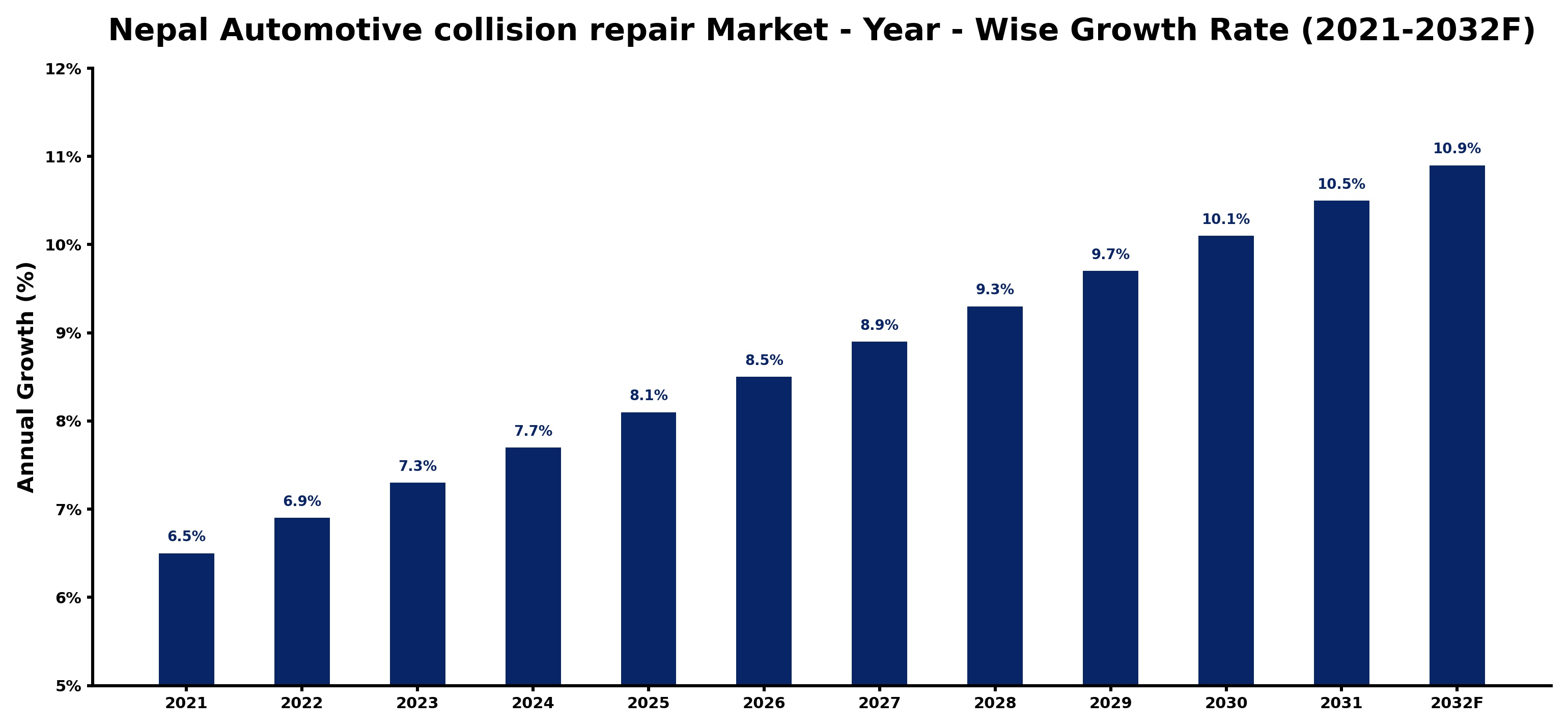
The table below presents the year‑wise growth rates along with the key drivers influencing the market
| Year | Growth Rate | Major Drivers |
| 2021 | 6.5% | Rising vehicle ownership trends observed |
| 2022 | 6.9% | Increased urbanization driving demand |
| 2023 | 7.3% | Technological advancements in repairs |
| 2024 | 7.7% | Insurance coverage expansion benefits consumers |
| 2025 | 8.1% | Growing awareness of vehicle maintenance |
| 2026 | 8.5% | Enhanced service quality attracts customers |
| 2027 | 8.9% | Government initiatives support industry growth |
| 2028 | 9.3% | Sustainability practices gaining traction |
| 2029 | 9.7% | Emergence of electric vehicle repairs |
| 2030 | 10.1% | Expansion of skilled labor force |
| 2031 | 10.5% | Increased consumer spending on vehicles |
| 2032 | 10.9% | Collaboration with automotive manufacturers |
Note - Market size estimations and growth projections presented in this report are based on 6Wresearch’s advanced forecasting approach, validated with industry datasets as of June 2026.
Nepal Automotive collision repair Market Synopsis
In recent years, the Nepal Automotive collision repair market has shown significant dynamism, driven by rising vehicle ownership and an uptick in accident rates. Local repair shops are evolving, adapting to both consumer needs and environmental considerations, which adds layers of complexity to their services.
The market landscape features a mix of independent and authorized service centers, each striving to offer comprehensive repair solutions. This diversity provides vehicle owners with ample choice, enabling them to select services that best meet their specific needs and budget.
Nepal Automotive collision repair Market Key Takeaways
- The market is characterized by a blend of independent and brand-affiliated repair shops.
- Consumers increasingly favor eco-friendly repair practices, impacting service offerings.
- Insurance companies play a crucial role in streamlining repair claims for vehicle owners.
- Technological advancements such as computerized diagnostics are becoming standard practice.
- Investment opportunities are emerging due to a growing vehicle population and demand for quality repairs.
Evaluation of Restraints in Nepal Automotive collision repair Market
Despite the promising growth of the Nepal Automotive collision repair market, several restraints limit its full potential. Access to advanced technology and equipment remains limited, posing challenges for repair shops aiming to deliver high-quality services. Furthermore, the shortage of skilled technicians often results in inconsistent service quality. The variability in spare parts quality exacerbates these issues, alongside regulatory hurdles that complicate operational efficiency. As such, these constraints create a pressing need for industry investments focused on training, technology, and standardized practices.
Nepal Automotive collision repair Market Trends
Current trends within the Nepal Automotive collision repair market reflect a significant shift towards sustainability and technological integration. Consumers are increasingly opting for eco-friendly repair options, spurring shops to adopt greener practices. Additionally, the incorporation of advanced diagnostics and 3D imaging technology is revolutionizing repair accuracy and efficiency, catering to a more tech-savvy consumer base.
A notable trend is the specialization in electric vehicle collision repairs, aligning with the growing adoption of electric vehicles in Nepal. Repair shops are adapting to these evolving consumer preferences by enhancing their service portfolios, which ultimately positions them for future growth.
Nepal Automotive collision repair Market Opportunities
The evolving landscape of the Nepal Automotive collision repair market presents numerous investment opportunities. Establishing state-of-the-art repair facilities equipped with cutting-edge technology can significantly enhance service quality. Moreover, specialized services such as paintless dent repair and alloy wheel refurbishment are on the rise, allowing businesses to cater to specific consumer needs and preferences. Collaborating with insurance companies to facilitate efficient claims processes can also attract a larger customer base, further capitalizing on the growing demand for automotive repair services.
Government Initiatives in the Nepal Automotive collision repair Market
The Nepalese government is actively promoting initiatives aimed at enhancing safety standards and quality in the automotive collision repair market. Regulatory frameworks require repair shops to adhere to specific guidelines, ensuring that consumer rights and vehicle safety are prioritized. Additionally, the government encourages the adoption of environmentally friendly practices through various incentives, fostering a sustainable approach to automotive repair. Fair pricing regulations also aim to protect consumers from exploitation within this rapidly evolving market.
Future Insights of the Nepal Automotive collision repair Market
Looking ahead to 2026-2032, the outlook for the Nepal Automotive collision repair market is optimistic. The steady rise in vehicle ownership, coupled with increasing disposable incomes, is expected to drive demand for repair services. Advances in repair technologies will likely enhance service quality and efficiency, accommodating the growing consumer focus on maintenance. Additionally, as more specialized repair shops emerge to meet consumer demands, the market is set to witness a sustained growth trajectory, ultimately transforming the automotive repair landscape in Nepal.
Nepal Automotive collision repair Market Latest Developments (May 2025 - June 2026)
In the past year, the Nepal Automotive collision repair market has seen several notable developments. Repair shops are increasingly investing in technology upgrades, with a focus on digital tools that enhance repair accuracy and efficiency. Simultaneously, there is a growing emphasis on employee training programs to ensure technicians are skilled in the latest repair techniques and eco-friendly practices. These trends highlight the industry's response to evolving consumer expectations and the increasing importance of sustainability in automotive repairs.
Nepal Automotive collision repair Market - Key Attractiveness of the Report
- 10 Years of Market Numbers
- Historical Data Starting from 2022 to 2025
- Base Year: 2025
- Forecast Data until 2032
- Key Performance Indicators Impacting the Market
- Major Upcoming Developments and Projects
Key Highlights of the Report:
- Nepal Automotive collision repair Market Outlook
- Market Size of Nepal Automotive collision repair Market, 2025
- Forecast of Nepal Automotive collision repair Market, 2032
- Historical Data and Forecast of Nepal Automotive collision repair Revenues & Volume for the Period 2022-2032F
- Nepal Automotive collision repair Market Trend Evolution
- Nepal Automotive collision repair Market Drivers and Challenges
- Nepal Automotive collision repair Price Trends
- Nepal Automotive collision repair Porter's Five Forces
- Nepal Automotive collision repair Industry Life Cycle
- Historical Data and Forecast of Nepal Automotive collision repair Market Revenues & Volume By Vehicle Type for the Period 2022-2032F
- Historical Data and Forecast of Nepal Automotive collision repair Market Revenues & Volume By Light-duty for the Period 2022-2032F
- Historical Data and Forecast of Nepal Automotive collision repair Market Revenues & Volume By Heavy-duty for the Period 2022-2032F
- Historical Data and Forecast of Nepal Automotive collision repair Market Revenues & Volume By Product for the Period 2022-2032F
- Historical Data and Forecast of Nepal Automotive collision repair Market Revenues & Volume By Paints & coatings for the Period 2022-2032F
- Historical Data and Forecast of Nepal Automotive collision repair Market Revenues & Volume By Consumables for the Period 2022-2032F
- Historical Data and Forecast of Nepal Automotive collision repair Market Revenues & Volume By Spare parts for the Period 2022-2032F
- Historical Data and Forecast of Nepal Automotive collision repair Market Revenues & Volume By Service Channel for the Period 2022-2032F
- Historical Data and Forecast of Nepal Automotive collision repair Market Revenues & Volume By DIY for the Period 2022-2032F
- Historical Data and Forecast of Nepal Automotive collision repair Market Revenues & Volume By DIFM for the Period 2022-2032F
- Historical Data and Forecast of Nepal Automotive collision repair Market Revenues & Volume By OE for the Period 2022-2032F
- Nepal Automotive collision repair Import Export Trade Statistics
- Market Opportunity Assessment By Vehicle Type
- Market Opportunity Assessment By Product
- Market Opportunity Assessment By Service Channel
- Nepal Automotive collision repair Top Companies Market Share
- Nepal Automotive collision repair Competitive Benchmarking By Technical and Operational Parameters
- Nepal Automotive collision repair Company Profiles
- Nepal Automotive collision repair Key Strategic Recommendations






































