Nepal Bamboos Market Size Growth Rate
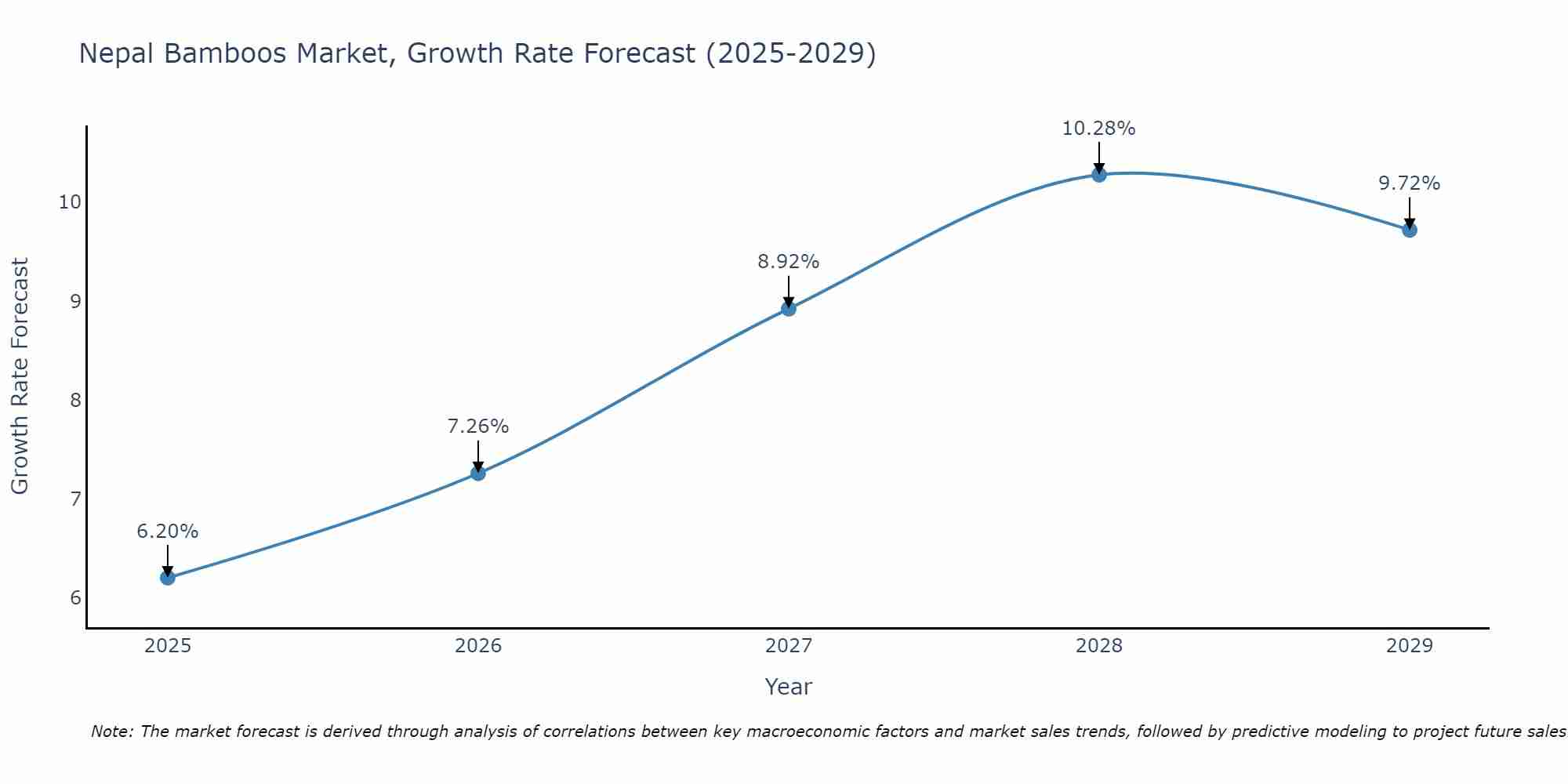
The Nepal Bamboos Market is projected to witness mixed growth rate patterns during 2025 to 2029. Starting at 6.20% in 2025, the market peaks at 10.28% in 2028, and settles at 9.72% by 2029.
Bamboos Market: Nepal vs Top 5 Major Economies in 2027 (Asia)
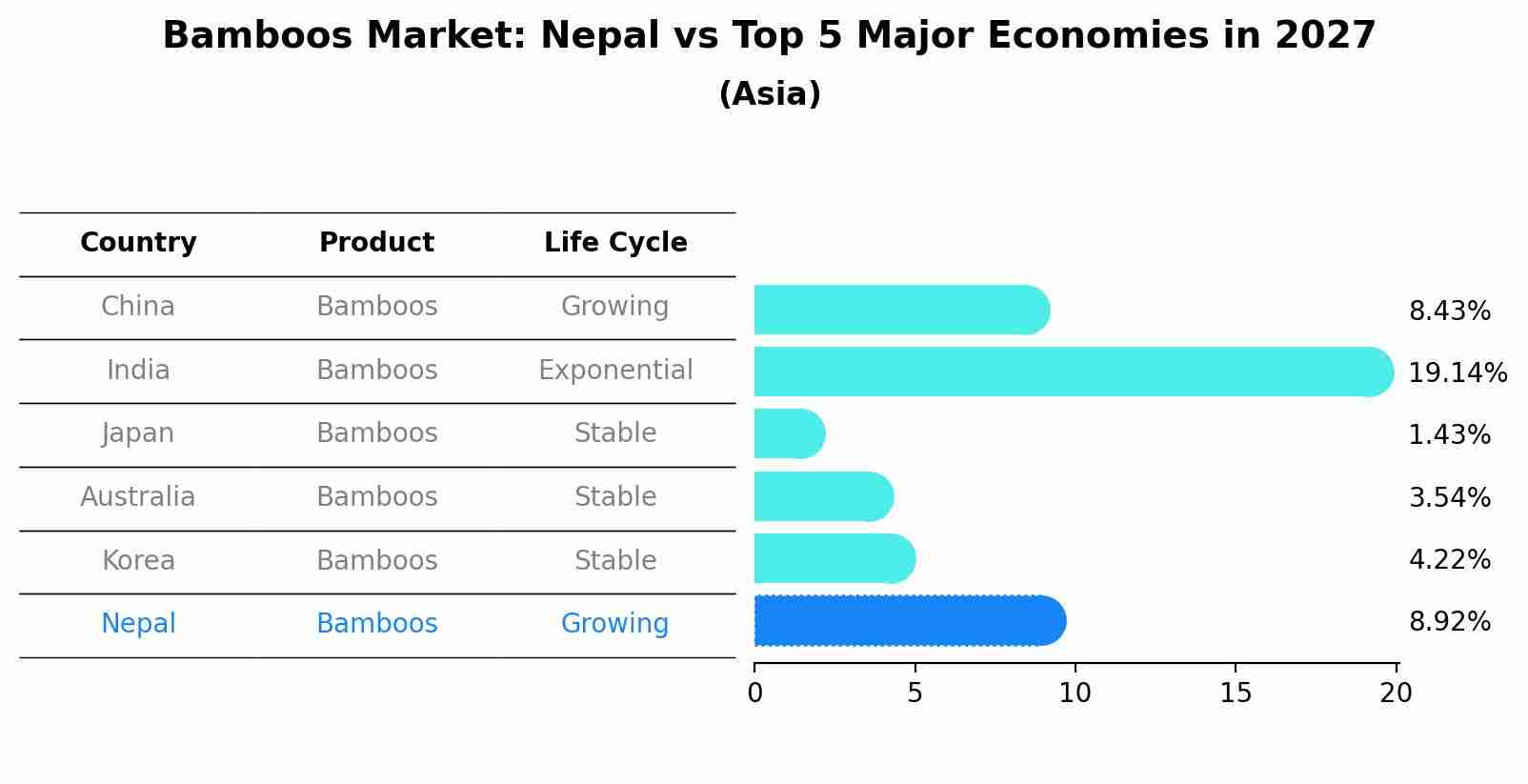
In the Asia region, the Bamboos market in Nepal is projected to expand at a growing growth rate of 8.92% by 2027. The largest economy is China, followed by India, Japan, Australia and South Korea.
Nepal Bamboos Market Overview
The Nepal Bamboos Market is experiencing steady growth due to the increasing demand for sustainable and eco-friendly construction materials. Bamboos are widely used in Nepal for various purposes such as construction, furniture making, handicrafts, and agricultural tools. The market is driven by factors like the versatility, durability, and renewability of bamboo. Additionally, the government`s initiatives to promote bamboo cultivation and utilization further boost the market. Key players in the Nepal Bamboos Market include bamboo growers, manufacturers, and exporters who are focusing on enhancing product quality and expanding their distribution networks both domestically and internationally. Overall, the Nepal Bamboos Market is poised for continued growth as consumers increasingly prioritize environmentally friendly products.
Nepal Bamboos Market Trends
The Nepal Bamboos Market is experiencing a growing demand for sustainable and eco-friendly building materials, leading to an increased focus on bamboo products. Consumers are increasingly choosing bamboo due to its versatility, durability, and renewability, making it a popular choice for construction, furniture, and handicrafts. The market is also witnessing a rise in innovative bamboo-based products such as flooring, textiles, and even bamboo charcoal. Additionally, there is a growing interest in utilizing bamboo as a solution for environmental challenges like deforestation and climate change. Overall, the Nepal Bamboos Market is seeing a shift towards sustainable practices and a recognition of bamboo as a valuable resource with diverse applications.
Nepal Bamboos Market Challenges
In the Nepal Bamboos Market, some of the key challenges include inconsistent supply due to natural factors such as weather conditions affecting bamboo growth, lack of standardized grading and quality control leading to variability in product quality, limited awareness and promotion of bamboo products resulting in low demand, and inadequate infrastructure for processing and transportation causing delays and inefficiencies in the supply chain. Additionally, the sector faces competition from alternative materials and traditional practices, as well as limited access to finance for small-scale bamboo growers and producers. Addressing these challenges will require investment in research and development, infrastructure improvements, quality standards enforcement, and market promotion efforts to unlock the full potential of the Nepal Bamboos Market.
Nepal Bamboos Market Investment Opportunities
The Nepal bamboo market presents promising investment opportunities due to the increasing demand for sustainable and eco-friendly construction materials. Bamboo is a versatile resource used in various industries, including construction, furniture, and handicrafts. Investing in bamboo plantations or processing facilities in Nepal can yield significant returns as the country boasts rich bamboo resources and a growing global interest in sustainable products. Additionally, bamboo has a short growth cycle, making it an attractive investment option for those looking for relatively quick returns. With the right investment strategy and market positioning, investors can capitalize on the growing demand for bamboo products both locally and internationally, contributing to economic growth and environmental sustainability in Nepal.
Nepal Bamboos Market Government Policy
The Nepal government has implemented various policies to regulate the bamboo market in the country. The government has focused on promoting sustainable bamboo cultivation practices, encouraging investment in bamboo industries, and creating market linkages for bamboo products. Policies also aim to support local bamboo artisans and entrepreneurs through capacity-building programs and financial incentives. Additionally, the government has established regulations to ensure the responsible harvesting and management of bamboo forests to prevent overexploitation. These policies are part of Nepal`s broader strategy to leverage the potential of the bamboo sector for economic growth, environmental conservation, and rural development, highlighting the importance of bamboo as a sustainable and versatile resource with significant socio-economic benefits.
Nepal Bamboos Market Future Outlook
The future outlook for the Nepal Bamboos Market appears promising due to increasing awareness of the environmental benefits of using bamboo as a sustainable alternative to traditional materials. The market is expected to witness steady growth driven by the rising demand for eco-friendly products in various industries such as construction, furniture, and handicrafts. Additionally, government initiatives to promote bamboo cultivation and processing are likely to further boost the market. With its versatility, strength, and rapid growth cycle, bamboo is poised to become a popular choice for consumers seeking environmentally conscious options. Overall, the Nepal Bamboos Market is anticipated to thrive in the coming years as sustainability continues to be a key focus for businesses and consumers alike.
Key Highlights of the Report:
- Nepal Bamboos Market Outlook
- Market Size of Nepal Bamboos Market, 2024
- Forecast of Nepal Bamboos Market, 2031
- Historical Data and Forecast of Nepal Bamboos Revenues & Volume for the Period 2021 - 2031
- Nepal Bamboos Market Trend Evolution
- Nepal Bamboos Market Drivers and Challenges
- Nepal Bamboos Price Trends
- Nepal Bamboos Porter's Five Forces
- Nepal Bamboos Industry Life Cycle
- Historical Data and Forecast of Nepal Bamboos Market Revenues & Volume By Application for the Period 2021 - 2031
- Historical Data and Forecast of Nepal Bamboos Market Revenues & Volume By Raw Materials for the Period 2021 - 2031
- Historical Data and Forecast of Nepal Bamboos Market Revenues & Volume By Industrial Products for the Period 2021 - 2031
- Historical Data and Forecast of Nepal Bamboos Market Revenues & Volume By Furniture for the Period 2021 - 2031
- Historical Data and Forecast of Nepal Bamboos Market Revenues & Volume By Shoots for the Period 2021 - 2031
- Historical Data and Forecast of Nepal Bamboos Market Revenues & Volume By Others for the Period 2021 - 2031
- Nepal Bamboos Import Export Trade Statistics
- Market Opportunity Assessment By Application
- Nepal Bamboos Top Companies Market Share
- Nepal Bamboos Competitive Benchmarking By Technical and Operational Parameters
- Nepal Bamboos Company Profiles
- Nepal Bamboos Key Strategic Recommendations






































