Nepal Bathroom Furniture Market Summary
The nepal bathroom furniture market was estimated at USD 277 Million in 2025 and is projected to reach USD 387 Million by 2032, growing at a CAGR of 5.5% from 2026 to 2032.
Nepal Bathroom Furniture Market Year-wise Growth Rate and Key Drivers
This graph highlights how the Nepal Bathroom Furniture Market has steadily grown over the past five years, supported by major growth factors.
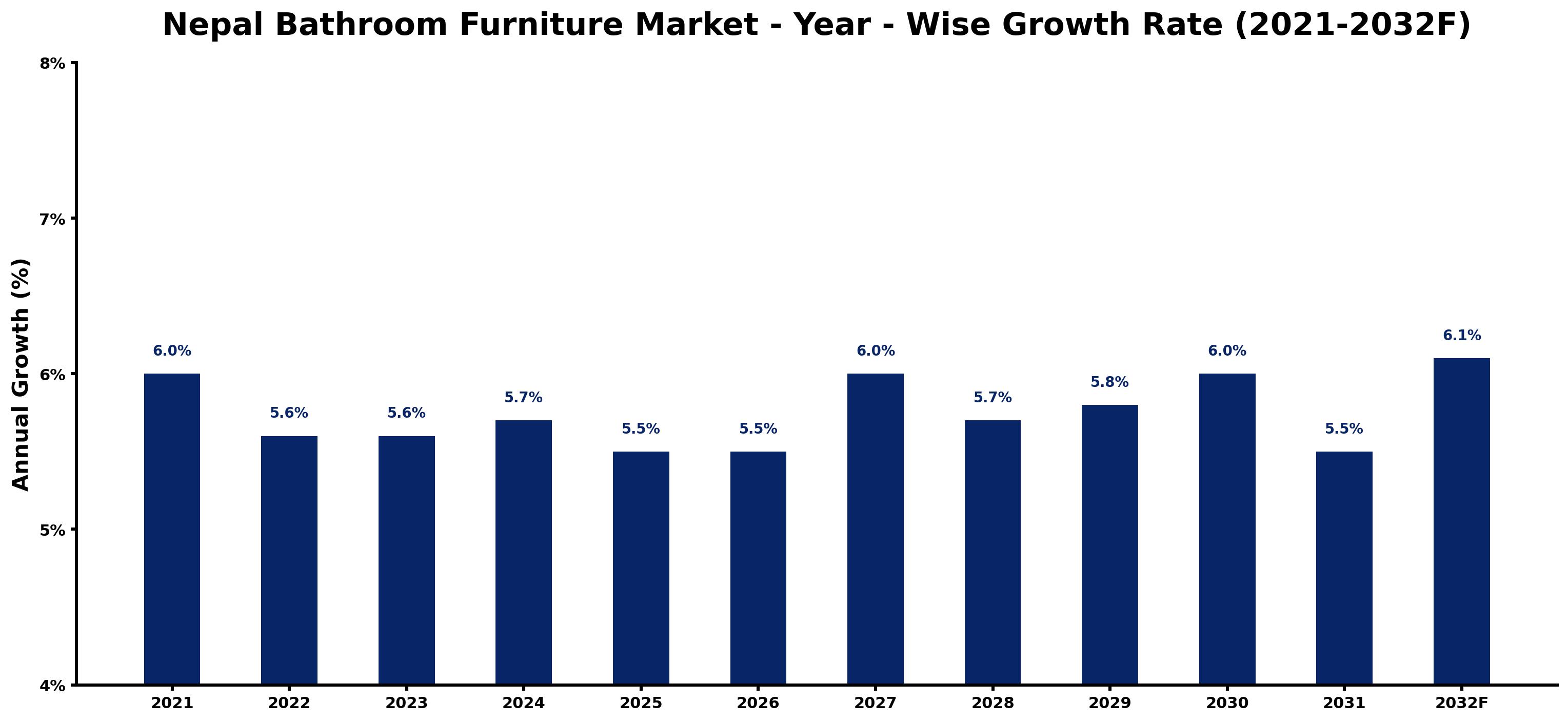
The table below presents the year wise growth rates along with the key drivers influencing the market
| Year | Growth Rate | Major Drivers |
| 2021 | 6.0% | Post-pandemic recovery revitalizes consumer interest in home renovation projects. |
| 2022 | 5.6% | Local craftsmen increasingly offer customized solutions for unique bathroom aesthetics. |
| 2023 | 5.6% | Urban migration leads to a surge in apartment renovations and bathroom upgrades. |
| 2024 | 5.7% | Emerging middle class prioritizes modern amenities, including stylish bathroom furnishings. |
| 2025 | 5.5% | Increased availability of eco-friendly materials caters to environmentally conscious buyers. |
| 2026 | 5.5% | International brands establish local partnerships, enhancing market competition and variety. |
| 2027 | 6.0% | Technological integration in manufacturing boosts efficiency and reduces production costs. |
| 2028 | 5.7% | Focus on sanitary hygiene drives demand for innovative bathroom furniture solutions. |
| 2029 | 5.8% | Aging infrastructure necessitates renovations, particularly in residential bathroom facilities. |
| 2030 | 6.0% | Shifts towards minimalism influence design trends in bathroom furniture selection. |
| 2031 | 5.5% | Online retail platforms expand reach, making products accessible to broader demographics. |
| 2032 | 6.1% | Collaborations with interior designers become essential for luxury bathroom project execution. |
Note - Market size estimations and growth projections presented in this report are based on 6Wresearch's advanced forecasting approach, validated with industry datasets as of June 2026.
Nepal Bathroom Furniture Market Synopsis
The Nepal Bathroom Furniture Market is projected to reach 5.5% and witness significant growth during the forecast period (2026-2032). This growth trajectory is primarily driven by increasing urbanization, evolving consumer lifestyles, and a heightened awareness of home decor trends. The market encompasses a broad spectrum of products, including bathroom vanities, cabinets, shelves, and various accessories crafted from materials such as wood, metal, and plastic. The increasing demand for stylish and functional bathroom furniture is particularly pronounced in urban centers, where space-efficient solutions are essential for maximizing limited areas.
Nepal Bathroom Furniture Market Growth Drivers
The growth of the Nepal Bathroom Furniture Market can be attributed to several interlinked drivers:
- Urbanization is rapidly transforming Nepal's demographic landscape, leading to a rise in housing construction and renovations where modern bathroom furniture is a priority.
- Changing lifestyles, with many consumers placing greater emphasis on home aesthetics, have resulted in a demand for high-quality, stylish bathroom furniture that reflects contemporary design trends.
- The increasing availability of e-commerce platforms has made it easier for consumers to access a wide range of products, enhancing their purchasing experience and expanding market reach.
- Growing environmental awareness among consumers is driving demand for eco-friendly designs and sustainable materials, prompting manufacturers to innovate in these areas.
- The rise of multifunctional furniture that optimizes space usage is appealing to urban dwellers who require practical solutions for smaller bathrooms.
Nepal Bathroom Furniture Market Trends and Opportunities
The Nepal Bathroom Furniture Market is witnessing notable trends that present both challenges and opportunities. One prominent trend is a shift towards modern, minimalist designs that cater to consumers seeking seamless integration into their home environments. Additionally, there is a growing demand for space-saving furniture solutions, such as wall-mounted vanities and cabinets with built-in mirrors, which are particularly well-suited for compact urban spaces.
- Neutral color palettes, including whites, greys, and light wood finishes, continue to dominate, appealing to consumers looking for timeless elegance while allowing for occasional bold accent pieces to provide personality.
- Sustainable materials are gaining traction, reflecting an increasing consumer preference for environmentally friendly options as awareness of climate change and sustainability issues grows.
- Online shopping is on the rise, enabling consumers to research, compare, and purchase bathroom furniture like never before, which enhances competition among vendors and promotes innovation.
- The emergence of customizable furniture solutions allows consumers to adapt products to their specific needs, further driving market growth as personalization becomes a significant consumer demand.
- As disposable incomes rise among the middle class, there is an increasing capacity to invest in high-quality, aesthetically pleasing bathroom furniture, paving the way for growth opportunities in luxury segments.
Nepal Bathroom Furniture Market Challenges and Restraints
Despite its growth potential, the Nepal Bathroom Furniture Market faces several challenges that could impede progress:
- Limited awareness of modern bathroom furniture trends, especially in rural areas, restricts market reach and adoption among broader consumer segments.
- A fragmented supply chain and the lack of organized distribution channels make it difficult for manufacturers to effectively reach target customers.
- The existence of numerous unorganized local manufacturers contributes to market saturation with low-quality products at lower price points, posing a significant challenge for established brands aiming for a reputable presence.
- Economic fluctuations, such as raw material price volatility and import regulations, can lead to increased costs and uncertain market conditions.
- Consumer preferences are continually evolving, and brands must keep pace with these shifts to remain relevant, requiring ongoing investment in research and development.
Nepal Bathroom Furniture Market Government Investment and Initiatives
The Nepalese government has adopted various policies to promote sustainable practices within the bathroom furniture market. Regulations encourage the use of certified sustainable wood for manufacturing, which aims to mitigate deforestation and support responsible sourcing. Further, there are initiatives in place that incentivize businesses investing in the development of water-saving and energy-efficient fixtures, aligning with broader environmental conservation goals. The government encourages R&D efforts to create innovative, eco-friendly bathroom products, fostering an environment conducive to sustainable market growth. Ultimately, these initiatives are designed to ensure that the bathroom furniture market in Nepal aligns with sustainable development objectives while meeting consumer demands for responsible products.
Nepal Bathroom Furniture Market Latest Developments (May 2025 - June 2026)
Recent developments in the Nepal Bathroom Furniture Market indicate a notable progression towards modernization and enhanced product offerings. Manufacturers are increasingly focusing on sustainability, responding to consumer demand for eco-friendly materials and designs. Many companies are adopting innovative manufacturing techniques that improve efficiency and reduce waste, contributing to environmental conservation efforts. Additionally, the expansion of online retail platforms is becoming a significant influence on consumer purchasing behavior, providing a convenient shopping experience. This period has also seen the emergence of new design trends, emphasizing multifunctionality in products that cater to the needs of urban dwellers. Overall, these developments suggest a dynamic shift within the market that aligns with global trends towards sustainability and modern living solutions.
Nepal Bathroom Furniture Market - Key Attractiveness of the Report
- 10 Years of Market Numbers
- Historical Data Starting from 2022 to 2025
- Base Year: 2025
- Forecast Data until 2032
- Key Performance Indicators Impacting the Market
- Major Upcoming Developments and Projects
Key Highlights of the Report:
- Nepal Bathroom Furniture Market Outlook
- Market Size of Nepal Bathroom Furniture Market, 2025
- Forecast of Nepal Bathroom Furniture Market, 2032F
- Historical Data and Forecast of Nepal Bathroom Furniture Revenues & Volume for the Period 2022-2032F
- Nepal Bathroom Furniture Market Trend Evolution
- Nepal Bathroom Furniture Market Drivers and Challenges
- Nepal Bathroom Furniture Price Trends
- Nepal Bathroom Furniture Porter's Five Forces
- Nepal Bathroom Furniture Industry Life Cycle
- Historical Data and Forecast of Nepal Bathroom Furniture Market Revenues & Volume By Type for the Period 2022-2032F
- Historical Data and Forecast of Nepal Bathroom Furniture Market Revenues & Volume By Bath Vanities for the Period 2022-2032F
- Historical Data and Forecast of Nepal Bathroom Furniture Market Revenues & Volume By Console Vanity for the Period 2022-2032F
- Historical Data and Forecast of Nepal Bathroom Furniture Market Revenues & Volume By Vanity Tops for the Period 2022-2032F
- Historical Data and Forecast of Nepal Bathroom Furniture Market Revenues & Volume By Bathroom Mirrors for the Period 2022-2032F
- Historical Data and Forecast of Nepal Bathroom Furniture Market Revenues & Volume By Other for the Period 2022-2032F
- Historical Data and Forecast of Nepal Bathroom Furniture Market Revenues & Volume By Application for the Period 2022-2032F
- Historical Data and Forecast of Nepal Bathroom Furniture Market Revenues & Volume By Household for the Period 2022-2032F
- Historical Data and Forecast of Nepal Bathroom Furniture Market Revenues & Volume By Commercial for the Period 2022-2032F
- Historical Data and Forecast of Nepal Bathroom Furniture Market Revenues & Volume By Other for the Period 2022-2032F
- Nepal Bathroom Furniture Import Export Trade Statistics
- Market Opportunity Assessment By Type
- Market Opportunity Assessment By Application
- Nepal Bathroom Furniture Top Companies Market Share
- Nepal Bathroom Furniture Competitive Benchmarking By Technical and Operational Parameters
- Nepal Bathroom Furniture Company Profiles
- Nepal Bathroom Furniture Key Strategic Recommendations






































