Nepal Biomimetic Materials Market Size, Share & Growth Rate
The Nepal Biomimetic Materials Market was estimated at USD 252 Million in 2025 and is projected to reach USD 332 Million by 2032, growing at a CAGR of 4.0% from 2026 to 2032. This growth trajectory is primarily fueled by a robust demand for sustainable and eco-friendly materials across industries such as construction and healthcare. A rising consumer awareness regarding environmental impacts further propels the market, driving innovation in biomimetic product development.
Nepal Biomimetic Materials Market Year-wise Growth Rate and Key Drivers
This graph highlights how the Nepal Biomimetic Materials Market has steadily grown over the years, supported by major growth factors.
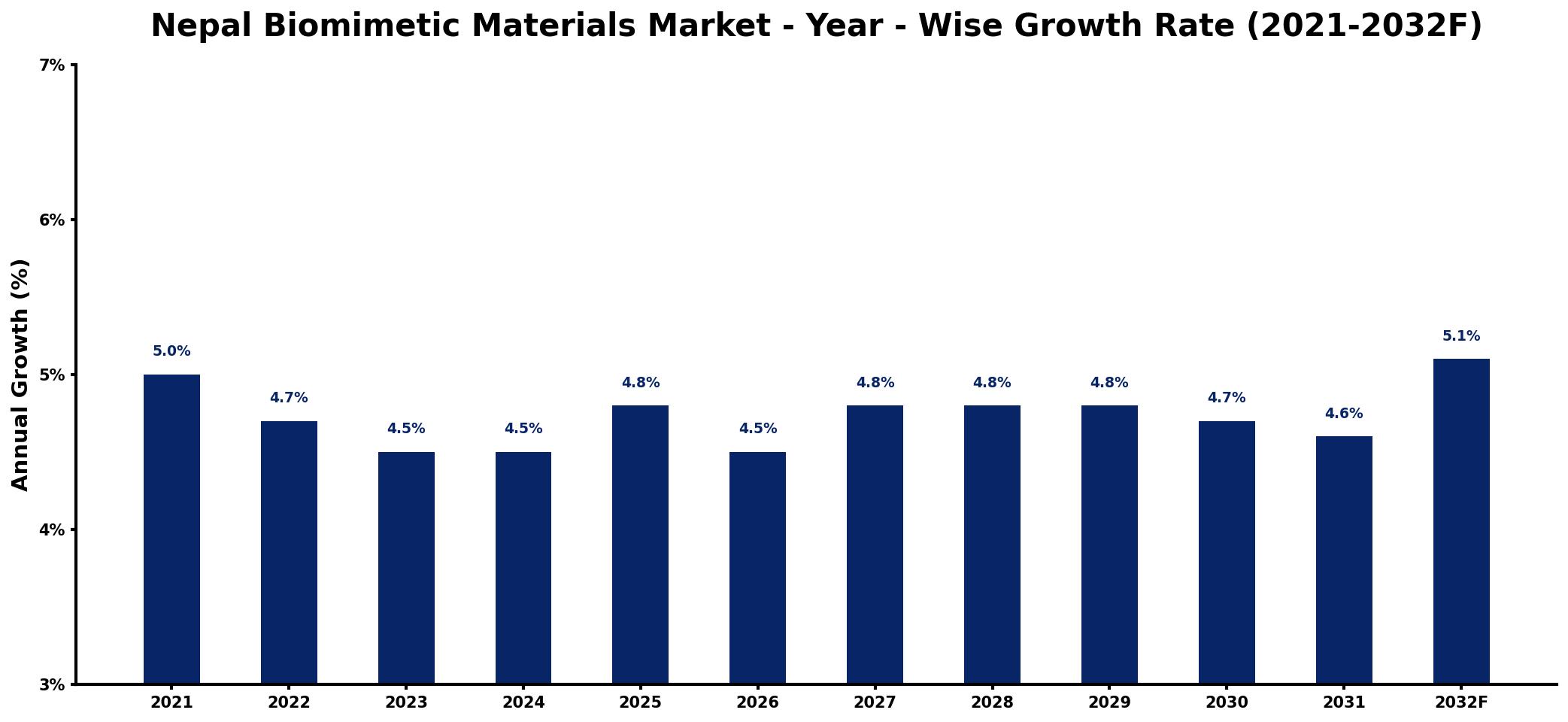
The table below presents the year‑wise growth rates along with the key drivers influencing the market
| Year | Growth Rate | Major Drivers |
| 2021 | 5.0% | Rising demand for sustainable solutions |
| 2022 | 4.7% | Increased investment in green technologies |
| 2023 | 4.5% | Growing interest in eco-friendly alternatives |
| 2024 | 4.5% | Expansion of renewable energy initiatives |
| 2025 | 4.8% | Surge in construction eco-certification projects |
| 2026 | 4.5% | increased capital investment inflows |
| 2027 | 4.8% | Advancements in environmental regulations compliance |
| 2028 | 4.8% | growing commercial sector adoption |
| 2029 | 4.8% | Growth in consumer awareness campaigns |
| 2030 | 4.7% | Increased collaboration among industries |
| 2031 | 4.6% | Emerging applications in healthcare sectors |
| 2032 | 5.1% | Strengthened partnerships for sustainable innovation |
Note: Market size estimations and growth projections presented in this report are based on 6Wresearch's proprietary forecasting methodology, utilizing the latest available industry data, government publications, and primary research inputs.
Nepal Biomimetic Materials Market Synopsis
The most significant force shaping the Nepal Biomimetic Materials Market is the increasing emphasis on sustainability. As global trends shift toward greener practices, local industries are adopting biomimetic solutions that align with eco-friendly standards, leading to widespread market adoption.
Moreover, ongoing research and development initiatives are catalyzing the emergence of novel biomimetic materials with enhanced properties. These innovations not only bolster performance but also cater to a growing consumer preference for materials that are both biodegradable and durable, thereby expanding their applications across various sectors.
Nepal Biomimetic Materials Market Key Takeaways
- The market is projected to grow steadily, reaching USD 332 Million by 2032.
- Sustainability initiatives are driving the demand for eco-friendly biomimetic solutions.
- Research and development are pivotal in creating innovative materials with superior characteristics.
- Consumer awareness regarding environmental impacts fosters greater adoption of biomimetic materials.
- Investment opportunities abound in sectors such as construction, healthcare, and packaging.
Evaluation of Restraints in Nepal Biomimetic Materials Market
Despite the promising outlook, the Nepal Biomimetic Materials Market faces significant restraints. A prevailing lack of awareness among consumers and businesses about the benefits and applications of these materials hinders their adoption. Additionally, limited research and development initiatives within Nepal restrict the creation of locally relevant biomimetic solutions. Infrastructure challenges, such as access to advanced technology and specialized expertise, further contribute to the market's slow growth. Targeted educational campaigns and strategic collaborations between research institutions and industries are essential to overcoming these obstacles.
Nepal Biomimetic Materials Market Trends
Current trends in the Nepal Biomimetic Materials Market are leaning heavily towards the incorporation of biodegradable materials, such as biomimetic polymers and fibers. Companies are increasingly focusing on innovative design concepts that are inspired by natural processes, which enhance the materials' performance while minimizing environmental impact. The growing recognition of biomimicry as a valuable design philosophy is driving research and development efforts, leading to a greater array of bio-inspired products in the market.
Nepal Biomimetic Materials Market Opportunities
The market presents numerous investment opportunities, particularly in research and development endeavors aimed at creating biomimetic materials that offer improved performance and durability. Sectors such as construction, healthcare, and packaging are actively seeking sustainable alternatives, making them ripe for innovation. Partnerships with research institutions and universities can also pave the way for groundbreaking advancements in biomimetic technology, leading to significant financial returns for early investors.
Government Initiatives in the Nepal Biomimetic Materials Market
The government of Nepal is fostering the growth of the Biomimetic Materials Market through a series of supportive policies aimed at promoting sustainable practices. There is a concerted effort to encourage research and development in biomimicry, positioning Nepal as a contender in the realm of sustainable technologies. Initiatives include incentives for startups and businesses working in the biomimetic sector, as well as collaborations with international organizations to bolster knowledge-sharing and capacity-building efforts.
Future Insights of the Nepal Biomimetic Materials Market
Looking forward to the 2026-2032 period, the Nepal Biomimetic Materials Market is set for significant growth. As consumer awareness of environmental issues continues to rise, the demand for sustainable and eco-friendly solutions will likely intensify. Government initiatives to promote green technologies will enhance market dynamics, while increasing investments in research and development will further facilitate the introduction of innovative biomimetic materials. This evolving landscape positions the market for steady expansion and lucrative opportunities.
Nepal Biomimetic Materials Market Latest Developments (2025 - 2026)
In recent months, the industry has seen a notable shift toward eco-centric product development, driven by both consumer demand and regulatory pressures for sustainability. Collaborative projects among research institutions are yielding promising advancements in biomimetic material applications. Moreover, several companies are ramping up their R&D efforts, exploring novel biomimetic solutions that align with global sustainability goals.
Nepal Biomimetic Materials Market - Key Attractiveness of the Report
- 10 Years of Market Numbers
- Historical Data Starting from 2022 to 2025
- Base Year: 2025
- Forecast Data until 2032
- Key Performance Indicators Impacting the Market
- Major Upcoming Developments and Projects
Key Highlights of the Report:
- Nepal Biomimetic Materials Market Outlook
- Market Size of Nepal Biomimetic Materials Market, 2025
- Forecast of Nepal Biomimetic Materials Market, 2032
- Historical Data and Forecast of Nepal Biomimetic Materials Revenues & Volume for the Period 2022-2032F
- Nepal Biomimetic Materials Market Trend Evolution
- Nepal Biomimetic Materials Market Drivers and Challenges
- Nepal Biomimetic Materials Price Trends
- Nepal Biomimetic Materials Porter's Five Forces
- Nepal Biomimetic Materials Industry Life Cycle
- Historical Data and Forecast of Nepal Biomimetic Materials Market Revenues & Volume By Material for the Period 2022-2032F
- Historical Data and Forecast of Nepal Biomimetic Materials Market Revenues & Volume By Biomimetic Polymers for the Period 2022-2032F
- Historical Data and Forecast of Nepal Biomimetic Materials Market Revenues & Volume By Biomimetic Ceramics & Glass for the Period 2022-2032F
- Historical Data and Forecast of Nepal Biomimetic Materials Market Revenues & Volume By Biomimetic Metals & Alloys for the Period 2022-2032F
- Historical Data and Forecast of Nepal Biomimetic Materials Market Revenues & Volume By Others for the Period 2022-2032F
- Historical Data and Forecast of Nepal Biomimetic Materials Market Revenues & Volume By Application for the Period 2022-2032F
- Historical Data and Forecast of Nepal Biomimetic Materials Market Revenues & Volume By Medical for the Period 2022-2032F
- Historical Data and Forecast of Nepal Biomimetic Materials Market Revenues & Volume By Automotive for the Period 2022-2032F
- Historical Data and Forecast of Nepal Biomimetic Materials Market Revenues & Volume By Defense for the Period 2022-2032F
- Historical Data and Forecast of Nepal Biomimetic Materials Market Revenues & Volume By Electronics for the Period 2022-2032F
- Historical Data and Forecast of Nepal Biomimetic Materials Market Revenues & Volume By Others for the Period 2022-2032F
- Nepal Biomimetic Materials Import Export Trade Statistics
- Market Opportunity Assessment By Material
- Market Opportunity Assessment By Application
- Nepal Biomimetic Materials Top Companies Market Share
- Nepal Biomimetic Materials Competitive Benchmarking By Technical and Operational Parameters
- Nepal Biomimetic Materials Company Profiles
- Nepal Biomimetic Materials Key Strategic Recommendations






































