Nepal Bulletproof Glass Market Size, Share & Growth Rate
The Nepal Bulletproof Glass Market was estimated at USD 480 Million in 2025 and is projected to reach USD 668 Million by 2032, growing at a CAGR of 4.8% from 2026 to 2032. This positive trajectory is fueled by heightened security concerns across multiple sectors, including banking, government, and residential properties. As organizations increasingly prioritize protective measures, the demand for advanced bulletproof glass solutions is set to expand significantly in the coming years.
Nepal Bulletproof Glass Market Year-wise Growth Rate and Key Drivers
This graph highlights how the Nepal Bulletproof Glass Market has steadily grown over the years, supported by major growth factors.
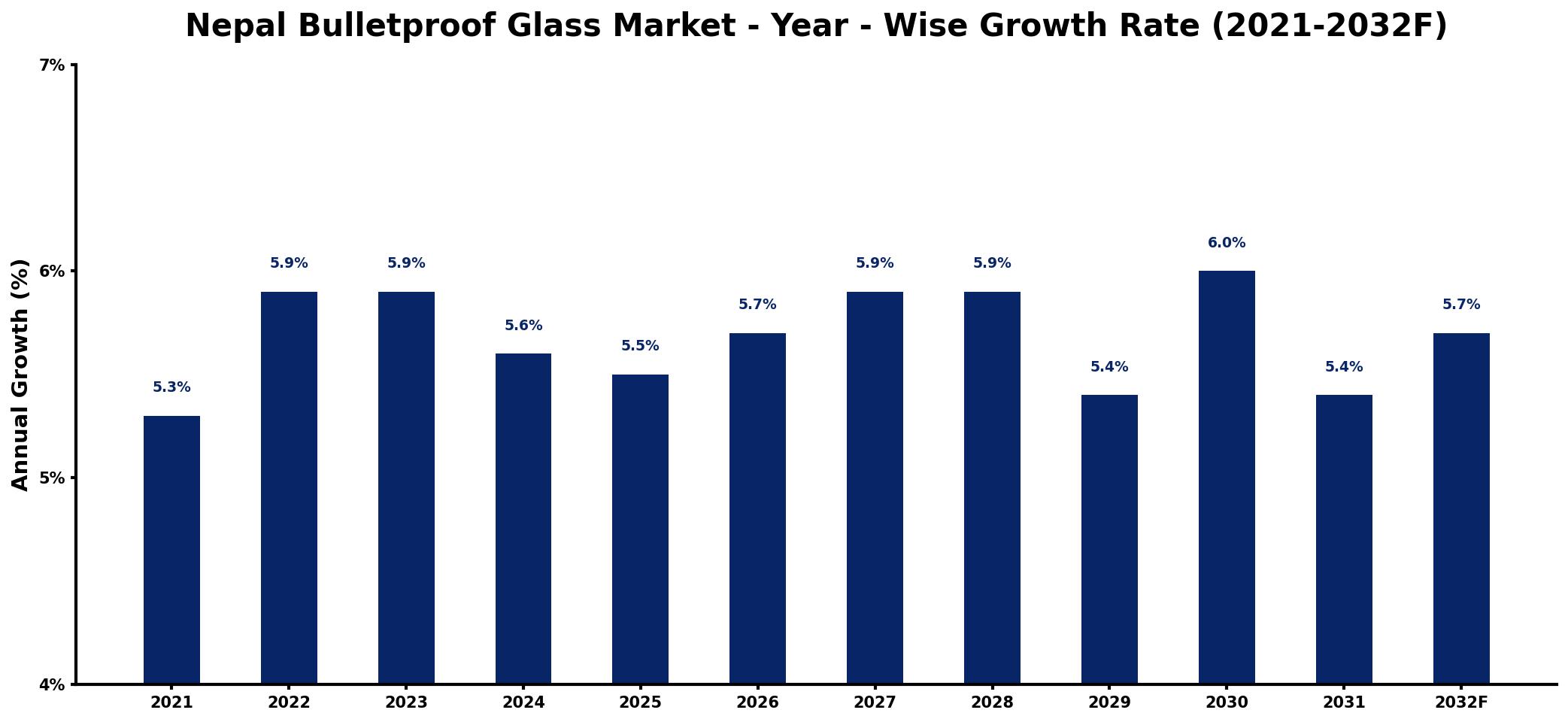
The table below presents the year‑wise growth rates along with the key drivers influencing the market
| Year | Growth Rate | Major Drivers |
| 2021 | 5.3% | Rising security concerns drive demand |
| 2022 | 5.9% | Increased investment in safety infrastructure |
| 2023 | 5.9% | Growing awareness of personal protection |
| 2024 | 5.6% | Expansion of commercial security applications |
| 2025 | 5.5% | Higher construction standards for safety |
| 2026 | 5.7% | Government initiatives for public safety |
| 2027 | 5.9% | Surge in automotive safety regulations |
| 2028 | 5.9% | Emergence of new security technologies |
| 2029 | 5.4% | Growing urbanization and infrastructure projects |
| 2030 | 6.0% | Increasing insurance requirements for safety |
| 2031 | 5.4% | Heightened demand for residential security |
| 2032 | 5.7% | increased production capacity utilization |
Note: Market size estimations and growth projections presented in this report are based on 6Wresearch's proprietary forecasting methodology, utilizing the latest available industry data, government publications, and primary research inputs.
Nepal Bulletproof Glass Market Synopsis
The strongest force currently shaping the Nepal Bulletproof Glass Market is the growing awareness of safety among businesses and individuals. In an environment where high-profile events and increasing crime rates are becoming more prevalent, there is an urgent need for enhanced security solutions.
Additionally, government initiatives to boost security infrastructure play a crucial role in driving market growth. Such policies not only mandate the use of certified bulletproof glass in sensitive areas but also encourage local manufacturing, reducing reliance on imports and supporting the domestic economy.
Nepal Bulletproof Glass Market Key Takeaways
- The market is projected to reach USD 668 Million by 2032, emphasizing strong growth potential.
- Growing security concerns across various sectors are a primary driver of market demand.
- Investment opportunities abound in the construction sector as it continues to expand.
- Government initiatives are promoting local manufacturing and enhancing safety standards.
- Technological innovations are paving the way for customized, lightweight, and energy-efficient products.
Evaluation of Restraints in Nepal Bulletproof Glass Market
Despite the growth potential, several restraints hinder the market's expansion. A significant challenge lies in the high costs associated with bulletproof glass installation, making it a less accessible option for many potential customers. Furthermore, limited awareness regarding the various types of bulletproof glass and their benefits may stifle market growth. The absence of standard regulations tailored to the Nepali context raises concerns about product quality and performance. Import restrictions and high tariffs on bulletproof glass can also impede the market's development, making it essential to address these issues through educational initiatives and regulatory improvements.
Nepal Bulletproof Glass Market Trends
Current trends indicate a shift towards advanced technologies in bulletproof glass production, with an increasing preference for products that balance security with aesthetic appeal. There's a notable rise in demand for customized solutions tailored to specific client needs, especially in high-end residential projects. Moreover, the market is observing an upsurge in the adoption of lightweight and transparent bulletproof glass, which aligns with contemporary architectural preferences, thereby promoting broader application across various building designs.
Nepal Bulletproof Glass Market Opportunities
Significant investment opportunities exist in the Nepal Bulletproof Glass Market, especially as the construction industry continues to flourish. The increasing focus on security solutions across various sectors creates a robust demand for high-quality bulletproof glass. Collaborations with local manufacturers or the establishment of partnerships can further enhance market entry and product availability. By offering innovative and cost-effective solutions tailored to the unique requirements of the Nepali market, stakeholders can capitalize on the increasing urgency surrounding safety and security.
Government Initiatives in the Nepal Bulletproof Glass Market
Government policies play a pivotal role in shaping the Nepal Bulletproof Glass Market. Initiatives designed to enhance security in high-risk areas, such as government facilities and financial institutions, mandate the use of certified bulletproof glass products. Efforts to stimulate local manufacturing are also in place, aimed at reducing import dependency and bolstering the domestic economy. Furthermore, government subsidies and incentives are offered to encourage businesses to invest in bulletproof glass technology, creating a supportive environment for market growth.
Future Insights of the Nepal Bulletproof Glass Market
The future of the Nepal Bulletproof Glass Market appears promising, with anticipated growth driven by escalating security demands across government and financial sectors, as well as residential areas. As crime prevention becomes increasingly critical, the demand for bulletproof glass is expected to rise dramatically. Technological advancements leading to lighter, more transparent solutions will likely stimulate market growth further. With ongoing infrastructure development in Nepal, the market for bulletproof glass is poised to expand, offering lucrative opportunities for stakeholders in the sector.
Nepal Bulletproof Glass Market Latest Developments (2025 - 2026)
Recent developments in the Nepal Bulletproof Glass Market reveal a growing emphasis on product innovation, with manufacturers exploring new materials and technologies to enhance safety features. There has been an increased focus on sustainability and energy efficiency in product design, catering to the preferences of environmentally-conscious consumers. Additionally, collaborations between local and international manufacturers are emerging, fostering advancements in quality and manufacturing standards.
Nepal Bulletproof Glass Market - Key Attractiveness of the Report
- 10 Years of Market Numbers
- Historical Data Starting from 2022 to 2025
- Base Year: 2025
- Forecast Data until 2032
- Key Performance Indicators Impacting the Market
- Major Upcoming Developments and Projects
Key Highlights of the Report:
- Nepal Bulletproof Glass Market Outlook
- Market Size of Nepal Bulletproof Glass Market, 2025
- Forecast of Nepal Bulletproof Glass Market, 2032
- Historical Data and Forecast of Nepal Bulletproof Glass Revenues & Volume for the Period 2022-2032F
- Nepal Bulletproof Glass Market Trend Evolution
- Nepal Bulletproof Glass Market Drivers and Challenges
- Nepal Bulletproof Glass Price Trends
- Nepal Bulletproof Glass Porter's Five Forces
- Nepal Bulletproof Glass Industry Life Cycle
- Historical Data and Forecast of Nepal Bulletproof Glass Market Revenues & Volume By Type for the Period 2022-2032F
- Historical Data and Forecast of Nepal Bulletproof Glass Market Revenues & Volume By Solid Acrylic for the Period 2022-2032F
- Historical Data and Forecast of Nepal Bulletproof Glass Market Revenues & Volume By Traditional Laminated for the Period 2022-2032F
- Historical Data and Forecast of Nepal Bulletproof Glass Market Revenues & Volume By Polycarbonate for the Period 2022-2032F
- Historical Data and Forecast of Nepal Bulletproof Glass Market Revenues & Volume By Glass-clad Polycarbonate for the Period 2022-2032F
- Historical Data and Forecast of Nepal Bulletproof Glass Market Revenues & Volume By Other Types for the Period 2022-2032F
- Historical Data and Forecast of Nepal Bulletproof Glass Market Revenues & Volume By End-user Industry for the Period 2022-2032F
- Historical Data and Forecast of Nepal Bulletproof Glass Market Revenues & Volume By Automotive for the Period 2022-2032F
- Historical Data and Forecast of Nepal Bulletproof Glass Market Revenues & Volume By Buildings and Construction for the Period 2022-2032F
- Historical Data and Forecast of Nepal Bulletproof Glass Market Revenues & Volume By Defense for the Period 2022-2032F
- Historical Data and Forecast of Nepal Bulletproof Glass Market Revenues & Volume By Other End-user Industries for the Period 2022-2032F
- Nepal Bulletproof Glass Import Export Trade Statistics
- Market Opportunity Assessment By Type
- Market Opportunity Assessment By End-user Industry
- Nepal Bulletproof Glass Top Companies Market Share
- Nepal Bulletproof Glass Competitive Benchmarking By Technical and Operational Parameters
- Nepal Bulletproof Glass Company Profiles
- Nepal Bulletproof Glass Key Strategic Recommendations






































