Nepal Car Air Fresheners Market Size, Share & Growth Rate
The Nepal Car Air Fresheners Market was estimated at USD 1223 Million in 2025 and is projected to reach USD 2238 Million by 2032, growing at a CAGR of 9.0% from 2026 to 2032. This upward trajectory is primarily driven by the rising rate of car ownership in Nepal, coupled with an increasing consumer focus on maintaining a fresh interior environment. As urbanization progresses, consumers are not only looking for functional products but also for those that enhance their driving experience.
Nepal Car Air Fresheners Market Year-wise Growth Rate and Key Drivers
This graph highlights how the Nepal Car Air Fresheners Market has steadily grown over the years, supported by major growth factors.
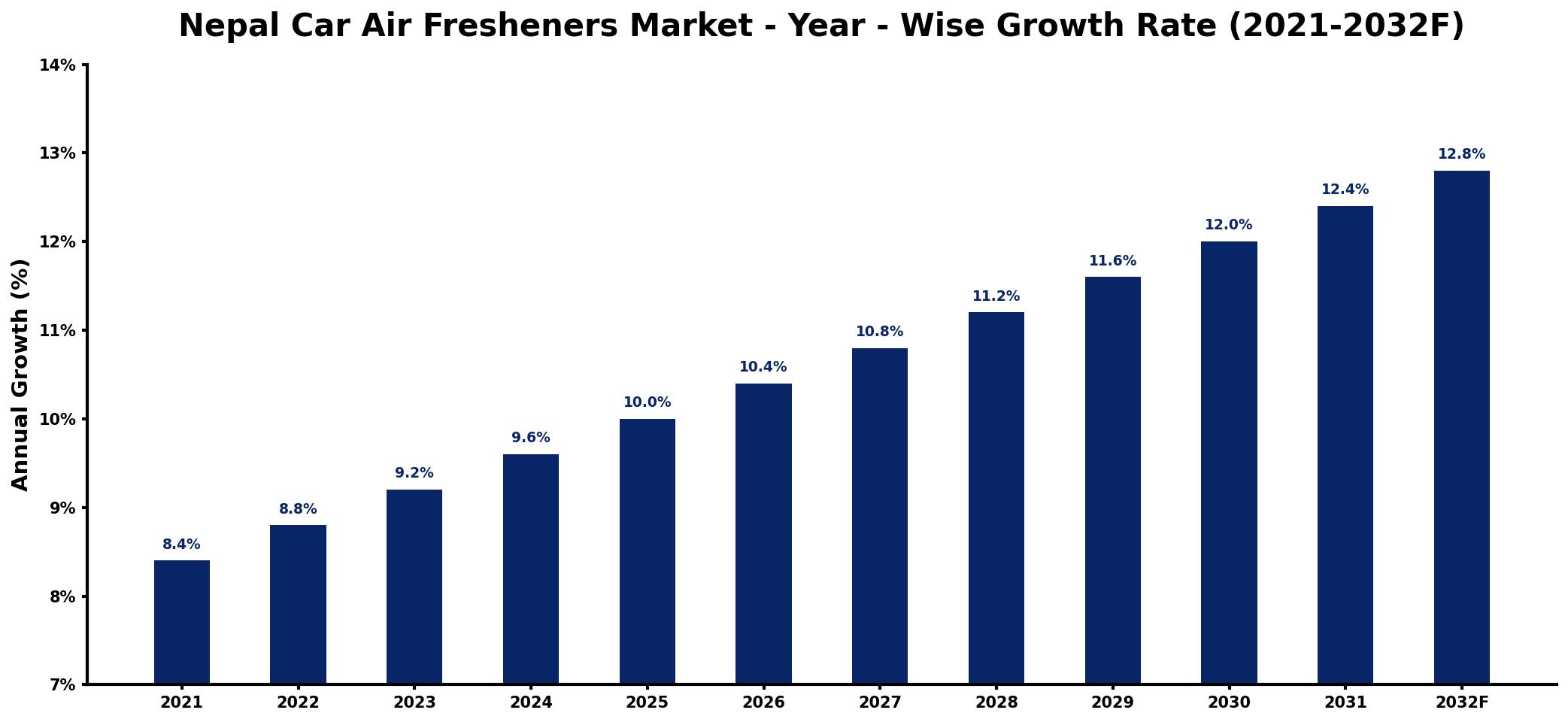
The table below presents the year‑wise growth rates along with the key drivers influencing the market
| Year | Growth Rate | Major Drivers |
| 2021 | 8.4% | Growing preference for ambiance enhancement |
| 2022 | 8.8% | Increase in disposable income levels |
| 2023 | 9.2% | Rising consumer health consciousness |
| 2024 | 9.6% | Expansion of retail distribution networks |
| 2025 | 10.0% | Surge in tourism and travel |
| 2026 | 10.4% | Growing trend of personalized products |
| 2027 | 10.8% | rising export shipment volumes |
| 2028 | 11.2% | Boost in eco-friendly product demand |
| 2029 | 11.6% | Rise in vehicle ownership rates |
| 2030 | 12.0% | growing commercial sector adoption |
| 2031 | 12.4% | Growth in urban population density |
| 2032 | 12.8% | growing downstream application demand |
Note: Market size estimations and growth projections presented in this report are based on 6Wresearch's proprietary forecasting methodology, utilizing the latest available industry data, government publications, and primary research inputs.
Nepal Car Air Fresheners Market Synopsis
The Nepal Car Air Fresheners market has recently gained momentum, reflecting a significant shift in consumer preferences toward maintaining a pleasant in-car atmosphere. With more individuals embracing the idea of vehicle hygiene and aesthetics, the market's future appears promising as it adapts to evolving consumer demands.
Looking ahead, the market is expected to expand as manufacturers introduce innovative and eco-friendly air freshener options. This evolution aligns with the growing consumer awareness regarding sustainability, which is reshaping product offerings and marketing strategies within the sector.
Nepal Car Air Fresheners Market Key Takeaways
- The market is witnessing a shift towards sustainable and eco-friendly air fresheners, catering to environmentally conscious consumers.
- Customizable and visually appealing air fresheners are gaining popularity as consumers seek to reflect their personal style.
- Rising disposable income levels are enhancing the purchasing power of consumers, further propelling market growth.
- Distribution through online platforms is expanding, allowing for greater accessibility to a diverse range of products.
- The presence of counterfeit products poses challenges for market growth and consumer trust.
Evaluation of Restraints in Nepal Car Air Fresheners Market
Despite the promising growth trajectory, several factors are inhibiting the full potential of the Nepal Car Air Fresheners Market. A major concern is the intense competition posed by international brands, which may overshadow local offerings. Additionally, many consumers lack awareness about the benefits of using car air fresheners, leading to a slower adoption rate. The presence of counterfeit products further complicates market dynamics, potentially eroding consumer trust and affecting brand loyalty. Furthermore, economic fluctuations can influence discretionary spending, impacting sales in the segment.
Nepal Car Air Fresheners Market Trends
The current trend within the Nepal car air fresheners market is significantly leaning toward eco-conscious products. With increasing awareness about environmental issues, consumers are gravitating towards air fresheners made from organic and natural ingredients, such as essential oils. Additionally, customization is becoming a key trend, as buyers seek unique fragrances and designs that resonate with their personal aesthetics. Innovations in packaging and product presentation are also driving consumer interest, adding to the competitive landscape.
Nepal Car Air Fresheners Market Opportunities
Investment opportunities abound in the Nepal Car Air Fresheners Market, particularly as the demand for high-quality and innovative products continues to surge. The growing focus on vehicle hygiene and aesthetics presents a lucrative avenue for manufacturers to introduce unique offerings. Moreover, as urbanization leads to higher rates of car ownership, theres an opportunity for new entrants to capture a share of a relatively underdeveloped market. This environment fosters the potential for diverse product development, especially in eco-friendly and customizable air fresheners.
Government Initiatives in the Nepal Car Air Fresheners Market
The Nepalese government has implemented regulations to ensure that car air fresheners meet safety and quality standards. The Department of Drug Administration (DDA) oversees the registration and approval processes, aiming to safeguard public health by monitoring the use of harmful chemicals in these products. Compliance with these regulations is essential for manufacturers, as it ensures not only consumer safety but also fosters a healthier market environment. Labeling requirements are also in place to inform consumers about the ingredients and proper usage of air fresheners.
Future Insights of the Nepal Car Air Fresheners Market
As we look towards 2026-2032, the Nepal Car Air Fresheners Market is poised for steady growth driven by an increase in vehicle numbers and heightened consumer awareness regarding interior vehicle upkeep. With disposable incomes rising, consumers are likely to invest in products that enhance their driving experience. The introduction of innovative air freshener products, coupled with aggressive marketing efforts, will further spur market expansion. As personalization and eco-friendliness become pivotal for buyers, brands that adapt swiftly to these preferences will thrive.
Nepal Car Air Fresheners Market Latest Developments (2025 - 2026)
Recently, the market has seen a notable shift towards the introduction of innovative air freshener products featuring eco-friendly formulations. There has been a marked increase in the marketing emphasis on sustainability, as brands aim to align with consumer expectations regarding environmental responsibility. Additionally, various players are exploring digital channels to enhance their visibility and accessibility among tech-savvy consumers, broadening their market reach in the process.
Nepal Car Air Fresheners Market - Key Attractiveness of the Report
- 10 Years of Market Numbers
- Historical Data Starting from 2022 to 2025
- Base Year: 2025
- Forecast Data until 2032
- Key Performance Indicators Impacting the Market
- Major Upcoming Developments and Projects
Key Highlights of the Report:
- Nepal Car Air Fresheners Market Outlook
- Market Size of Nepal Car Air Fresheners Market, 2025
- Forecast of Nepal Car Air Fresheners Market, 2032
- Historical Data and Forecast of Nepal Car Air Fresheners Revenues & Volume for the Period 2022-2032F
- Nepal Car Air Fresheners Market Trend Evolution
- Nepal Car Air Fresheners Market Drivers and Challenges
- Nepal Car Air Fresheners Price Trends
- Nepal Car Air Fresheners Porter's Five Forces
- Nepal Car Air Fresheners Industry Life Cycle
- Historical Data and Forecast of Nepal Car Air Fresheners Market Revenues & Volume By Product for the Period 2022-2032F
- Historical Data and Forecast of Nepal Car Air Fresheners Market Revenues & Volume By Gel & Cans for the Period 2022-2032F
- Historical Data and Forecast of Nepal Car Air Fresheners Market Revenues & Volume By Spray/Aerosol for the Period 2022-2032F
- Historical Data and Forecast of Nepal Car Air Fresheners Market Revenues & Volume By Paper Car Air Fresheners for the Period 2022-2032F
- Historical Data and Forecast of Nepal Car Air Fresheners Market Revenues & Volume By Vents & Clips for the Period 2022-2032F
- Historical Data and Forecast of Nepal Car Air Fresheners Market Revenues & Volume By End-User for the Period 2022-2032F
- Historical Data and Forecast of Nepal Car Air Fresheners Market Revenues & Volume By Sports Car for the Period 2022-2032F
- Historical Data and Forecast of Nepal Car Air Fresheners Market Revenues & Volume By Mid-range Car for the Period 2022-2032F
- Historical Data and Forecast of Nepal Car Air Fresheners Market Revenues & Volume By SUV for the Period 2022-2032F
- Historical Data and Forecast of Nepal Car Air Fresheners Market Revenues & Volume By Others for the Period 2022-2032F
- Historical Data and Forecast of Nepal Car Air Fresheners Market Revenues & Volume By Fragrance for the Period 2022-2032F
- Historical Data and Forecast of Nepal Car Air Fresheners Market Revenues & Volume By Scented for the Period 2022-2032F
- Historical Data and Forecast of Nepal Car Air Fresheners Market Revenues & Volume By UnScented for the Period 2022-2032F
- Nepal Car Air Fresheners Import Export Trade Statistics
- Market Opportunity Assessment By Product
- Market Opportunity Assessment By End-User
- Market Opportunity Assessment By Fragrance
- Nepal Car Air Fresheners Top Companies Market Share
- Nepal Car Air Fresheners Competitive Benchmarking By Technical and Operational Parameters
- Nepal Car Air Fresheners Company Profiles
- Nepal Car Air Fresheners Key Strategic Recommendations






































