Nepal Cellulose Acetate Fiber Market Size, Share & Growth Rate
The Nepal Cellulose Acetate Fiber Market was estimated at USD 1140 Million in 2025 and is projected to reach USD 1651 Million by 2032, growing at a CAGR of 5.4% from 2026 to 2032. This upward trajectory is primarily fueled by the rising consumer demand for sustainable textiles and eco-friendly products, as well as the growing recognition of cellulose acetate fibers' biodegradability and renewable sourcing. As Nepal's textile industry increasingly adopts greener practices, the market is likely to see robust investment and innovation to meet the evolving preferences of environmentally conscious consumers.
Nepal Cellulose Acetate Fiber Market Year-wise Growth Rate and Key Drivers
This graph highlights how the Nepal Cellulose Acetate Fiber Market has steadily grown over the years, supported by major growth factors.
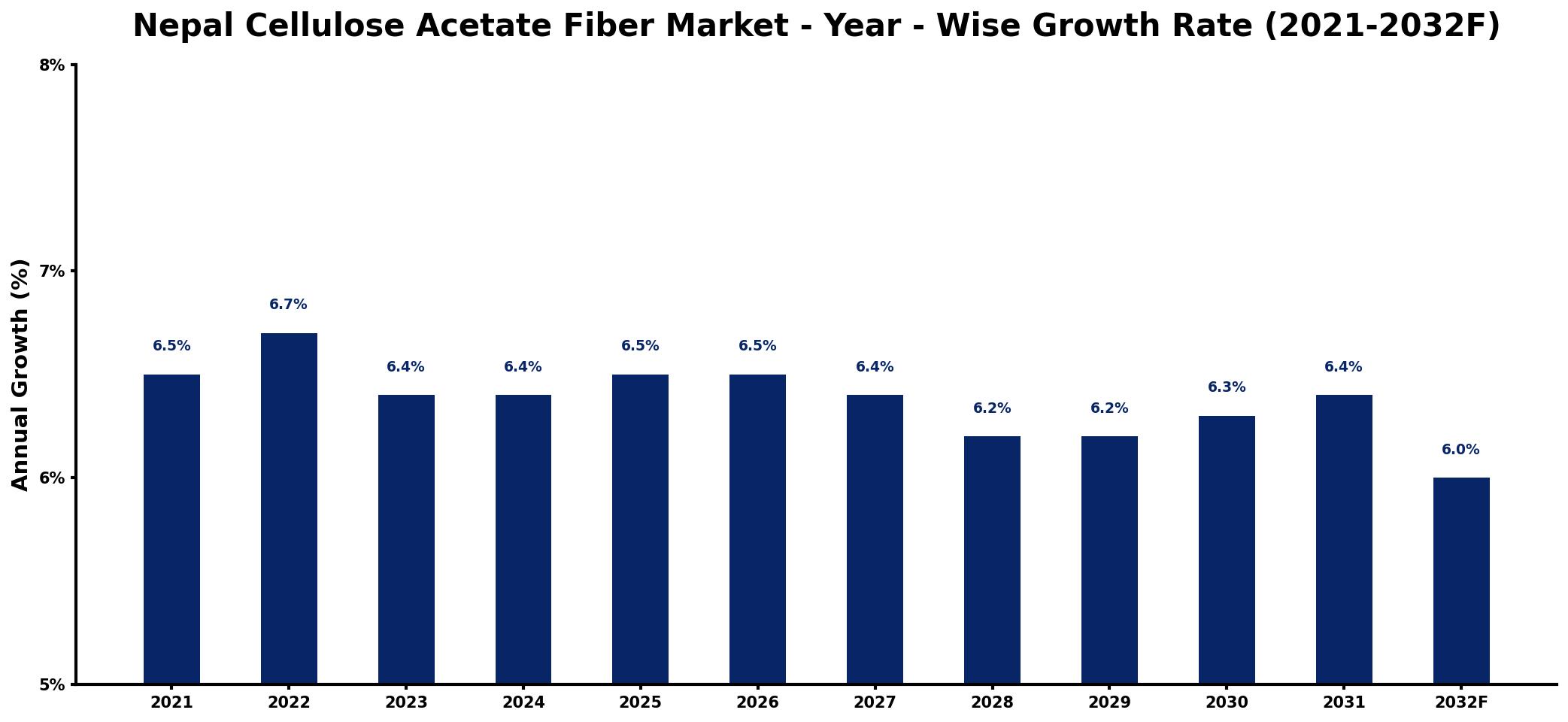
The table below presents the year‑wise growth rates along with the key drivers influencing the market
| Year | Growth Rate | Major Drivers |
| 2021 | 6.5% | Rising textile manufacturing capacity |
| 2022 | 6.7% | Increased demand from fashion industry |
| 2023 | 6.4% | Growing eco-friendly product initiatives |
| 2024 | 6.4% | Expansion of local production facilities |
| 2025 | 6.5% | Higher investment in sustainability technologies |
| 2026 | 6.5% | Strengthening export markets for textiles |
| 2027 | 6.4% | Surge in online retail platforms |
| 2028 | 6.2% | Growing awareness of sustainable materials |
| 2029 | 6.2% | Increase in government support policies |
| 2030 | 6.3% | Emergence of innovative product applications |
| 2031 | 6.4% | Rising consumer preference for alternatives |
| 2032 | 6.0% | Developments in biodegradable product offerings |
Note: Market size estimations and growth projections presented in this report are based on 6Wresearch's proprietary forecasting methodology, utilizing the latest available industry data, government publications, and primary research inputs.
Nepal Cellulose Acetate Fiber Market Synopsis
In recent years, there has been a notable shift towards sustainable textile practices in Nepal, leading to a rising demand for cellulose acetate fibers. These fibers, derived from natural sources like wood pulp, are becoming popular in various applications, including apparel and home textiles, as consumers prioritize eco-friendliness.
The local textile industry is responding to this demand by enhancing its production capabilities and exploring innovative manufacturing techniques. This not only improves the quality of cellulose acetate fibers but also encourages greater adoption across multiple sectors, which positions the market for further expansion in the coming years.
Nepal Cellulose Acetate Fiber Market Key Takeaways
- The market is driven by increasing consumer awareness regarding sustainable textiles.
- Cellulose acetate fibers are gaining traction due to their biodegradability and soft texture.
- Collaborations between manufacturers and research institutions are boosting product innovation.
- The Nepalese government is actively promoting policies favorable to the textile sector.
- Investment opportunities are ripe due to the emphasis on eco-friendly practices and products.
Evaluation of Restraints in Nepal Cellulose Acetate Fiber Market
Despite its growth potential, the Nepal Cellulose Acetate Fiber market faces several challenges that could hinder its progress. One of the primary constraints is the limited understanding among consumers regarding the advantages of cellulose acetate fibers, which impacts demand. Additionally, the industrys dependence on imported raw materials for production can lead to supply chain vulnerabilities, particularly in times of economic fluctuation or geopolitical instability. Furthermore, existing technological gaps and infrastructure deficiencies could delay efficient production processes, posing significant obstacles to market advancement.
Nepal Cellulose Acetate Fiber Market Trends
Current trends indicate a marked increase in consumer demand for eco-friendly alternatives in textiles, further driving the adoption of cellulose acetate fibers. Innovations in manufacturing processes are enabling improvements in fiber quality and performance, thus expanding their application potential. Additionally, the rise of sustainable fashion movements is encouraging brands to incorporate cellulose acetate fibers, paving the way for enhanced market visibility and consumer acceptance.
Nepal Cellulose Acetate Fiber Market Opportunities
The Nepal Cellulose Acetate Fiber market presents lucrative investment opportunities as the demand for sustainable materials continues to rise. Investors can explore partnerships with local manufacturers to enhance production capabilities or develop new product lines utilizing cellulose acetate fibers. The government's support of the textile industry, including financial incentives and research grants, further strengthens the case for investments in this sector. As sustainability becomes a cornerstone of consumer preferences, aligning with this trend could yield significant returns.
Government Initiatives in the Nepal Cellulose Acetate Fiber Market
The Nepalese government has implemented several initiatives to bolster the cellulose acetate fiber market, including financial incentives aimed at attracting investments and fostering growth in the textile sector. Additionally, there is a strong emphasis on promoting research and development activities to enhance product quality and sustainability practices. These policies are designed to create a favorable regulatory environment, encouraging manufacturers to adopt eco-friendly production techniques and comply with international standards.
Future Insights of the Nepal Cellulose Acetate Fiber Market
Looking ahead to the 2026-2032 period, the Nepal Cellulose Acetate Fiber market is anticipated to expand significantly as sustainability takes center stage in the global textile industry. The growing preference for biodegradable and natural materials will likely drive consumer behavior, while technological advancements in production are expected to enhance product offerings. With supportive government initiatives and a burgeoning textile sector, the market is well-positioned for sustained growth in the upcoming years.
Nepal Cellulose Acetate Fiber Market Latest Developments (2025 - 2026)
In the past year, the Nepal Cellulose Acetate Fiber market has seen a surge in initiatives aimed at increasing production efficiency and sustainability. Manufacturers have begun to prioritize eco-friendly practices and invest in innovative technologies that enhance fiber quality. Additionally, collaborations between industry players and research institutions have intensified, focusing on developing new applications and improving the overall sustainability of textile production processes.
Nepal Cellulose Acetate Fiber Market - Key Attractiveness of the Report
- 10 Years of Market Numbers
- Historical Data Starting from 2022 to 2025
- Base Year: 2025
- Forecast Data until 2032
- Key Performance Indicators Impacting the Market
- Major Upcoming Developments and Projects
Key Highlights of the Report:
- Nepal Cellulose Acetate Fiber Market Outlook
- Market Size of Nepal Cellulose Acetate Fiber Market, 2025
- Forecast of Nepal Cellulose Acetate Fiber Market, 2032
- Historical Data and Forecast of Nepal Cellulose Acetate Fiber Revenues & Volume for the Period 2022-2032F
- Nepal Cellulose Acetate Fiber Market Trend Evolution
- Nepal Cellulose Acetate Fiber Market Drivers and Challenges
- Nepal Cellulose Acetate Fiber Price Trends
- Nepal Cellulose Acetate Fiber Porter's Five Forces
- Nepal Cellulose Acetate Fiber Industry Life Cycle
- Historical Data and Forecast of Nepal Cellulose Acetate Fiber Market Revenues & Volume By Type for the Period 2022-2032F
- Historical Data and Forecast of Nepal Cellulose Acetate Fiber Market Revenues & Volume By Plastic for the Period 2022-2032F
- Historical Data and Forecast of Nepal Cellulose Acetate Fiber Market Revenues & Volume By Fiber for the Period 2022-2032F
- Historical Data and Forecast of Nepal Cellulose Acetate Fiber Market Revenues & Volume By Application for the Period 2022-2032F
- Historical Data and Forecast of Nepal Cellulose Acetate Fiber Market Revenues & Volume By Photographic Films for the Period 2022-2032F
- Historical Data and Forecast of Nepal Cellulose Acetate Fiber Market Revenues & Volume By Cigarette Filters for the Period 2022-2032F
- Historical Data and Forecast of Nepal Cellulose Acetate Fiber Market Revenues & Volume By Tapes & Labels for the Period 2022-2032F
- Historical Data and Forecast of Nepal Cellulose Acetate Fiber Market Revenues & Volume By Textiles & Apparel for the Period 2022-2032F
- Nepal Cellulose Acetate Fiber Import Export Trade Statistics
- Market Opportunity Assessment By Type
- Market Opportunity Assessment By Application
- Nepal Cellulose Acetate Fiber Top Companies Market Share
- Nepal Cellulose Acetate Fiber Competitive Benchmarking By Technical and Operational Parameters
- Nepal Cellulose Acetate Fiber Company Profiles
- Nepal Cellulose Acetate Fiber Key Strategic Recommendations






































