Nepal Cellulose Fiber Market Size Growth Rate
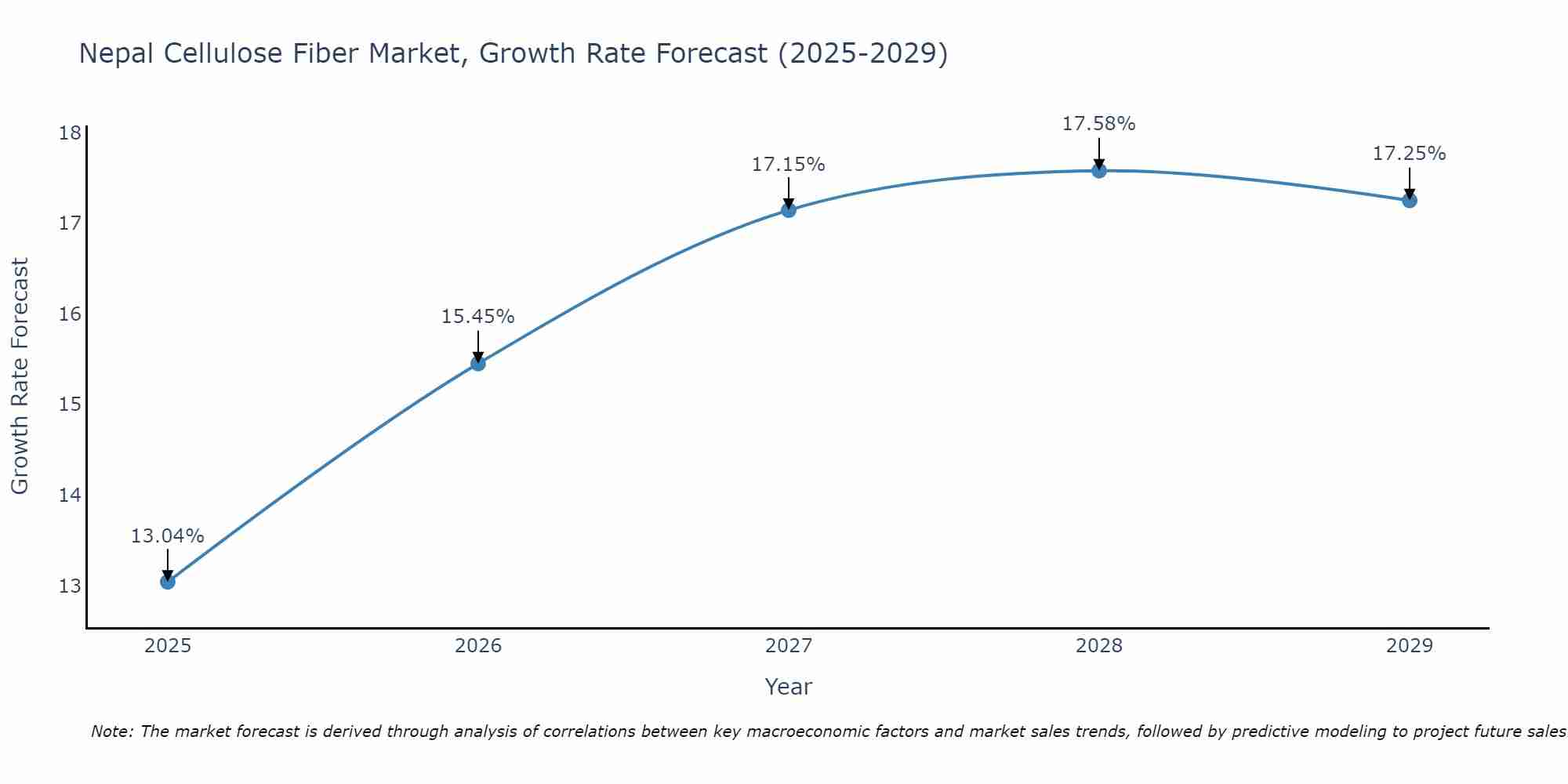
The Nepal Cellulose Fiber Market is projected to witness mixed growth rate patterns during 2025 to 2029. The growth rate begins at 13.04% in 2025, climbs to a high of 17.58% in 2028, and moderates to 17.25% by 2029.
Cellulose Fiber Market: Nepal vs Top 5 Major Economies in 2027 (Asia)
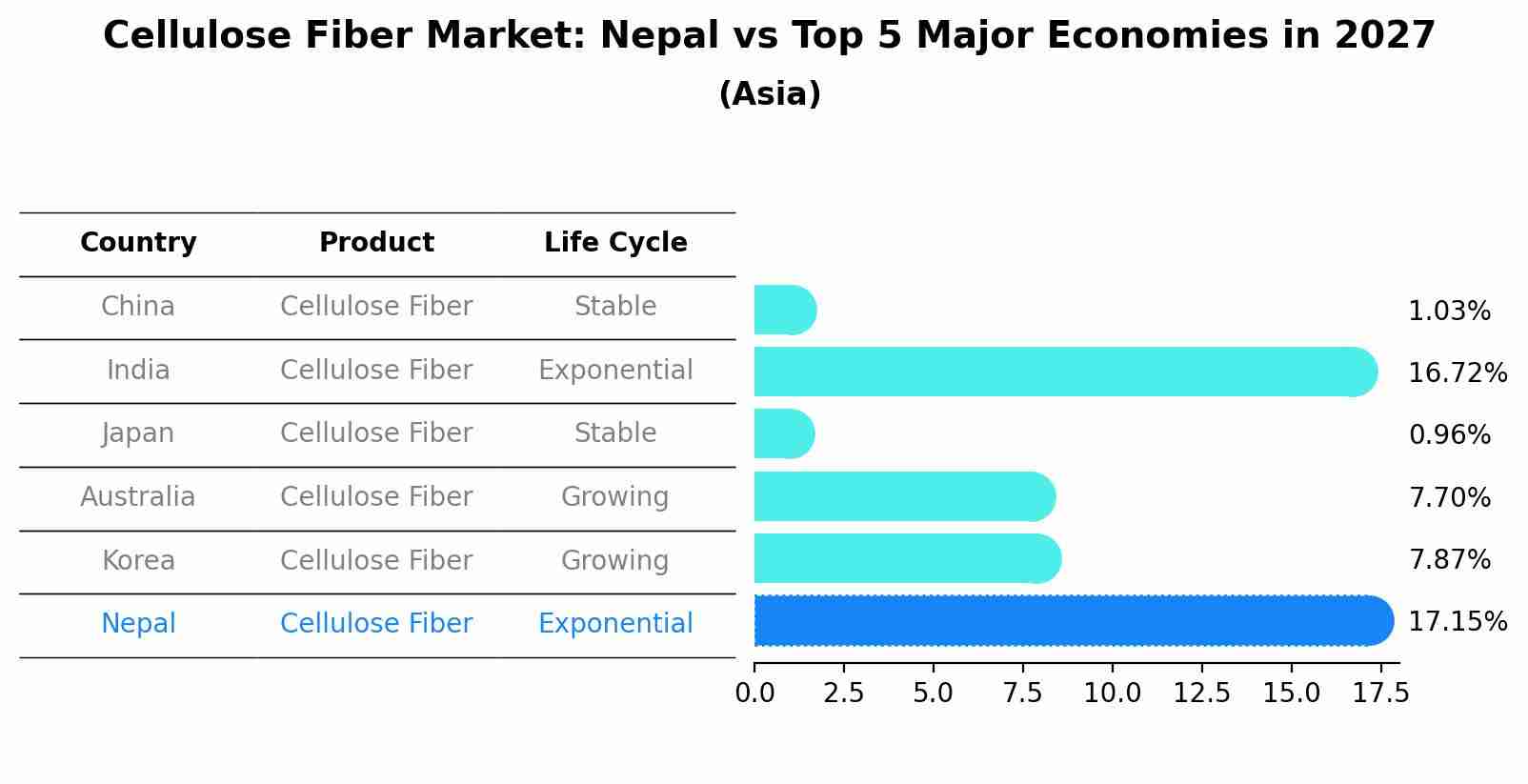
In the Asia region, the Cellulose Fiber market in Nepal is projected to expand at a exponential growth rate of 17.15% by 2027. The largest economy is China, followed by India, Japan, Australia and South Korea.
Nepal Cellulose Fiber Market Overview
The Nepal cellulose fiber market is experiencing steady growth due to the increasing demand for sustainable and eco-friendly materials in various industries such as textiles, pharmaceuticals, and cosmetics. The market is primarily driven by the rising awareness among consumers about the environmental impact of traditional synthetic fibers. Additionally, the government`s initiatives to promote sustainable practices and the presence of key players investing in research and development activities are contributing to the market`s expansion. However, challenges such as limited availability of raw materials and high production costs are hindering the market growth. Overall, the Nepal cellulose fiber market is poised for further development as manufacturers focus on innovation and sustainability to meet the growing demand for natural fibers.
Nepal Cellulose Fiber Market Trends
Currently, the Nepal Cellulose Fiber Market is experiencing a growing demand for sustainable and eco-friendly fiber alternatives. Consumers are becoming more conscious of the environmental impact of their purchases, leading to a shift towards cellulose fibers derived from renewable sources such as bamboo, cotton, and wood pulp. This trend is driving manufacturers in Nepal to explore sustainable practices and invest in innovative technologies for producing cellulose fibers with minimal impact on the environment. Additionally, the increasing emphasis on the comfort, breathability, and moisture-wicking properties of cellulose fibers is influencing product development in the textile industry. Overall, the Nepal Cellulose Fiber Market is witnessing a move towards sustainability and performance-driven products to meet the evolving needs of environmentally conscious consumers.
Nepal Cellulose Fiber Market Challenges
In the Nepal Cellulose Fiber Market, some key challenges include limited technological advancements in processing methods, inconsistent quality of raw materials due to reliance on traditional farming practices, and inadequate infrastructure for efficient supply chain management. Additionally, the industry faces competition from synthetic fibers and imported cellulose fibers, which can hinder the growth and market penetration of local producers. Furthermore, there is a lack of awareness and promotion of Nepali cellulose fibers in international markets, limiting export opportunities. Overcoming these challenges will require investments in research and development, modernization of manufacturing processes, improvements in quality control measures, and effective marketing strategies to enhance the competitiveness and sustainability of the Nepal Cellulose Fiber Market.
Nepal Cellulose Fiber Market Investment Opportunities
The Nepal Cellulose Fiber Market presents promising investment opportunities due to the increasing demand for eco-friendly and sustainable textile materials. With a growing awareness of environmental issues, consumers are seeking alternatives to traditional synthetic fibers, creating a niche market for cellulose fibers derived from sources such as bamboo, cotton, and wood pulp. Investing in the production and supply chain of cellulose fibers in Nepal can capitalize on this trend, especially considering the country`s abundant natural resources and skilled labor force. Additionally, the government`s initiatives to promote sustainable practices and the textile industry`s shift towards green manufacturing further support the growth potential of the cellulose fiber market in Nepal, making it an attractive investment prospect for forward-thinking investors.
Nepal Cellulose Fiber Market Government Policy
The government of Nepal has implemented various policies to support the growth of the cellulose fiber market in the country. These policies include providing financial incentives and subsidies to encourage investment in the sector, promoting research and development activities to enhance the quality of cellulose fibers produced domestically, and implementing regulations to ensure environmental sustainability in the production processes. Additionally, the government has set export targets and provided support to local manufacturers to increase their competitiveness in the global market. Overall, these policies aim to boost the growth of the Nepal cellulose fiber market, create employment opportunities, and enhance the country`s position as a key player in the global cellulose fiber industry.
Nepal Cellulose Fiber Market Future Outlook
The Nepal Cellulose Fiber Market is poised for steady growth in the coming years due to increasing awareness of sustainable and eco-friendly materials among consumers. With a growing demand for textiles and nonwoven products made from natural fibers, cellulose fibers are gaining popularity for their biodegradability and renewable sourcing. The market is expected to benefit from advancements in technology that enhance the performance and versatility of cellulose fibers, making them a preferred choice in industries such as fashion, hygiene products, and packaging. Additionally, the government`s initiatives to promote the use of eco-friendly materials are likely to drive further adoption of cellulose fibers in various applications, ensuring a positive outlook for the Nepal Cellulose Fiber Market in the foreseeable future.
Key Highlights of the Report:
- Nepal Cellulose Fiber Market Outlook
- Market Size of Nepal Cellulose Fiber Market, 2024
- Forecast of Nepal Cellulose Fiber Market, 2031
- Historical Data and Forecast of Nepal Cellulose Fiber Revenues & Volume for the Period 2021 - 2031
- Nepal Cellulose Fiber Market Trend Evolution
- Nepal Cellulose Fiber Market Drivers and Challenges
- Nepal Cellulose Fiber Price Trends
- Nepal Cellulose Fiber Porter's Five Forces
- Nepal Cellulose Fiber Industry Life Cycle
- Historical Data and Forecast of Nepal Cellulose Fiber Market Revenues & Volume By Fiber Type for the Period 2021 - 2031
- Historical Data and Forecast of Nepal Cellulose Fiber Market Revenues & Volume By Introduction for the Period 2021 - 2031
- Historical Data and Forecast of Nepal Cellulose Fiber Market Revenues & Volume By Natural Cellulose Fibers for the Period 2021 - 2031
- Historical Data and Forecast of Nepal Cellulose Fiber Market Revenues & Volume By Man-made Cellulose Fibers for the Period 2021 - 2031
- Historical Data and Forecast of Nepal Cellulose Fiber Market Revenues & Volume By Others for the Period 2021 - 2031
- Historical Data and Forecast of Nepal Cellulose Fiber Market Revenues & Volume By Applications for the Period 2021 - 2031
- Historical Data and Forecast of Nepal Cellulose Fiber Market Revenues & Volume By Introduction for the Period 2021 - 2031
- Historical Data and Forecast of Nepal Cellulose Fiber Market Revenues & Volume By Apparel for the Period 2021 - 2031
- Historical Data and Forecast of Nepal Cellulose Fiber Market Revenues & Volume By Home Textile for the Period 2021 - 2031
- Historical Data and Forecast of Nepal Cellulose Fiber Market Revenues & Volume By Industrial for the Period 2021 - 2031
- Historical Data and Forecast of Nepal Cellulose Fiber Market Revenues & Volume By Others for the Period 2021 - 2031
- Nepal Cellulose Fiber Import Export Trade Statistics
- Market Opportunity Assessment By Fiber Type
- Market Opportunity Assessment By Applications
- Nepal Cellulose Fiber Top Companies Market Share
- Nepal Cellulose Fiber Competitive Benchmarking By Technical and Operational Parameters
- Nepal Cellulose Fiber Company Profiles
- Nepal Cellulose Fiber Key Strategic Recommendations






































