Nepal Chlorine Dioxide Market Size, Share & Growth Rate
The Nepal Chlorine Dioxide Market was estimated at USD 1300 Million in 2025 and is projected to reach USD 1885 Million by 2032, growing at a CAGR of 5.5% from 2026 to 2032. This growth is predominantly fueled by the escalating demand for water treatment solutions across several sectors, including municipal water treatment, healthcare, and food and beverage. Additionally, increasing awareness of public health and stringent regulatory measures regarding water quality are compelling industries to adopt chlorine dioxide as a more effective and environmentally friendly disinfectant.
Nepal Chlorine Dioxide Market Year-wise Growth Rate and Key Drivers
This graph highlights how the Nepal Chlorine Dioxide Market has steadily grown over the years, supported by major growth factors.
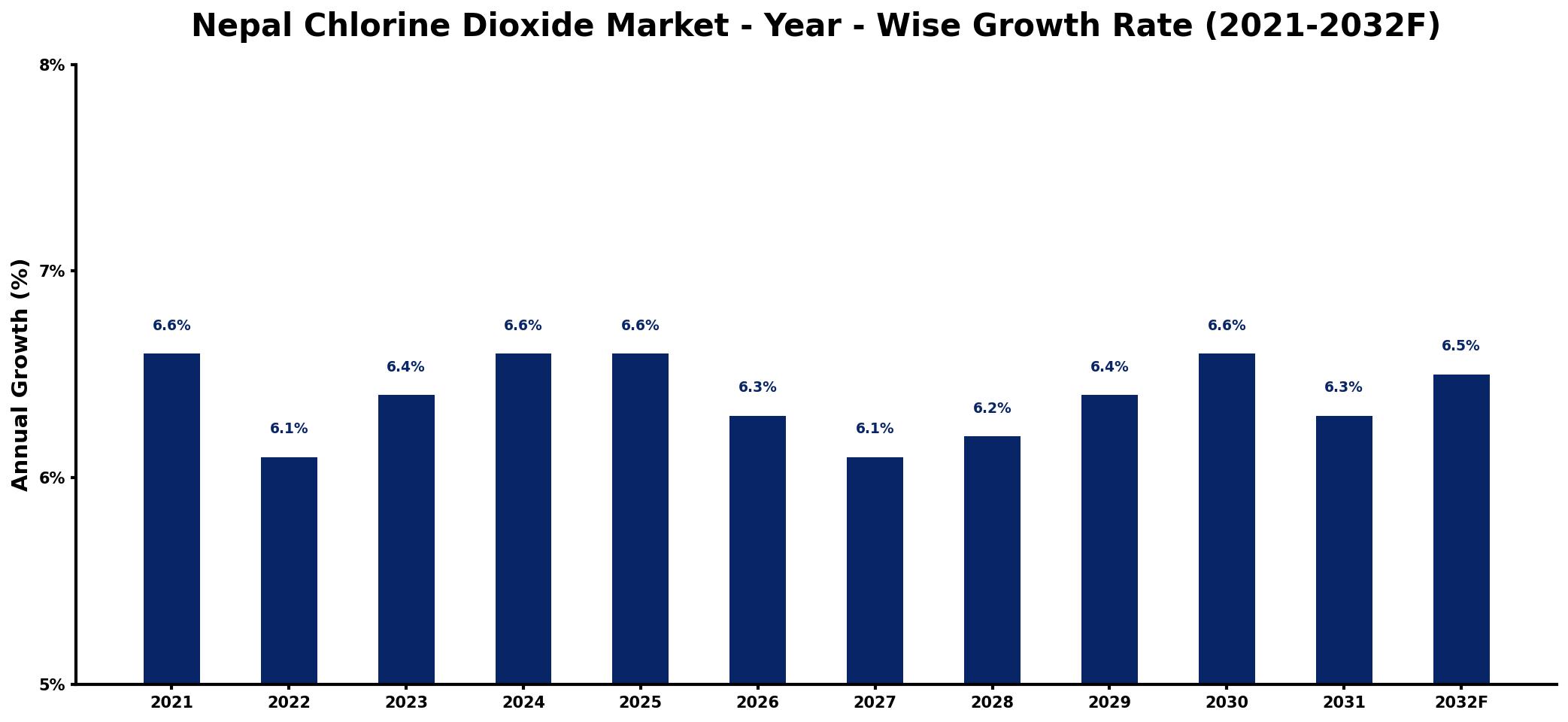
The table below presents the year‑wise growth rates along with the key drivers influencing the market
| Year | Growth Rate | Major Drivers |
| 2021 | 6.6% | Rising water purification demand |
| 2022 | 6.1% | Increased industrial safety regulations |
| 2023 | 6.4% | Growing healthcare facility investments |
| 2024 | 6.6% | Expansion of municipal water systems |
| 2025 | 6.6% | Surge in environmental awareness campaigns |
| 2026 | 6.3% | Boost in agricultural applications |
| 2027 | 6.1% | Strengthening of public health initiatives |
| 2028 | 6.2% | Enhancement of wastewater treatment facilities |
| 2029 | 6.4% | Development of new sanitation technologies |
| 2030 | 6.6% | Increased focus on clean energy |
| 2031 | 6.3% | Growth in food processing standards |
| 2032 | 6.5% | Advancements in hygiene protocols |
Note: Market size estimations and growth projections presented in this report are based on 6Wresearch's proprietary forecasting methodology, utilizing the latest available industry data, government publications, and primary research inputs.
Nepal Chlorine Dioxide Market Synopsis
The most significant force shaping the Nepal Chlorine Dioxide Market currently is the urgent need for efficient water treatment solutions driven by rising concerns over waterborne diseases. Municipal water treatment facilities and healthcare institutions are increasingly turning to chlorine dioxide for its superior disinfection capabilities, ensuring safe water supply and reducing health risks.
Moreover, the food and beverage industry is gradually recognizing the importance of chlorine dioxide in maintaining quality and safety standards. As industries seek to enhance their water management processes and align with national safety regulations, the demand for chlorine dioxide is poised for sustained growth in Nepal.
Nepal Chlorine Dioxide Market Key Takeaways
- The market is witnessing robust growth, driven by stringent water quality regulations and the need for effective disinfection.
- Increasing awareness about the health impacts of clean water is influencing industry investments in advanced treatment solutions.
- Product innovation and eco-friendly formulations are emerging trends among manufacturers in the chlorine dioxide space.
- Challenges such as limited consumer awareness and infrastructure constraints need to be addressed for market expansion.
- Investment opportunities are present in the manufacturing of chlorine dioxide generators and innovative product applications.
Evaluation of Restraints in Nepal Chlorine Dioxide Market
While the Nepal Chlorine Dioxide Market shows promise, several barriers impede its growth. A notable challenge is the limited awareness among consumers and businesses about the efficacy and benefits of chlorine dioxide as a viable water treatment solution. Additionally, the existing infrastructure for the production and distribution of chlorine dioxide is lacking, which hampers accessibility. Regulatory hurdles and inconsistent government policies further complicate the market landscape. Moreover, the perception of chlorine dioxide as a premium option compared to alternative water treatment solutions can deter potential users from adopting it. Overcoming these challenges will require concerted efforts in education, investment in infrastructure, and advocacy for supportive policies.
Nepal Chlorine Dioxide Market Trends
The current market trends indicate a notable shift towards sustainable and eco-friendly water treatment solutions. Chlorine dioxide is increasingly favored over traditional chlorine products due to its reduced environmental footprint and lower generation of harmful byproducts. Furthermore, advancements in product formulations are enhancing the efficiency and usability of chlorine dioxide, making it more appealing for diverse applications. The healthcare sector is also a significant driver, with increased utilization for disinfection purposes in medical facilities, highlighting its essential role in ensuring public health.
Nepal Chlorine Dioxide Market Opportunities
The Nepal Chlorine Dioxide Market is ripe with investment opportunities, particularly in the domains of manufacturing and supplying chlorine dioxide generators and associated chemicals. The growing recognition of the importance of effective water treatment measures opens avenues for developing innovative solutions that cater to specific industry requirements. Collaborations with local water treatment companies and government entities can also yield fruitful partnerships aimed at delivering sustainable and cost-effective chlorine dioxide solutions. Investing in research and development to explore novel applications for chlorine dioxide could further enhance market prospects and financial returns.
Government Initiatives in the Nepal Chlorine Dioxide Market
The Nepalese government has instituted policies to regulate the use of chlorine dioxide, emphasizing public health and environmental protection. Classified as a hazardous substance under the Environment Protection Act, its production, importation, sale, and use are subject to stringent safety guidelines. Regulations enforce limits on chlorine dioxide concentrations in products, alongside mandatory labeling requirements to ensure consumer safety. These policies underscore the government's commitment to promoting responsible practices while encouraging the safe application of chlorine dioxide in various sectors.
Future Insights of the Nepal Chlorine Dioxide Market
Looking ahead to 2026-2032, the Nepal Chlorine Dioxide Market is expected to flourish as demand for safe water treatment solutions escalates. The government's initiatives to improve water quality and sanitation infrastructure will likely play a crucial role in spurring growth. With increasing public awareness regarding water safety and health implications, the adoption of chlorine dioxide is anticipated to gain further momentum. Additionally, as key players continue to innovate, the market will witness a diversified range of products aimed at addressing the evolving needs of various industries.
Nepal Chlorine Dioxide Market Latest Developments (2025 - 2026)
In recent months, the industry has witnessed several significant trends aimed at enhancing the application and efficiency of chlorine dioxide products. Notable advancements include the introduction of more user-friendly generators that cater to the healthcare and municipal sectors. Furthermore, collaborations between private companies and local governments have emerged, focusing on improving the infrastructure for water treatment facilities. Overall, the direction of the market indicates an increasing commitment towards adopting innovative and sustainable practices to address public health concerns.
Nepal Chlorine Dioxide Market - Key Attractiveness of the Report
- 10 Years of Market Numbers
- Historical Data Starting from 2022 to 2025
- Base Year: 2025
- Forecast Data until 2032
- Key Performance Indicators Impacting the Market
- Major Upcoming Developments and Projects
Key Highlights of the Report:
- Nepal Chlorine Dioxide Market Outlook
- Market Size of Nepal Chlorine Dioxide Market, 2025
- Forecast of Nepal Chlorine Dioxide Market, 2032
- Historical Data and Forecast of Nepal Chlorine Dioxide Revenues & Volume for the Period 2022-2032F
- Nepal Chlorine Dioxide Market Trend Evolution
- Nepal Chlorine Dioxide Market Drivers and Challenges
- Nepal Chlorine Dioxide Price Trends
- Nepal Chlorine Dioxide Porter's Five Forces
- Nepal Chlorine Dioxide Industry Life Cycle
- Historical Data and Forecast of Nepal Chlorine Dioxide Market Revenues & Volume By Application for the Period 2022-2032F
- Historical Data and Forecast of Nepal Chlorine Dioxide Market Revenues & Volume By Industrial Water Treatment for the Period 2022-2032F
- Historical Data and Forecast of Nepal Chlorine Dioxide Market Revenues & Volume By Pulp & Paper Processing for the Period 2022-2032F
- Historical Data and Forecast of Nepal Chlorine Dioxide Market Revenues & Volume By Oil & Gas for the Period 2022-2032F
- Historical Data and Forecast of Nepal Chlorine Dioxide Market Revenues & Volume By Medical for the Period 2022-2032F
- Historical Data and Forecast of Nepal Chlorine Dioxide Market Revenues & Volume By Food & Beverages for the Period 2022-2032F
- Historical Data and Forecast of Nepal Chlorine Dioxide Market Revenues & Volume By Others for the Period 2022-2032F
- Nepal Chlorine Dioxide Import Export Trade Statistics
- Market Opportunity Assessment By Application
- Nepal Chlorine Dioxide Top Companies Market Share
- Nepal Chlorine Dioxide Competitive Benchmarking By Technical and Operational Parameters
- Nepal Chlorine Dioxide Company Profiles
- Nepal Chlorine Dioxide Key Strategic Recommendations






































