Nepal Christmas Tree Market Size, Share & Growth Rate
The Nepal Christmas Tree Market was estimated at USD 226 Million in 2025 and is projected to reach USD 313 Million by 2032, growing at a CAGR of 4.8% from 2026 to 2032. This upward trajectory is driven by a blend of increasing disposable incomes, urbanization, and the widespread adoption of Western holiday traditions. As more Nepalis embrace Christmas celebrations, there is a notable shift towards both artificial and locally sourced real trees, enhancing market dynamics.
Nepal Christmas Tree Market Year-wise Growth Rate and Key Drivers
This graph highlights how the Nepal Christmas Tree Market has steadily grown over the years, supported by major growth factors.
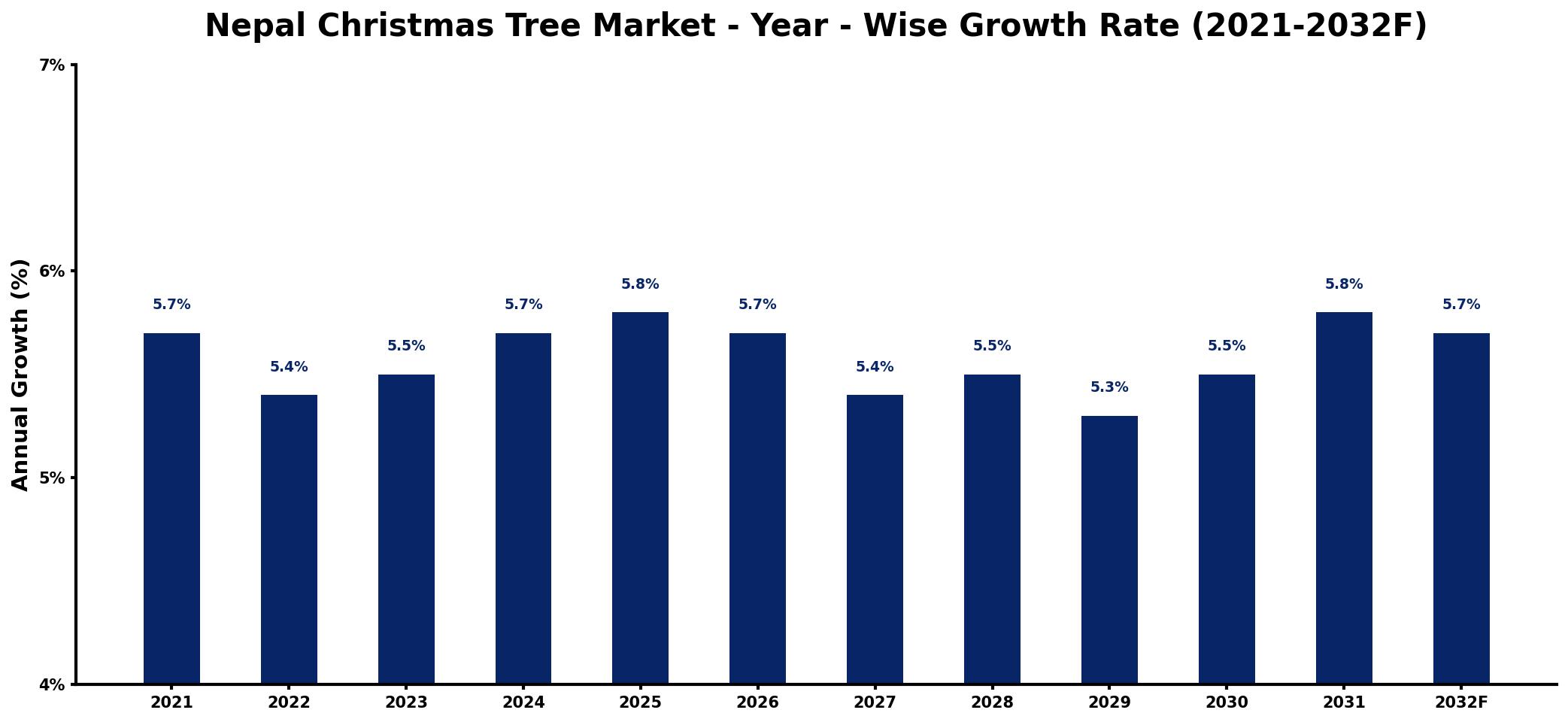
The table below presents the year‑wise growth rates along with the key drivers influencing the market
| Year | Growth Rate | Major Drivers |
| 2021 | 5.7% | Increase in seasonal decorations demand |
| 2022 | 5.4% | Growth in festive event planning |
| 2023 | 5.5% | Rise in home decoration trends |
| 2024 | 5.7% | Expansion of retail holiday offerings |
| 2025 | 5.8% | Increased online shopping convenience |
| 2026 | 5.7% | Surge in eco-friendly products popularity |
| 2027 | 5.4% | Growth of local artisan markets |
| 2028 | 5.5% | strengthening international trade flows |
| 2029 | 5.3% | growing regional consumption patterns |
| 2030 | 5.5% | rising export shipment volumes |
| 2031 | 5.8% | increased production capacity utilization |
| 2032 | 5.7% | increased overall sector activity |
Note: Market size estimations and growth projections presented in this report are based on 6Wresearch's proprietary forecasting methodology, utilizing the latest available industry data, government publications, and primary research inputs.
Nepal Christmas Tree Market Synopsis
In recent years, the Nepal Christmas tree market has seen an impressive surge, particularly in urban areas where Western cultural influences have taken hold. With the festive season now firmly embedded in the social fabric, the market is poised for continued growth, fueled by both local consumer interest and tourist demand.
Looking ahead, the market is expected to expand its reach, accommodating a diverse array of consumer preferences. The increasing emphasis on eco-friendly options, coupled with the demand for sustainable products, is set to redefine the market landscape in the years to come.
Nepal Christmas Tree Market Key Takeaways
- The market is rapidly expanding, driven by urbanization and cultural shifts.
- Demand for artificial trees outpaces that for natural trees due to convenience and reusability.
- Eco-friendly and locally sourced products are becoming increasingly popular among consumers.
- Retail channels are diversifying, with a growing presence of online platforms.
- Government policies support sustainable practices in tree harvesting and production.
Evaluation of Restraints in Nepal Christmas Tree Market
Despite its growth potential, the Nepal Christmas tree market faces significant challenges. The limited availability of native evergreen species constrains supply, necessitating reliance on costly imports. This scarcity can result in higher prices, which deter some consumers. Moreover, the lack of deep-rooted Christmas traditions means that overall market demand remains comparatively lower than in regions with more established festive practices. Consequently, local vendors find it difficult to achieve economies of scale, hindering their ability to compete effectively.
Nepal Christmas Tree Market Trends
A prominent trend within the Nepal Christmas tree market is the increasing shift towards sustainable and eco-friendly products. Consumers are becoming more conscious of the environmental impact of their purchases, leading to a rising demand for artificial trees crafted from recyclable materials. Additionally, handmade decorations and natural elements like pinecones and berries are gaining traction as consumers seek unique and rustic holiday aesthetics.
Another notable trend is the growth of e-commerce platforms, allowing consumers easier access to both trees and decorations. This shift not only meets the convenience demands of modern shoppers but also caters to the growing tourist population seeking authentic holiday experiences in Nepal.
Nepal Christmas Tree Market Opportunities
Investment opportunities abound within the Nepal Christmas tree market. Establishing local Christmas tree farms could address the demand for fresh, sustainably sourced trees while promoting agricultural innovation. Investing in technology and infrastructure for efficient tree cultivation, as well as exploring avenues for online retail, can significantly enhance market outreach. Furthermore, collaborations with local artisans to create unique handmade decorations present a lucrative niche for entrepreneurs.
Government Initiatives in the Nepal Christmas Tree Market
The Nepali government has enacted policies aimed at promoting sustainable forestry practices within the Christmas tree sector. Regulations governing the harvesting of tree species focus on biodiversity conservation and the prevention of illegal logging. Additionally, the government supports local producers through training programs and subsidies, fostering an environment conducive to sustainable agriculture and fair trade practices. This alignment of economic growth with environmental stewardship is pivotal for the future of the Christmas tree market in Nepal.
Future Insights of the Nepal Christmas Tree Market
As we look towards 2026-2032, the Nepal Christmas tree market is set for sustained growth. Factors such as increasing urbanization, rising disposable incomes, and the ongoing embrace of Western festive traditions will continue to elevate market demand. The expansion of both artificial and natural tree offerings will cater to a diverse consumer base, while eco-friendly practices are likely to resonate strongly with an increasingly environmentally conscious public. Thus, the market will present lucrative avenues for both local entrepreneurs and international investors alike.
Nepal Christmas Tree Market Latest Developments (2025 - 2026)
Recent developments in the Nepal Christmas tree market indicate a growing integration of technology in retail and distribution channels. Online shopping platforms are enhancing consumer accessibility, while innovative marketing strategies aimed at celebrating local culture are gaining traction. Additionally, initiatives promoting locally sourced products are fostering a more sustainable approach to holiday decorations. This evolution reflects the market's responsiveness to emerging consumer preferences and global sustainability trends.
Nepal Christmas Tree Market - Key Attractiveness of the Report
- 10 Years of Market Numbers
- Historical Data Starting from 2022 to 2025
- Base Year: 2025
- Forecast Data until 2032
- Key Performance Indicators Impacting the Market
- Major Upcoming Developments and Projects
Key Highlights of the Report:
- Nepal Christmas Tree Market Outlook
- Market Size of Nepal Christmas Tree Market, 2025
- Forecast of Nepal Christmas Tree Market, 2032
- Historical Data and Forecast of Nepal Christmas Tree Revenues & Volume for the Period 2022-2032F
- Nepal Christmas Tree Market Trend Evolution
- Nepal Christmas Tree Market Drivers and Challenges
- Nepal Christmas Tree Price Trends
- Nepal Christmas Tree Porter's Five Forces
- Nepal Christmas Tree Industry Life Cycle
- Historical Data and Forecast of Nepal Christmas Tree Market Revenues & Volume By Type for the Period 2022-2032F
- Historical Data and Forecast of Nepal Christmas Tree Market Revenues & Volume By Horizontal Tree for the Period 2022-2032F
- Historical Data and Forecast of Nepal Christmas Tree Market Revenues & Volume By Vertical Tree for the Period 2022-2032F
- Historical Data and Forecast of Nepal Christmas Tree Market Revenues & Volume By Location of Deployment for the Period 2022-2032F
- Historical Data and Forecast of Nepal Christmas Tree Market Revenues & Volume By Onshore for the Period 2022-2032F
- Historical Data and Forecast of Nepal Christmas Tree Market Revenues & Volume By Offshore for the Period 2022-2032F
- Nepal Christmas Tree Import Export Trade Statistics
- Market Opportunity Assessment By Type
- Market Opportunity Assessment By Location of Deployment
- Nepal Christmas Tree Top Companies Market Share
- Nepal Christmas Tree Competitive Benchmarking By Technical and Operational Parameters
- Nepal Christmas Tree Company Profiles
- Nepal Christmas Tree Key Strategic Recommendations






































