Nepal Cooking Appliances Market Summary
The nepal cooking appliances market was estimated at USD 1268 Million in 2025 and is projected to reach USD 1810 Million by 2032, growing at a CAGR of 6.3% from 2026 to 2032.
Nepal Cooking Appliances Market Year-wise Growth Rate and Key Drivers
This graph highlights how the Nepal Cooking Appliances Market has steadily grown over the past five years, supported by major growth factors.
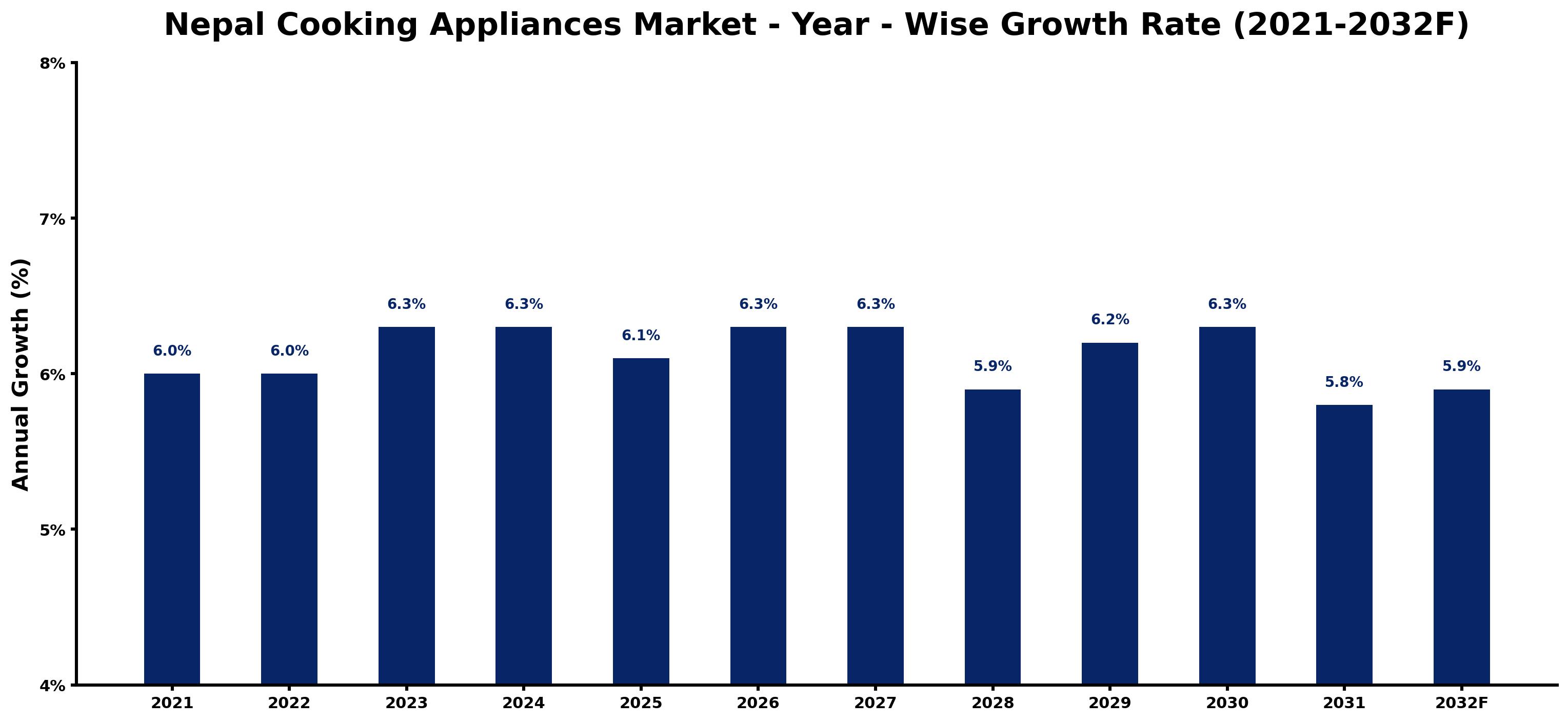
The table below presents the year wise growth rates along with the key drivers influencing the market
| Year | Growth Rate | Major Drivers |
| 2021 | 6.0% | Post-pandemic recovery spurred consumer interest in efficient cooking appliances. |
| 2022 | 6.0% | A surge in urbanization influenced demand for compact kitchen solutions among households. |
| 2023 | 6.3% | Increase in disposable income led to a preference for premium cooking products. |
| 2024 | 6.3% | Rural electrification projects enabled wider accessibility to modern cooking technologies. |
| 2025 | 6.1% | Emergence of e-commerce platforms expanded market reach for cooking appliances significantly. |
| 2026 | 6.3% | Cultural shifts toward convenience cuisine bolstered sales of multi-functional devices. |
| 2027 | 6.3% | Local manufacturers began emphasizing energy-efficient appliances amid environment-conscious consumerism. |
| 2028 | 5.9% | Collaborations with international brands introduced innovative products to Nepal's market landscape. |
| 2029 | 6.2% | Growing culinary tourism sparked interest in advanced cooking tools among local chefs. |
| 2030 | 6.3% | Urban lifestyle changes prompted a demand for smart kitchen appliances with connected features. |
| 2031 | 5.8% | Shift toward healthier eating habits increased interest in specialized cooking equipment. |
| 2032 | 5.9% | New financing options made premium cooking appliances more accessible to a broader audience. |
Note - Market size estimations and growth projections presented in this report are based on 6Wresearch's advanced forecasting approach, validated with industry datasets as of June 2026.
Nepal Cooking Appliances Market Synopsis
The Nepal Cooking Appliances Market is projected to reach 6.3% and witness significant growth during the forecast period (2026-2032). This growth trajectory is primarily attributed to several socio-economic factors reshaping consumer behavior and preferences across the country. With urbanization advancing at a considerable pace, a growing middle-class population and increased disposable incomes are catalyzing the demand for modern kitchen appliances. As lifestyles evolve, consumers are leaning towards convenience, thus favoring appliances like electric cookers, induction cooktops, and microwave ovens that facilitate efficient meal preparation.
Nepal Cooking Appliances Market Growth Drivers
The expansion of the Nepal cooking appliances market is driven by multiple interrelated factors:
- Urbanization is leading to a shift in living patterns that increasingly favors modern cooking solutions, making appliances more accessible and practical for daily use.
- The rise of the middle class is contributing to higher disposable incomes, which enhances consumer capability to invest in advanced cooking appliances that promise efficiency and convenience.
- Changing lifestyles are prompting consumers to seek appliances that not only save time but also improve the overall cooking experience.
- Health consciousness among consumers has led to increased interest in appliances like air fryers and steamers, which provide healthier cooking alternatives.
- Technological advancements in cooking appliances, such as smart temperature controls and digital timers, play a significant role in attracting tech-savvy consumers who desire innovative kitchen solutions.
Nepal Cooking Appliances Market Trends and Opportunities
Recent trends within the Nepal cooking appliances market highlight a transformative phase characterized by innovation and adaptation:
- The introduction of smart cooking appliances equipped with IoT capabilities is emerging as a significant trend, catering to the tech-driven consumer base that prioritizes connectivity and ease of use.
- Energy efficiency is becoming a crucial selling point, as consumers increasingly prefer appliances that help reduce electricity consumption while maintaining high performance.
- There is a growing market for locally manufactured appliances that reflect local cooking customs while incorporating modern technology, providing a unique value proposition.
- Online retail channels are expanding, providing consumers with greater access to a diverse range of cooking appliances, facilitating informed purchasing decisions.
- Health and wellness trends are pushing manufacturers to explore and market appliances that support healthier cooking methods, further diversifying product offerings in the market.
Nepal Cooking Appliances Market Challenges and Restraints
Despite the promising growth prospects, the Nepal cooking appliances market faces notable challenges:
- Market penetration of advanced cooking appliances remains uneven, particularly in rural areas where traditional cooking methods prevail.
- The high initial cost of modern cooking appliances can be a barrier for many consumers, limiting adoption rates despite growing interest.
- Infrastructure issues, such as irregular electricity supply in certain regions, hamper the usability of electric cooking appliances.
- Awareness regarding the benefits of advanced cooking technologies varies significantly, affecting overall market growth.
- Competition from traditional cooking methods continues to pose a challenge, as many consumers remain attached to traditional practices that are deeply rooted in culture.
Nepal Cooking Appliances Market Government Investment and Initiatives
The Nepalese government has recognized the potential of the cooking appliances sector as a crucial component of economic development and consumer welfare:
- Government policies are aimed at encouraging local manufacturing of cooking appliances, thereby creating jobs and supporting the economy.
- Subsidies or incentives for energy-efficient appliances are being explored to encourage consumers to shift towards modern cooking technologies.
- Public spending on infrastructure improvements is expected to enhance electricity access, further supporting the adoption of electric cooking appliances.
- Educational campaigns are being initiated to raise awareness about the benefits and functionalities of modern cooking appliances.
- Collaborations between the government and private sector players are being fostered to develop solutions tailored to local culinary needs, boosting appliance relevance and acceptance.
Nepal Cooking Appliances Market Latest Developments (May 2025 - June 2026)
During the period from May 2025 to June 2026, various developments have occurred within the Nepal cooking appliances market, shaping its current landscape:
- Innovative product launches have increased, with a focus on multifunctional cooking appliances catering to diverse consumer needs.
- Many companies are investing in digital marketing strategies to reach the younger generation, aiming to align their products with contemporary lifestyle aspirations.
- There has been a noticeable increase in cross-border partnerships aimed at introducing international standards in product quality and technology.
- Consumer feedback mechanisms have been implemented by several manufacturers, allowing for rapid adaptation of products based on user preferences.
- The market witnessed a spike in online sales channels, as consumers have increasingly turned to e-commerce platforms for purchasing cooking appliances during this period.
Nepal Cooking Appliances Market - Key Attractiveness of the Report
- 10 Years of Market Numbers
- Historical Data Starting from 2022 to 2025
- Base Year: 2025
- Forecast Data until 2032
- Key Performance Indicators Impacting the Market
- Major Upcoming Developments and Projects
Key Highlights of the Report:
- Nepal Cooking Appliances Market Outlook
- Market Size of Nepal Cooking Appliances Market, 2025
- Forecast of Nepal Cooking Appliances Market, 2032
- Historical Data and Forecast of Nepal Cooking Appliances Revenues & Volume for the Period 2022-2032
- Nepal Cooking Appliances Market Trend Evolution
- Nepal Cooking Appliances Market Drivers and Challenges
- Nepal Cooking Appliances Price Trends
- Nepal Cooking Appliances Porter's Five Forces
- Nepal Cooking Appliances Industry Life Cycle
- Historical Data and Forecast of Nepal Cooking Appliances Market Revenues & Volume By Types for the Period 2022-2032
- Historical Data and Forecast of Nepal Cooking Appliances Market Revenues & Volume By Microwaves for the Period 2022-2032
- Historical Data and Forecast of Nepal Cooking Appliances Market Revenues & Volume By Ovens for the Period 2022-2032
- Historical Data and Forecast of Nepal Cooking Appliances Market Revenues & Volume By Cooktops for the Period 2022-2032
- Historical Data and Forecast of Nepal Cooking Appliances Market Revenues & Volume By Range Hoods for the Period 2022-2032
- Historical Data and Forecast of Nepal Cooking Appliances Market Revenues & Volume By Small Appliances for the Period 2022-2032
- Historical Data and Forecast of Nepal Cooking Appliances Market Revenues & Volume By Parts & Accessories for the Period 2022-2032
- Historical Data and Forecast of Nepal Cooking Appliances Market Revenues & Volume By Applications for the Period 2022-2032
- Historical Data and Forecast of Nepal Cooking Appliances Market Revenues & Volume By Household for the Period 2022-2032
- Historical Data and Forecast of Nepal Cooking Appliances Market Revenues & Volume By Commercial for the Period 2022-2032
- Historical Data and Forecast of Nepal Cooking Appliances Market Revenues & Volume By Fuel Type for the Period 2022-2032
- Historical Data and Forecast of Nepal Cooking Appliances Market Revenues & Volume By Cooking gas for the Period 2022-2032
- Historical Data and Forecast of Nepal Cooking Appliances Market Revenues & Volume By Electricity for the Period 2022-2032
- Historical Data and Forecast of Nepal Cooking Appliances Market Revenues & Volume By Distribution Channel for the Period 2022-2032
- Historical Data and Forecast of Nepal Cooking Appliances Market Revenues & Volume By Online for the Period 2022-2032
- Historical Data and Forecast of Nepal Cooking Appliances Market Revenues & Volume By Offline for the Period 2022-2032
- Nepal Cooking Appliances Import Export Trade Statistics
- Market Opportunity Assessment By Types
- Market Opportunity Assessment By Applications
- Market Opportunity Assessment By Fuel Type
- Market Opportunity Assessment By Distribution Channel
- Nepal Cooking Appliances Top Companies Market Share
- Nepal Cooking Appliances Competitive Benchmarking By Technical and Operational Parameters
- Nepal Cooking Appliances Company Profiles
- Nepal Cooking Appliances Key Strategic Recommendations






































