Nepal Curtains and Window Blinds Market Size, Share & Growth Rate
The Nepal Curtains and Window Blinds Market was estimated at USD 1469 Million in 2025 and is projected to reach USD 2732 Million by 2032, growing at a CAGR of 9.3% from 2026 to 2032. This growth trajectory is fueled by rising urbanization and a burgeoning demand for stylish interior solutions. Furthermore, an increasing focus on energy efficiency and sustainable materials is reshaping consumer preferences, offering significant opportunities for innovative product development.
Nepal Curtains and Window Blinds Market Year-wise Growth Rate and Key Drivers
This graph highlights how the Nepal Curtains and Window Blinds Market has steadily grown over the years, supported by major growth factors.
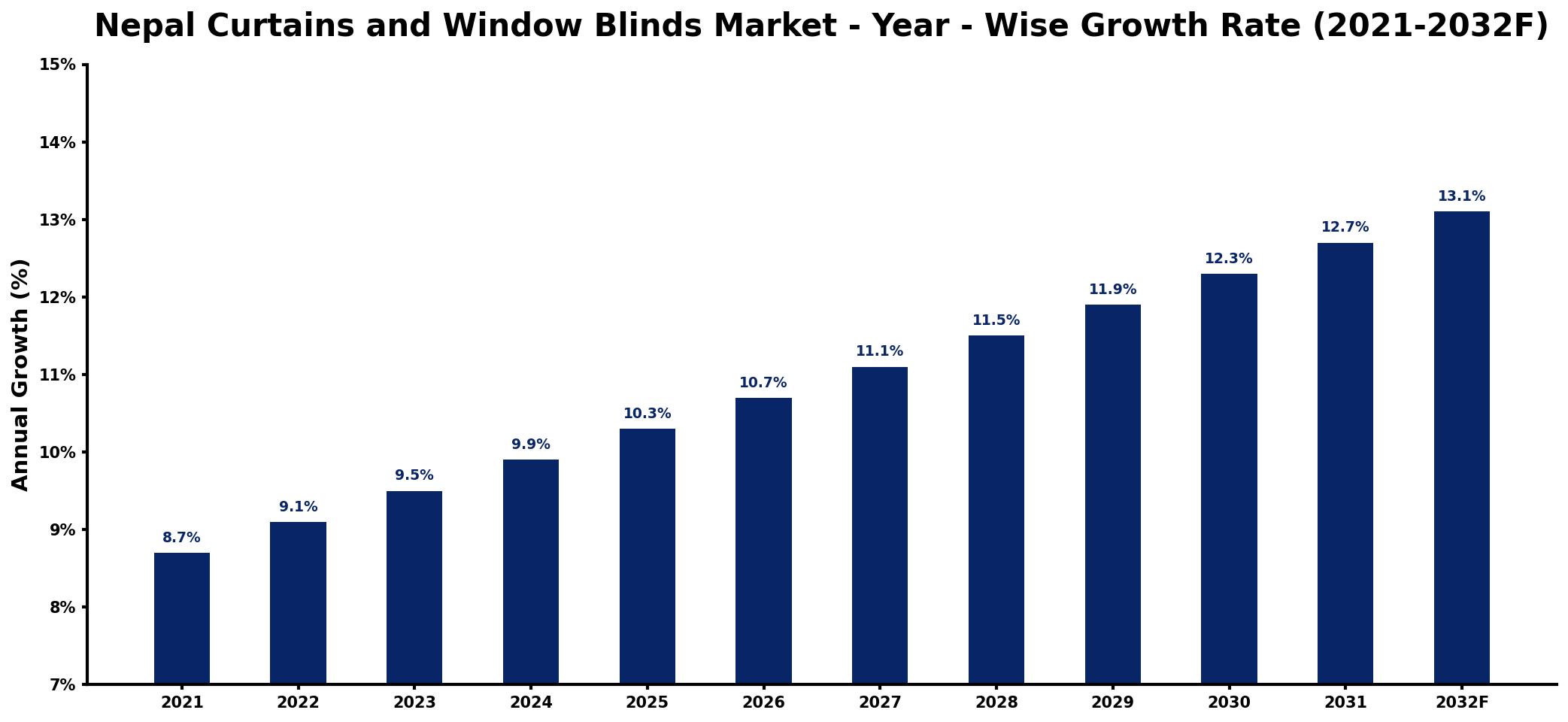
The table below presents the year‑wise growth rates along with the key drivers influencing the market
| Year | Growth Rate | Major Drivers |
| 2021 | 8.7% | Rising consumer home improvement spending |
| 2022 | 9.1% | Increased urbanization and housing projects |
| 2023 | 9.5% | Growing interest in interior design |
| 2024 | 9.9% | Expansion of e-commerce platforms |
| 2025 | 10.3% | Surge in disposable income levels |
| 2026 | 10.7% | Emergence of eco-friendly materials |
| 2027 | 11.1% | Popularity of smart home technologies |
| 2028 | 11.5% | Increase in real estate developments |
| 2029 | 11.9% | Higher demand for personalized decor |
| 2030 | 12.3% | strengthening international trade flows |
| 2031 | 12.7% | improved processing technologies adoption |
| 2032 | 13.1% | Rising awareness of sustainability trends |
Note: Market size estimations and growth projections presented in this report are based on 6Wresearch's proprietary forecasting methodology, utilizing the latest available industry data, government publications, and primary research inputs.
Nepal Curtains and Window Blinds Market Synopsis
The demand for customized window treatments is a key driver in the Nepal Curtains and Window Blinds Market, as consumers seek unique solutions that enhance their living and workspaces. This trend is particularly pronounced in urban areas, where residents are increasingly investing in home décor to reflect their personal style.
On the supply side, manufacturers are diversifying their offerings to include a mix of traditional Nepali textiles and contemporary designs. The emphasis on energy-efficient and eco-friendly products aligns with global sustainability trends, making it an attractive proposition for environmentally conscious consumers.
Nepal Curtains and Window Blinds Market Key Takeaways
- The market is witnessing robust growth driven by urbanization and increased disposable incomes.
- There is a significant shift towards sustainable materials, with rising demand for organic fabrics.
- Customized window treatments are gaining popularity, offering personalization for consumers.
- Online sales channels are expanding, providing consumers with easier access to a wide range of products.
- Smart blinds technology is emerging as a key trend among tech-savvy buyers.
Evaluation of Restraints in Nepal Curtains and Window Blinds Market
Despite its growth potential, the Nepal Curtains and Window Blinds Market faces notable challenges. A lack of consumer awareness regarding the benefits and variety of window treatment options hampers market expansion. Traditional covering methods, such as local fabric curtains, remain prevalent, posing competition for modern products. Furthermore, inconsistent access to necessary infrastructure, such as electricity and internet connectivity for online sales, can limit market penetration. Additionally, high import tariffs on essential materials complicate pricing strategies for local manufacturers, creating barriers to competitiveness.
Nepal Curtains and Window Blinds Market Trends
Current trends in the Nepal Curtains and Window Blinds Market emphasize the integration of sustainability and smart technology. Consumers are increasingly favoring eco-friendly products made from organic materials like cotton and bamboo. The rise of smart window blinds, which can be controlled remotely, is also appealing to tech-conscious consumers. Additionally, the trend towards energy-efficient solutions is gaining traction, as homeowners seek to lower their utility costs while enhancing their interior aesthetics.
Nepal Curtains and Window Blinds Market Opportunities
The growth of the Nepal Curtains and Window Blinds Market presents ample investment opportunities, particularly in light of the country's expanding real estate sector and rising urbanization. Investors can tap into the demand for high-quality, stylish window treatments driven by ongoing construction projects. Additionally, there is a distinct niche for energy-efficient and sustainable products, which aligns with global market trends. Collaborating with local manufacturers and leveraging innovative marketing strategies can enhance market entry and consumer engagement, positioning businesses to capture a share of this evolving market.
Government Initiatives in the Nepal Curtains and Window Blinds Market
Government policies in Nepal relevant to the Curtains and Window Blinds Market include regulations surrounding import tariffs and compliance with quality standards. These policies aim to ensure consumer protection and product reliability while promoting environmental sustainability in manufacturing processes. The government is also increasingly recognizing the importance of fostering a conducive business environment for manufacturers and retailers in the market, which could lead to future incentives and support.
Future Insights of the Nepal Curtains and Window Blinds Market
Looking ahead to 2026-2032, the Nepal Curtains and Window Blinds Market is anticipated to maintain its positive growth trajectory, influenced by urbanization and a heightened interest in home décor. The demand for smart technology in window treatments is likely to gain momentum, alongside the trend for personalized and eco-friendly options. However, market participants must navigate fluctuating raw material prices and competition from traditional alternatives. With the ongoing focus on enhancing residential and commercial spaces, the market is poised for sustained expansion and innovation.
Nepal Curtains and Window Blinds Market Latest Developments (2025 - 2026)
In recent months, the Nepal Curtains and Window Blinds Market has witnessed a surge in innovative product offerings, with several companies introducing eco-friendly materials and smart technologies in their blinds and curtains. The digital marketplace is also evolving, with various online platforms enhancing user experience and accessibility for consumers. These developments are indicative of a broader shift toward modernization in the industry, catering to a more informed and discerning customer base.
Nepal Curtains and Window Blinds Market - Key Attractiveness of the Report
- 10 Years of Market Numbers
- Historical Data Starting from 2022 to 2025
- Base Year: 2025
- Forecast Data until 2032
- Key Performance Indicators Impacting the Market
- Major Upcoming Developments and Projects
Key Highlights of the Report:
- Nepal Curtains and Window Blinds Market Outlook
- Market Size of Nepal Curtains and Window Blinds Market, 2025
- Forecast of Nepal Curtains and Window Blinds Market, 2032
- Historical Data and Forecast of Nepal Curtains and Window Blinds Revenues & Volume for the Period 2022-2032F
- Nepal Curtains and Window Blinds Market Trend Evolution
- Nepal Curtains and Window Blinds Market Drivers and Challenges
- Nepal Curtains and Window Blinds Price Trends
- Nepal Curtains and Window Blinds Porter's Five Forces
- Nepal Curtains and Window Blinds Industry Life Cycle
- Historical Data and Forecast of Nepal Curtains and Window Blinds Market Revenues & Volume By Materials for the Period 2022-2032F
- Historical Data and Forecast of Nepal Curtains and Window Blinds Market Revenues & Volume By Curtains (Cotton, Linen, Polyester) for the Period 2022-2032F
- Historical Data and Forecast of Nepal Curtains and Window Blinds Market Revenues & Volume By Window Blinds (Cotton, Linen, Wood, PVC, Metal) for the Period 2022-2032F
- Historical Data and Forecast of Nepal Curtains and Window Blinds Market Revenues & Volume By Product for the Period 2022-2032F
- Historical Data and Forecast of Nepal Curtains and Window Blinds Market Revenues & Volume By Curtains (Box pleat curtains, Pinch pleat curtains & drapery, Goblet pleat curtains & drapery, Eyelet curtains & drapery) for the Period 2022-2032F
- Historical Data and Forecast of Nepal Curtains and Window Blinds Market Revenues & Volume By Window Blinds (Window Shades,, Window Screens, Connected) for the Period 2022-2032F
- Historical Data and Forecast of Nepal Curtains and Window Blinds Market Revenues & Volume By Distribution Channel for the Period 2022-2032F
- Historical Data and Forecast of Nepal Curtains and Window Blinds Market Revenues & Volume By B2B for the Period 2022-2032F
- Historical Data and Forecast of Nepal Curtains and Window Blinds Market Revenues & Volume By B2C for the Period 2022-2032F
- Historical Data and Forecast of Nepal Curtains and Window Blinds Market Revenues & Volume By E-commerce for the Period 2022-2032F
- Historical Data and Forecast of Nepal Curtains and Window Blinds Market Revenues & Volume By Price Range for the Period 2022-2032F
- Historical Data and Forecast of Nepal Curtains and Window Blinds Market Revenues & Volume By High for the Period 2022-2032F
- Historical Data and Forecast of Nepal Curtains and Window Blinds Market Revenues & Volume By Medium for the Period 2022-2032F
- Historical Data and Forecast of Nepal Curtains and Window Blinds Market Revenues & Volume By Low for the Period 2022-2032F
- Nepal Curtains and Window Blinds Import Export Trade Statistics
- Market Opportunity Assessment By Materials
- Market Opportunity Assessment By Product
- Market Opportunity Assessment By Distribution Channel
- Market Opportunity Assessment By Price Range
- Nepal Curtains and Window Blinds Top Companies Market Share
- Nepal Curtains and Window Blinds Competitive Benchmarking By Technical and Operational Parameters
- Nepal Curtains and Window Blinds Company Profiles
- Nepal Curtains and Window Blinds Key Strategic Recommendations






































