Nepal Dermatology Drugs Market Size, Share & Growth Rate
The Nepal Dermatology Drugs Market was estimated at USD 317 Million in 2025 and is projected to reach USD 421 Million by 2032, growing at a CAGR of 4.1% from 2026 to 2032. This growth trajectory is primarily fueled by an increasing awareness of skin health among the population, coupled with the rising incidence of various skin disorders. Factors such as a growing elderly demographic, lifestyle changes, and enhanced disposable incomes further contribute to the expanding demand for effective dermatological solutions in Nepal.
Nepal Dermatology Drugs Market Year-wise Growth Rate and Key Drivers
This graph highlights how the Nepal Dermatology Drugs Market has steadily grown over the years, supported by major growth factors.
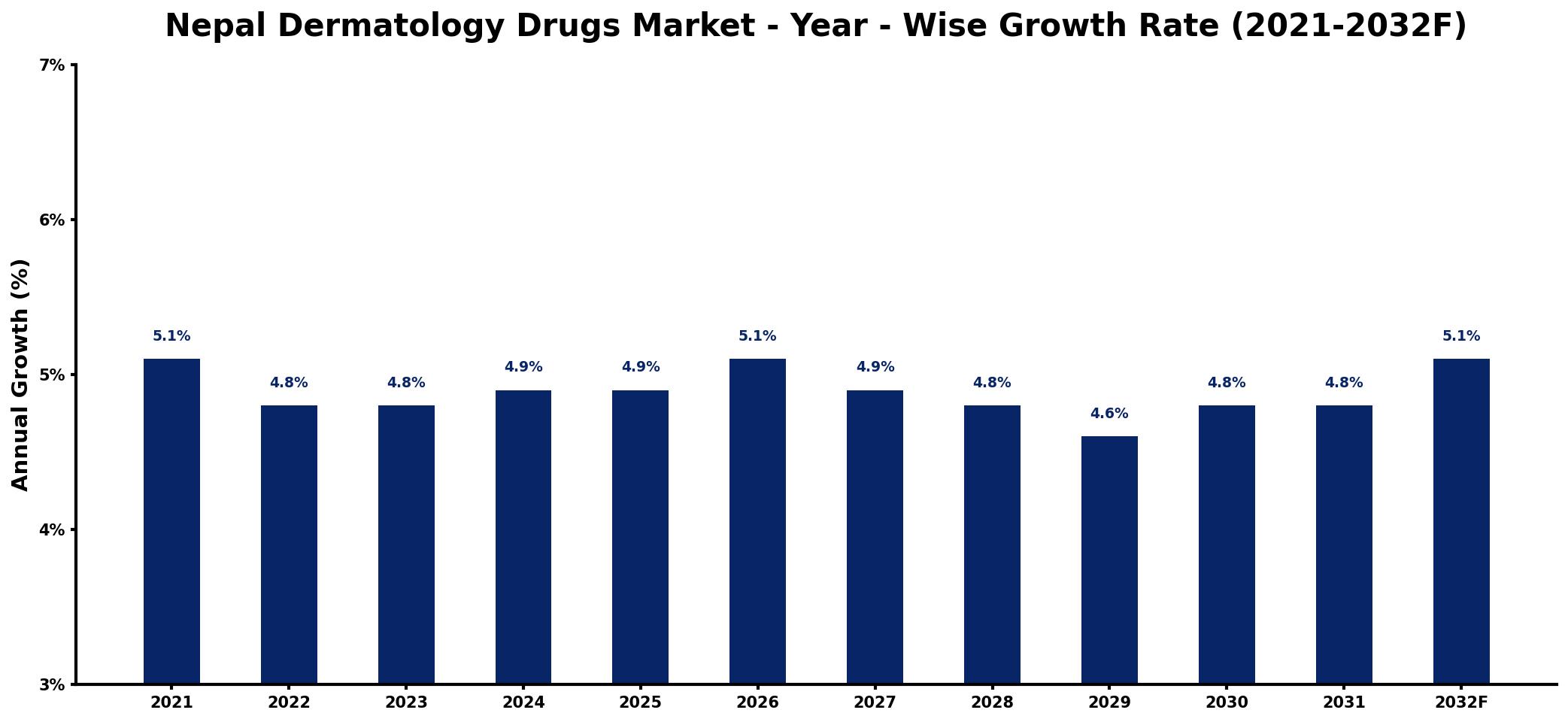
The table below presents the year‑wise growth rates along with the key drivers influencing the market
| Year | Growth Rate | Major Drivers |
| 2021 | 5.1% | Rising awareness of skin health |
| 2022 | 4.8% | Increasing prevalence of skin conditions |
| 2023 | 4.8% | Growing investment in healthcare infrastructure |
| 2024 | 4.9% | Expansion of telemedicine services |
| 2025 | 4.9% | Surge in cosmetic procedures demand |
| 2026 | 5.1% | Advancements in treatment technologies |
| 2027 | 4.9% | Increased focus on preventive care |
| 2028 | 4.8% | Growth in aging population demographics |
| 2029 | 4.6% | Emergence of innovative treatment options |
| 2030 | 4.8% | Rising disposable income levels |
| 2031 | 4.8% | Enhanced distribution network capabilities |
| 2032 | 5.1% | Strengthened regulatory support frameworks |
Note: Market size estimations and growth projections presented in this report are based on 6Wresearch's proprietary forecasting methodology, utilizing the latest available industry data, government publications, and primary research inputs.
Nepal Dermatology Drugs Market Synopsis
The demand for dermatology drugs in Nepal is significantly influenced by the increasing prevalence of skin conditions like eczema, psoriasis, and fungal infections, exacerbated by environmental factors and lifestyle changes. With topical medications, including creams and ointments, dominating the market, patients are increasingly turning to these convenient and effective treatment options.
The landscape of the Nepal Dermatology Drugs Market is characterized by a mix of multinational pharmaceutical companies and local manufacturers, both catering to the diverse skincare needs of the population. As the market evolves, a notable emphasis on research and innovation is observed, driving the development of advanced formulations that promise enhanced safety and efficacy.
Nepal Dermatology Drugs Market Key Takeaways
- The market is experiencing steady growth driven by heightened awareness of skin health and rising disposable incomes.
- Topical medications remain the mainstay due to their user-friendly application and effectiveness.
- There is a noticeable shift towards natural and herbal-based products in response to consumer preferences.
- Investment in R&D is critical for developing innovative dermatological therapies to meet changing demands.
- Regulatory frameworks are evolving to enhance market integrity and product safety.
Evaluation of Restraints in Nepal Dermatology Drugs Market
Despite the positive growth outlook, the Nepal Dermatology Drugs Market is not without its challenges. Access to specialized dermatological care is often limited in rural regions, which results in a significant number of skin conditions going undiagnosed or untreated. This is compounded by a general lack of awareness around skincare practices among the public, which in turn affects the demand for dermatology drugs. Furthermore, the market struggles with the prevalence of counterfeit products and a fragmented distribution network that can hamper the availability of authentic medications. These factors, along with regulatory hurdles, pose significant barriers that need to be addressed for sustained market growth.
Nepal Dermatology Drugs Market Trends
Current trends in the Nepal Dermatology Drugs Market reveal a rising demand for topical corticosteroids and anti-fungal medications, driven by an uptick in prevalent skin conditions. Increased awareness of skincare is fueling the introduction of a broader range of dermatological products, while consumers are also gravitating towards natural and herbal alternatives, responding to concerns about potential side effects from synthetic options. As awareness continues to rise, the market is likely to witness further diversification and innovation in product offerings.
Nepal Dermatology Drugs Market Opportunities
The expanding Nepal Dermatology Drugs Market presents numerous investment opportunities, especially for pharmaceutical companies looking to meet the growing demand for skincare treatments. As consumer interest in acne medications, anti-aging products, and therapeutic options for skin diseases increases, companies can explore strategic partnerships with local healthcare providers. Additionally, focusing on research and development of innovative formulations tailored to the unique needs of the Nepalese population could pave the way for significant market entry and expansion.
Government Initiatives in the Nepal Dermatology Drugs Market
The Nepalese government has implemented several policies aimed at regulating the dermatology drugs market to safeguard public health. The Department of Drug Administration (DDA) plays a pivotal role in overseeing the registration, manufacturing, and distribution of dermatological products. Pricing regulations have been introduced to enhance drug affordability, while advertising guidelines seek to prevent misleading marketing practices. Furthermore, the government encourages R&D in dermatology, promoting innovation and the introduction of new treatment options.
Future Insights of the Nepal Dermatology Drugs Market
Looking ahead to the period from 2026 to 2032, the Nepal Dermatology Drugs Market is poised for steady growth, driven by the escalating incidence of skin disorders and an increasing public focus on skincare. Rising disposable incomes and improvements in healthcare infrastructure are expected to facilitate access to dermatological treatments. Moreover, the ongoing development of innovative solutions is likely to keep pace with evolving consumer needs, ensuring a dynamic and responsive market environment.
Nepal Dermatology Drugs Market Latest Developments (2025 - 2026)
Recent developments in the Nepal Dermatology Drugs Market indicate a growing emphasis on collaboration between local manufacturers and international firms to enhance product offerings. Additionally, educational initiatives aimed at raising public awareness about skin health and the importance of dermatological care have gained traction. These efforts are anticipated to bolster market growth by increasing consumer engagement and driving demand for a wider range of dermatology products.
Nepal Dermatology Drugs Market - Key Attractiveness of the Report
- 10 Years of Market Numbers
- Historical Data Starting from 2022 to 2025
- Base Year: 2025
- Forecast Data until 2032
- Key Performance Indicators Impacting the Market
- Major Upcoming Developments and Projects
There are substantial opportunities in R&D for innovative formulations, as well as potential partnerships with healthcare providers to tap into the increasing demand for skincare solutions.
Key Highlights of the Report:
- Nepal Dermatology Drugs Market Outlook
- Market Size of Nepal Dermatology Drugs Market, 2025
- Forecast of Nepal Dermatology Drugs Market, 2032
- Historical Data and Forecast of Nepal Dermatology Drugs Revenues & Volume for the Period 2022-2032F
- Nepal Dermatology Drugs Market Trend Evolution
- Nepal Dermatology Drugs Market Drivers and Challenges
- Nepal Dermatology Drugs Price Trends
- Nepal Dermatology Drugs Porter's Five Forces
- Nepal Dermatology Drugs Industry Life Cycle
- Historical Data and Forecast of Nepal Dermatology Drugs Market Revenues & Volume By Application for the Period 2022-2032F
- Historical Data and Forecast of Nepal Dermatology Drugs Market Revenues & Volume By Acne for the Period 2022-2032F
- Historical Data and Forecast of Nepal Dermatology Drugs Market Revenues & Volume By Atopic Dermatitis for the Period 2022-2032F
- Historical Data and Forecast of Nepal Dermatology Drugs Market Revenues & Volume By Psoriasis for the Period 2022-2032F
- Historical Data and Forecast of Nepal Dermatology Drugs Market Revenues & Volume By Others for the Period 2022-2032F
- Historical Data and Forecast of Nepal Dermatology Drugs Market Revenues & Volume By Route of Administration for the Period 2022-2032F
- Historical Data and Forecast of Nepal Dermatology Drugs Market Revenues & Volume By Oral for the Period 2022-2032F
- Historical Data and Forecast of Nepal Dermatology Drugs Market Revenues & Volume By Parenteral for the Period 2022-2032F
- Historical Data and Forecast of Nepal Dermatology Drugs Market Revenues & Volume By Topical for the Period 2022-2032F
- Historical Data and Forecast of Nepal Dermatology Drugs Market Revenues & Volume By Distribution Channel for the Period 2022-2032F
- Historical Data and Forecast of Nepal Dermatology Drugs Market Revenues & Volume By Hospital Pharmacy for the Period 2022-2032F
- Historical Data and Forecast of Nepal Dermatology Drugs Market Revenues & Volume By Retail Pharmacy for the Period 2022-2032F
- Historical Data and Forecast of Nepal Dermatology Drugs Market Revenues & Volume By Online Pharmacy for the Period 2022-2032F
- Nepal Dermatology Drugs Import Export Trade Statistics
- Market Opportunity Assessment By Application
- Market Opportunity Assessment By Route of Administration
- Market Opportunity Assessment By Distribution Channel
- Nepal Dermatology Drugs Top Companies Market Share
- Nepal Dermatology Drugs Competitive Benchmarking By Technical and Operational Parameters
- Nepal Dermatology Drugs Company Profiles
- Nepal Dermatology Drugs Key Strategic Recommendations






































