Nepal Eyewear Market Size Growth Rate
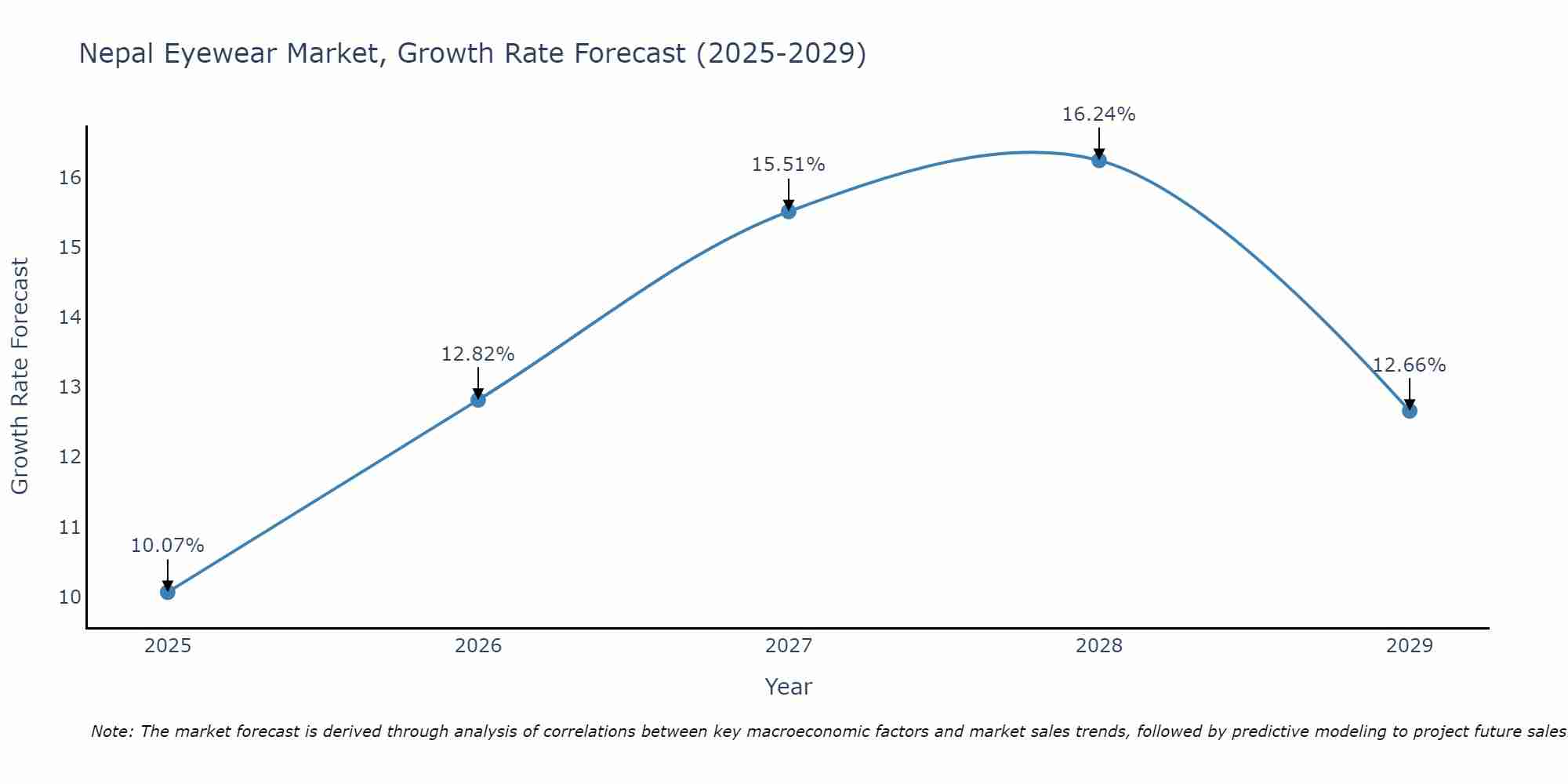
The Nepal Eyewear Market is projected to witness mixed growth rate patterns during 2025 to 2029. Growth accelerates to 16.24% in 2028, following an initial rate of 10.07%, before easing to 12.66% at the end of the period.
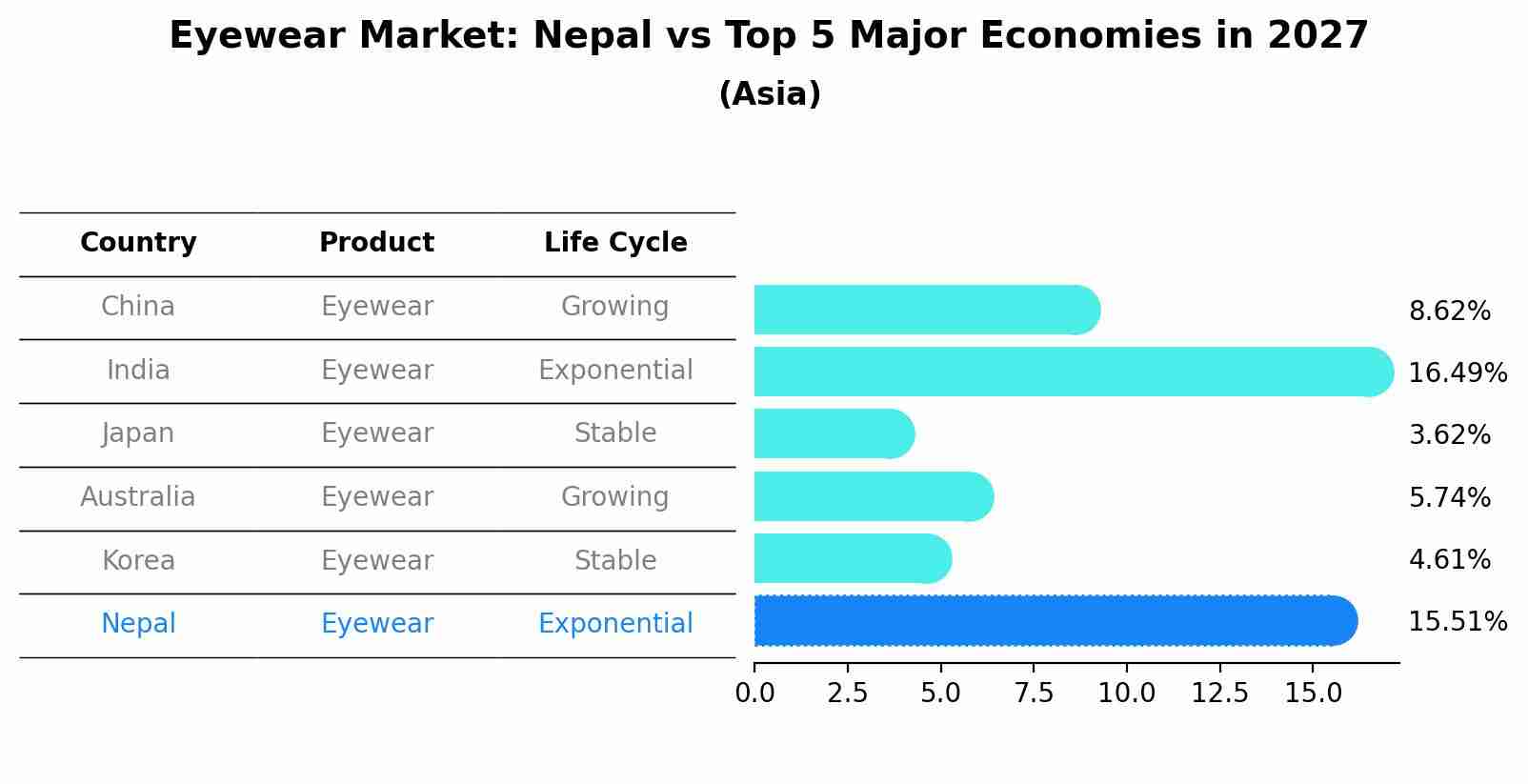
Eyewear Market: Nepal vs Top 5 Major Economies in 2027 (Asia)
In the Asia region, the Eyewear market in Nepal is projected to expand at a exponential growth rate of 15.51% by 2027. The largest economy is China, followed by India, Japan, Australia and South Korea.
Nepal Eyewear Market Synopsis
The Nepal eyewear market is witnessing steady growth driven by factors such as increasing awareness about eye health, rising disposable income, and a growing preference for fashion accessories. The market is characterized by a mix of local and international eyewear brands offering a wide range of products including spectacles, sunglasses, and contact lenses. Opticals stores, online retailers, and fashion boutiques serve as major distribution channels for eyewear products in Nepal. With a growing urban population and a shift towards a more fashion-conscious consumer base, there is a rising demand for trendy and affordable eyewear options in the market. Key players in the Nepal eyewear market include both global brands like Ray-Ban and local players focusing on catering to the diverse needs and preferences of consumers in the country.
Nepal Eyewear Market Trends
The Nepal eyewear market is experiencing a shift towards more fashionable and stylish eyewear options, driven by changing consumer preferences and increasing disposable income. There is a growing demand for premium and luxury eyewear brands, with consumers willing to invest in high-quality frames and lenses. Additionally, there is a significant emphasis on the incorporation of advanced technologies in eyewear products, such as blue light blocking lenses and customizable frames. The rise of e-commerce platforms has also made it easier for consumers to access a wider range of eyewear products and compare prices online. Sustainability and eco-friendly eyewear options are gaining popularity among environmentally conscious consumers. Overall, the Nepal eyewear market is witnessing a trend towards personalized, fashionable, and technologically advanced eyewear products.
Nepal Eyewear Market Challenges
The Nepal eyewear market faces several challenges, including a lack of awareness about the importance of eye health and the benefits of wearing eyewear. Limited access to eye care services, especially in rural areas, also hinders market growth. Additionally, the market is highly fragmented, with many small and unorganized players, leading to issues with product quality and standardization. Import restrictions and high tariffs on eyewear products further impact affordability and accessibility for consumers. Moreover, counterfeit products pose a threat to the market, undermining the reputation of genuine eyewear brands. Addressing these challenges will require collaborations between government agencies, eyewear manufacturers, and healthcare professionals to increase awareness, improve access to eye care services, and enforce regulations to ensure product quality and authenticity.
Nepal Eyewear Market Investment Opportunities
The Nepal eyewear market presents promising investment opportunities due to increasing consumer awareness about eye health and fashion trends. With a growing middle-class population and rising disposable incomes, there is a growing demand for high-quality eyewear products. Investing in established eyewear brands or setting up retail outlets offering a wide range of eyewear options could be lucrative. Additionally, there is potential for growth in the online eyewear segment, leveraging the increasing internet penetration in Nepal. Collaborating with local optometrists to provide vision care services along with eyewear products could also be a strategic investment opportunity. Overall, the Nepal eyewear market offers a favorable environment for investors looking to tap into a growing consumer market with untapped potential.
Nepal Eyewear Market Future Outlook
The Nepal eyewear market is poised for significant growth in the coming years. Factors such as increasing awareness about eye health, rising disposable income, and a growing focus on fashion trends are driving the demand for eyewear products in the country. Additionally, the expanding urban population and the prevalence of digital devices are contributing to the rise in vision-related issues, further boosting the market. The increasing penetration of e-commerce platforms is also making eyewear more accessible to a wider consumer base. As a result, both prescription and non-prescription eyewear segments are expected to witness strong growth, with a particular emphasis on stylish and functional designs. Overall, the Nepal eyewear market is forecasted to experience steady growth and opportunities for innovation and market expansion in the foreseeable future.
Key Highlights of the Report:
- Nepal Eyewear Market Outlook
- Market Size of Nepal Eyewear Market, 2024
- Forecast of Nepal Eyewear Market, 2031
- Historical Data and Forecast of Nepal Eyewear Revenues & Volume for the Period 2021 - 2031
- Nepal Eyewear Market Trend Evolution
- Nepal Eyewear Market Drivers and Challenges
- Nepal Eyewear Price Trends
- Nepal Eyewear Porter's Five Forces
- Nepal Eyewear Industry Life Cycle
- Historical Data and Forecast of Nepal Eyewear Market Revenues & Volume By Product Type for the Period 2021 - 2031
- Historical Data and Forecast of Nepal Eyewear Market Revenues & Volume By Prescription glasses/spectacles for the Period 2021 - 2031
- Historical Data and Forecast of Nepal Eyewear Market Revenues & Volume By Sunglasses for the Period 2021 - 2031
- Historical Data and Forecast of Nepal Eyewear Market Revenues & Volume By Contact lenses for the Period 2021 - 2031
- Historical Data and Forecast of Nepal Eyewear Market Revenues & Volume By Mode of Sale for the Period 2021 - 2031
- Historical Data and Forecast of Nepal Eyewear Market Revenues & Volume By Retail stores for the Period 2021 - 2031
- Historical Data and Forecast of Nepal Eyewear Market Revenues & Volume By Online stores for the Period 2021 - 2031
- Historical Data and Forecast of Nepal Eyewear Market Revenues & Volume By End User for the Period 2021 - 2031
- Historical Data and Forecast of Nepal Eyewear Market Revenues & Volume By Men for the Period 2021 - 2031
- Historical Data and Forecast of Nepal Eyewear Market Revenues & Volume By Women for the Period 2021 - 2031
- Nepal Eyewear Import Export Trade Statistics
- Market Opportunity Assessment By Product Type
- Market Opportunity Assessment By Mode of Sale
- Market Opportunity Assessment By End User
- Nepal Eyewear Top Companies Market Share
- Nepal Eyewear Competitive Benchmarking By Technical and Operational Parameters
- Nepal Eyewear Company Profiles
- Nepal Eyewear Key Strategic Recommendations






































