Nepal Fiberglass Wall Meshes Market Summary
The nepal fiberglass wall meshes market was estimated at USD 168 Million in 2025 and is projected to reach USD 222 Million by 2032, growing at a CAGR of 4.8% from 2026 to 2032.
Nepal Fiberglass Wall Meshes Market Year-wise Growth Rate and Key Drivers
This graph highlights how the Nepal Fiberglass Wall Meshes Market has steadily grown over the past five years, supported by major growth factors.
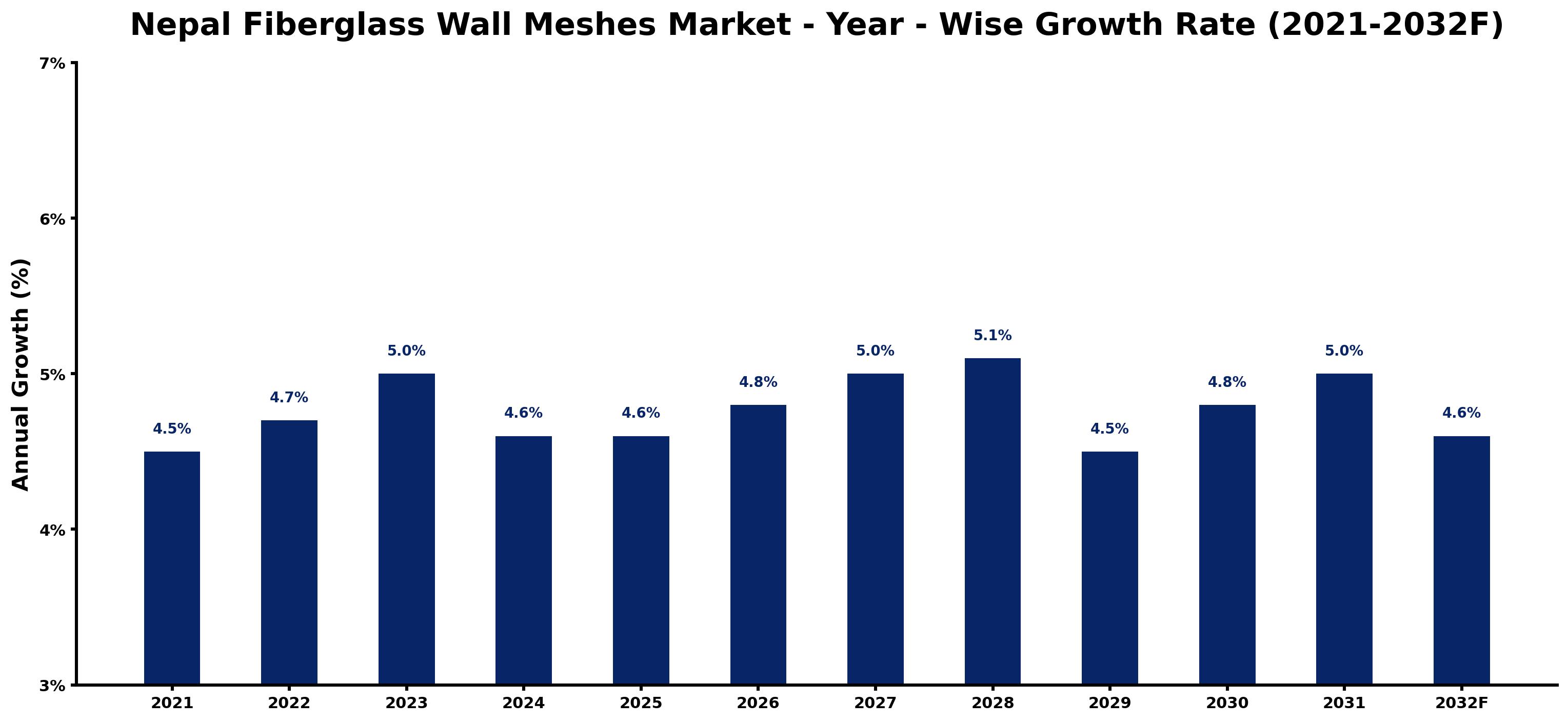
The table below presents the year wise growth rates along with the key drivers influencing the market
| Year | Growth Rate | Major Drivers |
| 2021 | 4.5% | Enhanced construction activities led to increased fiberglass mesh applications in infrastructure projects. |
| 2022 | 4.7% | A shift towards sustainable building materials sparked interest in fiberglass wall meshes. |
| 2023 | 5.0% | Technological improvements in production methods reduced costs for fiberglass mesh manufacturers. |
| 2024 | 4.6% | Local artisans began integrating fiberglass meshes into traditional building practices. |
| 2025 | 4.6% | Increased awareness about earthquake resilience encouraged fiberglass mesh adoption in construction. |
| 2026 | 4.8% | The tourism sector's growth led to more hospitality projects requiring durable building materials. |
| 2027 | 5.0% | Urban migration drove the need for affordable housing solutions, promoting fiberglass mesh usage. |
| 2028 | 5.1% | Government incentives for eco-friendly construction materials further propelled fiberglass mesh demand. |
| 2029 | 4.5% | Collaborations between local businesses and international manufacturers enhanced product accessibility. |
| 2030 | 4.8% | Infrastructure investments aimed at rural areas created new markets for fiberglass wall meshes. |
| 2031 | 5.0% | Emerging green building certifications heightened interest in sustainable mesh solutions among builders. |
| 2032 | 4.6% | Increased exports of fiberglass meshes positioned Nepal as a regional manufacturing hub. |
Note - Market size estimations and growth projections presented in this report are based on 6Wresearch's advanced forecasting approach, validated with industry datasets as of June 2026.
Nepal Fiberglass Wall Meshes Market Synopsis
The Nepal Fiberglass Wall Meshes Market is projected to reach 4.8% and witness significant growth during the forecast period (2026-2032). This growth can be attributed to several key factors, including the rising demand for insulation materials, the increasing adoption of lightweight and cost-effective construction solutions, and the growing emphasis on sustainable practices in construction. Additionally, heightened consumer awareness regarding environmental preservation and energy efficiency is propelling the adoption of fiberglass wall meshes across various applications such as building and construction, industrial insulation, and more.
Nepal Fiberglass Wall Meshes Market Growth Drivers
The Nepal Fiberglass Wall Meshes Market is primarily driven by the escalating demand for environmentally friendly construction materials. The increasing trend towards energy-efficient buildings is incentivizing builders and contractors to consider fiberglass wall meshes due to their thermal insulation properties. Furthermore, the lightweight nature of fiberglass allows for easier handling and installation, making it a favored choice among construction professionals.
- The shift towards sustainable development is prompting a boost in demand for insulation materials, contributing significantly to the market's expansion.
- Government initiatives focused on promoting green building certifications are encouraging the use of fiberglass wall meshes, thereby enhancing market growth.
- Technological advancements in the production of fiberglass wall meshes are leading to better product offerings, improving durability and performance.
- Increased public awareness regarding energy savings during construction processes is driving the market as consumers seek more efficient alternatives.
- Investment in R&D activities by manufacturers to innovate and improve product quality plays a crucial role in sustaining market growth.
Nepal Fiberglass Wall Meshes Market Trends and Opportunities
Current trends in the Nepal Fiberglass Wall Meshes Market illustrate a strong focus on the integration of advanced technologies into production processes. This results in the enhancement of product efficacy and a reduction in environmental impact. Moreover, there is a growing trend towards customization, where manufacturers are offering tailored solutions to meet specific client requirements across different applications.
- Adoption of smart technologies in construction is creating opportunities for innovative applications of fiberglass wall meshes in energy-efficient building designs.
- The rising popularity of prefabricated construction methods is increasing the demand for lightweight materials such as fiberglass mesh.
- Consumers are now more inclined to invest in durable, high-performance materials, which enhances the market prospects for fiberglass solutions.
- Expansion of infrastructure development projects in urban areas is anticipated to fuel demand for fiberglass wall meshes, supporting overall market growth.
- Partnerships and collaborations between construction firms and fiberglass manufacturers are emerging as a strategic trend to leverage combined expertise for market entry.
Nepal Fiberglass Wall Meshes Market Challenges and Restraints
Despite the positive outlook, the Nepal Fiberglass Wall Meshes Market faces certain challenges that could impede growth. Stringent regulations regarding the use of specific chemicals in production processes represent a significant hurdle for manufacturers. Compliance with these regulations often requires substantial investment in reformulating materials, which could impact profitability.
- The fluctuating prices of raw materials, such as glass fibers, can pose risks to manufacturers, affecting production costs and overall market stability.
- An inadequate supply chain infrastructure in certain regions may lead to delays in material availability, hindering timely project execution.
- Consumer perception regarding the durability of fiberglass products compared to traditional materials could influence adoption rates.
- Competition from alternative insulation materials, which may offer lower upfront costs, can pose challenges in market penetration.
- Economic fluctuations and uncertainties can impact the overall construction sector, consequently affecting demand for fiberglass wall meshes.
Nepal Fiberglass Wall Meshes Market Government Investment and Initiatives
Government investment in infrastructure development and sustainability initiatives plays a pivotal role in the Nepal Fiberglass Wall Meshes Market. The government is continuously working to enhance regulatory frameworks that promote energy-efficient building practices, which inherently increases the demand for fiberglass wall meshes. By providing subsidies and financial incentives for eco-friendly construction projects, the government is stimulating market growth.
- Investment in renewable energy projects is fostering a greater need for effective insulation solutions, including fiberglass meshes.
- The implementation of stringent building codes that enforce energy efficiency standards is contributing to the increased use of fiberglass materials in construction.
- Government-led awareness campaigns are educating consumers on the benefits of using sustainable construction materials, including fiberglass meshes.
- Infrastructure projects spearheaded by the government are creating opportunities for contractors to use fiberglass wall meshes in various applications.
- Collaborative projects between the government and private sectors in building development are encouraging innovation in product offerings.
Nepal Fiberglass Wall Meshes Market Latest Developments (May 2025 - June 2026)
In recent developments within the Nepal Fiberglass Wall Meshes Market from May 2025 to June 2026, there has been a notable increase in the adoption of new technologies aimed at enhancing product efficiency and environmental performance. Manufacturers have been focusing on sustainable practices, which is evident in their production methods and material selections. Furthermore, there is a growing trend of collaborative innovation, where companies are pooling resources to develop advanced fiberglass solutions tailored for specific applications in the construction industry.
- Research initiatives aimed at developing alternative raw materials for fiberglass production are gaining traction to reduce reliance on traditional sources.
- Innovations in the design and manufacturing process of fiberglass wall meshes are being implemented to improve product durability.
- Increased participation in international trade shows has enabled local manufacturers to showcase their products and technology advancements.
- New marketing strategies are being employed to educate potential customers about the advantages of fiberglass wall meshes over traditional materials.
- The market is seeing enhanced collaboration with sustainability-focused organizations to promote fiberglass as a green building material.
Nepal Fiberglass Wall Meshes Market - Key Attractiveness of the Report
- 10 Years of Market Numbers
- Historical Data Starting from 2022 to 2025
- Base Year: 2025
- Forecast Data until 2032
- Key Performance Indicators Impacting the Market
- Major Upcoming Developments and Projects
Key Highlights of the Report:
- Nepal Fiberglass Wall Meshes Market Outlook
- Market Size of Nepal Fiberglass Wall Meshes Market, 2025
- Forecast of Nepal Fiberglass Wall Meshes Market, 2032F
- Historical Data and Forecast of Nepal Fiberglass Wall Meshes Revenues & Volume for the Period 2022-2032F
- Nepal Fiberglass Wall Meshes Market Trend Evolution
- Nepal Fiberglass Wall Meshes Market Drivers and Challenges
- Nepal Fiberglass Wall Meshes Price Trends
- Nepal Fiberglass Wall Meshes Porter's Five Forces
- Nepal Fiberglass Wall Meshes Industry Life Cycle
- Historical Data and Forecast of Nepal Fiberglass Wall Meshes Market Revenues & Volume By Type for the Period 2022-2032F
- Historical Data and Forecast of Nepal Fiberglass Wall Meshes Market Revenues & Volume By C-Glass for the Period 2022-2032F
- Historical Data and Forecast of Nepal Fiberglass Wall Meshes Market Revenues & Volume By E-Glass for the Period 2022-2032F
- Historical Data and Forecast of Nepal Fiberglass Wall Meshes Market Revenues & Volume By Others for the Period 2022-2032F
- Historical Data and Forecast of Nepal Fiberglass Wall Meshes Market Revenues & Volume By Applications for the Period 2022-2032F
- Historical Data and Forecast of Nepal Fiberglass Wall Meshes Market Revenues & Volume By External Wall Insulation for the Period 2022-2032F
- Historical Data and Forecast of Nepal Fiberglass Wall Meshes Market Revenues & Volume By Building Waterproof for the Period 2022-2032F
- Historical Data and Forecast of Nepal Fiberglass Wall Meshes Market Revenues & Volume By Others for the Period 2022-2032F
- Nepal Fiberglass Wall Meshes Import Export Trade Statistics
- Market Opportunity Assessment By Type
- Market Opportunity Assessment By Applications
- Nepal Fiberglass Wall Meshes Top Companies Market Share
- Nepal Fiberglass Wall Meshes Competitive Benchmarking By Technical and Operational Parameters
- Nepal Fiberglass Wall Meshes Company Profiles
- Nepal Fiberglass Wall Meshes Key Strategic Recommendations






































