Nepal Fish Farming Market Size, Share & Growth Rate
The Nepal Fish Farming Market was estimated at USD 194 Million in 2025 and is projected to reach USD 257 Million by 2032, growing at a CAGR of 4.1% from 2026 to 2032. This growth trajectory is primarily driven by a rising demand for fish products, supported by a growing population increasingly shifting towards healthier protein sources. Additionally, favorable government policies and technological advancements in aquaculture practices are propelling this sector into a new era of productivity and efficiency.
Nepal Fish Farming Market Year-wise Growth Rate and Key Drivers
This graph highlights how the Nepal Fish Farming Market has steadily grown over the years, supported by major growth factors.
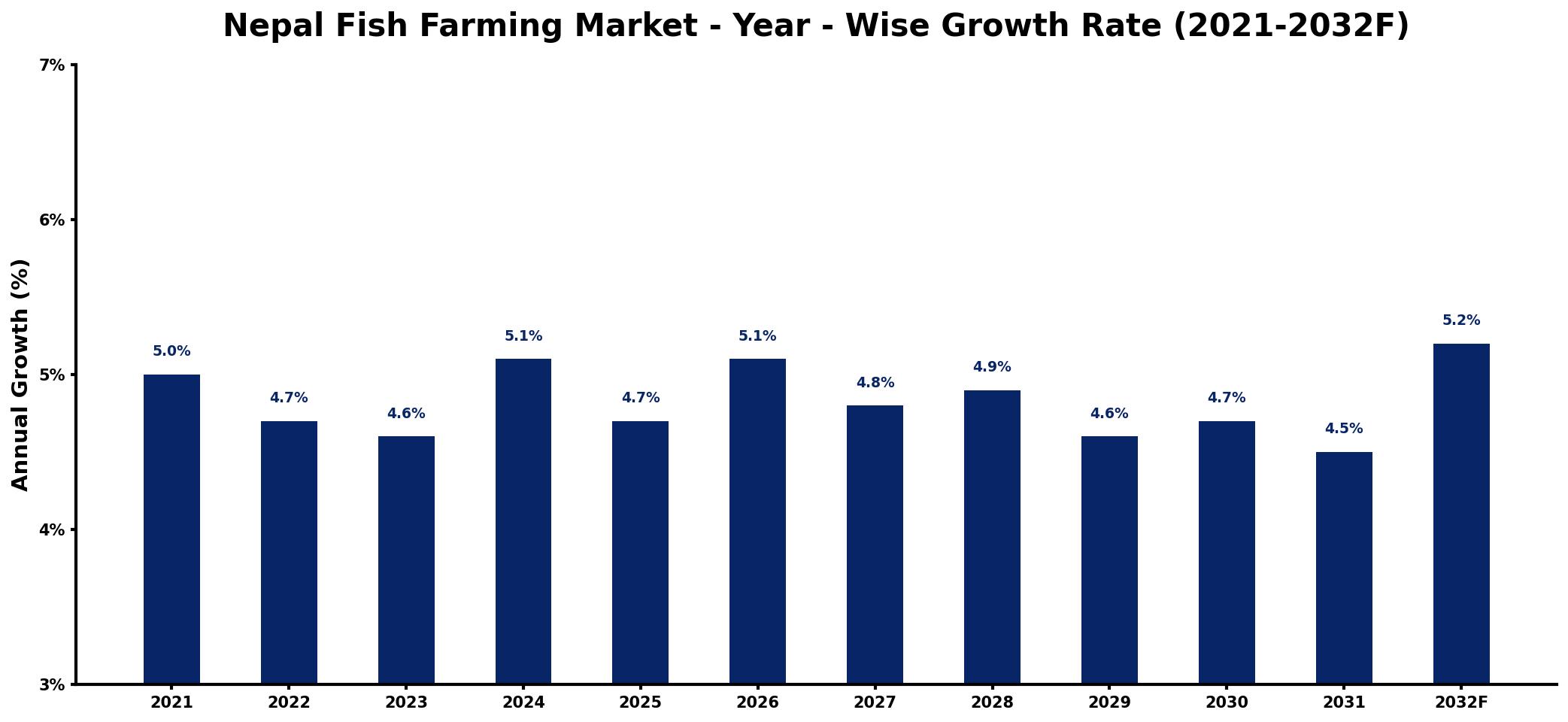
The table below presents the year‑wise growth rates along with the key drivers influencing the market
| Year | Growth Rate | Major Drivers |
| 2021 | 5.0% | Rising consumer protein demand |
| 2022 | 4.7% | Increased investment in aquaculture |
| 2023 | 4.6% | Expansion of export opportunities |
| 2024 | 5.1% | Growing health consciousness among consumers |
| 2025 | 4.7% | Technological advancements in production |
| 2026 | 5.1% | Strengthening supply chain networks |
| 2027 | 4.8% | growing commercial sector adoption |
| 2028 | 4.9% | Increase in sustainable practices |
| 2029 | 4.6% | Development of new distribution channels |
| 2030 | 4.7% | Emerging interest in aquaponics systems |
| 2031 | 4.5% | Collaboration with research institutions |
| 2032 | 5.2% | Government support for innovation |
Note: Market size estimations and growth projections presented in this report are based on 6Wresearch's proprietary forecasting methodology, utilizing the latest available industry data, government publications, and primary research inputs.
Nepal Fish Farming Market Synopsis
The Nepal Fish Farming Market is currently witnessing significant momentum as local fish farmers adapt to changing consumer preferences for healthier diets. The Terai region is emerging as a hub for commercial fish farming due to its advantageous climate and access to major markets, while small-scale farmers continue to play a pivotal role in the market.
With tilapia, carp, and catfish leading the species farmed, the market is seeing an increase in the adoption of sustainable practices. However, challenges such as inadequate infrastructure and limited access to quality fish feed remain prevalent, necessitating focused efforts to maximize the industry's potential.
Nepal Fish Farming Market Key Takeaways
- The market is increasingly characterized by small-scale farmers, who are significant contributors to production.
- Technological advancements are improving productivity and efficiency across fish farming operations.
- Sustainable aquaculture practices are becoming the standard, with a focus on minimizing environmental impact.
- Consumer demand is shifting toward high-value fish species, increasing opportunities for profitability.
- Challenges in infrastructure and resources must be addressed for sustainable long-term growth.
Evaluation of Restraints in Nepal Fish Farming Market
Despite its promising outlook, the Nepal Fish Farming Market faces significant restraints that limit its full potential. A critical barrier is the limited access to quality fish feed, which is essential for maintaining fish health and optimizing growth rates. Furthermore, the industry's infrastructure for transportation and storage remains inadequate, leading to inefficiencies and increased costs for farmers. Additionally, the susceptibility of fish farms to disease outbreaks complicates production stability, adversely affecting profitability. Inadequate training and education for farmers compound these challenges, emphasizing the need for investment in skill development and resource accessibility to foster a thriving aquaculture sector.
Nepal Fish Farming Market Trends
A noteworthy trend within the Nepal Fish Farming Market is the surge in sustainable and eco-friendly practices. Fish farmers are increasingly adopting integrated farming systems and using natural feeds to reduce environmental footprints. Additionally, the growing popularity of high-value species like trout and tilapia is becoming evident as consumers seek more nutritious options. The infusion of technology is also reshaping the landscape, with automation and data analytics improving operational efficiency and yield quality.
Nepal Fish Farming Market Opportunities
The fish farming sector in Nepal is ripe with investment opportunities, driven by an increasing appetite for fish products. Investors can capitalize on the demand by establishing modern fish farms outfitted with cutting-edge technology for optimal production. Furthermore, the burgeoning market for value-added fish products, such as processed fish items and innovative fish-based snacks, offers additional avenues for growth. Collaborating with local farmers to provide training, resources, and support for sustainable practices will enhance both profitability and the overall development of the market.
Government Initiatives in the Nepal Fish Farming Market
The Nepalese government has put various initiatives in place to bolster the fish farming industry. This includes financial assistance and subsidies aimed at enhancing fish farming infrastructure, such as the establishment of ponds and hatcheries. Regulations are established to promote sustainable aquaculture practices, focusing on water quality management, fish health, and responsible feed usage. Additionally, technical training programs for farmers aim to elevate their skills and competencies, while campaigns to encourage fish consumption seek to increase market access for local producers. Collectively, these initiatives reflect the government's commitment to advancing the sector while ensuring environmental sustainability.
Future Insights of the Nepal Fish Farming Market
Looking towards the future, the Nepal Fish Farming Market appears poised for continued growth through 2032. The increasing consumer awareness regarding the health benefits of fish consumption, combined with favorable demographic trends, is expected to keep demand strong. As sustainable practices become ingrained in the industry, investments in technology will likely yield enhanced productivity and operational efficiencies. Emerging trends like aquaponics, which synergize fish farming with agriculture, present fresh opportunities for market expansion. Overall, while challenges persist, the commitment to innovation and sustainability suggests a positive trajectory for the market.
Nepal Fish Farming Market Latest Developments (2025 - 2026)
In recent months, the Nepal Fish Farming Market has seen various initiatives aimed at enhancing productivity and sustainability. There has been a noticeable increase in the establishment of modern fish farms that leverage new technologies to boost production efficiency. Workshops and training sessions organized by government bodies and NGOs are gaining traction, helping farmers adopt best practices in sustainable aquaculture. Furthermore, local cooperatives are forming to improve market access for fish farmers, facilitating better communication and resource sharing among stakeholders. These developments underscore a collective effort toward advancing the market's growth and sustainability.
Nepal Fish Farming Market - Key Attractiveness of the Report
- 10 Years of Market Numbers
- Historical Data Starting from 2022 to 2025
- Base Year: 2025
- Forecast Data until 2032
- Key Performance Indicators Impacting the Market
- Major Upcoming Developments and Projects
Key Highlights of the Report:
- Nepal Fish Farming Market Outlook
- Market Size of Nepal Fish Farming Market, 2025
- Forecast of Nepal Fish Farming Market, 2032
- Historical Data and Forecast of Nepal Fish Farming Revenues & Volume for the Period 2022-2032F
- Nepal Fish Farming Market Trend Evolution
- Nepal Fish Farming Market Drivers and Challenges
- Nepal Fish Farming Price Trends
- Nepal Fish Farming Porter's Five Forces
- Nepal Fish Farming Industry Life Cycle
- Historical Data and Forecast of Nepal Fish Farming Market Revenues & Volume By Environment for the Period 2022-2032F
- Historical Data and Forecast of Nepal Fish Farming Market Revenues & Volume By Marine Water for the Period 2022-2032F
- Historical Data and Forecast of Nepal Fish Farming Market Revenues & Volume By Fresh Water for the Period 2022-2032F
- Historical Data and Forecast of Nepal Fish Farming Market Revenues & Volume By Brackish Water for the Period 2022-2032F
- Historical Data and Forecast of Nepal Fish Farming Market Revenues & Volume By Fish Type for the Period 2022-2032F
- Historical Data and Forecast of Nepal Fish Farming Market Revenues & Volume By Pompano for the Period 2022-2032F
- Historical Data and Forecast of Nepal Fish Farming Market Revenues & Volume By Snappers for the Period 2022-2032F
- Historical Data and Forecast of Nepal Fish Farming Market Revenues & Volume By Groupers for the Period 2022-2032F
- Historical Data and Forecast of Nepal Fish Farming Market Revenues & Volume By Salmon for the Period 2022-2032F
- Historical Data and Forecast of Nepal Fish Farming Market Revenues & Volume By Milkfish for the Period 2022-2032F
- Historical Data and Forecast of Nepal Fish Farming Market Revenues & Volume By Tuna for the Period 2022-2032F
- Historical Data and Forecast of Nepal Fish Farming Market Revenues & Volume By Tilapia for the Period 2022-2032F
- Historical Data and Forecast of Nepal Fish Farming Market Revenues & Volume By Others for the Period 2022-2032F
- Nepal Fish Farming Import Export Trade Statistics
- Market Opportunity Assessment By Environment
- Market Opportunity Assessment By Fish Type
- Nepal Fish Farming Top Companies Market Share
- Nepal Fish Farming Competitive Benchmarking By Technical and Operational Parameters
- Nepal Fish Farming Company Profiles
- Nepal Fish Farming Key Strategic Recommendations






































