Nepal Food & Grocery Retail Market Size, Share & Growth Rate
The Nepal Food & Grocery Retail Market was estimated at USD 644 Million in 2025 and is projected to reach USD 1178 Million by 2032, growing at a CAGR of 9.0% from 2026 to 2032. This impressive growth trajectory is primarily driven by urbanization trends, rising disposable incomes, and evolving consumer preferences favoring convenience and quality. As the middle-class population expands, so does the demand for diverse product offerings across both traditional and modern retail platforms.
Nepal Food & Grocery Retail Market Year-wise Growth Rate and Key Drivers
This graph highlights how the Nepal Food & Grocery Retail Market has steadily grown over the years, supported by major growth factors.
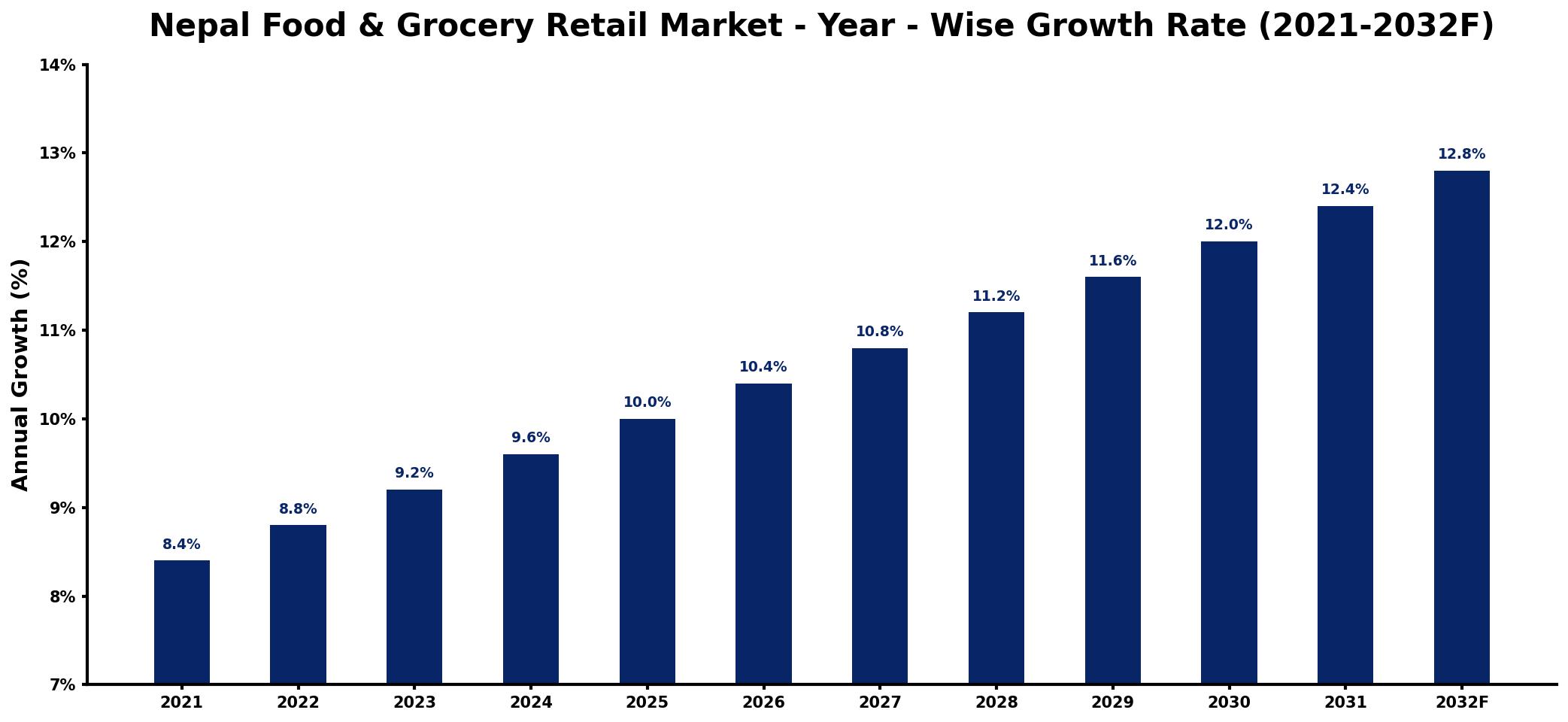
The table below presents the year‑wise growth rates along with the key drivers influencing the market
| Year | Growth Rate | Major Drivers |
| 2021 | 8.4% | Rising consumer purchasing power |
| 2022 | 8.8% | Increased urbanization trends observed |
| 2023 | 9.2% | Expansion of e-commerce platforms |
| 2024 | 9.6% | Growth in population demographics |
| 2025 | 10.0% | Investment in cold chain logistics |
| 2026 | 10.4% | Emergence of health consciousness |
| 2027 | 10.8% | Diversification of product offerings |
| 2028 | 11.2% | Enhancement of supply chain efficiency |
| 2029 | 11.6% | Adoption of modern payment solutions |
| 2030 | 12.0% | Increase in disposable incomes |
| 2031 | 12.4% | Development of local sourcing initiatives |
| 2032 | 12.8% | Strengthening of consumer loyalty programs |
Note: Market size estimations and growth projections presented in this report are based on 6Wresearch's proprietary forecasting methodology, utilizing the latest available industry data, government publications, and primary research inputs.
Nepal Food & Grocery Retail Market Synopsis
Currently, the Nepal Food & Grocery Retail Market reflects a dynamic landscape characterized by a blend of traditional and modern retail formats. While corner shops and mom-and-pop stores still hold a significant market share, the penetration of supermarkets and e-commerce is reshaping consumer habits and expectations.
In urban centers, the shift toward online shopping and the demand for health-conscious options are noteworthy. Retailers are increasingly adapting to these changes by diversifying their product ranges, ensuring the availability of organic and convenient food items to cater to the evolving lifestyle of Nepalese consumers.
- The market is seeing rapid growth fueled by rising urban populations and disposable income levels.
- Traditional retail formats remain dominant, but modern channels like e-commerce are gaining significant traction.
- Consumer preferences are shifting towards healthy and organic food products, driving innovations in product offerings.
- Environmental sustainability is becoming a priority, prompting retailers to adopt eco-friendly practices.
- Investment in supply chain improvements is critical to addressing post-harvest losses and enhancing efficiency.
Despite promising growth, the Nepal Food & Grocery Retail Market faces considerable challenges. Limited infrastructure hinders supply chain efficiency, while inadequate cold storage facilities lead to post-harvest losses. The presence of a fragmented market with numerous small retailers complicates distribution efforts and can lead to inconsistent quality standards that erode consumer trust. Additionally, political instability and a predominantly cash-based economy pose further hurdles, necessitating strategic initiatives to build a more resilient market framework.
The market is currently witnessing a significant shift toward online grocery shopping, spurred by the increasing penetration of smartphones and internet access. Convenience, diverse product availability, and the rising trend of food delivery services are reshaping how consumers engage with grocery retail. Moreover, the demand for organic and healthy food options is growing rapidly, prompting retailers to innovate and adapt their offerings accordingly. Sustainability is also at the forefront, with a marked interest in eco-friendly packaging and practices gaining momentum among consumers.
The landscape of the Nepal Food & Grocery Retail Market is ripe with investment opportunities. The expanding middle class is not only interested in convenience but also in quality, creating openings for supermarket chains and specialty food stores. Additionally, there is a need for enhanced supply chain and distribution networks to mitigate inefficiencies and reduce waste. The emphasis on health and sustainability offers avenues for innovative product development, enabling businesses to capture the growing consumer segment focused on these values.
Government policies in Nepal are increasingly aimed at enhancing food security, promoting fair competition, and safeguarding consumer rights. There are ongoing efforts to regulate food prices and enforce quality and safety standards within the retail sector. Support for small and medium-sized enterprises is also evident through access to financing and technical assistance, which are crucial for fostering innovation and growth. Overall, these initiatives are designed to create a conducive environment for sustainable market expansion and consumer protection.
Looking ahead to 2026-2032, the Nepal Food & Grocery Retail Market is set to flourish, driven by continued urbanization, evolving consumer preferences, and the ongoing rise in disposable incomes. As technological advancements and e-commerce solutions become more integrated into the shopping experience, the market will likely witness enhanced accessibility and convenience for consumers. However, addressing ongoing challenges related to infrastructure and supply chain efficiency will be essential for sustained growth and innovation in this sector.
Recent developments in the Nepal Food & Grocery Retail Market highlight a growing trend towards digital transformation and a surge in the adoption of e-commerce platforms. Retailers are increasingly focusing on enhancing their online presence to cater to the demand for convenience. Additionally, there has been a notable rise in collaborations between local producers and retailers, aiming to improve product quality and reduce supply chain inefficiencies.
- 10 Years of Market Numbers
- Historical Data Starting from 2022 to 2025
- Base Year: 2025
- Forecast Data until 2032
- Key Performance Indicators Impacting the Market
- Major Upcoming Developments and Projects
Key Highlights of the Report:
- Nepal Food & Grocery Retail Market Outlook
- Market Size of Nepal Food & Grocery Retail Market, 2025
- Forecast of Nepal Food & Grocery Retail Market, 2032
- Historical Data and Forecast of Nepal Food & Grocery Retail Revenues & Volume for the Period 2022-2032F
- Nepal Food & Grocery Retail Market Trend Evolution
- Nepal Food & Grocery Retail Market Drivers and Challenges
- Nepal Food & Grocery Retail Price Trends
- Nepal Food & Grocery Retail Porter's Five Forces
- Nepal Food & Grocery Retail Industry Life Cycle
- Historical Data and Forecast of Nepal Food & Grocery Retail Market Revenues & Volume By Product for the Period 2022-2032F
- Historical Data and Forecast of Nepal Food & Grocery Retail Market Revenues & Volume By Fresh Food for the Period 2022-2032F
- Historical Data and Forecast of Nepal Food & Grocery Retail Market Revenues & Volume By Frozen Food for the Period 2022-2032F
- Historical Data and Forecast of Nepal Food & Grocery Retail Market Revenues & Volume By Food Cupboard for the Period 2022-2032F
- Historical Data and Forecast of Nepal Food & Grocery Retail Market Revenues & Volume By Beverages for the Period 2022-2032F
- Historical Data and Forecast of Nepal Food & Grocery Retail Market Revenues & Volume By Cleaning & Household for the Period 2022-2032F
- Historical Data and Forecast of Nepal Food & Grocery Retail Market Revenues & Volume By Others for the Period 2022-2032F
- Historical Data and Forecast of Nepal Food & Grocery Retail Market Revenues & Volume By Distribution Channel for the Period 2022-2032F
- Historical Data and Forecast of Nepal Food & Grocery Retail Market Revenues & Volume By Supermarkets & Hypermarkets for the Period 2022-2032F
- Historical Data and Forecast of Nepal Food & Grocery Retail Market Revenues & Volume By Convenience Stores for the Period 2022-2032F
- Historical Data and Forecast of Nepal Food & Grocery Retail Market Revenues & Volume By Departmental Stores & Clubs for the Period 2022-2032F
- Historical Data and Forecast of Nepal Food & Grocery Retail Market Revenues & Volume By Online for the Period 2022-2032F
- Nepal Food & Grocery Retail Import Export Trade Statistics
- Market Opportunity Assessment By Product
- Market Opportunity Assessment By Distribution Channel
- Nepal Food & Grocery Retail Top Companies Market Share
- Nepal Food & Grocery Retail Competitive Benchmarking By Technical and Operational Parameters
- Nepal Food & Grocery Retail Company Profiles
- Nepal Food & Grocery Retail Key Strategic Recommendations






































