Nepal Food Processing & Handling Equipment Market Summary
The nepal food processing & handling equipment market was estimated at USD 352 Million in 2025 and is projected to reach USD 499 Million by 2032, growing at a CAGR of 6.1% from 2026 to 2032.
Nepal Food Processing & Handling Equipment Market Year-wise Growth Rate and Key Drivers
This graph highlights how the Nepal Food Processing & Handling Equipment Market has steadily grown over the past five years, supported by major growth factors.
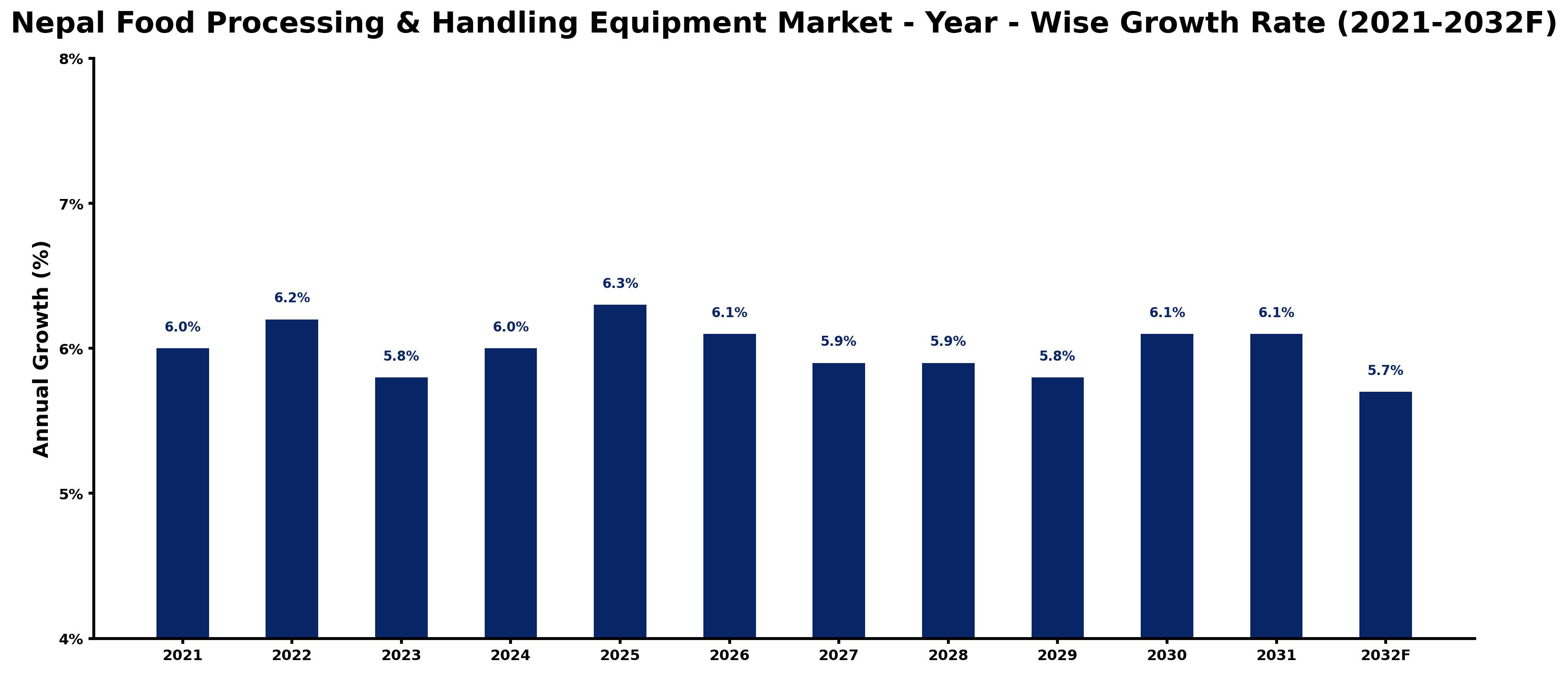
The table below presents the year wise growth rates along with the key drivers influencing the market
| Year | Growth Rate | Major Drivers |
| 2021 | 6.0% | Investment in food safety standards is reshaping processing equipment demands across industries. |
| 2022 | 6.2% | E-commerce's growth has led to innovative packaging solutions for food products. |
| 2023 | 5.8% | Rural electrification projects are expanding access to modern food processing technologies. |
| 2024 | 6.0% | Consumer preferences are shifting towards organic and locally sourced food products. |
| 2025 | 6.3% | Technological partnerships are enhancing efficiency in food handling processes and logistics. |
| 2026 | 6.1% | Supply chain resilience initiatives are driving investments in advanced food processing technologies. |
| 2027 | 5.9% | Sustainable practices are influencing procurement choices for equipment and materials. |
| 2028 | 5.9% | Urbanization trends are prompting a surge in demand for packaged food items. |
| 2029 | 5.8% | Emerging startups are introducing disruptive innovations in food processing and preservation. |
| 2030 | 6.1% | Health consciousness among consumers is driving demand for nutritious processing solutions. |
| 2031 | 6.1% | Integration of IoT in food processing is improving operational efficiency and monitoring. |
| 2032 | 5.7% | Technological advancements in automation are reshaping labor dynamics within food handling. |
Note - Market size estimations and growth projections presented in this report are based on 6Wresearch's advanced forecasting approach, validated with industry datasets as of June 2026.
Nepal Food Processing & Handling Equipment Market Synopsis
The Nepal Food Processing Handling Equipment Market is projected to reach 6.1% and witness significant growth during the forecast period (2026-2032). This growth is primarily fueled by the increasing urbanization in Nepal, evolving consumer preferences towards processed food products, and a notable rise in the middle-class population seeking convenience foods. In this landscape, the focus on food safety and quality has emerged as a critical imperative for manufacturers, driving the demand for modern food processing and handling equipment.
Nepal Food Processing & Handling Equipment Market Growth Drivers
A variety of factors are contributing to the growth trajectory of the Nepal Food Processing & Handling Equipment Market. Key drivers include:
- The rapid urbanization trends leading to changing dietary habits among consumers, increasing the demand for ready-to-eat and processed food options.
- A growing middle-class population, which is increasingly inclined towards quality and convenience in food consumption, thus elevating the requirement for efficient food processing machinery.
- Heightened awareness regarding food safety and hygiene standards, prompting manufacturers to invest in modern equipment that adheres to these regulations.
- The government's initiatives aimed at promoting the food processing sector, significantly creating a conducive environment for investments and technological advancements.
- The increasing integration of automation in food handling processes to improve operational efficiency and reduce labor-related costs.
Nepal Food Processing & Handling Equipment Market Trends and Opportunities
In recent years, the Nepal Food Processing & Handling Equipment Market has exhibited several notable trends that offer significant opportunities for stakeholders:
- A noticeable shift towards eco-friendly and sustainable equipment, responding to both consumer preferences and environmental regulations.
- The adoption of cutting-edge technologies such as IoT and AI that enhance operational efficiency, allowing for real-time tracking and quality control of processed food products.
- Growing investment in research and development to create innovative equipment tailored to the unique needs of Nepal's agricultural landscape.
- Increasing collaboration between local food processors and technology providers to modernize production processes and supply chain facilities.
- Rising demand for cold storage solutions and packaging machinery, driven by the necessity to maintain food quality and extend shelf-life in a rapidly evolving market.
Nepal Food Processing & Handling Equipment Market Challenges and Restraints
Despite the promising outlook, the Nepal Food Processing & Handling Equipment Market faces a set of challenges that could impede its growth:
- High initial investment costs associated with advanced machinery, which can be a significant barrier for small-scale food processors.
- Limited access to the latest technologies and equipment, hindering the ability of local manufacturers to compete effectively.
- Inadequate infrastructure and transportation facilities complicate the logistics of food processing operations, leading to inefficiencies.
- A shortage of skilled labor trained in modern food processing techniques restricts operational effectiveness and the adoption of advanced equipment.
- Inconsistent power supply issues further challenge the smooth functioning of food processing units, impacting production schedules and product quality.
Nepal Food Processing & Handling Equipment Market Government Investment and Initiatives
The government of Nepal has recognized the strategic importance of the food processing sector, leading to several initiatives aimed at fostering its growth:
- Implementation of financial incentives and subsidies designed to encourage investment in food processing equipment and bolster the sector's infrastructure.
- Facilitation of easier access to credit for businesses operating within the food processing domain to support modernization efforts.
- Promotion of technology transfer initiatives aimed at integrating advanced machinery and methodologies into local production processes.
- Enforcement of compliance with food safety and quality standards to enhance consumer trust in processed food products.
- Investment in the improvement of logistics and transportation networks to ensure efficient handling and distribution of food products.
Nepal Food Processing & Handling Equipment Market Latest Developments (May 2025 - June 2026)
During the period from May 2025 to June 2026, the Nepal Food Processing & Handling Equipment Market has seen several noteworthy developments that signal a shift in industry dynamics. The focus on automation and digital technologies has intensified, with many manufacturers investing in IoT-based solutions for process monitoring and optimization. There has been a marked increase in the collaboration between private sectors and academic institutions to develop innovative and localized processing equipment. Additionally, the government has ramped up its efforts to promote modern food processing through enhanced funding and infrastructure development policies, reflecting a commitment to transforming the sector.
Nepal Food Processing & Handling Equipment Market - Key Attractiveness of the Report
- 10 Years of Market Numbers
- Historical Data Starting from 2022 to 2025
- Base Year: 2025
- Forecast Data until 2032
- Key Performance Indicators Impacting the Market
- Major Upcoming Developments and Projects
Key Highlights of the Report:
- Nepal Food Processing & Handling Equipment Market Outlook
- Market Size of Nepal Food Processing & Handling Equipment Market, 2025
- Forecast of Nepal Food Processing & Handling Equipment Market, 2032F
- Historical Data and Forecast of Nepal Food Processing & Handling Equipment Revenues & Volume for the Period 2022-2032F
- Nepal Food Processing & Handling Equipment Market Trend Evolution
- Nepal Food Processing & Handling Equipment Market Drivers and Challenges
- Nepal Food Processing & Handling Equipment Price Trends
- Nepal Food Processing & Handling Equipment Porter's Five Forces
- Nepal Food Processing & Handling Equipment Industry Life Cycle
- Historical Data and Forecast of Nepal Food Processing & Handling Equipment Market Revenues & Volume By Equipment Type for the Period 2022-2032F
- Historical Data and Forecast of Nepal Food Processing & Handling Equipment Market Revenues & Volume By Food Processing equipment for the Period 2022-2032F
- Historical Data and Forecast of Nepal Food Processing & Handling Equipment Market Revenues & Volume By Foodservice equipment for the Period 2022-2032F
- Historical Data and Forecast of Nepal Food Processing & Handling Equipment Market Revenues & Volume By Food Packaging equipment for the Period 2022-2032F
- Historical Data and Forecast of Nepal Food Processing & Handling Equipment Market Revenues & Volume By Application for the Period 2022-2032F
- Historical Data and Forecast of Nepal Food Processing & Handling Equipment Market Revenues & Volume By Bakery & confectionery products for the Period 2022-2032F
- Historical Data and Forecast of Nepal Food Processing & Handling Equipment Market Revenues & Volume By Meat & poultry products for the Period 2022-2032F
- Historical Data and Forecast of Nepal Food Processing & Handling Equipment Market Revenues & Volume By Dairy products for the Period 2022-2032F
- Historical Data and Forecast of Nepal Food Processing & Handling Equipment Market Revenues & Volume By Alcoholic beverages for the Period 2022-2032F
- Historical Data and Forecast of Nepal Food Processing & Handling Equipment Market Revenues & Volume By Non-alcoholic beverages for the Period 2022-2032F
- Historical Data and Forecast of Nepal Food Processing & Handling Equipment Market Revenues & Volume By Fish & seafood products for the Period 2022-2032F
- Historical Data and Forecast of Nepal Food Processing & Handling Equipment Market Revenues & Volume By Others? for the Period 2022-2032F
- Historical Data and Forecast of Nepal Food Processing & Handling Equipment Market Revenues & Volume By Form for the Period 2022-2032F
- Historical Data and Forecast of Nepal Food Processing & Handling Equipment Market Revenues & Volume By Solid for the Period 2022-2032F
- Historical Data and Forecast of Nepal Food Processing & Handling Equipment Market Revenues & Volume By Liquid for the Period 2022-2032F
- Historical Data and Forecast of Nepal Food Processing & Handling Equipment Market Revenues & Volume By Semi-solid for the Period 2022-2032F
- Nepal Food Processing & Handling Equipment Import Export Trade Statistics
- Market Opportunity Assessment By Equipment Type
- Market Opportunity Assessment By Application
- Market Opportunity Assessment By Form
- Nepal Food Processing & Handling Equipment Top Companies Market Share
- Nepal Food Processing & Handling Equipment Competitive Benchmarking By Technical and Operational Parameters
- Nepal Food Processing & Handling Equipment Company Profiles
- Nepal Food Processing & Handling Equipment Key Strategic Recommendations






































