Nepal Gas Equipment Market Size, Share & Growth Rate
The Nepal Gas Equipment Market was estimated at USD 165 Million in 2025 and is projected to reach USD 216 Million by 2032, growing at a CAGR of 3.9% from 2026 to 2032. This growth trajectory is largely attributed to the increasing shift towards cleaner energy sources, with LPG becoming the preferred choice for cooking in both urban and rural settings. The expansion of distribution networks and government support for LPG usage are key elements driving this upward trend.
Nepal Gas Equipment Market Year-wise Growth Rate and Key Drivers
This graph highlights how the Nepal Gas Equipment Market has steadily grown over the years, supported by major growth factors.
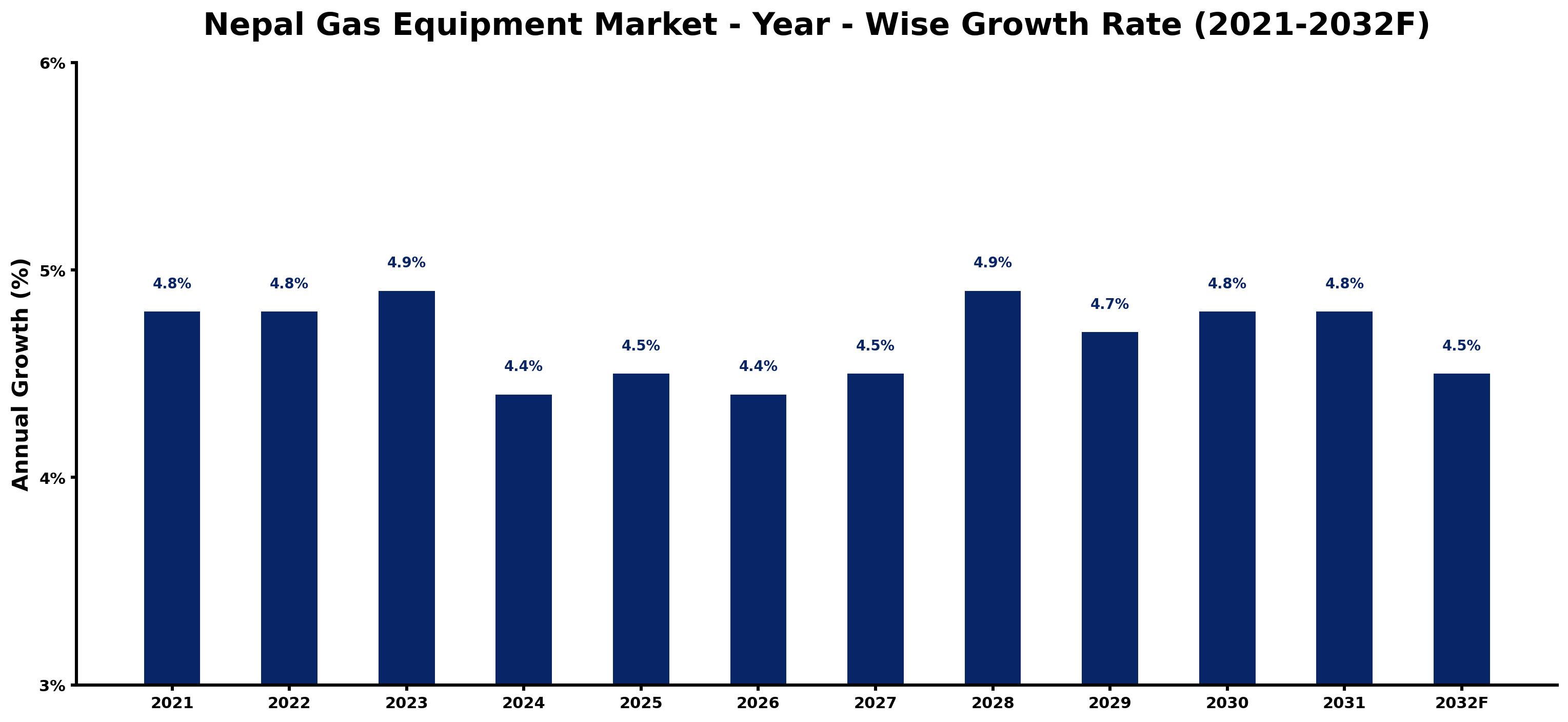
The table below presents the year‑wise growth rates along with the key drivers influencing the market
| Year | Growth Rate | Major Drivers |
| 2021 | 4.8% | Growing renewable energy integration projects |
| 2022 | 4.8% | Increasing industrial automation investments |
| 2023 | 4.9% | Expansion of transportation and logistics networks |
| 2024 | 4.4% | Expansion of manufacturing activities |
| 2025 | 4.5% | Growing urbanization and commercial development |
| 2026 | 4.4% | Expansion of commercial construction activities |
| 2027 | 4.5% | Increasing industrial infrastructure investments |
| 2028 | 4.9% | Expansion of commercial construction activities |
| 2029 | 4.7% | Rapid growth in telecom and data center sectors |
| 2030 | 4.8% | Increasing adoption of advanced technologies |
| 2031 | 4.8% | Expansion of commercial construction activities |
| 2032 | 4.5% | Increasing industrial infrastructure investments |
Note - Market size estimations and growth projections presented in this report are based on 6Wresearch's advanced forecasting approach, validated with industry datasets as of June 2026.
Nepal Gas Equipment Market Synopsis
In recent years, the Nepal Gas Equipment Market has witnessed significant transformations, propelled by a growing awareness of the benefits associated with liquefied petroleum gas (LPG). With rising disposable incomes and changing consumer preferences, households and commercial establishments are increasingly opting for efficient gas solutions.
The market is diverse, featuring a variety of products from stoves to cylinders, which cater to the needs of different consumer segments. Enhanced focus on safety and environmental sustainability further underscores the importance of adopting modern gas equipment in daily life.
Nepal Gas Equipment Market Key Takeaways
- The market is poised for consistent growth, driven by increased consumer demand for clean energy solutions.
- Government initiatives support the adoption of LPG, highlighting its benefits over traditional cooking methods.
- Investment opportunities are rising, particularly in the manufacture and distribution of efficient gas equipment.
- Trends indicate a shift towards portable and user-friendly gas solutions, aligned with consumer preferences.
- Collaboration with local businesses can enhance market penetration for new entrants.
Evaluation of Restraints in Nepal Gas Equipment Market
Despite the promising prospects, the Nepal Gas Equipment Market faces several restraints that could hinder its full potential. A primary concern is the inadequate infrastructure for gas distribution and storage, especially in remote areas where access remains challenging. Additionally, the prevalence of counterfeit products threatens consumer safety and the reputation of legitimate suppliers. Regulatory complexities may also create barriers for new entrants, further complicating the landscape for innovation and competition. These issues necessitate concerted efforts from stakeholders and government bodies to create a more conducive environment for growth.
Nepal Gas Equipment Market Trends
Several trends are shaping the Nepal Gas Equipment Market, particularly the increasing consumer preference for portable gas solutions. As outdoor cooking and camping gain popularity, the demand for compact and efficient gas stoves is on the rise. Furthermore, innovations in safety features—such as advanced regulators and high-quality hoses—are becoming crucial, reflecting heightened safety awareness among consumers. The move towards more eco-friendly products is evident, with manufacturers exploring greener alternatives to traditional gas equipment.
Nepal Gas Equipment Market Opportunities
The future holds significant investment opportunities within the Nepal Gas Equipment Market. With a population increasingly conscious of environmental issues, there is a burgeoning market for high-quality gas equipment tailored to local preferences. This includes everything from modern cooking stoves to efficient cylinders that promise better performance. Innovators can also leverage the demand for energy-efficient solutions, positioning themselves to capture market share as consumer education progresses. Strategic partnerships with local distributors can facilitate market entry and enhance product reach in underserved regions.
Government Initiatives in the Nepal Gas Equipment Market
The government of Nepal has taken important steps to regulate the gas equipment market, focusing on ensuring safety and quality for consumers. Policies are in place to set manufacturing standards and to govern the transportation and installation of gas products. Licensing requirements for suppliers and technicians promote accountability within the industry. Additionally, initiatives designed to monitor pricing practices help maintain affordability and competitiveness in the market, ultimately fostering a healthier economic environment for stakeholders.
Future Insights of the Nepal Gas Equipment Market
Looking ahead, the Nepal Gas Equipment Market is set to continue its upward trajectory, driven by factors such as rising urbanization, government support for LPG initiatives, and increasing public awareness of the advantages of cleaner cooking solutions. The focus on improving infrastructure and expanding distribution networks will play a pivotal role in reaching untapped consumer segments. As disposable incomes rise, more households will likely transition to LPG, creating a sustained demand that presents fruitful opportunities for both local and international manufacturers.
Nepal Gas Equipment Market Latest Developments (May 2025 - June 2026)
In the past year, the Nepal Gas Equipment Market has experienced noteworthy developments, including advancements in product safety and efficiency. Manufacturers are increasingly investing in research and development to create innovative gas solutions that meet both consumer expectations and regulatory requirements. Furthermore, there have been positive discussions regarding infrastructure improvements, aimed at better distribution channels, particularly in rural areas, ensuring a broader reach of LPG and related equipment.
Nepal Gas Equipment Market - Key Attractiveness of the Report
- 10 Years of Market Numbers
- Historical Data Starting from 2022 to 2025
- Base Year: 2025
- Forecast Data until 2032
- Key Performance Indicators Impacting the Market
- Major Upcoming Developments and Projects
Key Highlights of the Report:
- Nepal Gas Equipment Market Outlook
- Market Size of Nepal Gas Equipment Market, 2025
- Forecast of Nepal Gas Equipment Market, 2032F
- Historical Data and Forecast of Nepal Gas Equipment Revenues & Volume for the Period 2022-2032F
- Nepal Gas Equipment Market Trend Evolution
- Nepal Gas Equipment Market Drivers and Challenges
- Nepal Gas Equipment Price Trends
- Nepal Gas Equipment Porter's Five Forces
- Nepal Gas Equipment Industry Life Cycle
- Historical Data and Forecast of Nepal Gas Equipment Market Revenues & Volume By Equipment Type for the Period 2022-2032F
- Historical Data and Forecast of Nepal Gas Equipment Market Revenues & Volume By Gas Delivery Systems for the Period 2022-2032F
- Historical Data and Forecast of Nepal Gas Equipment Market Revenues & Volume By Gas Regulators for the Period 2022-2032F
- Historical Data and Forecast of Nepal Gas Equipment Market Revenues & Volume By Flow Devices for the Period 2022-2032F
- Historical Data and Forecast of Nepal Gas Equipment Market Revenues & Volume By Purifiers & Filters for the Period 2022-2032F
- Historical Data and Forecast of Nepal Gas Equipment Market Revenues & Volume By Gas Generating Systems for the Period 2022-2032F
- Historical Data and Forecast of Nepal Gas Equipment Market Revenues & Volume By Gas Detection Systems for the Period 2022-2032F
- Historical Data and Forecast of Nepal Gas Equipment Market Revenues & Volume By Cryogenic Products for the Period 2022-2032F
- Historical Data and Forecast of Nepal Gas Delivery Systems Gas Equipment Market Revenues & Volume By Accessories for the Period 2022-2032F
- Historical Data and Forecast of Nepal Gas Equipment Market Revenues & Volume By Process for the Period 2022-2032F
- Historical Data and Forecast of Nepal Gas Equipment Market Revenues & Volume By Gas Generation for the Period 2022-2032F
- Historical Data and Forecast of Nepal Gas Equipment Market Revenues & Volume By Gas Storage for the Period 2022-2032F
- Historical Data and Forecast of Nepal Gas Equipment Market Revenues & Volume By Gas Detection for the Period 2022-2032F
- Historical Data and Forecast of Nepal Gas Equipment Market Revenues & Volume By Gas Transportation for the Period 2022-2032F
- Historical Data and Forecast of Nepal Gas Equipment Market Revenues & Volume By End-Gas for the Period 2022-2032F
- Historical Data and Forecast of Nepal Gas Equipment Market Revenues & Volume By Nitrogen for the Period 2022-2032F
- Historical Data and Forecast of Nepal Gas Equipment Market Revenues & Volume By Hydrogen for the Period 2022-2032F
- Historical Data and Forecast of Nepal Gas Equipment Market Revenues & Volume By Helium for the Period 2022-2032F
- Historical Data and Forecast of Nepal Gas Equipment Market Revenues & Volume By Oxygen for the Period 2022-2032F
- Historical Data and Forecast of Nepal Gas Equipment Market Revenues & Volume By Carbon Dioxide for the Period 2022-2032F
- Historical Data and Forecast of Nepal Gas Equipment Market Revenues & Volume By Others for the Period 2022-2032F
- Historical Data and Forecast of Nepal Gas Equipment Market Revenues & Volume By End-Users for the Period 2022-2032F
- Historical Data and Forecast of Nepal Gas Equipment Market Revenues & Volume By Metal Fabrication for the Period 2022-2032F
- Historical Data and Forecast of Nepal Gas Equipment Market Revenues & Volume By Chemicals for the Period 2022-2032F
- Historical Data and Forecast of Nepal Gas Equipment Market Revenues & Volume By Healthcare for the Period 2022-2032F
- Historical Data and Forecast of Nepal Gas Equipment Market Revenues & Volume By Oil and Gas for the Period 2022-2032F
- Historical Data and Forecast of Nepal Gas Equipment Market Revenues & Volume By Food and Beverage for the Period 2022-2032F
- Historical Data and Forecast of Nepal Gas Equipment Market Revenues & Volume By Others for the Period 2022-2032F
- Nepal Gas Equipment Import Export Trade Statistics
- Market Opportunity Assessment By Equipment Type
- Market Opportunity Assessment By Process
- Market Opportunity Assessment By End-Gas
- Market Opportunity Assessment By End-Users
- Nepal Gas Equipment Top Companies Market Share
- Nepal Gas Equipment Competitive Benchmarking By Technical and Operational Parameters
- Nepal Gas Equipment Company Profiles
- Nepal Gas Equipment Key Strategic Recommendations






































