Nepal Generator Market Size Growth Rate
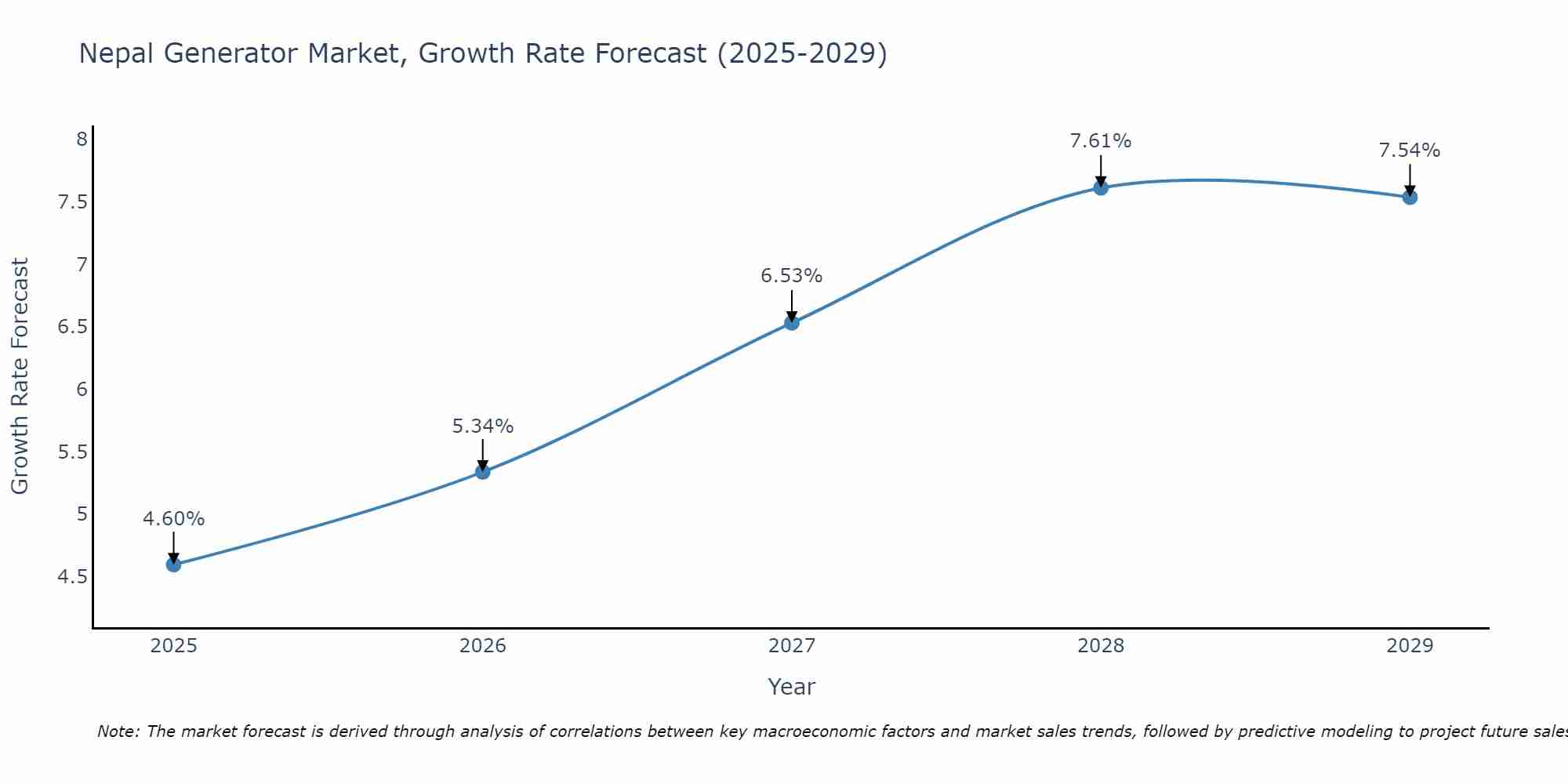
The Nepal Generator Market is projected to witness mixed growth rate patterns during 2025 to 2029. The growth rate begins at 4.60% in 2025, climbs to a high of 7.61% in 2028, and moderates to 7.54% by 2029.
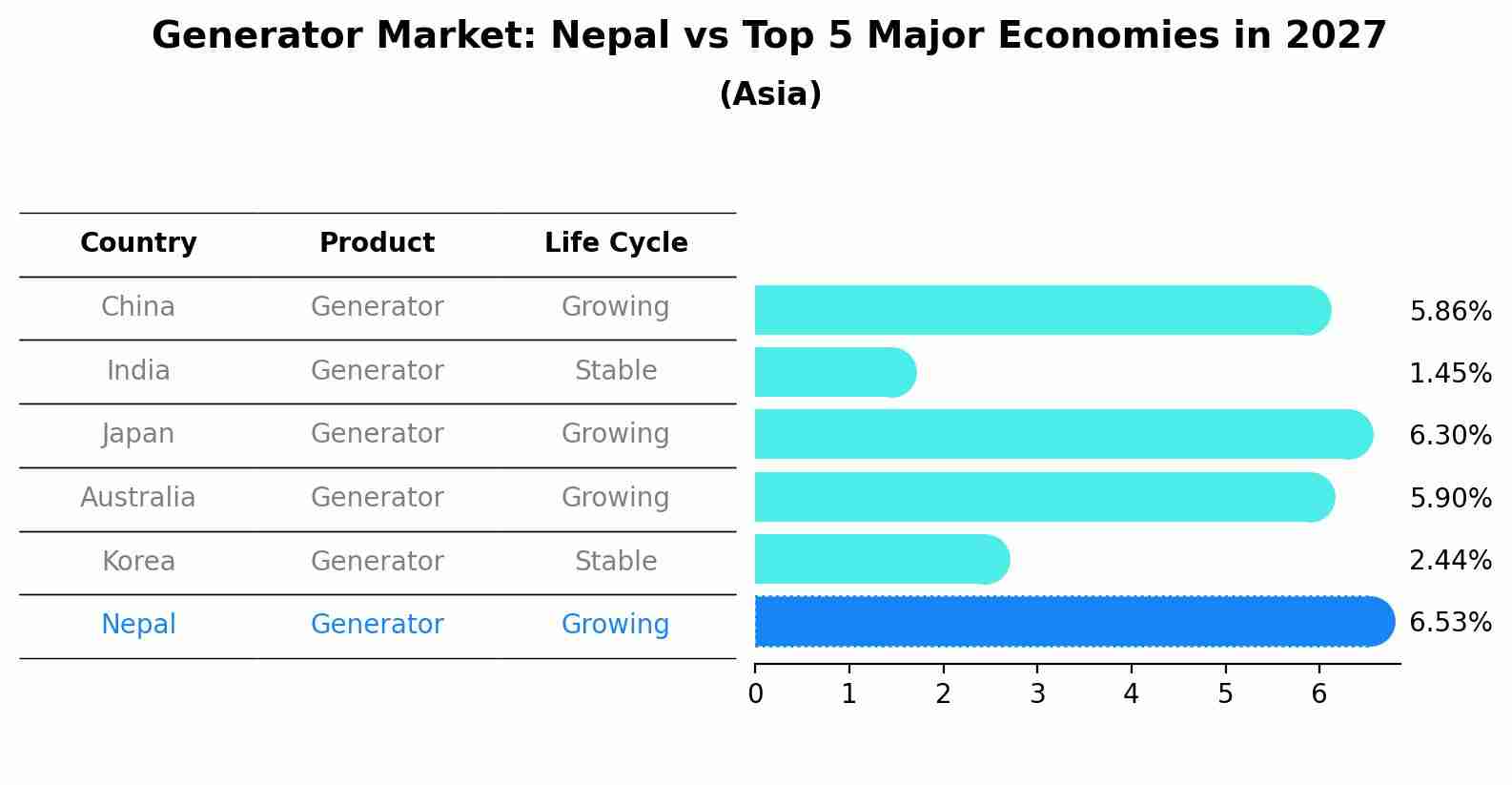
Generator Market: Nepal vs Top 5 Major Economies in 2027 (Asia)
Nepal's Generator market is anticipated to experience a growing growth rate of 6.53% by 2027, reflecting trends observed in the largest economy China, followed by India, Japan, Australia and South Korea.
Nepal Generator Market Synopsis
The Nepal generator market is experiencing steady growth due to factors such as unreliable grid power supply, frequent power outages, and increasing demand from various sectors like commercial, industrial, and residential. Diesel generators are the most commonly used type due to their cost-effectiveness and reliability. The market is also witnessing a shift towards more environmentally friendly options such as gas generators and solar-powered generators, driven by increasing awareness of sustainability practices. Key players in the Nepal generator market include brands like Cummins, Kirloskar, and Honda, offering a range of products catering to different power needs. The government`s focus on infrastructure development and initiatives promoting clean energy sources is expected to further drive the demand for generators in Nepal.
Nepal Generator Market Trends
The Nepal Generator Market is witnessing a growing demand for portable and inverter generators due to the frequent power outages in the country. Consumers are increasingly looking for generators that are fuel-efficient, environmentally friendly, and capable of providing reliable backup power during emergencies. Additionally, there is a rising trend towards the adoption of smart generators equipped with advanced features such as remote monitoring, automatic shut-off, and parallel connectivity. The market is also experiencing a shift towards solar-powered generators as the country focuses on renewable energy sources. Overall, the Nepal Generator Market is evolving towards more efficient and sustainable solutions to meet the growing power needs of residential, commercial, and industrial sectors.
Nepal Generator Market Challenges
In the Nepal Generator Market, several challenges are prevalent. The primary challenge is the inconsistent power supply in the country, leading to a high demand for generators as backup power sources. However, the market faces issues such as high import costs due to government regulations and taxes, which increase the overall price of generators for consumers. Additionally, the lack of proper infrastructure and maintenance services in rural areas limits the widespread adoption of generators outside urban centers. Market players also encounter difficulties in accessing financing options to expand their businesses and reach a broader customer base. Overall, addressing these challenges would be crucial for the sustained growth and development of the generator market in Nepal.
Nepal Generator Market Investment Opportunities
In the Nepal Generator Market, there are several promising investment opportunities for both domestic and international investors. The increasing demand for reliable power supply due to frequent power cuts and inadequate grid infrastructure presents a lucrative opportunity for investing in standby generators for residential, commercial, and industrial purposes. Additionally, the government`s focus on promoting renewable energy sources like solar power has created a growing market for hybrid generators that combine traditional fuel-based generators with clean energy solutions. With Nepal`s expanding economy and infrastructure development projects, there is a rising need for generators in sectors such as construction, healthcare, hospitality, and telecommunications. Investing in the Nepal Generator Market offers potential for long-term growth and profitability in meeting the country`s energy needs and addressing power supply challenges.
Jordan Agar Market Government Policies
The Nepal Generator Market is subject to government policies aimed at promoting clean energy sources and mitigating environmental impact. The government has implemented regulations to encourage the use of renewable energy sources such as solar and wind power, offering subsidies and incentives to consumers and businesses to adopt these technologies. Additionally, there are restrictions on the import and use of diesel generators in urban areas to reduce air pollution. The government also enforces standards for emissions and noise levels for generators to ensure environmental sustainability. Overall, the policies in Nepal focus on transitioning towards cleaner energy options and reducing reliance on traditional fossil fuel-based generators to promote a greener and more sustainable energy sector.
Nepal Generator Market Future Outlook
The future outlook for the Nepal Generator Market appears promising, driven by increasing demand for reliable power sources in the face of frequent power outages and an unreliable grid infrastructure. Factors such as rapid urbanization, industrial growth, and government initiatives to improve access to electricity in rural areas are expected to fuel the market growth. Additionally, the growing need for backup power solutions in critical sectors such as healthcare, telecommunications, and manufacturing is likely to boost generator sales. Technological advancements leading to more efficient and environmentally friendly generator systems are also anticipated to drive market expansion. Overall, the Nepal Generator Market is poised for steady growth in the coming years as businesses and consumers alike seek reliable power solutions to meet their energy needs.
Key Highlights of the Report:
- Nepal Generator Market Outlook
- Market Size of Nepal Generator Market, 2024
- Forecast of Nepal Generator Market, 2031
- Historical Data and Forecast of Nepal Generator Revenues & Volume for the Period 2021 - 2031
- Nepal Generator Market Trend Evolution
- Nepal Generator Market Drivers and Challenges
- Nepal Generator Price Trends
- Nepal Generator Porter's Five Forces
- Nepal Generator Industry Life Cycle
- Historical Data and Forecast of Nepal Generator Market Revenues & Volume By Application for the Period 2021 - 2031
- Historical Data and Forecast of Nepal Generator Market Revenues & Volume By Stationary Generators for the Period 2021 - 2031
- Historical Data and Forecast of Nepal Generator Market Revenues & Volume By Portable Generators for the Period 2021 - 2031
- Historical Data and Forecast of Nepal Generator Market Revenues & Volume By Fuel for the Period 2021 - 2031
- Historical Data and Forecast of Nepal Generator Market Revenues & Volume By Diesel Generators for the Period 2021 - 2031
- Historical Data and Forecast of Nepal Generator Market Revenues & Volume By Gas Generators for the Period 2021 - 2031
- Historical Data and Forecast of Nepal Generator Market Revenues & Volume By End Use for the Period 2021 - 2031
- Historical Data and Forecast of Nepal Generator Market Revenues & Volume By Residential Generators for the Period 2021 - 2031
- Historical Data and Forecast of Nepal Generator Market Revenues & Volume By Commercial Generators for the Period 2021 - 2031
- Historical Data and Forecast of Nepal Generator Market Revenues & Volume By Industrial Generators for the Period 2021 - 2031
- Historical Data and Forecast of Nepal Generator Market Revenues & Volume By Others for the Period 2021 - 2031
- Historical Data and Forecast of Nepal Generator Market Revenues & Volume By Capacity for the Period 2021 - 2031
- Historical Data and Forecast of Nepal Generator Market Revenues & Volume By 0-100 kVA for the Period 2021 - 2031
- Historical Data and Forecast of Nepal Generator Market Revenues & Volume By 100-350 kVA for the Period 2021 - 2031
- Historical Data and Forecast of Nepal Generator Market Revenues & Volume By 350-1000kVA for the Period 2021 - 2031
- Historical Data and Forecast of Nepal Generator Market Revenues & Volume By Above 1000kVA for the Period 2021 - 2031
- Nepal Generator Import Export Trade Statistics
- Market Opportunity Assessment By Application
- Market Opportunity Assessment By Fuel
- Market Opportunity Assessment By End Use
- Market Opportunity Assessment By Capacity
- Nepal Generator Top Companies Market Share
- Nepal Generator Competitive Benchmarking By Technical and Operational Parameters
- Nepal Generator Company Profiles
- Nepal Generator Key Strategic Recommendations






































