Nepal Gold Bullion Market Size, Share & Growth Rate
The Nepal Gold Bullion Market was estimated at USD 466 Million in 2025 and is projected to reach USD 646 Million by 2032, growing at a CAGR of 4.8% from 2026 to 2032. This robust growth trajectory is primarily driven by an increase in cultural significance, with gold being an essential asset for weddings and festivals, thus propelling demand. Additionally, economic uncertainties prompt investors to seek gold as a safe-haven asset, contributing to the market's resilience and growth.
Nepal Gold Bullion Market Year-wise Growth Rate and Key Drivers
This graph highlights how the Nepal Gold Bullion Market has steadily grown over the years, supported by major growth factors.
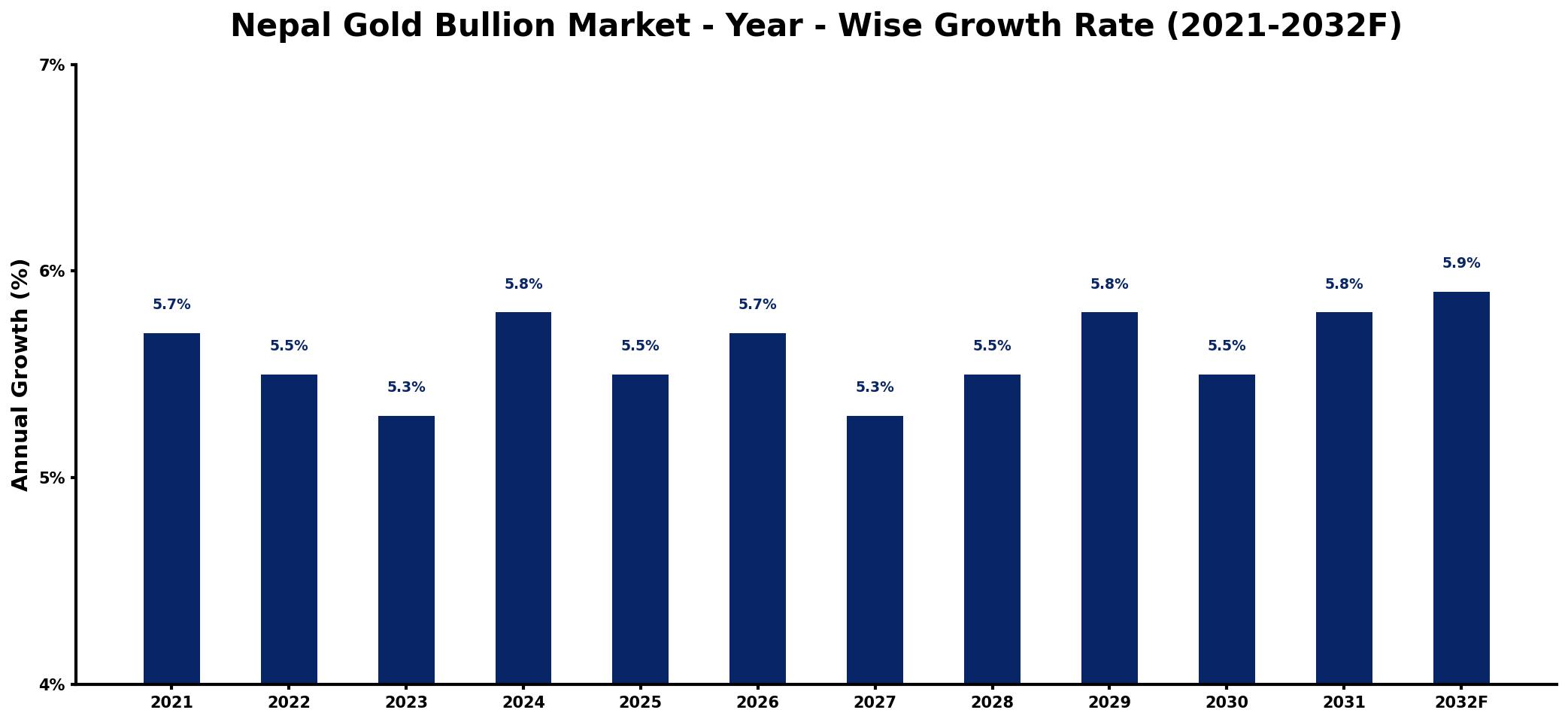
The table below presents the year‑wise growth rates along with the key drivers influencing the market
| Year | Growth Rate | Major Drivers |
| 2021 | 5.7% | Increased foreign investment interest |
| 2022 | 5.5% | Growing demand from jewelry sector |
| 2023 | 5.3% | Rising global economic stability |
| 2024 | 5.8% | Expansion of local mining operations |
| 2025 | 5.5% | Increased consumer purchasing power |
| 2026 | 5.7% | Strengthening of remittance flows |
| 2027 | 5.3% | Growth in industrial applications |
| 2028 | 5.5% | Surge in tourism revenue influx |
| 2029 | 5.8% | Enhancement of trade agreements |
| 2030 | 5.5% | Boost in digital payment systems |
| 2031 | 5.8% | Rise in alternative investment options |
| 2032 | 5.9% | Growing awareness of asset diversification |
Note: Market size estimations and growth projections presented in this report are based on 6Wresearch's proprietary forecasting methodology, utilizing the latest available industry data, government publications, and primary research inputs.
Nepal Gold Bullion Market Synopsis
In Nepal, gold serves not only as a medium for investment but also plays a crucial role in cultural and religious traditions. The country has a high demand for gold, particularly in jewelry-making, where intricate designs symbolize wealth and prosperity. Due to the limited local production, Nepal heavily relies on imports to meet this demand, further embedding gold's significance in the economy.
The Nepal Gold Bullion Market is characterized by an intricate interplay of traditional values and modern investment trends. Increasingly, consumers are shifting towards digital platforms for trading, creating a more accessible and efficient marketplace. This shift is likely to enhance transparency and could potentially draw in a younger demographic of investors who are tech-savvy.
Nepal Gold Bullion Market Key Takeaways
- The market is driven by cultural significance, particularly during festivals and weddings.
- Digital trading platforms are becoming increasingly popular among investors.
- Gold is viewed as a safe-haven investment during economic uncertainty.
- Regulatory reforms are needed to enhance market transparency and credibility.
- Investment in gold-related ETFs is gaining traction as a viable investment avenue.
Evaluation of Restraints in Nepal Gold Bullion Market
The Nepal Gold Bullion Market faces notable restraints that could impede its potential. One primary concern is the fluctuation of global gold prices, which can create uncertainty for investors. Moreover, the market lacks transparency, leading to inconsistencies in pricing and quality assurance. The prevalence of counterfeit products further complicates trust among consumers. Regulatory constraints, such as high import duties and taxation policies, can also stifle growth, making it crucial for stakeholders to advocate for reforms that promote efficiency and reliability.
Nepal Gold Bullion Market Trends
Current trends in the Nepal Gold Bullion Market indicate a growing preference for digital platforms, allowing for seamless transactions and broader market access. Additionally, the economic climate has fueled interest in gold as a stable investment option amid stock market volatility. Social media and online marketing strategies are also playing pivotal roles in educating consumers and driving demand, particularly among younger investors seeking alternative assets.
Nepal Gold Bullion Market Opportunities
There are multiple avenues for investment and growth within the Nepal Gold Bullion Market. Direct purchases of gold bars and coins remain a traditional yet effective strategy for wealth retention. The rise of gold exchange-traded funds (ETFs) offers a modern alternative for investors looking for liquidity and lower transaction costs. Furthermore, as local mining activities develop, opportunities may arise for investments in domestic gold mining ventures, catering to those willing to embrace higher-risk profiles for potentially higher returns.
Government Initiatives in the Nepal Gold Bullion Market
The Nepalese government actively regulates the Gold Bullion Market through policies aimed at enhancing transparency and curbing illegal activities. The Ministry of Finance oversees licensing for gold dealers to ensure adherence to regulatory standards. Policies such as value-added tax (VAT) on gold sales not only generate revenue but also work to prevent tax evasion. Additionally, import and export controls are regularly reviewed to adapt to changing market conditions and maintain economic stability, reflecting the government's commitment to a secure gold trading environment.
Future Insights of the Nepal Gold Bullion Market
Looking ahead to 2026-2032, the Nepal Gold Bullion Market is poised for steady growth, driven by an unwavering demand for gold as a cultural asset and investment. The economic backdrop, influenced by global gold price fluctuations and local consumer behavior, will play a crucial role in shaping the market's future. As digital platforms continue to evolve, they may facilitate greater market participation and transparency, ultimately attracting a broader investor base. However, addressing the regulatory challenges and enhancing the credibility of transactions will be essential in sustaining this growth momentum.
Nepal Gold Bullion Market Latest Developments (2025 - 2026)
Recent industry developments indicate a growing integration of technology into the Nepal Gold Bullion Market. New digital trading platforms are being launched, catering to the needs of tech-savvy investors. Moreover, there is an increasing focus on educational initiatives to inform consumers about safe investment practices and the importance of quality assurance in gold purchases. These shifts indicate a positive move towards greater market efficiency and consumer empowerment.
Nepal Gold Bullion Market - Key Attractiveness of the Report
- 10 Years of Market Numbers
- Historical Data Starting from 2022 to 2025
- Base Year: 2025
- Forecast Data until 2032
- Key Performance Indicators Impacting the Market
- Major Upcoming Developments and Projects
Key Highlights of the Report:
- Nepal Gold Bullion Market Outlook
- Market Size of Nepal Gold Bullion Market, 2025
- Forecast of Nepal Gold Bullion Market, 2032
- Historical Data and Forecast of Nepal Gold Bullion Revenues & Volume for the Period 2022-2032F
- Nepal Gold Bullion Market Trend Evolution
- Nepal Gold Bullion Market Drivers and Challenges
- Nepal Gold Bullion Price Trends
- Nepal Gold Bullion Porter's Five Forces
- Nepal Gold Bullion Industry Life Cycle
- Historical Data and Forecast of Nepal Gold Bullion Market Revenues & Volume By Type for the Period 2022-2032F
- Historical Data and Forecast of Nepal Gold Bullion Market Revenues & Volume By Gold Bar for the Period 2022-2032F
- Historical Data and Forecast of Nepal Gold Bullion Market Revenues & Volume By Gold Coin for the Period 2022-2032F
- Historical Data and Forecast of Nepal Gold Bullion Market Revenues & Volume By Distribution Channel for the Period 2022-2032F
- Historical Data and Forecast of Nepal Gold Bullion Market Revenues & Volume By Online for the Period 2022-2032F
- Historical Data and Forecast of Nepal Gold Bullion Market Revenues & Volume By Offline for the Period 2022-2032F
- Nepal Gold Bullion Import Export Trade Statistics
- Market Opportunity Assessment By Type
- Market Opportunity Assessment By Distribution Channel
- Nepal Gold Bullion Top Companies Market Share
- Nepal Gold Bullion Competitive Benchmarking By Technical and Operational Parameters
- Nepal Gold Bullion Company Profiles
- Nepal Gold Bullion Key Strategic Recommendations






































