Nepal Grape Juice Market Size, Share & Growth Rate
The Nepal Grape Juice Market was estimated at USD 801 Million in 2025 and is projected to reach USD 1163 Million by 2032, growing at a CAGR of 5.5% from 2026 to 2032. This growth is primarily fueled by an increasing health consciousness among consumers who are seeking natural and nutritious beverage options. Additionally, rising disposable incomes and a marked shift toward non-alcoholic beverages are contributing to the market's expansion.
Nepal Grape Juice Market Year-wise Growth Rate and Key Drivers
This graph highlights how the Nepal Grape Juice Market has steadily grown over the years, supported by major growth factors.
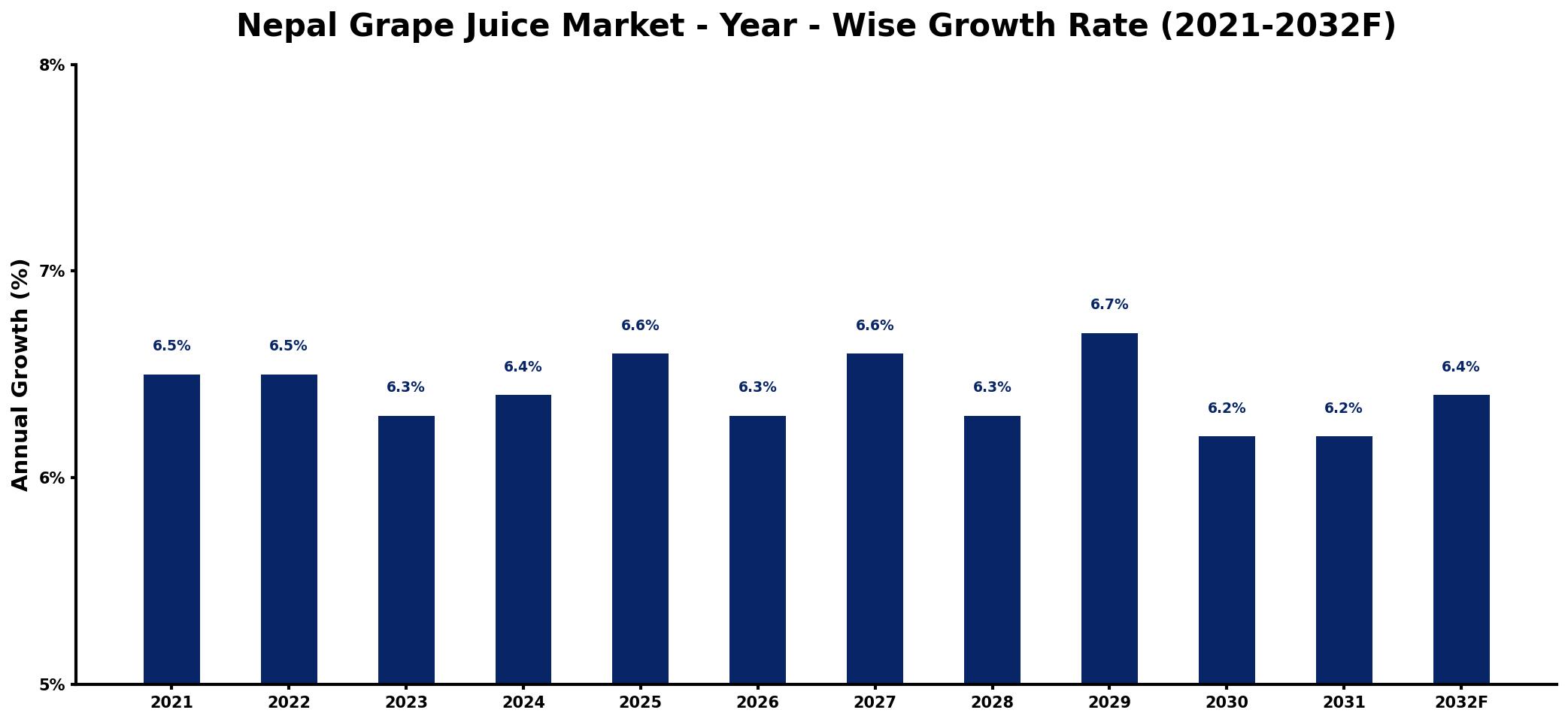
The table below presents the year‑wise growth rates along with the key drivers influencing the market
| Year | Growth Rate | Major Drivers |
| 2021 | 6.5% | growing health consciousness among consumers |
| 2022 | 6.5% | rising demand for natural beverages |
| 2023 | 6.3% | increased availability of local ingredients |
| 2024 | 6.4% | expansion of distribution channels |
| 2025 | 6.6% | growing interest in organic options |
| 2026 | 6.3% | investments in production technology |
| 2027 | 6.6% | increased consumer preference for convenience |
| 2028 | 6.3% | development of new flavor profiles |
| 2029 | 6.7% | growing regional consumption patterns |
| 2030 | 6.2% | growing popularity of wellness trends |
| 2031 | 6.2% | increased marketing and promotion efforts |
| 2032 | 6.4% | enhanced packaging innovations and designs |
Note: Market size estimations and growth projections presented in this report are based on 6Wresearch's proprietary forecasting methodology, utilizing the latest available industry data, government publications, and primary research inputs.
Nepal Grape Juice Market Synopsis
The Nepal grape juice market is on the rise, driven by consumers' growing preference for healthy and authentic beverage choices. With an expanding range of grape juice products available, local manufacturers are focusing on quality and sourcing grapes from domestic farms to meet the rising demand.
As distribution channels evolve, grape juice products are now more accessible than ever, found in supermarkets, convenience stores, and online platforms. The market is witnessing both established companies and new entrants bringing innovative products, fueling competition and enhancing the diversity of options for consumers.
Nepal Grape Juice Market Key Takeaways
- Consumer health consciousness is driving the demand for natural beverages.
- Local sourcing and quality production are becoming essential for market players.
- Distribution networks are expanding, increasing product availability.
- Innovative offerings are entering the market, appealing to diverse consumer segments.
- Government policies are enhancing the agricultural framework for grape cultivation.
Evaluation of Restraints in Nepal Grape Juice Market
Despite its promising growth trajectory, the Nepal grape juice market faces several critical restraints. Climatic conditions limit grape production, resulting in fluctuating availability and quality of raw materials. Moreover, high production costs and inadequate infrastructure for storage and distribution further constrain the market's potential. The competition from other beverages and limited consumer awareness regarding grape juice's health benefits also pose significant challenges that must be addressed to realize the full market potential.
Nepal Grape Juice Market Trends
Current trends in the Nepal grape juice market highlight a growing preference for organic and natural products, as consumers become increasingly aware of health benefits associated with grape juice. The premiumization trend is evident, with consumers gravitating towards gourmet options that offer enhanced flavors and sophisticated branding. The demand for ready-to-drink and single-serve packaging is also on the rise, catering to the convenience sought by busy lifestyles.
Nepal Grape Juice Market Opportunities
The market is ripe with investment opportunities, particularly in establishing grape juice processing facilities and robust distribution networks. Investors can also benefit from collaborating with local farmers to ensure a sustainable supply of high-quality grapes. Furthermore, by focusing on innovative product offerings and appealing packaging, companies can differentiate themselves in an increasingly competitive landscape.
Government Initiatives in the Nepal Grape Juice Market
The Nepalese government has put forth various policies to bolster the grape juice industry. Initiatives include financial incentives for grape farmers aimed at boosting production levels and promoting advancements in cultivation techniques. Improvements in infrastructure, such as enhanced cold storage facilities and transportation networks, are being prioritized to facilitate better market access for grape juice producers. Regulations are also in place to maintain product standards, ensuring safety for consumers.
Future Insights of the Nepal Grape Juice Market
Looking ahead to 2026-2032, the Nepal grape juice market is anticipated to continue its growth as awareness around healthy living escalates. The increasing consumer demand for natural beverages suggests that grape juice will capture a significant share of the market, particularly as premium products become more prevalent. Local sourcing and sustainable production methods are expected to strengthen the market's foundation, creating further opportunities for innovation and diversification.
Nepal Grape Juice Market Latest Developments (2025 - 2026)
Recent trends indicate an uptick in the introduction of premium grape juice brands in Nepal. Local producers are enhancing their product offerings with organic certification and innovative flavors to attract health-conscious consumers. In tandem, efforts to improve distribution channels, especially through online platforms, are on the rise, making it easier for consumers to access a broader array of grape juice products.
Nepal Grape Juice Market - Key Attractiveness of the Report
- 10 Years of Market Numbers
- Historical Data Starting from 2022 to 2025
- Base Year: 2025
- Forecast Data until 2032
- Key Performance Indicators Impacting the Market
- Major Upcoming Developments and Projects
Key Highlights of the Report:
- Nepal Grape Juice Market Outlook
- Market Size of Nepal Grape Juice Market, 2025
- Forecast of Nepal Grape Juice Market, 2032
- Historical Data and Forecast of Nepal Grape Juice Revenues & Volume for the Period 2022-2032F
- Nepal Grape Juice Market Trend Evolution
- Nepal Grape Juice Market Drivers and Challenges
- Nepal Grape Juice Price Trends
- Nepal Grape Juice Porter's Five Forces
- Nepal Grape Juice Industry Life Cycle
- Historical Data and Forecast of Nepal Grape Juice Market Revenues & Volume By Type for the Period 2022-2032F
- Historical Data and Forecast of Nepal Grape Juice Market Revenues & Volume By Pure Juice for the Period 2022-2032F
- Historical Data and Forecast of Nepal Grape Juice Market Revenues & Volume By Mixed Juice for the Period 2022-2032F
- Historical Data and Forecast of Nepal Grape Juice Market Revenues & Volume By Application for the Period 2022-2032F
- Historical Data and Forecast of Nepal Grape Juice Market Revenues & Volume By 0-14 yrs for the Period 2022-2032F
- Historical Data and Forecast of Nepal Grape Juice Market Revenues & Volume By 15-34 yrs for the Period 2022-2032F
- Historical Data and Forecast of Nepal Grape Juice Market Revenues & Volume By 35-54 yrs for the Period 2022-2032F
- Historical Data and Forecast of Nepal Grape Juice Market Revenues & Volume By 55 yrs up for the Period 2022-2032F
- Nepal Grape Juice Import Export Trade Statistics
- Market Opportunity Assessment By Type
- Market Opportunity Assessment By Application
- Nepal Grape Juice Top Companies Market Share
- Nepal Grape Juice Competitive Benchmarking By Technical and Operational Parameters
- Nepal Grape Juice Company Profiles
- Nepal Grape Juice Key Strategic Recommendations






































