Nepal Herbal Cosmetics Market Size, Share & Growth Rate
The Nepal Herbal Cosmetics Market was estimated at USD 1300 Million in 2025 and is projected to reach USD 1873 Million by 2032, growing at a CAGR of 5.4% from 2026 to 2032. This growth trajectory is primarily driven by a burgeoning consumer preference for natural and organic beauty solutions, coupled with an increase in awareness of the numerous benefits associated with herbal ingredients. The combination of traditional wisdom and modern wellness trends is uniquely positioning the herbal cosmetics sector in Nepal for substantial expansion.
Nepal Herbal Cosmetics Market Year-wise Growth Rate and Key Drivers
This graph highlights how the Nepal Herbal Cosmetics Market has steadily grown over the years, supported by major growth factors.
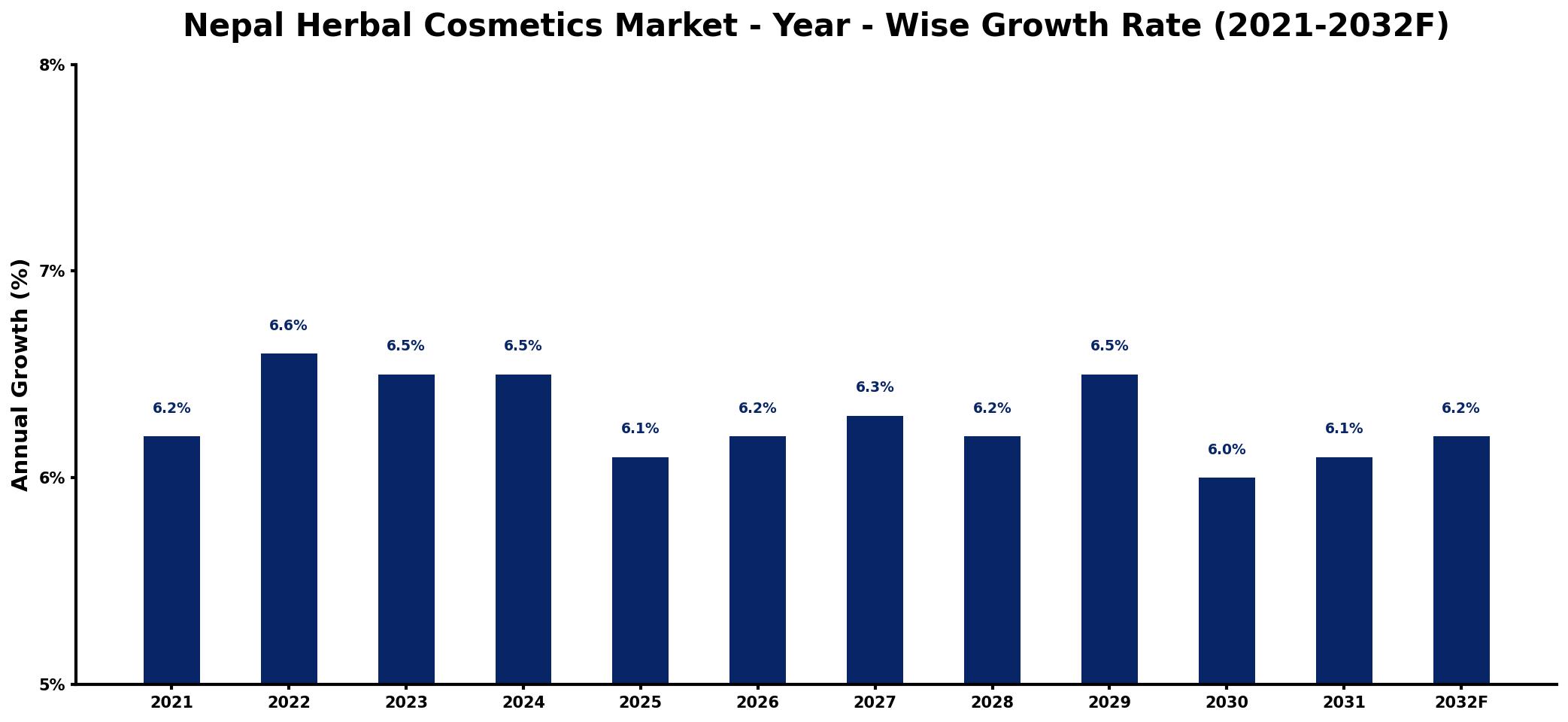
The table below presents the year‑wise growth rates along with the key drivers influencing the market
| Year | Growth Rate | Major Drivers |
| 2021 | 6.2% | Rising consumer health awareness |
| 2022 | 6.6% | Increased online shopping trends |
| 2023 | 6.5% | Growing preference for natural ingredients |
| 2024 | 6.5% | Expansion of retail distribution channels |
| 2025 | 6.1% | Enhanced marketing of sustainability |
| 2026 | 6.2% | Emerging local brand innovations |
| 2027 | 6.3% | Boost in eco-friendly packaging |
| 2028 | 6.2% | Strengthened export market opportunities |
| 2029 | 6.5% | Increased investment in research |
| 2030 | 6.0% | Development of organic farming practices |
| 2031 | 6.1% | Heightened focus on ethical sourcing |
| 2032 | 6.2% | Wider acceptance of alternative therapies |
Note: Market size estimations and growth projections presented in this report are based on 6Wresearch's proprietary forecasting methodology, utilizing the latest available industry data, government publications, and primary research inputs.
Nepal Herbal Cosmetics Market Synopsis
In Nepal, the rising consciousness regarding the harmful effects of synthetic chemicals has propelled the demand for herbal cosmetics, particularly among young consumers. Ingredients such as turmeric, neem, and aloe vera are not only abundant in local biodiversity but also cherished in cultural practices, thereby fostering a strong domestic market for these products.
The sector is witnessing a notable influx of both local and international brands introducing innovative formulations. This diversification is not merely a response to consumer demand; it also reflects a broader trend towards sustainability and cruelty-free practices. As consumers increasingly seek holistic approaches to beauty, the market is well-positioned to cater to this shift.
Nepal Herbal Cosmetics Market Key Takeaways
- The market is experiencing a robust growth rate, driven by consumer shift toward natural and organic products.
- Herbal ingredients are increasingly recognized for their skin-nourishing properties, reinforcing consumer preference.
- Local brands are rapidly emerging, offering diverse herbal skincare, haircare, and personal care products.
- Government policies are supporting the sector's growth by regulating product safety and promoting local ingredient use.
- Investment opportunities exist in manufacturing, R&D, and digital marketing tailored to local consumer needs.
Evaluation of Restraints in Nepal Herbal Cosmetics Market
Despite its growth potential, the Nepal herbal cosmetics market faces several constraints. Limited consumer knowledge about the full range of benefits and applications of herbal products can hinder market penetration. Additionally, competition from established mainstream cosmetic brands poses a significant challenge, as these companies often have more resources for marketing and distribution. Regulatory frameworks are still evolving, creating uncertainties around quality control and standardization, which can impact consumer trust. Lastly, sourcing authentic herbal ingredients consistently remains a significant hurdle, making product innovation vital in maintaining market relevance.
Nepal Herbal Cosmetics Market Trends
The market is currently embracing a strong trend towards sustainability, with consumers increasingly interested in eco-friendly packaging and ethical sourcing. There is also a marked shift towards Ayurvedic and traditional formulations, as consumers reconnect with indigenous knowledge and herbal remedies. Furthermore, the rise of digital commerce is shaping consumer purchasing behaviors, with online platforms becoming significant channels for reaching younger demographics. Overall, these trends indicate a vibrant evolution in consumer preferences that will continue to redefine the landscape of the Nepal herbal cosmetics market.
Nepal Herbal Cosmetics Market Opportunities
Investment opportunities within the Nepal herbal cosmetics market are abundant, especially in product innovation and distribution strategies. By focusing on creating unique herbal formulations tailored to local preferences, companies can differentiate themselves in an increasingly competitive space. Collaborating with local suppliers can enhance product authenticity and quality, while tapping into the digital landscape can amplify marketing reach and consumer engagement. Additionally, companies should consider utilizing the unique biodiversity of Nepal to develop novel products that appeal to both domestic and international markets.
Government Initiatives in the Nepal Herbal Cosmetics Market
The Nepalese government has taken steps to bolster the herbal cosmetics industry through regulatory frameworks aimed at ensuring product safety and efficacy. The Department of Drug Administration plays a crucial role in overseeing the registration of herbal cosmetic products, necessitating approval before products can enter the market. Support for locally sourced ingredients is a key focus, with initiatives designed to enhance consumer awareness about traditional herbal practices and combat counterfeit products. Overall, these governmental policies create a supportive environment for growth within the sector.
Future Insights of the Nepal Herbal Cosmetics Market
Looking ahead to 2026-2032, the Nepal herbal cosmetics market is set for promising developments. The increasing consumer awareness regarding the adverse effects of synthetic products and the growing affinity for organic alternatives position the market for continued growth. Additionally, leveraging the country's rich biodiversity to create unique product offerings will be essential for companies aiming to capture consumer interest. However, maintaining competitive advantage will require ongoing innovation and responsiveness to shifting consumer demands.
Nepal Herbal Cosmetics Market Latest Developments (2025 - 2026)
Recent trends in the Nepal herbal cosmetics market showcase an increasing commitment to sustainable practices, as brands adapt to consumer preferences for eco-friendly products. The focus on transparency regarding ingredient sourcing has intensified, with companies striving to convey authenticity to consumers. Collaborations between local farmers and manufacturers are becoming more common, enhancing both product quality and local economies. These developments indicate a continued evolution towards a more responsible and consumer-driven market landscape.
Nepal Herbal Cosmetics Market - Key Attractiveness of the Report
- 10 Years of Market Numbers
- Historical Data Starting from 2022 to 2025
- Base Year: 2025
- Forecast Data until 2032
- Key Performance Indicators Impacting the Market
- Major Upcoming Developments and Projects
Key Highlights of the Report:
- Nepal Herbal Cosmetics Market Outlook
- Market Size of Nepal Herbal Cosmetics Market, 2025
- Forecast of Nepal Herbal Cosmetics Market, 2032
- Historical Data and Forecast of Nepal Herbal Cosmetics Revenues & Volume for the Period 2022-2032F
- Nepal Herbal Cosmetics Market Trend Evolution
- Nepal Herbal Cosmetics Market Drivers and Challenges
- Nepal Herbal Cosmetics Price Trends
- Nepal Herbal Cosmetics Porter's Five Forces
- Nepal Herbal Cosmetics Industry Life Cycle
- Historical Data and Forecast of Nepal Herbal Cosmetics Market Revenues & Volume By Physical State for the Period 2022-2032F
- Historical Data and Forecast of Nepal Herbal Cosmetics Market Revenues & Volume By Solid for the Period 2022-2032F
- Historical Data and Forecast of Nepal Herbal Cosmetics Market Revenues & Volume By Semi-solid for the Period 2022-2032F
- Historical Data and Forecast of Nepal Herbal Cosmetics Market Revenues & Volume By Liquid for the Period 2022-2032F
- Historical Data and Forecast of Nepal Herbal Cosmetics Market Revenues & Volume By Product for the Period 2022-2032F
- Historical Data and Forecast of Nepal Herbal Cosmetics Market Revenues & Volume By Skin Care Product for the Period 2022-2032F
- Historical Data and Forecast of Nepal Herbal Cosmetics Market Revenues & Volume By Hair Care Product for the Period 2022-2032F
- Historical Data and Forecast of Nepal Herbal Cosmetics Market Revenues & Volume By Baby Care Product for the Period 2022-2032F
- Historical Data and Forecast of Nepal Herbal Cosmetics Market Revenues & Volume By Oral Care Product for the Period 2022-2032F
- Historical Data and Forecast of Nepal Herbal Cosmetics Market Revenues & Volume By Make-up Product for the Period 2022-2032F
- Historical Data and Forecast of Nepal Herbal Cosmetics Market Revenues & Volume By Distribution Channel for the Period 2022-2032F
- Historical Data and Forecast of Nepal Herbal Cosmetics Market Revenues & Volume By Supermarket for the Period 2022-2032F
- Historical Data and Forecast of Nepal Herbal Cosmetics Market Revenues & Volume By Pharmacy for the Period 2022-2032F
- Historical Data and Forecast of Nepal Herbal Cosmetics Market Revenues & Volume By Departmental Store for the Period 2022-2032F
- Historical Data and Forecast of Nepal Herbal Cosmetics Market Revenues & Volume By Beauty Spa/Salon for the Period 2022-2032F
- Historical Data and Forecast of Nepal Herbal Cosmetics Market Revenues & Volume By Internet Retailing for the Period 2022-2032F
- Historical Data and Forecast of Nepal Herbal Cosmetics Market Revenues & Volume By Specialty Store for the Period 2022-2032F
- Nepal Herbal Cosmetics Import Export Trade Statistics
- Market Opportunity Assessment By Physical State
- Market Opportunity Assessment By Product
- Market Opportunity Assessment By Distribution Channel
- Nepal Herbal Cosmetics Top Companies Market Share
- Nepal Herbal Cosmetics Competitive Benchmarking By Technical and Operational Parameters
- Nepal Herbal Cosmetics Company Profiles
- Nepal Herbal Cosmetics Key Strategic Recommendations






































