Nepal Hiking Gear & Equipment Market Size, Share & Growth Rate
The Nepal Hiking Gear & Equipment Market was estimated at USD 387 Million in 2025 and is projected to reach USD 541 Million by 2032, growing at a CAGR of 4.9% from 2026 to 2032. This growth trajectory is driven largely by the increasing influx of trekkers and tourists seeking adventure in Nepals diverse landscapes. Additionally, local interest in outdoor activities, spurred by the growth of eco-tourism and community-led trekking initiatives, is further solidifying the market's foundation.
Nepal Hiking Gear & Equipment Market Year-wise Growth Rate and Key Drivers
This graph highlights how the Nepal Hiking Gear & Equipment Market has steadily grown over the years, supported by major growth factors.
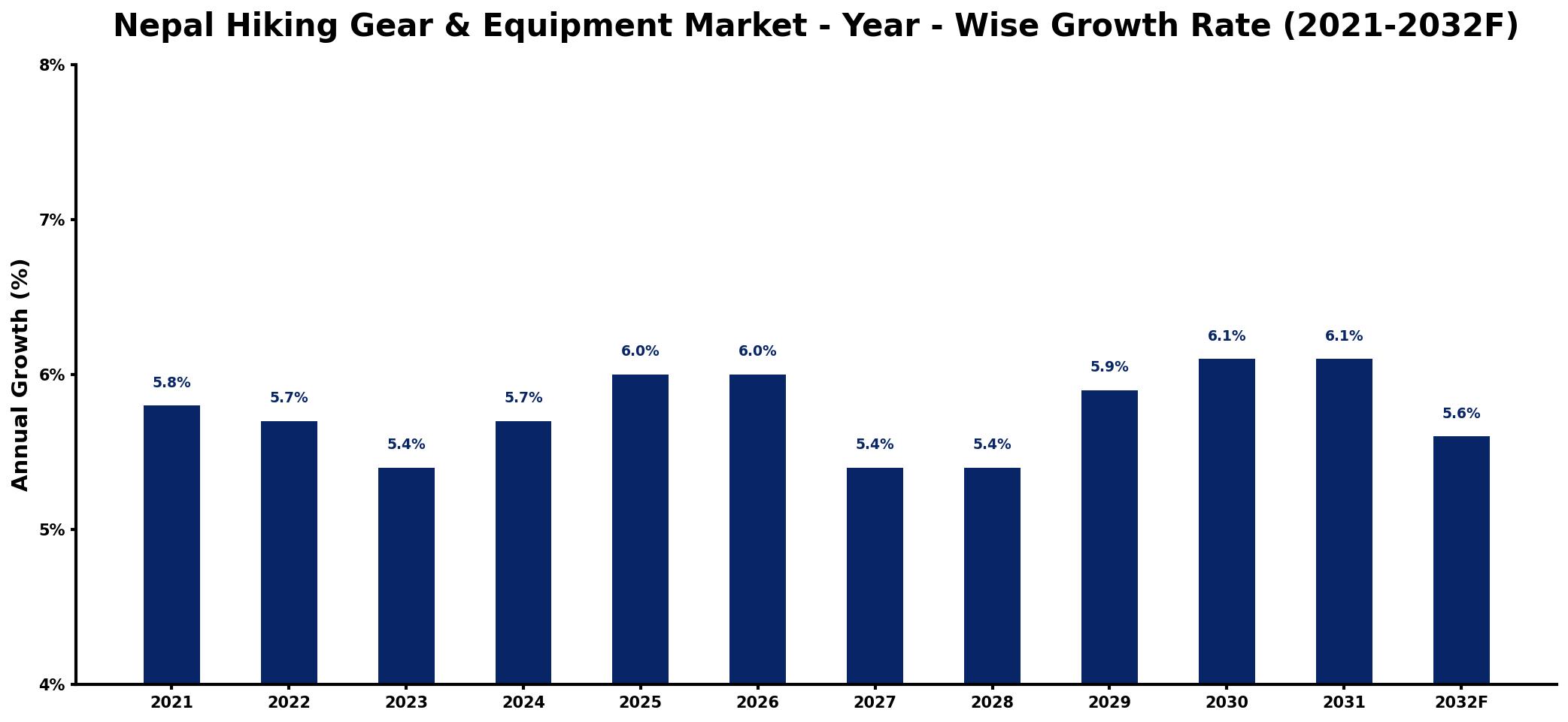
The table below presents the year‑wise growth rates along with the key drivers influencing the market
| Year | Growth Rate | Major Drivers |
| 2021 | 5.8% | Rising outdoor adventure tourism |
| 2022 | 5.7% | Increased disposable income levels |
| 2023 | 5.4% | Growing environmental awareness initiatives |
| 2024 | 5.7% | Expansion of national parks network |
| 2025 | 6.0% | Surge in domestic travel interest |
| 2026 | 6.0% | Improved infrastructure for accessibility |
| 2027 | 5.4% | Emergence of eco-friendly brands |
| 2028 | 5.4% | Heightened social media influence |
| 2029 | 5.9% | Introduction of innovative technologies |
| 2030 | 6.1% | Strengthened international travel policies |
| 2031 | 6.1% | Enhanced community engagement programs |
| 2032 | 5.6% | Wider availability of rental services |
Note: Market size estimations and growth projections presented in this report are based on 6Wresearch's proprietary forecasting methodology, utilizing the latest available industry data, government publications, and primary research inputs.
Nepal Hiking Gear & Equipment Market Synopsis
In recent years, the Nepal hiking gear and equipment market has gained significant momentum, buoyed by both international tourists and a burgeoning local population eager to explore the outdoors. This initial surge signals a promising future, as stakeholders in the market position themselves to capitalize on evolving consumer preferences for quality, sustainability, and innovative designs.
Looking ahead, the market is set to evolve, with a marked shift towards environmentally sustainable and versatile gear. This alignment with global trends toward sustainability reflects a growing awareness among consumers of their impact on the environment, and offers a unique opportunity for brands that can provide innovative, eco-friendly products tailored to the Nepalese market.
- The market is on a growth trajectory, spurred by increased tourist numbers and local outdoor activity participation.
- Innovative and sustainable product offerings are becoming a key driver of consumer preference.
- The rise of e-commerce platforms is enhancing accessibility to hiking gear.
- Local brands are gaining traction, offering budget-friendly options alongside established international names.
- Collaborative initiatives between local businesses and international brands can drive market expansion.
Despite its growth prospects, the Nepal hiking gear and equipment market faces several restraints. A significant challenge is the prevalence of counterfeit products, which can tarnish the reputation of genuine brands and lead to consumer distrust. Import restrictions and tariffs further complicate access to high-quality international brands, while inadequate infrastructure, including retail outlets and online platforms, limits consumer access to a diverse range of hiking gear. Moreover, the seasonal nature of hiking in Nepal creates fluctuations in demand, making it difficult for businesses to achieve stable revenue streams year-round.
The current trend in the Nepal hiking gear and equipment market reflects a growing consumer preference for lightweight, durable, and sustainable products. As awareness about environmental responsibility rises, brands are increasingly incorporating eco-friendly materials and advanced technologies into their offerings. There's also a noted demand for multifunctional gear that supports various outdoor activities, catering to the diverse interests of consumers. This shift towards value-driven purchases highlights a significant evolution in consumer behavior, particularly among younger adventurers.
There are ample investment opportunities within the Nepal hiking gear and equipment market, particularly in the manufacturing and distribution of high-quality outdoor gear. Investors can explore the development of weather-resistant clothing, innovative GPS devices, and sustainable camping equipment, catering to the increasing demand from both local and international hikers. Furthermore, establishing robust online retail platforms can enhance market penetration, allowing brands to reach a wider audience while capitalizing on the growing trend of e-commerce in the region.
While there are no specific policies directly targeting the hiking gear and equipment market, the Nepalese government is actively promoting tourism, particularly in trekking and hiking. Their focus on improving infrastructure in key trekking areas, ensuring tourist safety, and preserving the environment indirectly supports the market. Compliance with import regulations and standard manufacturing practices is essential for businesses operating in this space, creating a framework for sustainable growth and development.
Looking forward to 2026-2032, the Nepal hiking gear and equipment market is poised for significant growth, driven by a rising interest in outdoor activities and sustainability among both locals and visitors. The demand for high-quality, eco-friendly gear will likely accelerate, pushing brands to innovate and adapt to consumer expectations. The expansion of digital retail avenues will further facilitate market access, providing a unique opportunity for businesses to capture a broader customer base drawn to the rich trekking routes and stunning landscapes of Nepal.
In recent months, the industry has seen a growing emphasis on sustainability, with brands investing in environmentally friendly practices and materials. E-commerce platforms are gaining traction, enabling more consumers to access quality hiking gear from the comfort of their homes. Collaborative initiatives between local artisans and international brands are beginning to emerge, aiming to blend traditional craftsmanship with modern technological advancements, enhancing product appeal.
- 10 Years of Market Numbers
- Historical Data Starting from 2022 to 2025
- Base Year: 2025
- Forecast Data until 2032
- Key Performance Indicators Impacting the Market
- Major Upcoming Developments and Projects
Key Highlights of the Report:
- Nepal Hiking Gear & Equipment Market Outlook
- Market Size of Nepal Hiking Gear & Equipment Market, 2025
- Forecast of Nepal Hiking Gear & Equipment Market, 2032
- Historical Data and Forecast of Nepal Hiking Gear & Equipment Revenues & Volume for the Period 2022-2032F
- Nepal Hiking Gear & Equipment Market Trend Evolution
- Nepal Hiking Gear & Equipment Market Drivers and Challenges
- Nepal Hiking Gear & Equipment Price Trends
- Nepal Hiking Gear & Equipment Porter's Five Forces
- Nepal Hiking Gear & Equipment Industry Life Cycle
- Historical Data and Forecast of Nepal Hiking Gear & Equipment Market Revenues & Volume By Product for the Period 2022-2032F
- Historical Data and Forecast of Nepal Hiking Gear & Equipment Market Revenues & Volume By Clothes for the Period 2022-2032F
- Historical Data and Forecast of Nepal Hiking Gear & Equipment Market Revenues & Volume By Footwear for the Period 2022-2032F
- Historical Data and Forecast of Nepal Hiking Gear & Equipment Market Revenues & Volume By Backpack for the Period 2022-2032F
- Historical Data and Forecast of Nepal Hiking Gear & Equipment Market Revenues & Volume By Equipment for the Period 2022-2032F
- Historical Data and Forecast of Nepal Hiking Gear & Equipment Market Revenues & Volume By Others for the Period 2022-2032F
- Historical Data and Forecast of Nepal Hiking Gear & Equipment Market Revenues & Volume By Distribution Channel for the Period 2022-2032F
- Historical Data and Forecast of Nepal Hiking Gear & Equipment Market Revenues & Volume By Specialty stores for the Period 2022-2032F
- Historical Data and Forecast of Nepal Hiking Gear & Equipment Market Revenues & Volume By Retail stores for the Period 2022-2032F
- Historical Data and Forecast of Nepal Hiking Gear & Equipment Market Revenues & Volume By Online for the Period 2022-2032F
- Nepal Hiking Gear & Equipment Import Export Trade Statistics
- Market Opportunity Assessment By Product
- Market Opportunity Assessment By Distribution Channel
- Nepal Hiking Gear & Equipment Top Companies Market Share
- Nepal Hiking Gear & Equipment Competitive Benchmarking By Technical and Operational Parameters
- Nepal Hiking Gear & Equipment Company Profiles
- Nepal Hiking Gear & Equipment Key Strategic Recommendations






































