Nepal Hospital Equipment And Supplies Market Size, Share & Growth Rate
The Nepal Hospital Equipment And Supplies Market was estimated at USD 469 Million in 2025 and is projected to reach USD 661 Million by 2032, growing at a CAGR of 5.0% from 2026 to 2032. This growth trajectory is primarily driven by increasing government investment in healthcare infrastructure and rising demand for advanced medical technologies across the nation. As the awareness of modern treatment methods expands among the population, the requirement for high-quality medical devices and supplies is set to surge.
Nepal Hospital Equipment And Supplies Market Year-wise Growth Rate and Key Drivers
This graph highlights how the Nepal Hospital Equipment And Supplies Market has steadily grown over the years, supported by major growth factors.
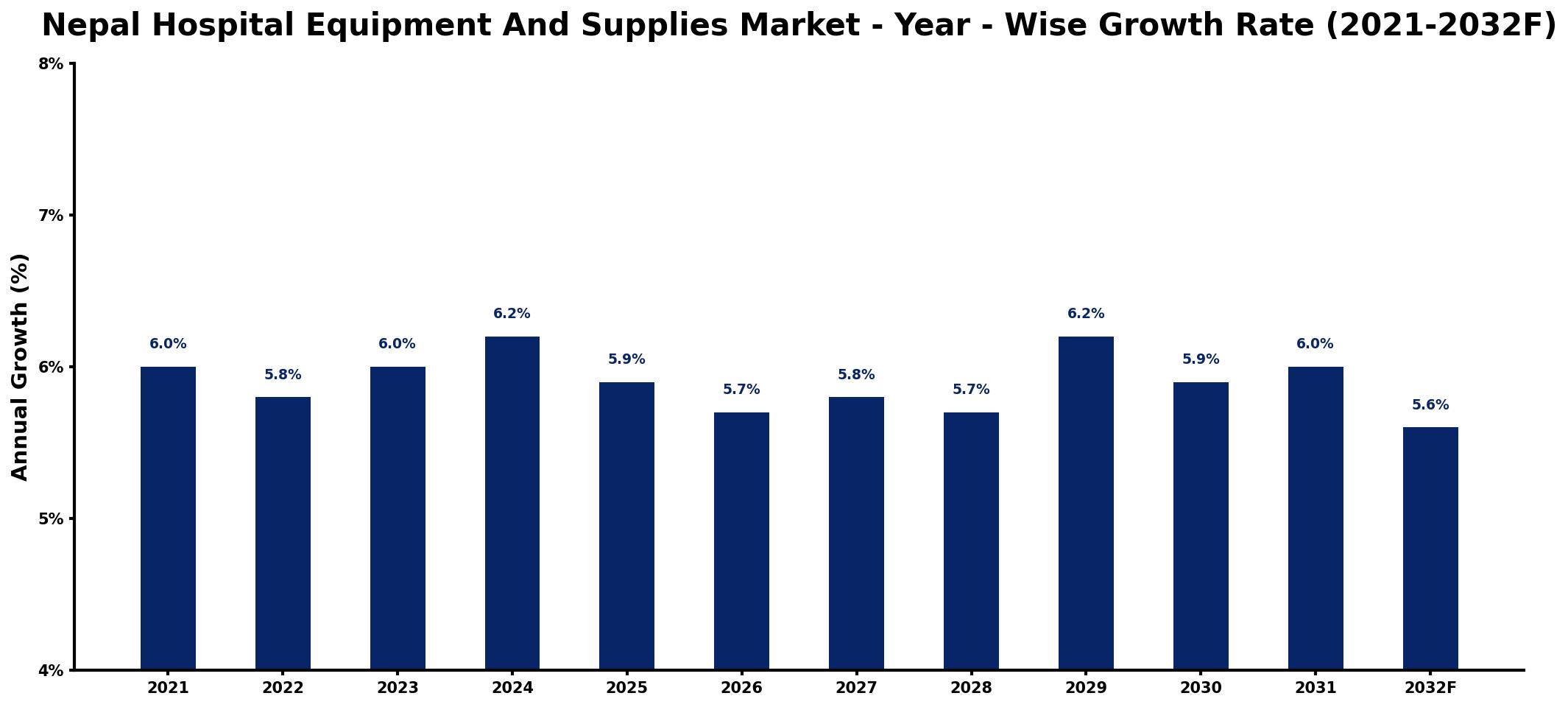
The table below presents the year‑wise growth rates along with the key drivers influencing the market
| Year | Growth Rate | Major Drivers |
| 2021 | 6.0% | Rising healthcare infrastructure investments |
| 2022 | 5.8% | Increased demand for medical services |
| 2023 | 6.0% | Growing population health awareness |
| 2024 | 6.2% | Expansion of private healthcare facilities |
| 2025 | 5.9% | Technological advancements in diagnostics |
| 2026 | 5.7% | Increase in health insurance coverage |
| 2027 | 5.8% | Surge in telemedicine adoption |
| 2028 | 5.7% | Growing elderly population requiring care |
| 2029 | 6.2% | Rise in preventive healthcare initiatives |
| 2030 | 5.9% | Boost in government health funding |
| 2031 | 6.0% | expanding industrial usage applications |
| 2032 | 5.6% | Increased focus on patient safety |
Note: Market size estimations and growth projections presented in this report are based on 6Wresearch's proprietary forecasting methodology, utilizing the latest available industry data, government publications, and primary research inputs.
Nepal Hospital Equipment And Supplies Market Synopsis
The Nepal Hospital Equipment and Supplies market is characterized by an increasing demand for sophisticated diagnostic equipment and surgical instruments tailored to meet the evolving needs of healthcare facilities. As the population grows and healthcare access improves, hospitals are seeking innovative solutions to enhance patient care and operational efficiency.
Furthermore, the surge in private healthcare establishments is fostering competition, thereby prompting enhancements in the quality and variety of medical supplies available. Initiatives aimed at bolstering local manufacturing are paving the way for reduced dependency on imports, contributing positively to the market landscape.
Nepal Hospital Equipment And Supplies Market Key Takeaways
- The market is poised for steady growth, driven by government initiatives aimed at healthcare infrastructure enhancement.
- Demand for advanced diagnostic tools and surgical equipment is on the rise, reflecting a shift towards modern healthcare practices.
- Public and private partnerships are increasingly crucial for addressing logistical and budgetary challenges within the sector.
- Investment in training programs for healthcare professionals is essential for maximizing the benefits of new technologies.
- Emerging trends like digitalization are reshaping the medical supplies landscape, leading to improved patient outcomes.
Evaluation of Restraints in Nepal Hospital Equipment And Supplies Market
Despite the positive growth indicators, the Nepal Hospital Equipment and Supplies market faces significant challenges. Limited healthcare budgets continue to constrain hospitals, particularly in rural areas where access to advanced technologies is minimal. Infrastructure inadequacies, compounded by logistical hurdles, impede the timely delivery and servicing of medical equipment. Moreover, regulatory complexities can hinder the rapid introduction of innovative products into the market, while the prevalence of counterfeit supplies raises serious concerns about patient safety and trust in medical facilities.
Nepal Hospital Equipment And Supplies Market Trends
A clear trend towards the adoption of advanced technologies is evident in the Nepal Hospital Equipment and Supplies market. Healthcare facilities are increasingly investing in specialized equipment, particularly in fields like diagnostic imaging and patient monitoring systems. Digitalization is also becoming prominent, with hospitals seeking solutions that integrate data management and patient care processes. This trend aligns with the global healthcare movement towards improved efficiency and better patient outcomes, indicating a transformative period for Nepal's healthcare landscape.
Nepal Hospital Equipment And Supplies Market Opportunities
The Nepal Hospital Equipment and Supplies Market is rich with investment opportunities. There is significant demand for quality medical devices, particularly diagnostic tools and surgical instruments that cater to the growing healthcare sector. Additionally, the need for medical consumables, including disposable products and personal protective equipment (PPE), is increasing as healthcare facilities work to meet safety standards. With the government's commitment to enhancing healthcare services, investors have a fertile ground for growth and innovation within this evolving market.
Government Initiatives in the Nepal Hospital Equipment And Supplies Market
The Nepalese government has implemented various policies aimed at ensuring the availability of high-quality hospital equipment and supplies. Regulations mandate that medical products must meet strict quality standards to guarantee patient safety and efficacy. Furthermore, the government promotes the localization of manufacturing, which aims to decrease dependency on imports and stimulate the local economy. These initiatives reflect a commitment to enhancing healthcare infrastructure and ensuring compliance with regulatory standards.
Future Insights of the Nepal Hospital Equipment And Supplies Market
Looking ahead to 2026-2032, the Nepal Hospital Equipment and Supplies Market is expected to maintain a growth trajectory. With ongoing investments in healthcare infrastructure and a continuous push for modernization, the demand for advanced medical equipment will expand significantly. The commitment to improving patient outcomes will drive the adoption of innovative technologies, ensuring that both local and international suppliers have substantial opportunities in the market. However, addressing existing challenges will be essential to maximize growth potential.
Nepal Hospital Equipment And Supplies Market Latest Developments (2025 - 2026)
Recent developments in the Nepal Hospital Equipment and Supplies market indicate a progressive shift toward advanced healthcare solutions. Significant public sector investment has been observed in the establishment of new healthcare facilities, alongside a growing emphasis on partnerships with international suppliers for state-of-the-art medical technologies. Additionally, advancements in digital health solutions are increasingly becoming integral to operational strategies, aiming to enhance service delivery and patient engagement across the board.
Nepal Hospital Equipment And Supplies Market - Key Attractiveness of the Report
- 10 Years of Market Numbers
- Historical Data Starting from 2022 to 2025
- Base Year: 2025
- Forecast Data until 2032
- Key Performance Indicators Impacting the Market
- Major Upcoming Developments and Projects
Key Highlights of the Report:
- Nepal Hospital Equipment And Supplies Market Outlook
- Market Size of Nepal Hospital Equipment And Supplies Market, 2025
- Forecast of Nepal Hospital Equipment And Supplies Market, 2032
- Historical Data and Forecast of Nepal Hospital Equipment And Supplies Revenues & Volume for the Period 2022-2032F
- Nepal Hospital Equipment And Supplies Market Trend Evolution
- Nepal Hospital Equipment And Supplies Market Drivers and Challenges
- Nepal Hospital Equipment And Supplies Price Trends
- Nepal Hospital Equipment And Supplies Porter's Five Forces
- Nepal Hospital Equipment And Supplies Industry Life Cycle
- Historical Data and Forecast of Nepal Hospital Equipment And Supplies Market Revenues & Volume By Product for the Period 2022-2032F
- Historical Data and Forecast of Nepal Hospital Equipment And Supplies Market Revenues & Volume By Sterilization And Disinfectant Equipment for the Period 2022-2032F
- Historical Data and Forecast of Nepal Hospital Equipment And Supplies Market Revenues & Volume By Disposable Hospital Supplies Patient Examination Devices for the Period 2022-2032F
- Historical Data and Forecast of Nepal Hospital Equipment And Supplies Market Revenues & Volume By Syringes And Needles for the Period 2022-2032F
- Historical Data and Forecast of Nepal Hospital Equipment And Supplies Market Revenues & Volume By Application for the Period 2022-2032F
- Historical Data and Forecast of Nepal Hospital Equipment And Supplies Market Revenues & Volume By OEMs for the Period 2022-2032F
- Historical Data and Forecast of Nepal Hospital Equipment And Supplies Market Revenues & Volume By Aftermarket for the Period 2022-2032F
- Nepal Hospital Equipment And Supplies Import Export Trade Statistics
- Market Opportunity Assessment By Product
- Market Opportunity Assessment By Application
- Nepal Hospital Equipment And Supplies Top Companies Market Share
- Nepal Hospital Equipment And Supplies Competitive Benchmarking By Technical and Operational Parameters
- Nepal Hospital Equipment And Supplies Company Profiles
- Nepal Hospital Equipment And Supplies Key Strategic Recommendations






































