Nepal Household furniture Market Summary
The nepal household furniture market was estimated at USD 235 Million in 2025 and is projected to reach USD 258 Million by 2032, growing at a CAGR of 0.8% from 2026 to 2032.
Nepal Household furniture Market Year-wise Growth Rate and Key Drivers
This graph highlights how the Nepal Household furniture Market has steadily grown over the past five years, supported by major growth factors.
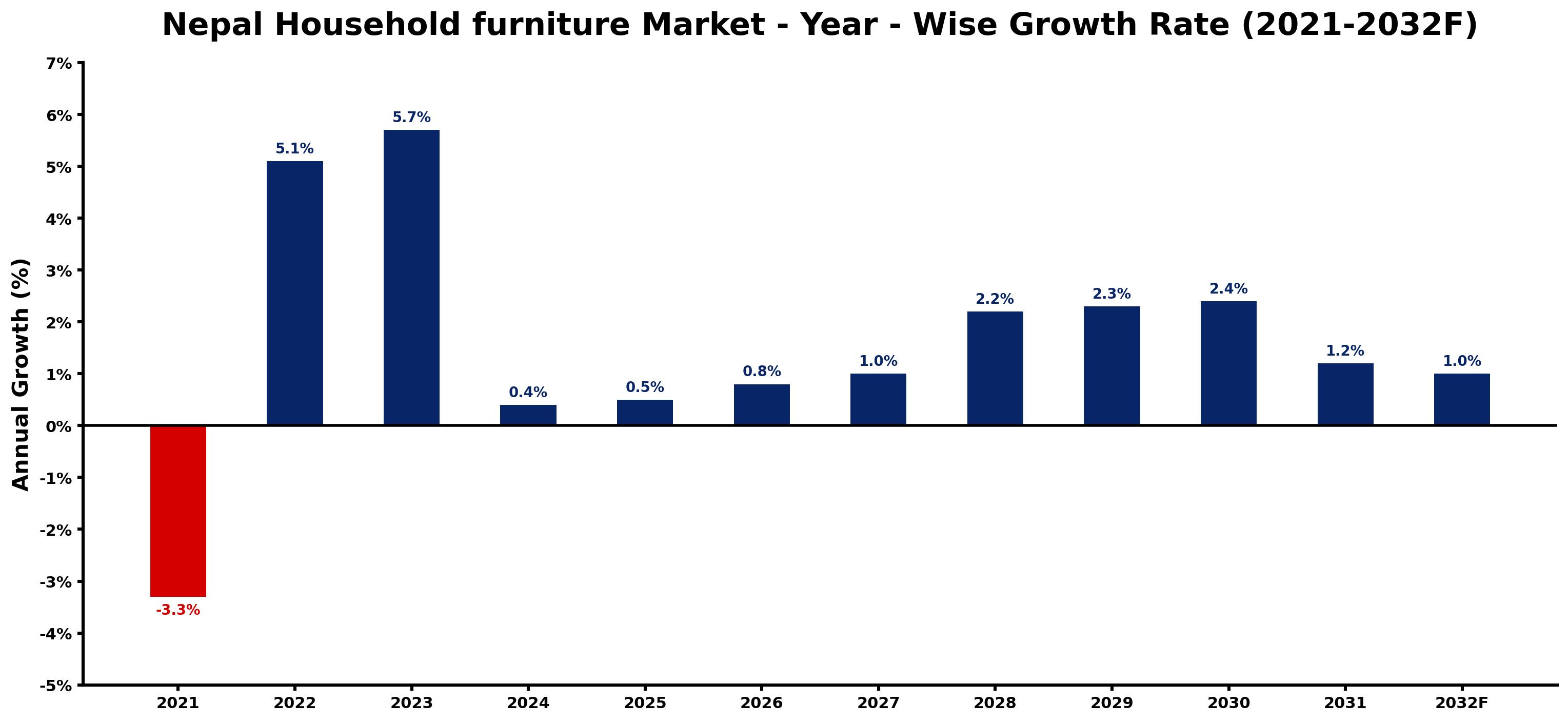
The table below presents the year wise growth rates along with the key drivers influencing the market
| Year | Growth Rate | Major Drivers |
| 2021 | -3.3% | Pandemicinduced restrictions limited consumer mobility, sharply reducing demand for household furniture purchases in 2021. |
| 2022 | 5.1% | Urban migration trends indicate a steady increase in urban housing developments. |
| 2023 | 5.7% | E-commerce expansion enables furniture retailers to reach remote rural markets effectively. |
| 2024 | 0.4% | Sustainable materials gain popularity as environmentally conscious buying patterns emerge. |
| 2025 | 0.5% | Rising disposable income allows households to invest in higher-quality furnishings. |
| 2026 | 0.8% | Home renovation projects flourish as young professionals seek personalized living spaces. |
| 2027 | 1.0% | Increased availability of financing options encourages consumers to purchase premium furniture. |
| 2028 | 2.2% | Global design influences reshape local furniture styles, appealing to younger demographics. |
| 2029 | 2.3% | Supply chain optimizations reduce costs, making furniture more accessible for average consumers. |
| 2030 | 2.4% | Smart home technology integration pushes furniture companies to innovate product offerings. |
| 2031 | 1.2% | Cultural appreciation for traditional designs fosters a niche market for heritage furniture. |
| 2032 | 1.0% | Overall market consolidation leads to stronger brand loyalty among furniture buyers. |
Note - Market size estimations and growth projections presented in this report are based on 6Wresearch's advanced forecasting approach, validated with industry datasets as of June 2026.
Nepal Household furniture Market Synopsis
The Nepal Household furniture Market is projected to reach 0.8% and witness significant growth during the forecast period (2026-2032). As the population of Nepal continues to expand, currently estimated at around 28 million people, the demand for household furniture, particularly wooden products, has demonstrated a consistent upward trend. The market size of household furniture in Nepal was valued at approximately US$ 491 million in 2020, with an annual growth rate of 7.1%. This growth can be attributed to increasing income levels among the populace and a demographic shift towards urban living.
Nepal Household furniture Market Growth Drivers
Several factors are driving the growth of the Nepal Household furniture Market. First, the rise in disposable income has empowered consumers to invest in higher-quality furniture that combines aesthetics with functionality. Second, the changing consumer preferences towards modern home furnishings are creating opportunities for businesses to innovate and expand their offerings. Third, the increasing urbanization trend is prompting families to seek versatile and space-saving furniture solutions. Fourth, improved access to online retail platforms has facilitated consumer shopping behaviors, enabling customers to explore a variety of products from the comfort of their homes. Lastly, government initiatives aimed at promoting local manufacturing and craftsmanship have supported the growth of the domestic furniture sector, ensuring its competitiveness against imported options.
Nepal Household furniture Market Trends and Opportunities
The Nepal Household furniture Market is witnessing several notable trends that present both challenges and opportunities for growth. The surge in demand for sustainable and eco-friendly furniture options is reshaping the market landscape as consumers become more environmentally conscious. Additionally, there is a growing popularity of modular furniture, which caters to the evolving needs of urban households. Technology integration, such as smart furniture that enhances user comfort and convenience, is also gaining traction. Furthermore, a rising trend in online shopping has prompted retailers to establish stronger digital presences, offering a greater range of products and enhancing customer experiences. Lastly, the demographic shift toward younger generations moving into their own households amplifies the demand for contemporary and stylish furniture solutions.
Nepal Household furniture Market Challenges and Restraints
Despite its growth trajectory, the Nepal Household furniture Market faces several challenges. One significant hurdle is the intense competition from unorganized players who provide cheaper alternatives, which can pressure profit margins for established retailers. Moreover, the fluctuating costs of raw materials, particularly wood, due to climatic changes and deforestation, remain a concern impacting production costs. Additionally, limited access to advanced technology and production techniques among local manufacturers can hinder their ability to meet the evolving demands of consumers. Furthermore, logistical challenges in distribution and delivery, particularly in rural areas, can affect customer satisfaction and brand loyalty. Finally, the economic uncertainties arising from global events may influence consumer spending habits, presenting a risk to market stability.
Nepal Household furniture Market Regional Analysis
The geographical dynamics of the Nepal Household furniture Market reveal significant regional variations in demand and consumer preferences. Urban centers, such as Kathmandu and Pokhara, display a robust demand for modern, stylish furniture due to rising incomes and changing lifestyles. In contrast, rural areas tend to prioritize traditional wooden furniture that caters to basic needs. The diverse cultural backgrounds across regions also influence furniture design preferences, with certain areas favoring handcrafted pieces reflecting local artistry. Additionally, as infrastructure improves, previously underserved markets are beginning to show increased potential for growth in household furniture sales. Understanding these regional distinctions is essential for manufacturers and retailers aiming to optimize their market strategies.
Nepal Household furniture Market Government Investment and Initiatives
The government of Nepal has recognized the importance of the household furniture sector and is actively working to foster its growth through various initiatives. Policies aimed at promoting foreign direct investment (FDI) have been established, facilitating the infusion of capital and advanced technologies into the local furniture industry. Public spending on infrastructure improvements is also enhancing logistics and distribution networks, making it easier for manufacturers to reach consumers. Additionally, development plans focused on supporting local craftsmanship stimulate the production of artisanal and culturally relevant furniture, allowing for the preservation of traditional techniques while meeting modern market demands. These initiatives contribute positively to the competitive landscape of the Nepal Household furniture Market.
Nepal Household furniture Market Latest Developments (May 2025 - June 2026)
Recent developments in the Nepal Household furniture Market have positioned it for continued expansion. The ongoing recovery from the global pandemic has driven a return to consumer spending, particularly on home improvements and renovations. Retailers are enhancing their online platforms to cater to the shifting shopping preferences, integrating augmented reality features to allow customers to visualize products in their living spaces. Additionally, collaborations between local artisans and modern brands have emerged, promoting unique designs that preserve traditional techniques while appealing to contemporary consumers. There is an increasing emphasis on sustainable materials, with many businesses transitioning toward responsible sourcing practices to meet the growing demand for eco-friendly products. These movements indicate a shift towards a more innovative and consumer-centered market landscape.
Nepal Household furniture Market - Key Attractiveness of the Report
- 10 Years of Market Numbers
- Historical Data Starting from 2022 to 2025
- Base Year: 2025
- Forecast Data until 2032
- Key Performance Indicators Impacting the Market
- Major Upcoming Developments and Projects
Key Highlights of the Report:
- Nepal Household furniture Market Outlook
- Market Size of Nepal Household furniture Market, 2025
- Forecast of Nepal Household furniture Market, 2032F
- Historical Data and Forecast of Nepal Household furniture Revenues & Volume for the Period 2022-2032F
- Nepal Household furniture Market Trend Evolution
- Nepal Household furniture Market Drivers and Challenges
- Nepal Household furniture Price Trends
- Nepal Household furniture Porter's Five Forces
- Nepal Household furniture Industry Life Cycle
- Historical Data and Forecast of Nepal Household furniture Market Revenues & Volume By Types for the Period 2022-2032F
- Historical Data and Forecast of Nepal Household furniture Market Revenues & Volume By Wood Furniture for the Period 2022-2032F
- Historical Data and Forecast of Nepal Household furniture Market Revenues & Volume By Metal Furniture for the Period 2022-2032F
- Historical Data and Forecast of Nepal Household furniture Market Revenues & Volume By Plastic Furniture for the Period 2022-2032F
- Historical Data and Forecast of Nepal Household furniture Market Revenues & Volume By Others for the Period 2022-2032F
- Historical Data and Forecast of Nepal Household furniture Market Revenues & Volume By Area of Use for the Period 2022-2032F
- Historical Data and Forecast of Nepal Household furniture Market Revenues & Volume By ?Bedroom Furniture for the Period 2022-2032F
- Historical Data and Forecast of Nepal Household furniture Market Revenues & Volume By Living Room Furniture for the Period 2022-2032F
- Historical Data and Forecast of Nepal Household furniture Market Revenues & Volume By Dining Room Furniture for the Period 2022-2032F
- Historical Data and Forecast of Nepal Household furniture Market Revenues & Volume By Household Furniture for the Period 2022-2032F
- Historical Data and Forecast of Nepal Household furniture Market Revenues & Volume By Others for the Period 2022-2032F
- Nepal Household furniture Import Export Trade Statistics
- Market Opportunity Assessment By Types
- Market Opportunity Assessment By Area of Use
- Nepal Household furniture Top Companies Market Share
- Nepal Household furniture Competitive Benchmarking By Technical and Operational Parameters
- Nepal Household furniture Company Profiles
- Nepal Household furniture Key Strategic Recommendations






































