Nepal Industrial Burner Market Size, Share & Growth Rate
The Nepal Industrial Burner Market was estimated at USD 248 Million in 2025 and is projected to reach USD 271 Million by 2032, growing at a CAGR of 1.3% from 2026 to 2032. This upward trajectory is primarily fueled by increasing industrial activities across critical sectors such as manufacturing, food processing, and textiles, where high heat input is essential for operations. Additionally, the growing awareness of sustainability and the push for regulatory compliance regarding emissions are prompting a shift towards more efficient burner technologies.
Nepal Industrial Burner Market Year-wise Growth Rate and Key Drivers
This graph highlights how the Nepal Industrial Burner Market has steadily grown over the years, supported by major growth factors.
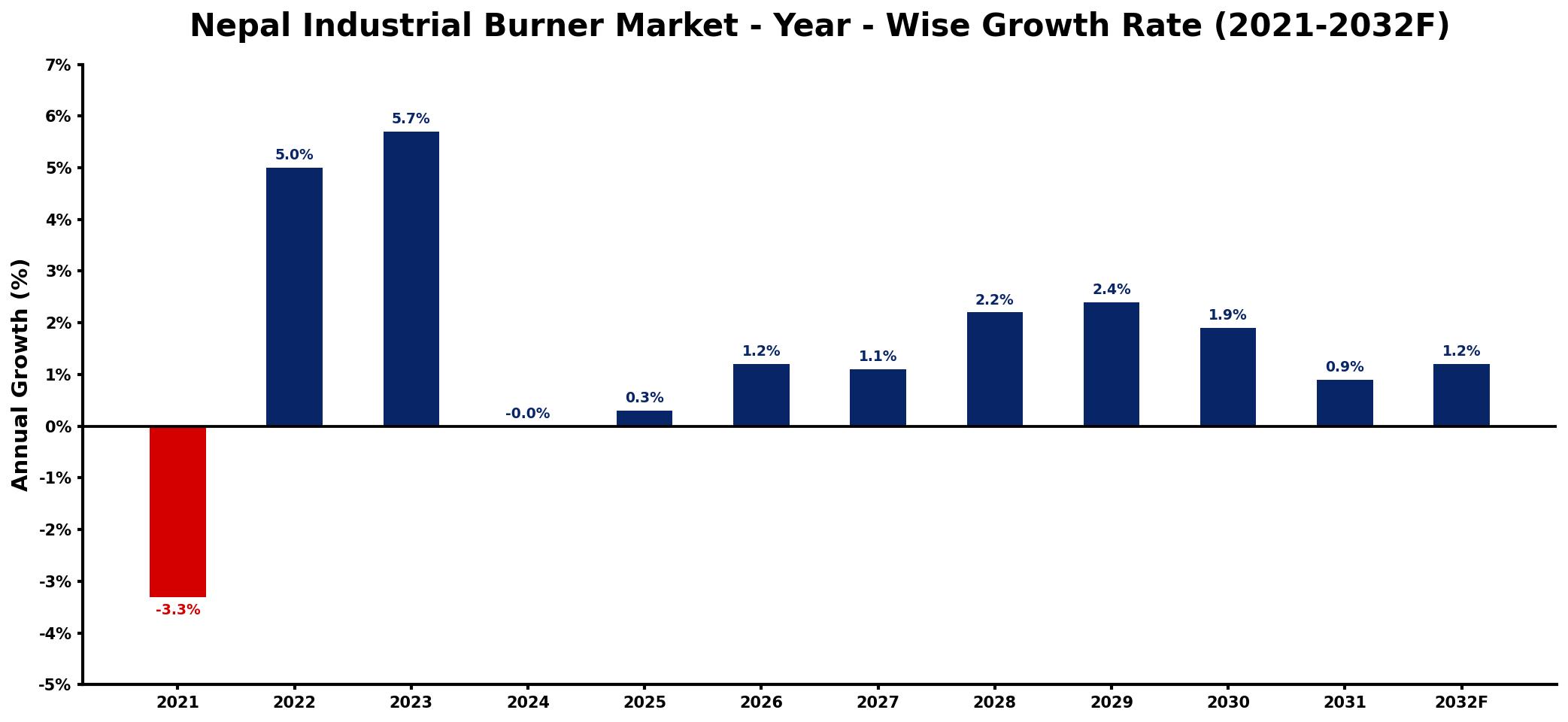
The table below presents the year‑wise growth rates along with the key drivers influencing the market
| Year | Growth Rate | Major Drivers |
| 2021 | -3.3% | decrease in manufacturing activities |
| 2022 | 5.0% | rise in energy sector investments |
| 2023 | 5.7% | growth in hospitality industry demand |
| 2024 | -0.0% | expansion of food processing sector |
| 2025 | 0.3% | increased construction project launches |
| 2026 | 1.2% | surge in agricultural processing needs |
| 2027 | 1.1% | enhanced regulatory support initiatives |
| 2028 | 2.2% | developments in renewable energy projects |
| 2029 | 2.4% | growing urban infrastructure projects |
| 2030 | 1.9% | uptick in export-oriented industries |
| 2031 | 0.9% | strengthening of local production capabilities |
| 2032 | 1.2% | advancements in technology adoption |
Note: Market size estimations and growth projections presented in this report are based on 6Wresearch's proprietary forecasting methodology, utilizing the latest available industry data, government publications, and primary research inputs.
Nepal Industrial Burner Market Synopsis
In Nepal, industrial burners are vital for processes such as melting and heating, making them indispensable in various manufacturing sectors. The current market is characterized by a burgeoning demand for technologically advanced burner systems that enhance energy efficiency while meeting stringent environmental standards.
As industries strive for optimal performance, the shift towards dual-fuel burners that can accommodate multiple fuel types, including natural gas and biofuels, is becoming increasingly pronounced. This trend is helping manufacturers reduce operational costs and improve sustainability, aligning with global standards.
Nepal Industrial Burner Market Key Takeaways
- The market is experiencing steady growth, driven by rising industrial activities in key sectors.
- There is an increased demand for environmentally friendly and energy-efficient burner technologies.
- Advanced burner solutions are being developed to comply with stringent emission regulations.
- Investors are exploring opportunities in manufacturing, distribution, and maintenance services for industrial burners.
- Government policies are guiding the market towards enhanced safety, efficiency, and reduced emissions.
Evaluation of Restraints in Nepal Industrial Burner Market
Despite its growth potential, the Nepal Industrial Burner Market faces significant constraints. A primary concern is the limited awareness among potential customers regarding the benefits of modern industrial burners, which can hinder adoption rates. Additionally, challenges such as inadequate infrastructure for installation and maintenance, along with high initial investment costs, create barriers for many businesses. The skills gap, characterized by a lack of trained technicians, further complicates the market landscape, limiting the effective implementation of advanced burner systems. Lastly, external factors such as economic and political instability in Nepal contribute to uncertainty, deterring investment and further development in the market.
Nepal Industrial Burner Market Trends
The market is witnessing a transformative trend towards more sustainable technologies, which is reshaping the industrial burner landscape in Nepal. Manufacturers are focusing on designing burners that not only enhance operational efficiency but also minimize environmental impact through lower emissions. The integration of smart technologies such as IoT and digital controls is emerging, enabling users to monitor and optimize burner performance in real-time. Additionally, as industries become more adept at using diverse fuel types, there is a burgeoning interest in burners that can seamlessly switch between fuels, thus further enhancing versatility and reducing dependency on a single energy source.
Nepal Industrial Burner Market Opportunities
The Nepal Industrial Burner Market is ripe with investment opportunities, particularly as industrialization accelerates within the country. The demand for energy-efficient solutions in sectors like textiles and food processing presents a lucrative avenue for investors looking to manufacture and distribute advanced burner technologies tailored to local needs. Furthermore, the potential for maintenance and repair services provides an attractive proposition, ensuring existing burner systems operate at peak performance. Collaborating with local industries can facilitate smoother market entry, helping investors navigate unique challenges and establish beneficial partnerships for sustained growth.
Government Initiatives in the Nepal Industrial Burner Market
The Nepalese government is actively fostering a regulatory framework that supports the Industrial Burner Market through policies aimed at emissions control and energy efficiency. These initiatives include promoting the adoption of energy-efficient burners, which align with global sustainability standards. Safety regulations are also in place to ensure that industrial burners are installed and operated safely, thereby protecting workers and minimizing accident risks. These government policies are instrumental in driving the market towards more environmentally sound and efficient combustion practices.
Future Insights of the Nepal Industrial Burner Market
Looking ahead to 2026-2032, the Nepal Industrial Burner Market is poised for continual growth, underpinned by the ongoing industrialization and the pressing need for effective combustion systems. The demand for energy-efficient burners will likely surge in response to stricter environmental regulations, pushing manufacturers to innovate continuously. Furthermore, advancements in technology, such as enhanced digital controls and IoT capabilities, are expected to boost operational efficiency and reduce emissions. As industries align with global sustainability goals, opportunities for manufacturers and suppliers to evolve alongside market needs will expand significantly.
Nepal Industrial Burner Market Latest Developments (2025 - 2026)
In recent months, the market has seen increased activity focused on the development of energy-efficient burner technologies. Manufacturers are investing in R&D to enhance their product offerings and meet the growing demand for sustainable solutions. Moreover, collaborations between industry stakeholders are becoming more common, aimed at sharing best practices and promoting innovations that cater to Nepal's unique industrial needs. The focus on improving technician training programs is also emerging as a critical area of development to address the skills gap in the market.
Nepal Industrial Burner Market - Key Attractiveness of the Report
- 10 Years of Market Numbers
- Historical Data Starting from 2022 to 2025
- Base Year: 2025
- Forecast Data until 2032
- Key Performance Indicators Impacting the Market
- Major Upcoming Developments and Projects
Key Highlights of the Report:
- Nepal Industrial Burner Market Outlook
- Market Size of Nepal Industrial Burner Market, 2025
- Forecast of Nepal Industrial Burner Market, 2032
- Historical Data and Forecast of Nepal Industrial Burner Revenues & Volume for the Period 2022-2032F
- Nepal Industrial Burner Market Trend Evolution
- Nepal Industrial Burner Market Drivers and Challenges
- Nepal Industrial Burner Price Trends
- Nepal Industrial Burner Porter's Five Forces
- Nepal Industrial Burner Industry Life Cycle
- Historical Data and Forecast of Nepal Industrial Burner Market Revenues & Volume By Type for the Period 2022-2032F
- Historical Data and Forecast of Nepal Industrial Burner Market Revenues & Volume By Cold Chamber Die Casting Machine for the Period 2022-2032F
- Historical Data and Forecast of Nepal Industrial Burner Market Revenues & Volume By Hot Chamber Die Casting Machine for the Period 2022-2032F
- Historical Data and Forecast of Nepal Industrial Burner Market Revenues & Volume By Gravity Die Casting Machine for the Period 2022-2032F
- Historical Data and Forecast of Nepal Industrial Burner Market Revenues & Volume By Material for the Period 2022-2032F
- Historical Data and Forecast of Nepal Industrial Burner Market Revenues & Volume By Aluminum for the Period 2022-2032F
- Historical Data and Forecast of Nepal Industrial Burner Market Revenues & Volume By Zinc for the Period 2022-2032F
- Historical Data and Forecast of Nepal Industrial Burner Market Revenues & Volume By Magnesium for the Period 2022-2032F
- Historical Data and Forecast of Nepal Industrial Burner Market Revenues & Volume By End User for the Period 2022-2032F
- Historical Data and Forecast of Nepal Industrial Burner Market Revenues & Volume By Transportation for the Period 2022-2032F
- Historical Data and Forecast of Nepal Industrial Burner Market Revenues & Volume By Mechanical & Manufacturing Equipment for the Period 2022-2032F
- Historical Data and Forecast of Nepal Industrial Burner Market Revenues & Volume By Building & Construction for the Period 2022-2032F
- Nepal Industrial Burner Import Export Trade Statistics
- Market Opportunity Assessment By Type
- Market Opportunity Assessment By Material
- Market Opportunity Assessment By End User
- Nepal Industrial Burner Top Companies Market Share
- Nepal Industrial Burner Competitive Benchmarking By Technical and Operational Parameters
- Nepal Industrial Burner Company Profiles
- Nepal Industrial Burner Key Strategic Recommendations






































