Nepal Industrial Machinery Market Size, Share & Growth Rate
The Nepal Industrial Machinery Market was estimated at USD 119 Million in 2025 and is projected to reach USD 131 Million by 2032, growing at a CAGR of 1.4% from 2026 to 2032. This growth trajectory is primarily fueled by the ongoing industrialization and infrastructure initiatives spearheaded by the Nepalese government. As key sectors such as manufacturing, construction, and agriculture continue to expand, the demand for a diverse array of industrial machinery is set to rise significantly.
Nepal Industrial Machinery Market Year-wise Growth Rate and Key Drivers
This graph highlights how the Nepal Industrial Machinery Market has steadily grown over the years, supported by major growth factors.
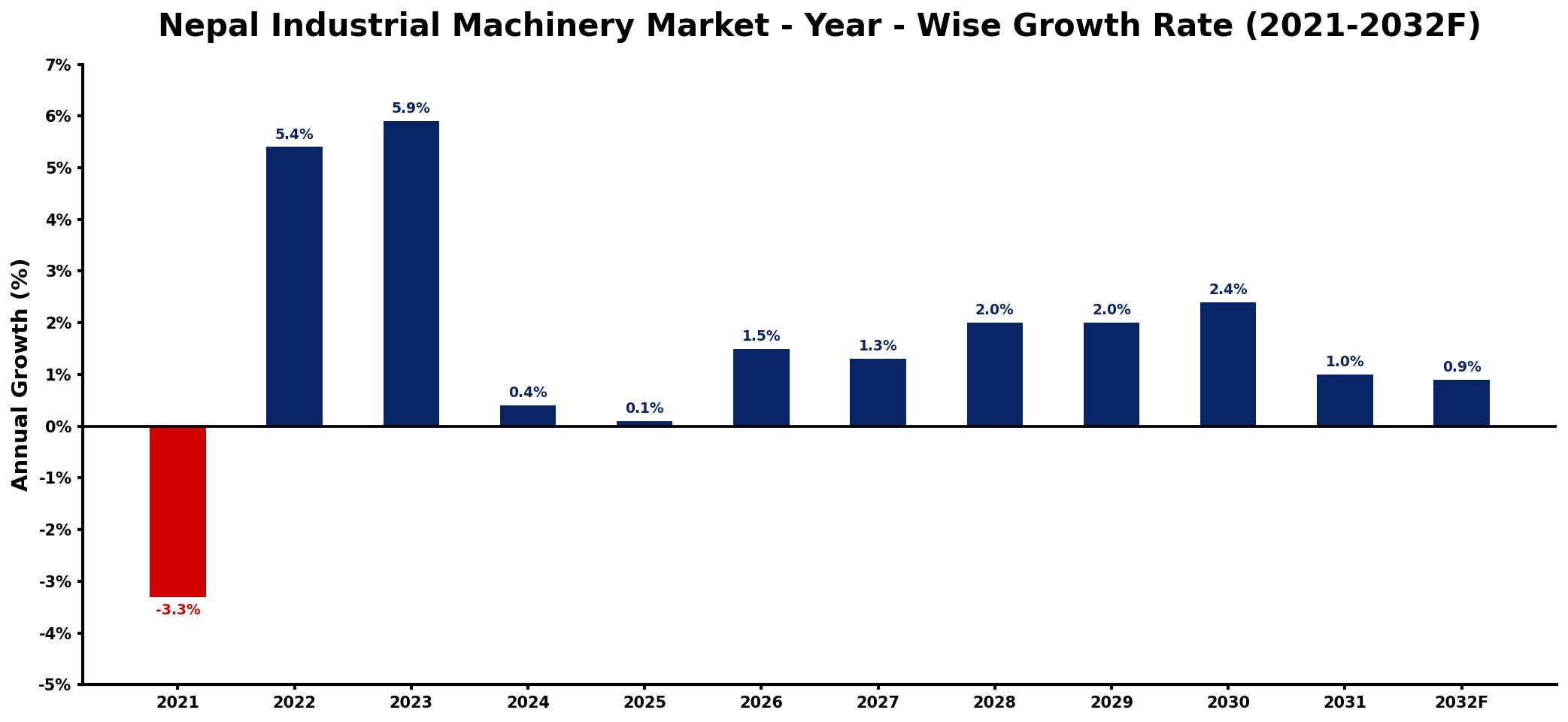
The table below presents the year‑wise growth rates along with the key drivers influencing the market
| Year | Growth Rate | Major Drivers |
| 2021 | -3.3% | decreased investment in manufacturing sector |
| 2022 | 5.4% | rise in construction project demand |
| 2023 | 5.9% | expansion of renewable energy initiatives |
| 2024 | 0.4% | growth in agricultural mechanization trends |
| 2025 | 0.1% | increased focus on automation solutions |
| 2026 | 1.5% | development of infrastructure projects surge |
| 2027 | 1.3% | enhanced government support for industries |
| 2028 | 2.0% | growing interest in eco-friendly technologies |
| 2029 | 2.0% | adoption of advanced production techniques |
| 2030 | 2.4% | increased pharmaceutical industry usage |
| 2031 | 1.0% | growing automotive sector requirements |
| 2032 | 0.9% | increased collaboration with foreign investors |
Note: Market size estimations and growth projections presented in this report are based on 6Wresearch's proprietary forecasting methodology, utilizing the latest available industry data, government publications, and primary research inputs.
Nepal Industrial Machinery Market Synopsis
The Nepal Industrial Machinery Market is currently navigating a dynamic landscape marked by rapid industrialization and a commitment to infrastructure development. The increasing need for efficient machinery across various industries underscores the market's potential and attractiveness for both local and international manufacturers.
Recent trends indicate a substantial shift toward automation, as companies seek advanced technologies to improve productivity and operational efficiency. Coupled with government support for industrial growth, the market appears poised for significant expansion, despite encountering challenges related to financing and infrastructure.
Nepal Industrial Machinery Market Key Takeaways
- Steady growth is anticipated, driven by industrialization and infrastructure projects.
- Key demand sectors include manufacturing, construction, and agriculture.
- Automation and digitalization trends are reshaping the market landscape.
- Government initiatives are fostering an environment conducive to industrial machinery investments.
- Challenges related to financing and infrastructure persist, impacting market dynamics.
Evaluation of Restraints in Nepal Industrial Machinery Market
The Nepal Industrial Machinery Market faces significant hurdles that could impact its trajectory. High import costs remain a primary concern, making it difficult for many businesses to procure advanced machinery. Additionally, limited access to financing constrains companies from investing in new technologies or expanding operations. The rugged terrain and underdeveloped infrastructure pose logistical challenges, complicating the distribution of machinery across the country. Lastly, the prevalence of counterfeit products undermines the competitiveness and reliability of genuine manufacturers.
Nepal Industrial Machinery Market Trends
The trend towards automation and digitalization is profoundly influencing the Nepal Industrial Machinery Market. Companies are increasingly integrating robotics and IoT technologies into their operations, allowing for enhanced flexibility and efficiency. Moreover, there is a growing emphasis on sustainability, with eco-friendly and energy-efficient machinery gaining traction. As businesses adapt to these evolving market demands, the introduction of innovative solutions will become essential in maintaining a competitive edge.
Nepal Industrial Machinery Market Opportunities
With the country's industrial sector on the rise, opportunities for investment in the Nepal Industrial Machinery Market are abundant. The need for state-of-the-art construction, agricultural, and manufacturing machinery opens numerous avenues for growth. Investors can benefit from establishing partnerships with local manufacturers, facilitating market entry and navigating regulatory landscapes. Additionally, focusing on automation technologies presents lucrative potential, aligning with market trends toward increased efficiency and productivity.
Government Initiatives in the Nepal Industrial Machinery Market
The government of Nepal has laid the groundwork to stimulate the growth of the industrial machinery market through various initiatives. This includes providing incentives such as tax breaks and subsidies to attract investments in the sector. Additionally, efforts to enhance infrastructure, particularly in transportation and energy supply, are vital for supporting industrial machinery development. Regulatory measures aimed at ensuring safety standards and encouraging environmentally friendly practices further contribute to creating a favorable environment for market players.
Future Insights of the Nepal Industrial Machinery Market
Looking ahead to 2026-2032, the Nepal Industrial Machinery Market is projected to experience continued growth, driven by further industrialization and a strong focus on infrastructure development. The government's commitment to enhancing manufacturing capabilities and attracting foreign investments will bolster demand for industrial machinery. Moreover, the increasing adoption of automation and advanced technologies will likely reshape the competitive landscape, presenting both challenges and opportunities for market participants.
Nepal Industrial Machinery Market Latest Developments (2025 - 2026)
Recent developments in the Nepal Industrial Machinery Market indicate a positive trend toward modernization and technological integration. Companies are increasingly investing in innovative machinery solutions, aligning with global advancements in efficiency and productivity. Additionally, collaborations between local and international firms are on the rise, fostering knowledge transfer and enhancing the overall quality of machinery available in the Nepalese market.
Nepal Industrial Machinery Market - Key Attractiveness of the Report
- 10 Years of Market Numbers
- Historical Data Starting from 2022 to 2025
- Base Year: 2025
- Forecast Data until 2032
- Key Performance Indicators Impacting the Market
- Major Upcoming Developments and Projects
Key Highlights of the Report:
- Nepal Industrial Machinery Market Outlook
- Market Size of Nepal Industrial Machinery Market, 2025
- Forecast of Nepal Industrial Machinery Market, 2032
- Historical Data and Forecast of Nepal Industrial Machinery Revenues & Volume for the Period 2022-2032F
- Nepal Industrial Machinery Market Trend Evolution
- Nepal Industrial Machinery Market Drivers and Challenges
- Nepal Industrial Machinery Price Trends
- Nepal Industrial Machinery Porter's Five Forces
- Nepal Industrial Machinery Industry Life Cycle
- Historical Data and Forecast of Nepal Industrial Machinery Market Revenues & Volume By Application for the Period 2022-2032F
- Historical Data and Forecast of Nepal Industrial Machinery Market Revenues & Volume By Agriculture for the Period 2022-2032F
- Historical Data and Forecast of Nepal Industrial Machinery Market Revenues & Volume By Construction for the Period 2022-2032F
- Historical Data and Forecast of Nepal Industrial Machinery Market Revenues & Volume By Packaging for the Period 2022-2032F
- Historical Data and Forecast of Nepal Industrial Machinery Market Revenues & Volume By Food Processing for the Period 2022-2032F
- Historical Data and Forecast of Nepal Industrial Machinery Market Revenues & Volume By Mining for the Period 2022-2032F
- Historical Data and Forecast of Nepal Industrial Machinery Market Revenues & Volume By Semiconductor Manufacturing for the Period 2022-2032F
- Nepal Industrial Machinery Import Export Trade Statistics
- Market Opportunity Assessment By Application
- Nepal Industrial Machinery Top Companies Market Share
- Nepal Industrial Machinery Competitive Benchmarking By Technical and Operational Parameters
- Nepal Industrial Machinery Company Profiles
- Nepal Industrial Machinery Key Strategic Recommendations






































