Nepal IPTV Market Size, Share & Growth Rate
The Nepal IPTV Market was estimated at USD 324 Million in 2025 and is projected to reach USD 444 Million by 2032, growing at a CAGR of 4.6% from 2026 to 2032. This growth is primarily driven by the increasing penetration of internet services across urban and rural areas, alongside a burgeoning demand for high-quality, diverse digital content. As consumers shift from traditional cable to on-demand viewing, IPTV providers are poised to enhance their offerings, capturing a larger share of the entertainment market.
Nepal IPTV Market Year-wise Growth Rate and Key Drivers
This graph highlights how the Nepal IPTV Market has steadily grown over the years, supported by major growth factors.
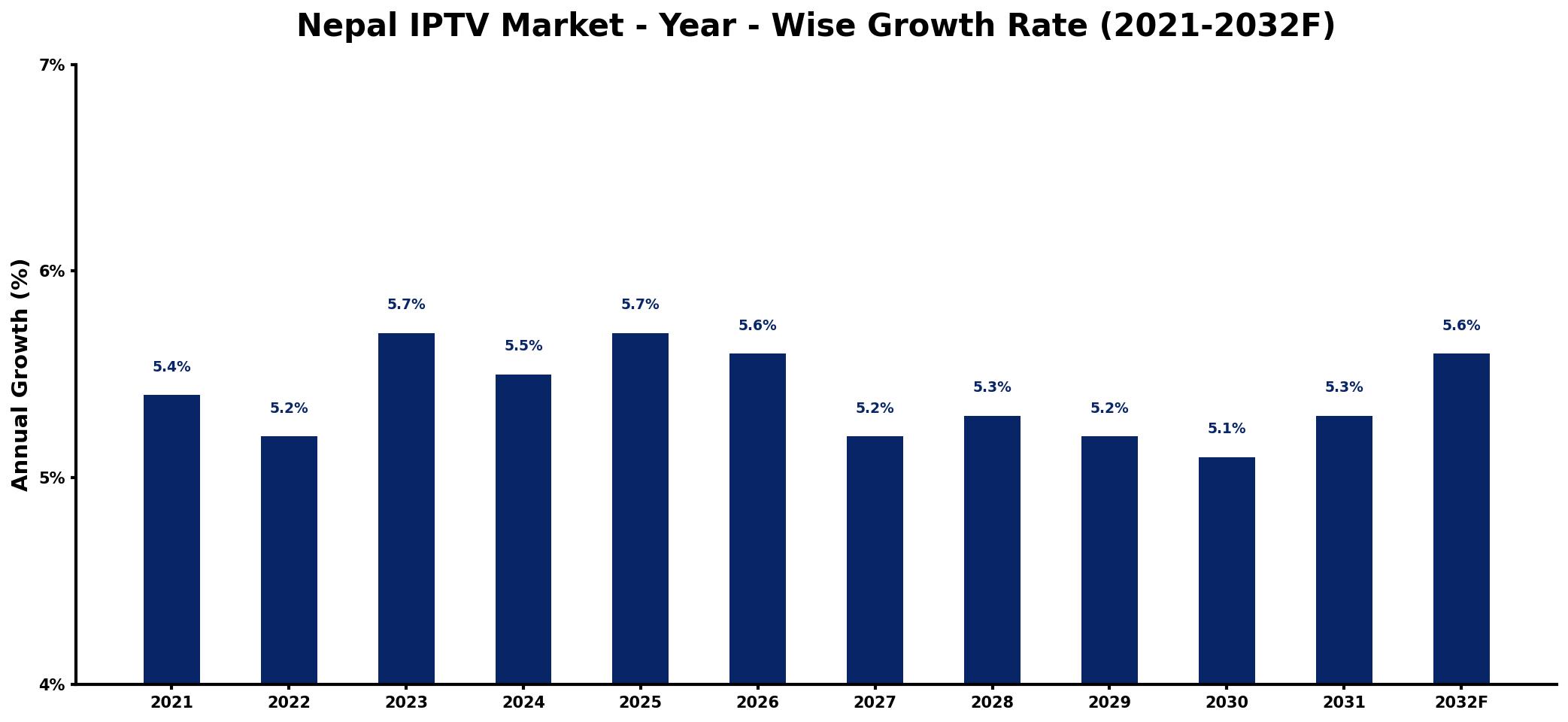
The table below presents the year‑wise growth rates along with the key drivers influencing the market
| Year | Growth Rate | Major Drivers |
| 2021 | 5.4% | Increased internet penetration rates |
| 2022 | 5.2% | Growing consumer demand for streaming |
| 2023 | 5.7% | Expansion of affordable broadband services |
| 2024 | 5.5% | Rise in mobile device usage |
| 2025 | 5.7% | Increased investment in digital infrastructure |
| 2026 | 5.6% | Growth in local content production |
| 2027 | 5.2% | Emergence of competitive pricing strategies |
| 2028 | 5.3% | Adoption of smart home technologies |
| 2029 | 5.2% | Rising popularity of on-demand services |
| 2030 | 5.1% | Increased partnerships with telecom providers |
| 2031 | 5.3% | Development of user-friendly platforms |
| 2032 | 5.6% | increased production capacity utilization |
Note: Market size estimations and growth projections presented in this report are based on 6Wresearch's proprietary forecasting methodology, utilizing the latest available industry data, government publications, and primary research inputs.
Nepal IPTV Market Synopsis
The Nepal IPTV market is witnessing a significant transformation fueled by technological advancements and evolving consumer preferences. With an increase in internet accessibility, more households are seeking high-quality digital content, positioning IPTV as a desirable option for entertainment.
IPTV providers are actively engaging in partnerships with local telecommunications firms to bundle services, thereby creating more attractive offers for customers. Moreover, the focus on content localization allows for customized viewing experiences, appealing to the unique tastes of Nepali audiences and boosting subscriber retention rates.
Nepal IPTV Market Key Takeaways
- The Nepal IPTV market is set for robust growth, driven by increased internet access and demand for quality content.
- Partnerships between IPTV providers and telecom companies are crucial for offering competitive service packages.
- Localized content and customization are emerging strategies to enhance customer attraction and loyalty.
- Investments in advanced technologies will be key to improving the overall user experience.
- Regulatory support plays an essential role in fostering a conducive environment for market expansion.
Evaluation of Restraints in Nepal IPTV Market
While the Nepal IPTV market displays tremendous potential, several factors pose significant challenges to its widespread adoption. A notable limitation is the uneven development of internet infrastructure, particularly in remote regions, which restricts access for many potential users. Additionally, the high costs associated with data plans and IPTV subscriptions may discourage lower-income consumers from engaging with these services. Complications surrounding content licensing and regulatory hurdles also hinder the ability of providers to offer popular international channels, further complicating their market positioning. Addressing these barriers through infrastructure investments and strategic partnerships will be crucial for unlocking the market's true potential.
Nepal IPTV Market Trends
The Nepal IPTV landscape is characterized by several dynamic trends that are shaping its evolution. One prominent trend is the rise of over-the-top (OTT) platforms that offer consumers a plethora of content options, including live channels and on-demand streaming services. Additionally, the production of local content is gaining traction, as providers seek to meet the diverse tastes of viewers by creating culturally relevant programming.
Another critical trend is the adoption of cutting-edge technologies like 4K streaming and cloud DVR services, significantly enhancing viewer experiences. Furthermore, as competitive pricing packages proliferate in the market, there is an increasing emphasis on service differentiation through unique features and customer engagement initiatives.
Nepal IPTV Market Opportunities
The Nepal IPTV market presents lucrative investment opportunities, particularly as the demand for high-quality digital entertainment continues to rise. Investors can explore avenues such as developing tailored content to cater to the rich cultural landscape of Nepal, which would resonate well with local audiences. Enhancing network infrastructure to ensure seamless streaming experiences will also be vital, positioning IPTV providers favorably in a competitive environment.
Moreover, investing in innovative technologies and interactive features can provide a distinct edge, allowing providers to differentiate their offerings. Strategic collaborations with local content creators can not only enrich the content pool but also help in fostering a loyal customer base, ensuring sustained growth in this burgeoning market.
Government Initiatives in the Nepal IPTV Market
Government initiatives aimed at promoting the Nepal IPTV market focus primarily on enhancing competition and consumer protection. The Nepal Telecommunications Authority (NTA) plays a pivotal role in regulating IPTV services, ensuring that operators comply with licensing requirements and quality standards. To stimulate growth, the government has introduced incentives that facilitate investment in digital infrastructure and reduce regulatory burdens. These measures not only promote innovation but also enhance service quality, contributing to a more vibrant IPTV ecosystem in Nepal.
Future Insights of the Nepal IPTV Market
Looking ahead to 2026-2032, the Nepal IPTV market is anticipated to experience steady expansion as consumer preferences continue to shift towards personalized and on-demand content. The government's commitment to improving digital infrastructure will likely support increased adoption rates, further enhancing accessibility across urban and rural areas alike. As IPTV providers innovate and diversify their offerings, they will be well-positioned to cater to the evolving demands of Nepali viewers, thereby solidifying their presence in the dynamic digital landscape.
Nepal IPTV Market Latest Developments (2025 - 2026)
Recent developments in the Nepal IPTV market indicate a growing emphasis on local content production, with several providers investing in original programming to engage a diverse audience. Additionally, advancements in streaming technology are being prioritized, enhancing the user experience through improved connectivity and interactive features. Providers are also focusing on strategic partnerships with telecommunications companies to create bundled offerings that enhance customer value. Regulatory improvements are being proposed to streamline licensing processes, potentially encouraging more entrants into the market.
Nepal IPTV Market - Key Attractiveness of the Report
- 10 Years of Market Numbers
- Historical Data Starting from 2022 to 2025
- Base Year: 2025
- Forecast Data until 2032
- Key Performance Indicators Impacting the Market
- Major Upcoming Developments and Projects
Key Highlights of the Report:
- Nepal IPTV Market Outlook
- Market Size of Nepal IPTV Market, 2025
- Forecast of Nepal IPTV Market, 2032
- Historical Data and Forecast of Nepal IPTV Revenues & Volume for the Period 2022-2032F
- Nepal IPTV Market Trend Evolution
- Nepal IPTV Market Drivers and Challenges
- Nepal IPTV Price Trends
- Nepal IPTV Porter's Five Forces
- Nepal IPTV Industry Life Cycle
- Historical Data and Forecast of Nepal IPTV Market Revenues & Volume By Component for the Period 2022-2032F
- Historical Data and Forecast of Nepal IPTV Market Revenues & Volume By Hardware (Router, Set-top Box, Receiver, Encoder) for the Period 2022-2032F
- Historical Data and Forecast of Nepal IPTV Market Revenues & Volume By Services (In-house services, Managed services) for the Period 2022-2032F
- Historical Data and Forecast of Nepal IPTV Market Revenues & Volume By Software for the Period 2022-2032F
- Historical Data and Forecast of Nepal IPTV Market Revenues & Volume By Transmission Type for the Period 2022-2032F
- Historical Data and Forecast of Nepal IPTV Market Revenues & Volume By Wired for the Period 2022-2032F
- Historical Data and Forecast of Nepal IPTV Market Revenues & Volume By Wireless for the Period 2022-2032F
- Historical Data and Forecast of Nepal IPTV Market Revenues & Volume By Streaming Type for the Period 2022-2032F
- Historical Data and Forecast of Nepal IPTV Market Revenues & Volume By Non-Video Television for the Period 2022-2032F
- Historical Data and Forecast of Nepal IPTV Market Revenues & Volume By Video Television for the Period 2022-2032F
- Historical Data and Forecast of Nepal IPTV Market Revenues & Volume By Subscription Type for the Period 2022-2032F
- Historical Data and Forecast of Nepal IPTV Market Revenues & Volume By Subscription-based IPTV for the Period 2022-2032F
- Historical Data and Forecast of Nepal IPTV Market Revenues & Volume By Subscription free IPTV for the Period 2022-2032F
- Historical Data and Forecast of Nepal IPTV Market Revenues & Volume By Device Type for the Period 2022-2032F
- Historical Data and Forecast of Nepal IPTV Market Revenues & Volume By Smartphones and tablets for the Period 2022-2032F
- Historical Data and Forecast of Nepal IPTV Market Revenues & Volume By Smart TVs for the Period 2022-2032F
- Historical Data and Forecast of Nepal IPTV Market Revenues & Volume By Desktops and laptops for the Period 2022-2032F
- Historical Data and Forecast of Nepal IPTV Market Revenues & Volume By Application for the Period 2022-2032F
- Historical Data and Forecast of Nepal IPTV Market Revenues & Volume By Linear Television for the Period 2022-2032F
- Historical Data and Forecast of Nepal IPTV Market Revenues & Volume By Non-linear Television for the Period 2022-2032F
- Historical Data and Forecast of Nepal IPTV Market Revenues & Volume By End User for the Period 2022-2032F
- Historical Data and Forecast of Nepal IPTV Market Revenues & Volume By SMEs for the Period 2022-2032F
- Historical Data and Forecast of Nepal IPTV Market Revenues & Volume By Large Enterprises for the Period 2022-2032F
- Historical Data and Forecast of Nepal IPTV Market Revenues & Volume By Residential customers for the Period 2022-2032F
- Historical Data and Forecast of Nepal IPTV Market Revenues & Volume By Vertical for the Period 2022-2032F
- Historical Data and Forecast of Nepal IPTV Market Revenues & Volume By Advertising and marketing for the Period 2022-2032F
- Historical Data and Forecast of Nepal IPTV Market Revenues & Volume By Media and entertainment for the Period 2022-2032F
- Historical Data and Forecast of Nepal IPTV Market Revenues & Volume By Gaming for the Period 2022-2032F
- Historical Data and Forecast of Nepal IPTV Market Revenues & Volume By Online stores for the Period 2022-2032F
- Historical Data and Forecast of Nepal IPTV Market Revenues & Volume By Telecom and IT for the Period 2022-2032F
- Historical Data and Forecast of Nepal IPTV Market Revenues & Volume By Healthcare and medical for the Period 2022-2032F
- Historical Data and Forecast of Nepal IPTV Market Revenues & Volume By Other Verticals (education and manufacturing). for the Period 2022-2032F
- Nepal IPTV Import Export Trade Statistics
- Market Opportunity Assessment By Component
- Market Opportunity Assessment By Transmission Type
- Market Opportunity Assessment By Streaming Type
- Market Opportunity Assessment By Subscription Type
- Market Opportunity Assessment By Device Type
- Market Opportunity Assessment By Application
- Market Opportunity Assessment By End User
- Market Opportunity Assessment By Vertical
- Nepal IPTV Top Companies Market Share
- Nepal IPTV Competitive Benchmarking By Technical and Operational Parameters
- Nepal IPTV Company Profiles
- Nepal IPTV Key Strategic Recommendations






































