Nepal Letterpress Printing Machinery Market Size, Share & Growth Rate
The Nepal Letterpress Printing Machinery Market was estimated at USD 485 Million in 2025 and is projected to reach USD 638 Million by 2032, growing at a CAGR of 4.0% from 2026 to 2032. This growth trajectory is fueled by the burgeoning sectors of publishing, packaging, and advertising, which are increasingly demanding high-quality printing solutions. Additionally, the market is seeing a shift towards sustainable printing practices, spurred by both consumer preferences and regulatory incentives.
Nepal Letterpress Printing Machinery Market Year-wise Growth Rate and Key Drivers
This graph highlights how the Nepal Letterpress Printing Machinery Market has steadily grown over the years, supported by major growth factors.
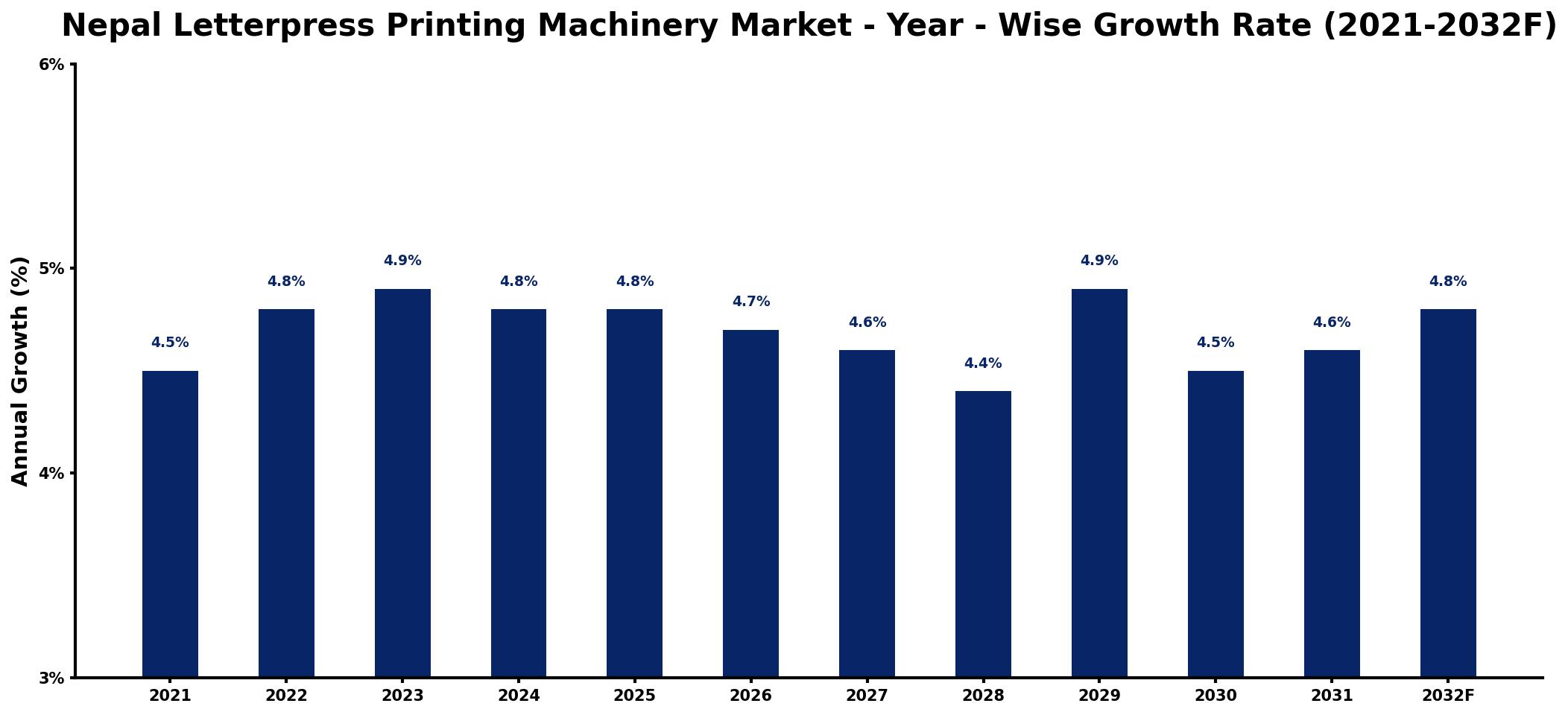
The table below presents the year‑wise growth rates along with the key drivers influencing the market
| Year | Growth Rate | Major Drivers |
| 2021 | 4.5% | Rising demand for customized solutions |
| 2022 | 4.8% | Increased investments in technology |
| 2023 | 4.9% | Growth in local manufacturing capabilities |
| 2024 | 4.8% | Expansion of small business sector |
| 2025 | 4.8% | Surge in eco-friendly initiatives |
| 2026 | 4.7% | Growing interest in artisanal products |
| 2027 | 4.6% | Boost in regional export opportunities |
| 2028 | 4.4% | Emergence of niche markets |
| 2029 | 4.9% | Increased collaboration with designers |
| 2030 | 4.5% | Strengthening of local supply chains |
| 2031 | 4.6% | Heightened focus on sustainability practices |
| 2032 | 4.8% | growing downstream application demand |
Note: Market size estimations and growth projections presented in this report are based on 6Wresearch's proprietary forecasting methodology, utilizing the latest available industry data, government publications, and primary research inputs.
Nepal Letterpress Printing Machinery Market Synopsis
Recent momentum in the Nepal Letterpress Printing Machinery Market reflects a dual dynamic of traditional craftsmanship meeting modern demands. While the popularity of digital printing technologies poses competition, there remains a steadfast appreciation for letterpress printing's quality, particularly for niche markets such as bespoke invitations and artisanal products.
Moving forward, the market's outlook is optimistic, supported by investments in advanced machinery and a growing trend towards eco-friendly practices. As businesses adopt more innovative printing methods, the letterpress segment is likely to evolve, accommodating both traditional and contemporary consumer expectations.
Nepal Letterpress Printing Machinery Market Key Takeaways
- The market is experiencing a gradual shift toward modern letterpress technologies that enhance efficiency and quality.
- Sustainability and eco-friendliness are emerging as key competitive differentiators among printing firms.
- Niche markets, particularly for specialized printing, continue to drive demand for traditional letterpress machinery.
- Government support through policy initiatives is fostering a more robust domestic printing industry.
- Investment opportunities are ripe for businesses looking to innovate within the sustainable printing landscape.
Evaluation of Restraints in Nepal Letterpress Printing Machinery Market
Despite its potential, the Nepal Letterpress Printing Machinery Market faces several constraints that hinder growth. The high cost of advanced printing technologies limits access for many small and mid-sized companies. Furthermore, inadequate infrastructure for maintenance and repair poses challenges, particularly in rural areas. The shortage of skilled technicians proficient in operating letterpress equipment further exacerbates these issues, compelling businesses to either invest heavily in training or seek alternatives in digital printing technologies that are perceived to be more cost-effective.
Nepal Letterpress Printing Machinery Market Trends
One notable trend is the increasing integration of eco-friendly materials and inks into the letterpress printing process, reflecting a broader industry shift towards sustainability. Additionally, the market is witnessing a revival of interest in vintage printing methods, driven by consumers' desire for unique, artisanal products. This nostalgic appreciation is likely to maintain a niche demand for traditional letterpress machinery, even amid rising digital printing preferences.
Nepal Letterpress Printing Machinery Market Opportunities
Opportunities abound in the Nepal Letterpress Printing Machinery Market, especially for those looking to introduce state-of-the-art machinery tailored to local needs. As the demand for sustainable printing continues to rise, there is significant potential for companies to develop eco-friendly solutions that cater to this growing consumer base. Collaborations with local printing firms to modernize their existing machinery or provide training could prove fruitful for investors keen on capitalizing on the market's evolving landscape.
Government Initiatives in the Nepal Letterpress Printing Machinery Market
The Nepalese government has enacted policies to bolster the letterpress printing machinery sector, including protective tariffs on imports to support domestic manufacturers. Incentives for local production and compliance with environmental regulations have been put in place to promote self-reliance and sustainability in the industry. Additionally, training programs aimed at skill development for workers are essential components of government initiatives, enhancing workforce productivity and competitiveness.
Future Insights of the Nepal Letterpress Printing Machinery Market
Looking ahead to 2026-2032, the Nepal Letterpress Printing Machinery Market is poised for steady growth. The unique advantages of letterpress printing, such as superior quality and craftsmanship, are increasingly being recognized by both businesses and consumers. As companies embrace technological innovations and eco-friendly practices, the market is expected to expand further, offering lucrative opportunities for manufacturers and suppliers to align with evolving consumer preferences and sustainability goals.
Nepal Letterpress Printing Machinery Market Latest Developments (2025 - 2026)
In recent months, the industry has seen a trend towards increased collaboration between local and international machinery suppliers. This includes partnerships aimed at improving the quality and sustainability of printing practices. Furthermore, various initiatives focusing on technology upgrades and training programs for technicians are gaining traction, enhancing the capabilities of local businesses in navigating the competitive landscape.
Nepal Letterpress Printing Machinery Market - Key Attractiveness of the Report
- 10 Years of Market Numbers
- Historical Data Starting from 2022 to 2025
- Base Year: 2025
- Forecast Data until 2032
- Key Performance Indicators Impacting the Market
- Major Upcoming Developments and Projects
Key Highlights of the Report:
- Nepal Letterpress Printing Machinery Market Outlook
- Market Size of Nepal Letterpress Printing Machinery Market, 2025
- Forecast of Nepal Letterpress Printing Machinery Market, 2032
- Historical Data and Forecast of Nepal Letterpress Printing Machinery Revenues & Volume for the Period 2022-2032F
- Nepal Letterpress Printing Machinery Market Trend Evolution
- Nepal Letterpress Printing Machinery Market Drivers and Challenges
- Nepal Letterpress Printing Machinery Price Trends
- Nepal Letterpress Printing Machinery Porter's Five Forces
- Nepal Letterpress Printing Machinery Industry Life Cycle
- Historical Data and Forecast of Nepal Letterpress Printing Machinery Market Revenues & Volume By Type for the Period 2022-2032F
- Historical Data and Forecast of Nepal Letterpress Printing Machinery Market Revenues & Volume By Rotary Letterpress Machine for the Period 2022-2032F
- Historical Data and Forecast of Nepal Letterpress Printing Machinery Market Revenues & Volume By Other for the Period 2022-2032F
- Historical Data and Forecast of Nepal Letterpress Printing Machinery Market Revenues & Volume By Application for the Period 2022-2032F
- Historical Data and Forecast of Nepal Letterpress Printing Machinery Market Revenues & Volume By Securities for the Period 2022-2032F
- Historical Data and Forecast of Nepal Letterpress Printing Machinery Market Revenues & Volume By Invitation Card for the Period 2022-2032F
- Historical Data and Forecast of Nepal Letterpress Printing Machinery Market Revenues & Volume By Other for the Period 2022-2032F
- Nepal Letterpress Printing Machinery Import Export Trade Statistics
- Market Opportunity Assessment By Type
- Market Opportunity Assessment By Application
- Nepal Letterpress Printing Machinery Top Companies Market Share
- Nepal Letterpress Printing Machinery Competitive Benchmarking By Technical and Operational Parameters
- Nepal Letterpress Printing Machinery Company Profiles
- Nepal Letterpress Printing Machinery Key Strategic Recommendations






































