Nepal Metal Shredder Machine Market Size, Share & Growth Rate
The Nepal Metal Shredder Machine Market was estimated at USD 619 Million in 2025 and is projected to reach USD 883 Million by 2032, growing at a CAGR of 5.2% from 2026 to 2032. This growth trajectory can be attributed to a combination of increasing industrial activity and heightened governmental focus on sustainability. As various sectors, including construction and manufacturing, ramp up their operations, the need for efficient metal recycling solutions becomes imperative, further driving demand for advanced shredding technology.
Nepal Metal Shredder Machine Market Year-wise Growth Rate and Key Drivers
This graph highlights how the Nepal Metal Shredder Machine Market has steadily grown over the years, supported by major growth factors.
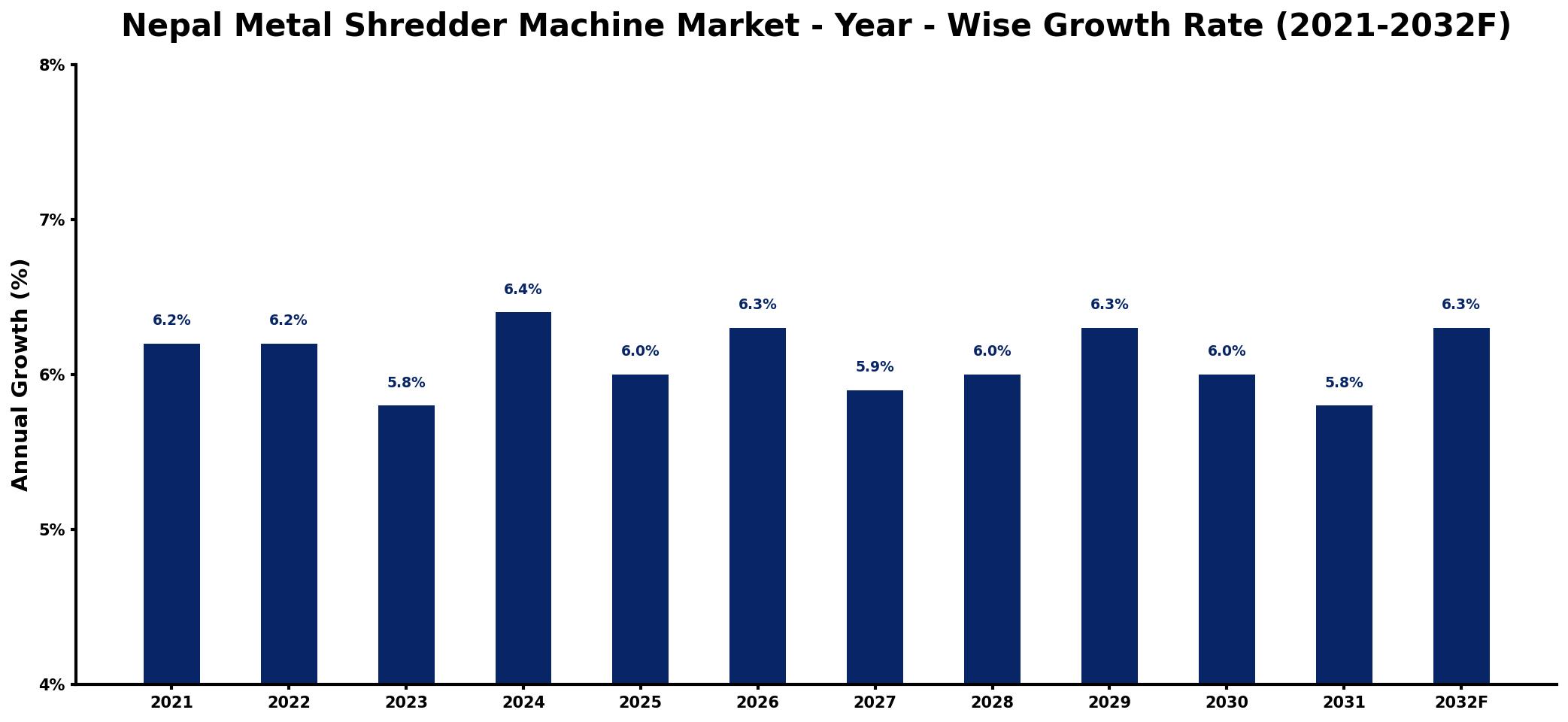
The table below presents the year‑wise growth rates along with the key drivers influencing the market
| Year | Growth Rate | Major Drivers |
| 2021 | 6.2% | Rising recycling industry investments |
| 2022 | 6.2% | Growing urban waste management needs |
| 2023 | 5.8% | Increased demand for sustainable practices |
| 2024 | 6.4% | Expansion of manufacturing sector requirements |
| 2025 | 6.0% | Higher regulations on waste disposal |
| 2026 | 6.3% | Advancements in recycling technologies |
| 2027 | 5.9% | Boost in automotive parts recycling |
| 2028 | 6.0% | Surge in electronic waste processing |
| 2029 | 6.3% | Emergence of new recycling facilities |
| 2030 | 6.0% | Increased focus on resource recovery |
| 2031 | 5.8% | Growth in construction material recycling |
| 2032 | 6.3% | Demand for circular economy solutions |
Note: Market size estimations and growth projections presented in this report are based on 6Wresearch's proprietary forecasting methodology, utilizing the latest available industry data, government publications, and primary research inputs.
Nepal Metal Shredder Machine Market Synopsis
The Nepal Metal Shredder Machine Market is on an upward path, fueled by a growing awareness of the importance of recycling. Industries across Nepal are becoming increasingly cognizant of the need to efficiently process metal waste, spurred by both governmental policies and the global shift toward sustainability. This has created fertile ground for innovations in metal shredder technology.
With a backdrop of regulatory incentives aimed at promoting environmental stewardship, stakeholders in the market are keen on adopting solutions that not only optimize operational efficiency but also minimize their ecological footprint. As such, investment in state-of-the-art shredding machines equipped with advanced features is on the rise, positioning the market for robust growth.
Nepal Metal Shredder Machine Market Key Takeaways
- The market is expected to experience significant growth driven by heightened demand for metal recycling solutions.
- Technological advancements focusing on energy efficiency and automation are shaping market dynamics.
- Government initiatives are creating a conducive environment for the adoption of shredding technology.
- Intense competition among market players is fostering innovation in product design and pricing.
- Awareness and educational campaigns are essential for increasing market penetration, especially among small enterprises.
Evaluation of Restraints in Nepal Metal Shredder Machine Market
Despite the promising growth prospects, the Nepal Metal Shredder Machine Market grapples with several constraints that hinder wider adoption. A significant barrier is the limited understanding of metal shredding technology among potential users, particularly small and medium-sized enterprises. This lack of awareness, coupled with the high initial investment costs associated with purchasing shredders, creates hesitancy among businesses to transition from traditional metal disposal methods.
Furthermore, insufficient waste management infrastructure complicates efforts to implement effective recycling practices. Without the necessary systems in place, the full potential of shredding technology cannot be realized. Thus, addressing these challenges will require coordinated efforts, including education initiatives and infrastructure development, to create a more favorable landscape for market growth.
Nepal Metal Shredder Machine Market Trends
The market is currently witnessing a clear trend toward the adoption of sophisticated shredding technologies. Key innovations focus on enhancing processing capacity, energy efficiency, and safety features, reflecting the industry's shift towards sustainability. Moreover, integration of automation and digital technologies is becoming a critical aspect, enabling companies to optimize their operational workflows and productivity.
In response to regulatory frameworks promoting sustainable waste management, businesses are increasingly interested in machinery that can process diverse types of metal scrap. This alignment with environmental goals is not only beneficial for the planet but also enhances profitability through improved material recovery rates.
Nepal Metal Shredder Machine Market Opportunities
The Nepal Metal Shredder Machine Market presents a multitude of investment opportunities for stakeholders looking to capitalize on the growing focus on recycling and sustainability. Manufacturing and distributing high-quality shredders tailored to specific industry needs can be particularly lucrative. Moreover, providing ongoing maintenance and repair services will cater to existing customers while attracting new ones seeking reliable solutions.
Collaborative ventures with governmental bodies promoting waste management can further open avenues for growth. Investing in research and development to innovate new shredding technologies will position companies favorably in a competitive market eager for advanced and efficient solutions.
Government Initiatives in the Nepal Metal Shredder Machine Market
The Nepalese government has introduced several initiatives aimed at bolstering the metal shredder machine market as part of its broader commitment to sustainable development. These initiatives include regulatory frameworks that ensure compliance with environmental standards, as well as financial incentives designed to promote the acquisition of energy-efficient machines. Furthermore, investment in recycling infrastructure and support for research and development in shredding technology is intended to facilitate market growth and minimize the ecological impact of waste management.
Future Insights of the Nepal Metal Shredder Machine Market
Looking ahead, the Nepal Metal Shredder Machine Market is poised for substantial growth from 2026 to 2032. As industries increasingly prioritize efficient waste management solutions, the adoption of advanced shredding technologies will become essential. Coupled with rising governmental support for sustainable practices, these factors are expected to drive market expansion. However, stakeholders must remain vigilant in addressing existing barriers, such as cost and awareness, to fully harness the market's potential.
Nepal Metal Shredder Machine Market Latest Developments (2025 - 2026)
Recent trends within the Nepal Metal Shredder Machine Market indicate a shift toward more automated and sophisticated machinery as businesses seek to enhance productivity while meeting environmental standards. Increased collaborations between private sector companies and government entities have fostered a more conducive environment for technological advancements. Additionally, educational initiatives aimed at raising awareness about the benefits of metal shredding are gaining momentum, reflecting a collective effort to improve recycling practices across the nation.
Nepal Metal Shredder Machine Market - Key Attractiveness of the Report
- 10 Years of Market Numbers
- Historical Data Starting from 2022 to 2025
- Base Year: 2025
- Forecast Data until 2032
- Key Performance Indicators Impacting the Market
- Major Upcoming Developments and Projects
Key Highlights of the Report:
- Nepal Metal Shredder Machine Market Outlook
- Market Size of Nepal Metal Shredder Machine Market, 2025
- Forecast of Nepal Metal Shredder Machine Market, 2032
- Historical Data and Forecast of Nepal Metal Shredder Machine Revenues & Volume for the Period 2022-2032F
- Nepal Metal Shredder Machine Market Trend Evolution
- Nepal Metal Shredder Machine Market Drivers and Challenges
- Nepal Metal Shredder Machine Price Trends
- Nepal Metal Shredder Machine Porter's Five Forces
- Nepal Metal Shredder Machine Industry Life Cycle
- Historical Data and Forecast of Nepal Metal Shredder Machine Market Revenues & Volume By Type for the Period 2022-2032F
- Historical Data and Forecast of Nepal Metal Shredder Machine Market Revenues & Volume By Mechanical Shredder Machine for the Period 2022-2032F
- Historical Data and Forecast of Nepal Metal Shredder Machine Market Revenues & Volume By Shock Wave Shredder Machine for the Period 2022-2032F
- Historical Data and Forecast of Nepal Metal Shredder Machine Market Revenues & Volume By Application for the Period 2022-2032F
- Historical Data and Forecast of Nepal Metal Shredder Machine Market Revenues & Volume By Iron and Steel for the Period 2022-2032F
- Historical Data and Forecast of Nepal Metal Shredder Machine Market Revenues & Volume By Aluminum and Copper for the Period 2022-2032F
- Historical Data and Forecast of Nepal Metal Shredder Machine Market Revenues & Volume By Non-Ferrous Metals for the Period 2022-2032F
- Nepal Metal Shredder Machine Import Export Trade Statistics
- Market Opportunity Assessment By Type
- Market Opportunity Assessment By Application
- Nepal Metal Shredder Machine Top Companies Market Share
- Nepal Metal Shredder Machine Competitive Benchmarking By Technical and Operational Parameters
- Nepal Metal Shredder Machine Company Profiles
- Nepal Metal Shredder Machine Key Strategic Recommendations






































