Nepal MVNO Market Size & Growth Rate (2026-2032)
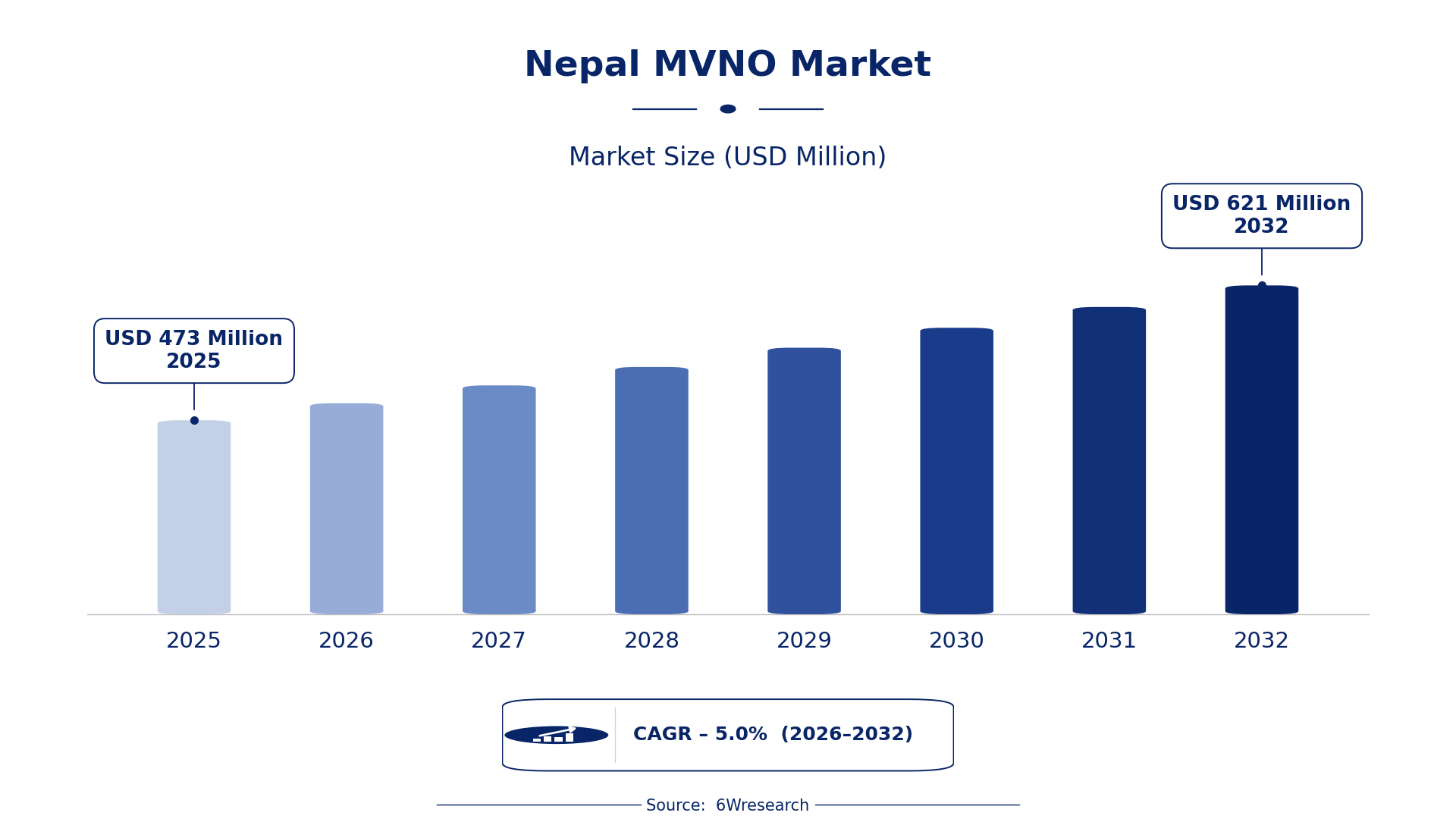
The Nepal MVNO Market was estimated at USD 473 Million in 2025 and is projected to reach USD 621 Million by 2032, growing at a CAGR of 5.0% from 2026 to 2032.
Nepal MVNO Market Synopsis
The Nepal MVNO market is gradually gaining traction, with a distinct focus on niche customer segments. This is especially relevant for the youth demographic, who seek affordable, data-heavy plans tailored to their digital lifestyle.
Consumer demand for customized services is pushing MVNOs to differentiate themselves, often through innovative partnerships with established mobile network operators. These collaborations allow MVNOs to leverage existing infrastructure while concentrating on marketing strategies and customer engagement.
Nepal MVNO Market Year-wise Growth Rate and Key Drivers
This graph illustrates the annual growth rates of the Nepal MVNO Market from 2021 to 2032, highlighting a steady upward trajectory and projected expansion over the forecast period.
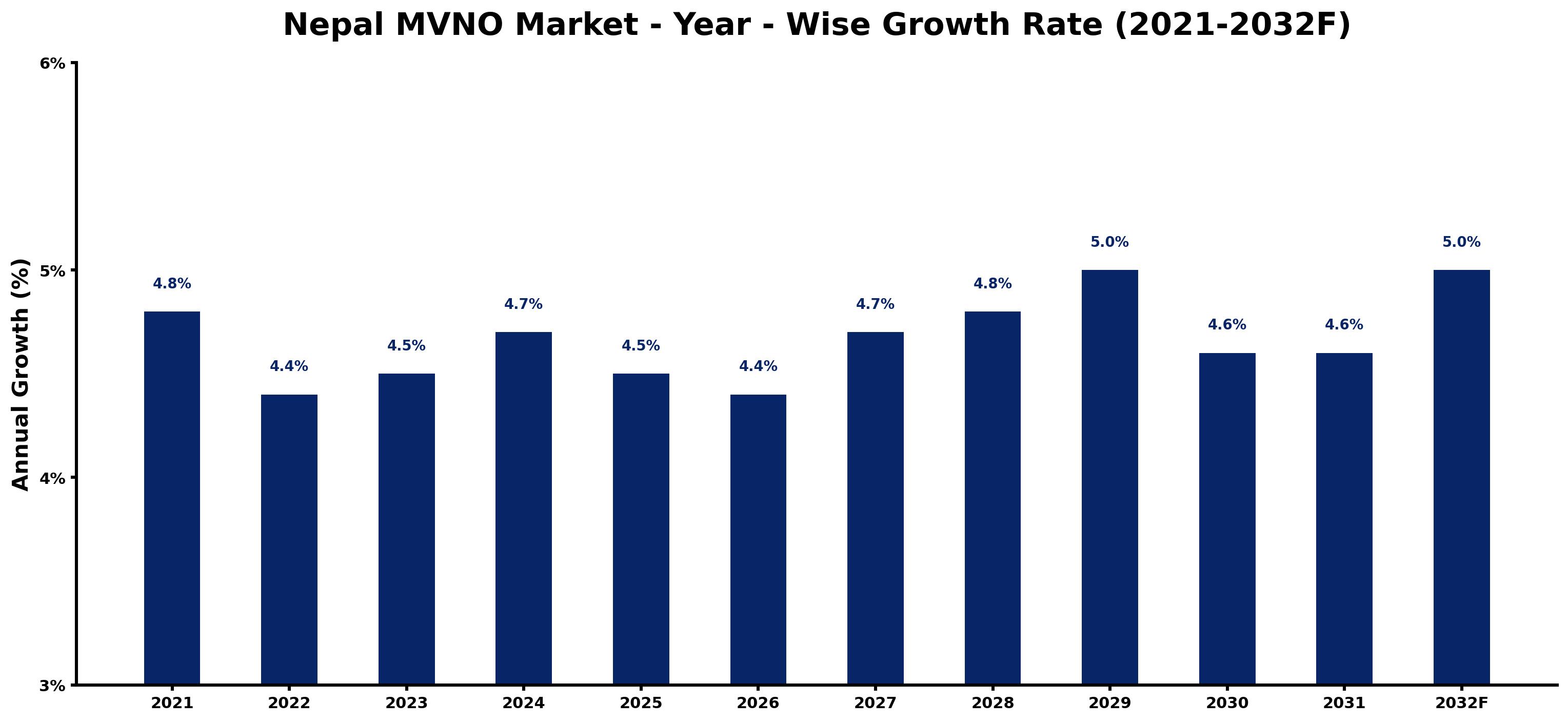
The table below presents the year‑wise growth rates along with the key drivers influencing the market
| Year | Growth Rate | Major Drivers |
| 2021 | 4.8% | Increase in demand for affordable mobile services. |
| 2022 | 4.4% | Government's policy to encourage telecommunication competition. |
| 2023 | 4.5% | Growing rural population adopting mobile communication solutions. |
| 2024 | 4.7% | Launch of innovative prepaid mobile subscription plans. |
| 2025 | 4.5% | Partnerships between MVNOs and local retailers expanding reach. |
| 2026 | 4.4% | Surge in mobile payment adoption among small businesses. |
| 2027 | 4.7% | Digital education initiatives increasing mobile usage in schools. |
| 2028 | 4.8% | Local content creation driving data consumption growth. |
| 2029 | 5.0% | Increased foreign investments in telecommunications infrastructure. |
| 2030 | 4.6% | Government incentives for startups in telecommunications sector. |
| 2031 | 4.6% | Enhanced customer service offerings attracting new subscribers. |
| 2032 | 5.0% | Rise in digital entrepreneurship boosting mobile service demands. |
Note: Market size estimations and growth projections presented in this report are based on 6Wresearch's proprietary forecasting methodology, utilizing the latest available industry data, government publications, and primary research inputs.
Nepal MVNO Market Key Takeaways
Below are some of the specific key takeaways from the market, including:
- The MVNO sector in Nepal is still emerging, with considerable room for growth as smartphone usage rises.
- Collaboration between MVNOs and traditional telecom operators is becoming a key strategy for market penetration.
- Regulatory frameworks are supportive, promoting competition and innovation within the telecom sector.
- Customizable mobile service offerings are in demand, catering to specific demographics like youth and expatriates.
- Investment opportunities exist for MVNOs that focus on affordable and innovative service packages.
Evaluation of Restraints in Nepal MVNO Market
Despite its growth potential, the Nepal MVNO market faces certain restraints. Regulatory barriers can hinder the entry of new players, complicating the licensing process. on top of that, the existing mobile network operators maintain a stronghold on customer loyalty and market share, making it difficult for MVNOs to carve out their niche. Limited network infrastructure in rural areas also poses a challenge, as reliable service remains a critical component for customer satisfaction and retention.
Nepal MVNO Market Trends
Current trends indicate a rising inclination towards partnerships that enhance service offerings and customer reach. MVNOs are focusing on specialized services to attract users in unique market segments, such as expatriates who require international calling plans. The technological landscape is shifting as well, with an emphasis on digital services that cater to the increasing data consumption across the country.
Nepal MVNO Market Opportunities
The Nepal MVNO market presents substantial opportunities for investment, particularly as the government continues to advocate for enhanced connectivity. By targeting underserved demographics, such as rural populations and young consumers, MVNOs can tap into a growing user base. Additionally, the introduction of innovative service packages and competitive pricing strategies will be vital for attracting budget-conscious consumers.
Government Initiatives in the Nepal MVNO Market
Government policies are instrumental in shaping the operational framework for MVNOs in Nepal. The Nepal Telecommunications Authority (NTA) has established guidelines that encourage the entry of MVNOs, fostering competition and ensuring consumer protection. This proactive regulatory posture is crucial for the sector's growth, offering a conducive environment for new entrants.
- A regulatory framework was introduced in 2023 to streamline the licensing process for MVNOs, promoting easier market entry.
- Ongoing initiatives aim to upgrade the national digital infrastructure, enhancing connectivity options across urban and rural areas.
- A planned public-private partnership expected to launch in 2026 focuses on expanding telecom infrastructure in underserved regions.
- Recent guidelines by the NTA mandate transparency in billing practices for all telecom operators, including MVNOs.
Future Insights of the Nepal MVNO Market
Looking ahead, the Nepal MVNO market is set for progressive growth driven by technological advancements and an expanding consumer base. As smartphone penetration continues to rise, the demand for innovative and affordable mobile services will only increase. Expect MVNOs to capitalize on strategic collaborations with established operators to enhance their service offerings and improve market reach.
Nepal MVNO Market Latest Developments
In the past year, the Nepal MVNO market has seen several noteworthy developments that signal its growth trajectory. The focus has been on enhancing service offerings and expanding infrastructure to meet rising consumer demands.
- A partnership was formed in early 2025 between a leading MVNO and a major telecom operator to launch youth-centric data plans, completed by mid-2025.
- Ongoing efforts to improve network coverage in rural areas are being undertaken, with initiatives that began in late 2024 and remain underway.
- An upcoming service enhancement initiative is expected to roll out in Q1 2026, introducing value-added features for existing MVNO customers.
- In late 2025, a major technology vendor announced a collaboration to provide advanced analytics tools for MVNOs, enhancing customer service capabilities.
Nepal MVNO Market - Key Attractiveness of the Report
- 10 Years of Market Numbers
- Historical Data Starting from 2022 to 2025
- Base Year: 2025
- Forecast Data until 2032
- Key Performance Indicators Impacting the Market
- Major Upcoming Developments and Projects
Key Highlights of the Report:
- Nepal MVNO Market Outlook
- Market Size of Nepal MVNO Market, 2025
- Forecast of Nepal MVNO Market, 2032
- Historical Data and Forecast of Nepal MVNO Revenues & Volume for the Period 2022-2032F
- Nepal MVNO Market Trend Evolution
- Nepal MVNO Market Drivers and Challenges
- Nepal MVNO Price Trends
- Nepal MVNO Porter's Five Forces
- Nepal MVNO Industry Life Cycle
- Historical Data and Forecast of Nepal MVNO Market Revenues & Volume By Operational Model for the Period 2022-2032F
- Historical Data and Forecast of Nepal MVNO Market Revenues & Volume By Reseller for the Period 2022-2032F
- Historical Data and Forecast of Nepal MVNO Market Revenues & Volume By Service Operator for the Period 2022-2032F
- Historical Data and Forecast of Nepal MVNO Market Revenues & Volume By Full MVNO for the Period 2022-2032F
- Historical Data and Forecast of Nepal MVNO Market Revenues & Volume By Organization Size for the Period 2022-2032F
- Historical Data and Forecast of Nepal MVNO Market Revenues & Volume By SMES for the Period 2022-2032F
- Historical Data and Forecast of Nepal MVNO Market Revenues & Volume By Large Enterprise for the Period 2022-2032F
- Historical Data and Forecast of Nepal MVNO Market Revenues & Volume By Subscriber for the Period 2022-2032F
- Historical Data and Forecast of Nepal MVNO Market Revenues & Volume By Consumer for the Period 2022-2032F
- Historical Data and Forecast of Nepal MVNO Market Revenues & Volume By Enterprise for the Period 2022-2032F
- Nepal MVNO Import Export Trade Statistics
- Market Opportunity Assessment By Operational Model
- Market Opportunity Assessment By Organization Size
- Market Opportunity Assessment By Subscriber
- Nepal MVNO Top Companies Market Share
- Nepal MVNO Competitive Benchmarking By Technical and Operational Parameters
- Nepal MVNO Company Profiles
- Nepal MVNO Key Strategic Recommendations






































