Nepal Oilfield Air Drilling Market Size, Share & Growth Rate
The Nepal Oilfield Air Drilling Market was estimated at USD 1500 Million in 2025 and is projected to reach USD 2599 Million by 2032, growing at a CAGR of 8.2% from 2026 to 2032. This growth trajectory is predominantly fueled by increasing investments in advanced drilling technologies and the rising need for efficient exploration methods in Nepals challenging geological formations. As companies seek cost-effective solutions to tap into untapped oil reserves, air drilling techniques are gaining significant traction in the market.
Nepal Oilfield Air Drilling Market Year-wise Growth Rate and Key Drivers
This graph highlights how the Nepal Oilfield Air Drilling Market has steadily grown over the years, supported by major growth factors.
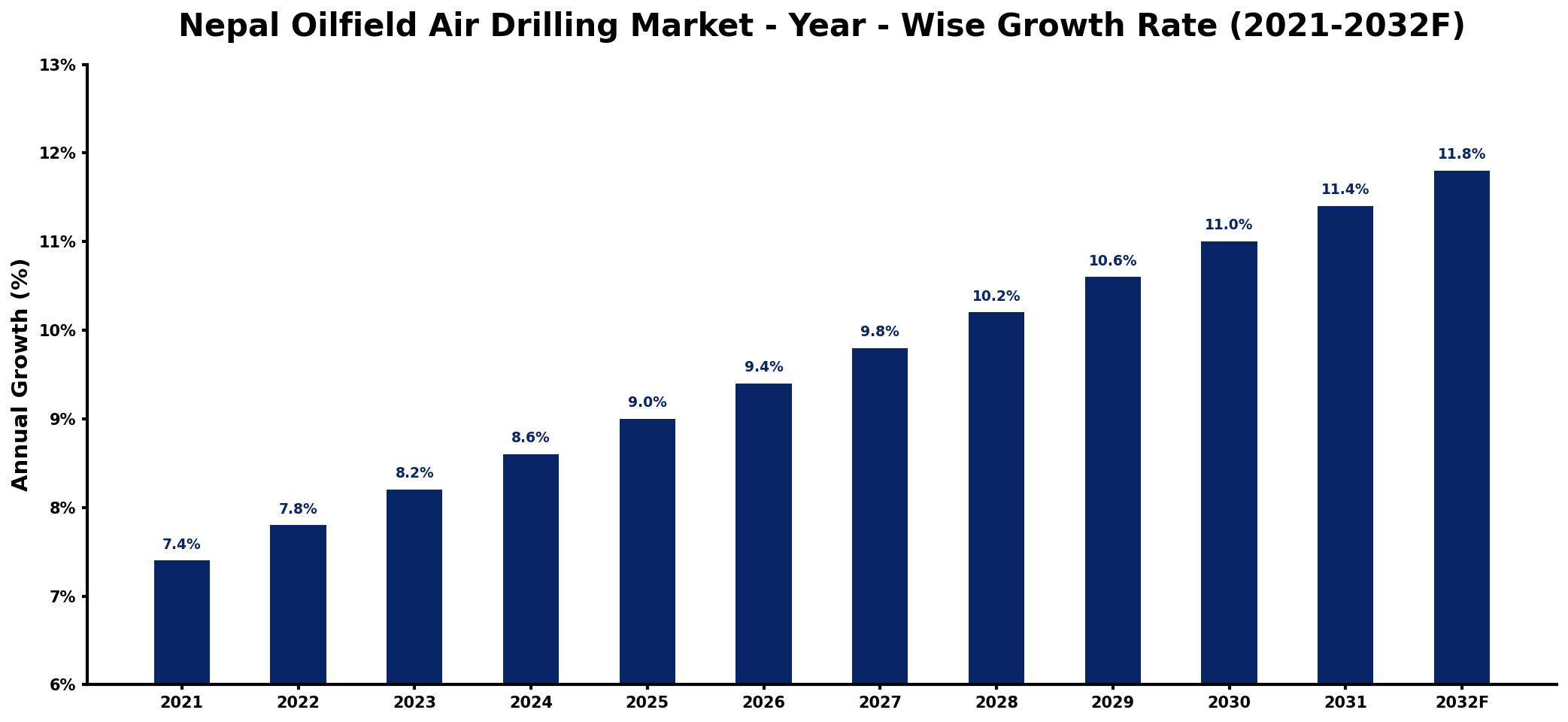
The table below presents the year‑wise growth rates along with the key drivers influencing the market
| Year | Growth Rate | Major Drivers |
| 2021 | 7.4% | Rising energy demand globally |
| 2022 | 7.8% | Increased investment in infrastructure |
| 2023 | 8.2% | Technological advancements in extraction |
| 2024 | 8.6% | Growing focus on renewable energy |
| 2025 | 9.0% | Expansion of energy sector projects |
| 2026 | 9.4% | Higher foreign direct investments |
| 2027 | 9.8% | Improved regulatory framework benefits |
| 2028 | 10.2% | Rising domestic energy production initiatives |
| 2029 | 10.6% | Enhanced exploration activities planned |
| 2030 | 11.0% | Growing partnerships with international firms |
| 2031 | 11.4% | Increased skilled workforce availability |
| 2032 | 11.8% | Emerging markets require more energy |
Note: Market size estimations and growth projections presented in this report are based on 6Wresearch's proprietary forecasting methodology, utilizing the latest available industry data, government publications, and primary research inputs.
Nepal Oilfield Air Drilling Market Synopsis
While the Nepal oilfield air drilling market has shown promising growth, it is now transitioning towards a more innovation-driven approach to meet the evolving demands of the industry. Recent advancements in air drilling technology are enhancing operational efficiencies, which can significantly affect the country's energy landscape.
The market is poised to expand as domestic and international players recognize the potential of air drilling in reducing environmental impact while maximizing production capabilities. This shift not only aids in the sustainable development of energy resources but also fosters collaborations that could further strengthen the market.
Nepal Oilfield Air Drilling Market Key Takeaways
- The market is evolving towards more sustainable and efficient drilling practices.
- Investment in air drilling technologies presents significant growth opportunities for equipment and service providers.
- Government policies are increasingly supportive of the oil and gas sector, promoting foreign investment and local partnerships.
- Technological advancements are driving improvements in drilling efficiency and cost reductions.
- Challenges such as initial capital investment and workforce training need to be addressed for market expansion.
Evaluation of Restraints in Nepal Oilfield Air Drilling Market
The Nepal Oilfield Air Drilling Market faces notable restraints that can hinder its growth. High initial investment costs for setting up air drilling infrastructure pose a significant barrier for new entrants and existing companies looking to expand. Furthermore, the rugged terrain and remote oilfield locations complicate logistics, making the efficient transportation and operation of air drilling equipment challenging. There is also a shortage of skilled labor familiar with air drilling techniques, which can affect the operational efficiency of companies in the sector. Companies must navigate these challenges by investing in local workforce training and adopting innovative technologies to streamline operations while ensuring compliance with stringent regulatory environments.
Nepal Oilfield Air Drilling Market Trends
Current trends in the Nepal Oilfield Air Drilling Market are strongly oriented towards the adoption of more environmentally friendly practices. The shift towards air drilling is not just about efficiency but also about sustainability, as these techniques minimize water usage and waste generation. Additionally, there is a growing trend toward enhancing technological capabilities in drilling operations, focusing on improved penetration rates and wellbore stability, especially in difficult formations. This emphasis on innovation and sustainability is expected to redefine operational benchmarks within the sector.
Nepal Oilfield Air Drilling Market Opportunities
Significant investment opportunities exist in the Nepal Oilfield Air Drilling Market, particularly in the technology and equipment sectors. Companies that provide air drilling equipment, such as compressors and specialized drill bits, are likely to benefit from increased demand as exploration activities ramp up. Moreover, service providers that offer expertise in air drilling can capitalize on the rising trend towards improved drilling methodologies. The government's proactive stance in promoting the oil and gas sector further enhances the attractiveness of this market for prospective investors, positioning it as an attractive avenue for growth.
Government Initiatives in the Nepal Oilfield Air Drilling Market
The Nepalese government has undertaken several initiatives aimed at fostering growth in the oilfield air drilling market. By providing tax incentives and subsidies, the government is actively encouraging investments in the sector. Regulatory frameworks have been established to ensure environmental sustainability, along with safety standards that operators must meet. Additionally, the government is promoting partnerships between domestic and international firms, thereby enhancing technological transfer and skill development within the local workforce. Such policies are crucial to boosting domestic oil production while reducing reliance on imports.
Future Insights of the Nepal Oilfield Air Drilling Market
Looking ahead to 2026-2032, the future of the Nepal Oilfield Air Drilling Market is optimistic. The trend towards more efficient, eco-friendly drilling methods will continue to attract both domestic and foreign investments. As exploration for oil expands, the demand for innovative air drilling solutions is expected to rise, paving the way for new technological developments. With ongoing government support and growing international interest, the market is set to experience robust growth, providing ample opportunities for stakeholders to capitalize on this burgeoning sector.
Nepal Oilfield Air Drilling Market Latest Developments (2025 - 2026)
Recent developments in the Nepal Oilfield Air Drilling Market indicate a strengthening focus on sustainability and technology adoption. Companies are increasingly investing in advanced air drilling techniques that promise to enhance efficiency and reduce environmental impact. Meanwhile, regulatory bodies are refining compliance frameworks to ensure that these technologies adhere to safety and environmental standards. These developments reflect the market's responsiveness to both industry needs and government mandates, suggesting a forward momentum that prioritizes innovation.
Nepal Oilfield Air Drilling Market - Key Attractiveness of the Report
- 10 Years of Market Numbers
- Historical Data Starting from 2022 to 2025
- Base Year: 2025
- Forecast Data until 2032
- Key Performance Indicators Impacting the Market
- Major Upcoming Developments and Projects
Key Highlights of the Report:
- Nepal Oilfield Air Drilling Market Outlook
- Market Size of Nepal Oilfield Air Drilling Market, 2025
- Forecast of Nepal Oilfield Air Drilling Market, 2032
- Historical Data and Forecast of Nepal Oilfield Air Drilling Revenues & Volume for the Period 2022-2032F
- Nepal Oilfield Air Drilling Market Trend Evolution
- Nepal Oilfield Air Drilling Market Drivers and Challenges
- Nepal Oilfield Air Drilling Price Trends
- Nepal Oilfield Air Drilling Porter's Five Forces
- Nepal Oilfield Air Drilling Industry Life Cycle
- Historical Data and Forecast of Nepal Oilfield Air Drilling Market Revenues & Volume By Type for the Period 2022-2032F
- Historical Data and Forecast of Nepal Oilfield Air Drilling Market Revenues & Volume By Dust for the Period 2022-2032F
- Historical Data and Forecast of Nepal Oilfield Air Drilling Market Revenues & Volume By Aerated fluid for the Period 2022-2032F
- Historical Data and Forecast of Nepal Oilfield Air Drilling Market Revenues & Volume By Foam for the Period 2022-2032F
- Historical Data and Forecast of Nepal Oilfield Air Drilling Market Revenues & Volume By Mist for the Period 2022-2032F
- Historical Data and Forecast of Nepal Oilfield Air Drilling Market Revenues & Volume By Nitrogen membrane for the Period 2022-2032F
- Nepal Oilfield Air Drilling Import Export Trade Statistics
- Market Opportunity Assessment By Type
- Nepal Oilfield Air Drilling Top Companies Market Share
- Nepal Oilfield Air Drilling Competitive Benchmarking By Technical and Operational Parameters
- Nepal Oilfield Air Drilling Company Profiles
- Nepal Oilfield Air Drilling Key Strategic Recommendations






































