Nepal Organic Fruits And Vegetables Market Size, Share & Growth Rate
The Nepal Organic Fruits And Vegetables Market was estimated at USD 375 Million in 2025 and is projected to reach USD 530 Million by 2032, growing at a CAGR of 5.1% from 2026 to 2032. This growth trajectory is largely fueled by a notable increase in health consciousness among consumers and a burgeoning preference for organic produce. As urban populations become more aware of the benefits of chemical-free food, the demand for organic fruits and vegetables is poised to rise significantly.
Nepal Organic Fruits And Vegetables Market Year-wise Growth Rate and Key Drivers
This graph highlights how the Nepal Organic Fruits And Vegetables Market has steadily grown over the years, supported by major growth factors.
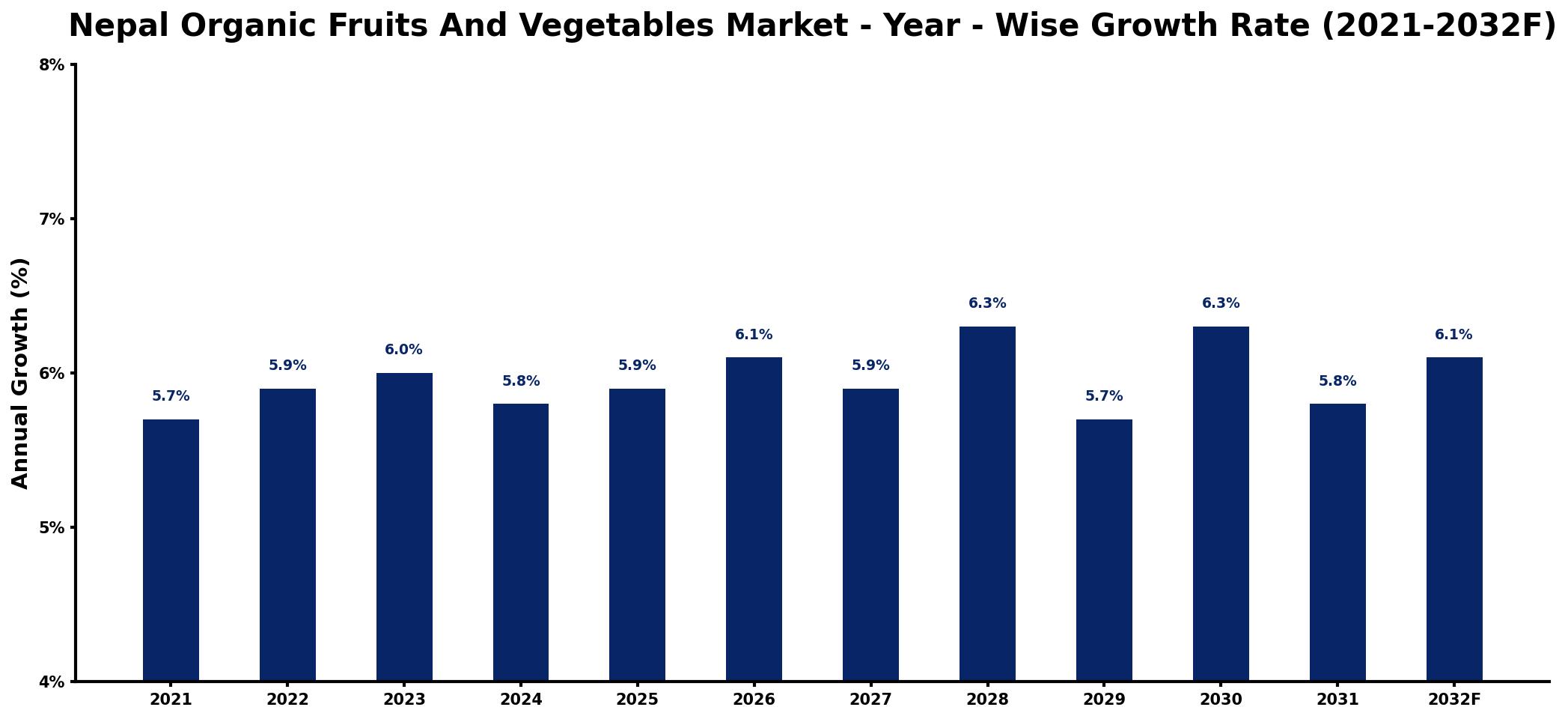
The table below presents the year‑wise growth rates along with the key drivers influencing the market
| Year | Growth Rate | Major Drivers |
| 2021 | 5.7% | Rising consumer health consciousness |
| 2022 | 5.9% | Increased local farming initiatives |
| 2023 | 6.0% | Growing demand for sustainability |
| 2024 | 5.8% | Expansion of distribution networks |
| 2025 | 5.9% | Investments in agricultural technology |
| 2026 | 6.1% | Boost in export opportunities |
| 2027 | 5.9% | Enhanced marketing strategies implemented |
| 2028 | 6.3% | Government support for local producers |
| 2029 | 5.7% | Rising urban population demand |
| 2030 | 6.3% | growing downstream application demand |
| 2031 | 5.8% | Diversification of product offerings |
| 2032 | 6.1% | Increased focus on eco-friendly practices |
Note: Market size estimations and growth projections presented in this report are based on 6Wresearch's proprietary forecasting methodology, utilizing the latest available industry data, government publications, and primary research inputs.
Nepal Organic Fruits And Vegetables Market Synopsis
The landscape of the Nepal Organic Fruits and Vegetables Market is rapidly evolving, reflecting a shift in consumer preferences towards healthier and sustainably produced foods. The increasing number of organic farms and the adoption of sustainable farming practices further highlight this transition, which aligns with global trends in food consumption.
In addition, the willingness of consumers to pay a premium for organic produce speaks to a broader understanding of its health benefits and environmental significance. Collaborative efforts from organic farming cooperatives and individual farmers are helping to bolster the market, despite facing challenges such as inconsistent supply chain management and the proliferation of counterfeit organic products.
Nepal Organic Fruits And Vegetables Market Key Takeaways
- The market is driven by increasing health awareness and a preference for organic produce.
- Government initiatives are promoting organic farming practices and consumer awareness.
- Investment opportunities exist in organic farming ventures, e-commerce, and value-added products.
- Challenges include limited consumer awareness and the need for improved certification processes.
- Collaboration among stakeholders is critical to overcoming obstacles and fostering growth.
Evaluation of Restraints in Nepal Organic Fruits And Vegetables Market
Despite its positive growth trajectory, the Nepal Organic Fruits and Vegetables Market faces several critical restraints. Limited awareness about organic farming among both consumers and farmers continues to hinder market potential. Furthermore, the lack of infrastructure for effective organic certification and labeling can lead to consumer mistrust and confusion. This situation is exacerbated by the prevalence of counterfeit products, which can undermine genuine organic offerings. The high production costs associated with organic farming inputs also serve as a barrier, particularly for smallholder farmers lacking adequate financial support and resources.
Nepal Organic Fruits And Vegetables Market Trends
The market is witnessing several notable trends that are shaping consumer demand and technological advancements. There is a marked shift towards healthy eating habits, with consumers increasingly seeking organic, locally sourced, and fresh produce. This trend is supported by an expanding digital marketplace for organic fruits and vegetables, allowing consumers to access products more conveniently. Additionally, as sustainable practices become more mainstream, producers are integrating eco-friendly methods and technologies in their farming practices, aligning with growing consumer demand for transparency and sustainability.
Nepal Organic Fruits And Vegetables Market Opportunities
The organic fruits and vegetables market in Nepal presents significant investment opportunities. The rising awareness of health benefits associated with organic produce creates a fertile ground for investment in organic farming operations. Additionally, there are ample opportunities within the distribution and retail sectors, particularly for businesses that can effectively utilize e-commerce platforms to reach consumers. Value-added products, including organic juices and snacks, are also gaining traction, further enhancing the prospects for investors willing to innovate and collaborate with local farmers to promote organic methods.
Government Initiatives in the Nepal Organic Fruits And Vegetables Market
The government of Nepal is actively engaged in promoting organic farming practices through various policies and initiatives. These efforts include providing subsidies for organic farming inputs, instituting training programs on organic techniques, and establishing certification bodies to regulate the organic market. By raising consumer awareness regarding the benefits of organic produce and supporting local farmers, government initiatives aim to create a conducive environment for the growth of the organic fruits and vegetables market.
Future Insights of the Nepal Organic Fruits And Vegetables Market
Looking forward to the period from 2026 to 2032, the Nepal Organic Fruits and Vegetables Market appears poised for significant expansion. The increasing focus on sustainable and organic farming, alongside government support, is expected to enhance production capabilities and drive consumption. With rising disposable incomes and shifting consumer lifestyles, the demand for premium organic products is likely to grow. Key players in the market will need to adapt by diversifying their offerings and expanding distribution channels to meet the evolving preferences of health-conscious consumers.
Nepal Organic Fruits And Vegetables Market Latest Developments (2025 - 2026)
Recent developments in the Nepal Organic Fruits and Vegetables Market indicate a commitment to enhancing organic farming practices and improving certification processes. As more farmers adopt sustainable methods, collaborative initiatives between non-profits and local producers are becoming increasingly common. This period has seen an uptick in government-backed campaigns aimed at educating consumers about the benefits of organic products, thereby fostering a more robust market environment.
Nepal Organic Fruits And Vegetables Market - Key Attractiveness of the Report
- 10 Years of Market Numbers
- Historical Data Starting from 2022 to 2025
- Base Year: 2025
- Forecast Data until 2032
- Key Performance Indicators Impacting the Market
- Major Upcoming Developments and Projects
Key Highlights of the Report:
- Nepal Organic Fruits And Vegetables Market Outlook
- Market Size of Nepal Organic Fruits And Vegetables Market, 2025
- Forecast of Nepal Organic Fruits And Vegetables Market, 2032
- Historical Data and Forecast of Nepal Organic Fruits And Vegetables Revenues & Volume for the Period 2022-2032F
- Nepal Organic Fruits And Vegetables Market Trend Evolution
- Nepal Organic Fruits And Vegetables Market Drivers and Challenges
- Nepal Organic Fruits And Vegetables Price Trends
- Nepal Organic Fruits And Vegetables Porter's Five Forces
- Nepal Organic Fruits And Vegetables Industry Life Cycle
- Historical Data and Forecast of Nepal Organic Fruits And Vegetables Market Revenues & Volume By Product Type for the Period 2022-2032F
- Historical Data and Forecast of Nepal Organic Fruits And Vegetables Market Revenues & Volume By Organic Fruits for the Period 2022-2032F
- Historical Data and Forecast of Nepal Organic Fruits And Vegetables Market Revenues & Volume By Organic Vegetables for the Period 2022-2032F
- Historical Data and Forecast of Nepal Organic Fruits And Vegetables Market Revenues & Volume By Form for the Period 2022-2032F
- Historical Data and Forecast of Nepal Organic Fruits And Vegetables Market Revenues & Volume By Fresh for the Period 2022-2032F
- Historical Data and Forecast of Nepal Organic Fruits And Vegetables Market Revenues & Volume By Frozen for the Period 2022-2032F
- Historical Data and Forecast of Nepal Organic Fruits And Vegetables Market Revenues & Volume By End User for the Period 2022-2032F
- Historical Data and Forecast of Nepal Organic Fruits And Vegetables Market Revenues & Volume By Residential for the Period 2022-2032F
- Historical Data and Forecast of Nepal Organic Fruits And Vegetables Market Revenues & Volume By Commercial for the Period 2022-2032F
- Historical Data and Forecast of Nepal Organic Fruits And Vegetables Market Revenues & Volume By Distribution Channel for the Period 2022-2032F
- Historical Data and Forecast of Nepal Organic Fruits And Vegetables Market Revenues & Volume By Supermarket for the Period 2022-2032F
- Historical Data and Forecast of Nepal Organic Fruits And Vegetables Market Revenues & Volume By Hypermarket for the Period 2022-2032F
- Historical Data and Forecast of Nepal Organic Fruits And Vegetables Market Revenues & Volume By Convenience Store for the Period 2022-2032F
- Historical Data and Forecast of Nepal Organic Fruits And Vegetables Market Revenues & Volume By Online Sale Channel for the Period 2022-2032F
- Historical Data and Forecast of Nepal Organic Fruits And Vegetables Market Revenues & Volume By Others for the Period 2022-2032F
- Nepal Organic Fruits And Vegetables Import Export Trade Statistics
- Market Opportunity Assessment By Product Type
- Market Opportunity Assessment By Form
- Market Opportunity Assessment By End User
- Market Opportunity Assessment By Distribution Channel
- Nepal Organic Fruits And Vegetables Top Companies Market Share
- Nepal Organic Fruits And Vegetables Competitive Benchmarking By Technical and Operational Parameters
- Nepal Organic Fruits And Vegetables Company Profiles
- Nepal Organic Fruits And Vegetables Key Strategic Recommendations






































