Nepal Pearl Jewelry Market Size, Share & Growth Rate
The Nepal Pearl Jewelry Market was estimated at USD 151 Million in 2025 and is projected to reach USD 208 Million by 2032, growing at a CAGR of 4.7% from 2026 to 2032. This growth trajectory is fueled by an increasing disposable income among consumers, a shift in fashion preferences toward unique, handcrafted pieces, and a cultural renaissance that celebrates traditional craftsmanship infused with modern designs. The evolving perception of pearls as a symbol of elegance is broadening the consumer base.
Nepal Pearl Jewelry Market Year-wise Growth Rate and Key Drivers
This graph highlights how the Nepal Pearl Jewelry Market has steadily grown over the years, supported by major growth factors.
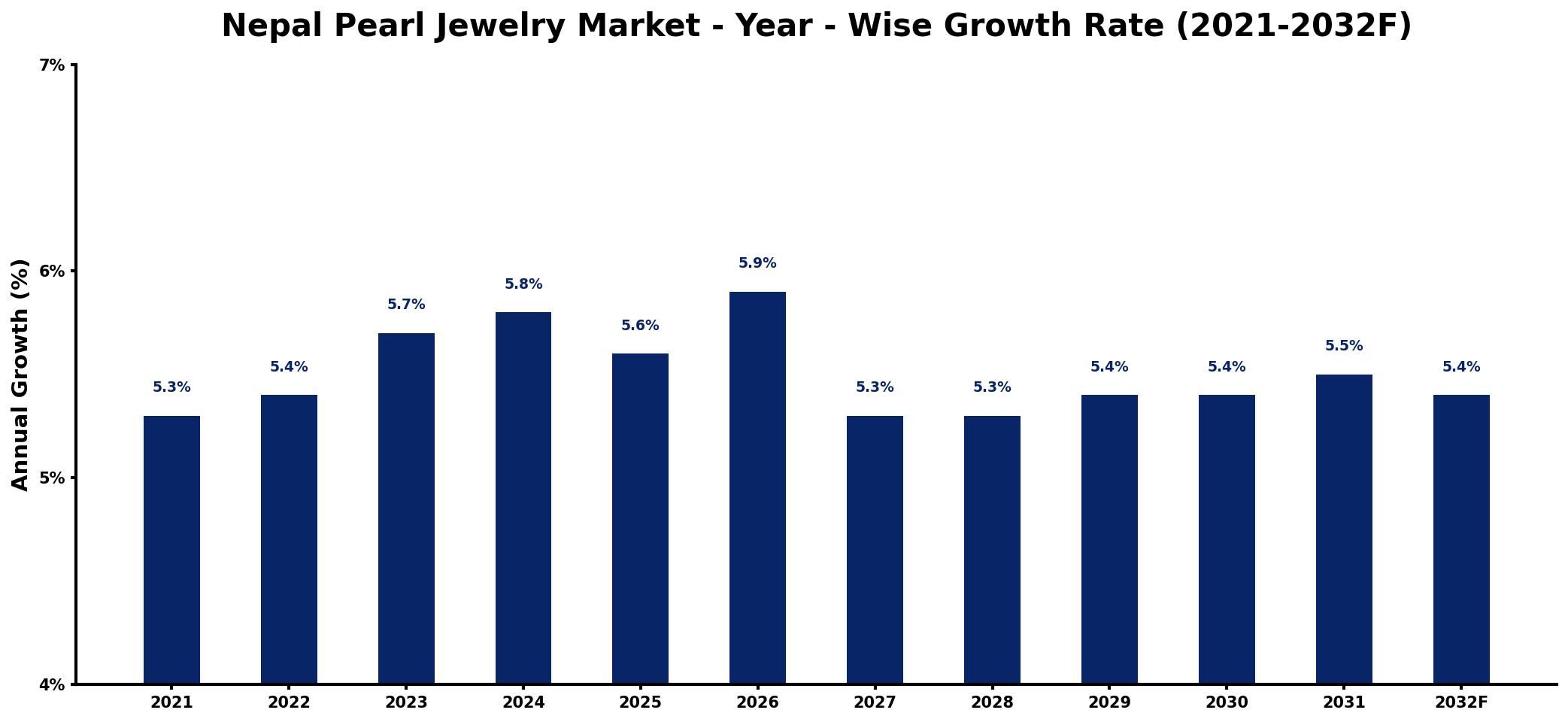
The table below presents the year‑wise growth rates along with the key drivers influencing the market
| Year | Growth Rate | Major Drivers |
| 2021 | 5.3% | Rising consumer spending patterns |
| 2022 | 5.4% | Growing popularity of luxury gifts |
| 2023 | 5.7% | Increase in online retail platforms |
| 2024 | 5.8% | Expansion of artisanal crafting techniques |
| 2025 | 5.6% | Strengthening local cultural heritage |
| 2026 | 5.9% | Surge in destination wedding trends |
| 2027 | 5.3% | Increased investment in craftsmanship |
| 2028 | 5.3% | Emergence of eco-friendly practices |
| 2029 | 5.4% | Collaboration with fashion influencers |
| 2030 | 5.4% | Growth in international trade agreements |
| 2031 | 5.5% | Diversification of product offerings |
| 2032 | 5.4% | Strengthening of export markets |
Note: Market size estimations and growth projections presented in this report are based on 6Wresearch's proprietary forecasting methodology, utilizing the latest available industry data, government publications, and primary research inputs.
Nepal Pearl Jewelry Market Synopsis
The Nepal Pearl Jewelry Market is currently experiencing a surge in interest, contrasting sharply with its historically niche status. As consumers move away from conventional gold and gemstone jewelry, pearl jewelry is emerging as a favored choice, celebrated for its versatility and timeless beauty.
Local artisans and designers are increasingly innovating by blending traditional Nepali motifs with contemporary aesthetics, captivating a wider audience. This shift not only appeals to local tastes but also positions pearl jewelry as a unique offering in the competitive global marketplace.
Nepal Pearl Jewelry Market Key Takeaways
- The market is witnessing a growing consumer inclination towards personalized and culturally significant jewelry.
- Online retail channels are expanding access to pearl jewelry, increasing sales and brand visibility.
- Rising disposable incomes are enhancing demand for luxury jewelry options among Nepali consumers.
- Sustainable and ethical sourcing is becoming a pivotal factor influencing purchasing decisions.
- Collaborations between local artisans and designers are driving innovation in product offerings.
Evaluation of Restraints in Nepal Pearl Jewelry Market
Despite its potential, the Nepal Pearl Jewelry Market faces significant restraints. A limited consumer understanding of pearl jewelry compared to more traditional gold and gemstone alternatives hampers broader acceptance. The reliance on imported pearls poses challenges in maintaining quality and competitive pricing, as local production capabilities remain underdeveloped. Furthermore, issues related to counterfeit products and varying quality standards can undermine consumer confidence, necessitating targeted efforts to foster trust and educate the market.
Nepal Pearl Jewelry Market Trends
Current trends in the Nepal Pearl Jewelry Market reflect a strong demand for fusion designs that marry traditional and modern elements. Consumers are increasingly interested in bespoke pieces that echo their personal stories and cultural heritage. Sustainability has also emerged as a driving force, with ethical sourcing and environmentally friendly practices gaining traction among consumers. The rise of digital platforms is enhancing engagement, allowing for a broader reach and the ability to showcase unique designs effectively.
Nepal Pearl Jewelry Market Opportunities
The market offers substantial investment opportunities, especially in local pearl sourcing and manufacturing. By tapping into the growing demand for high-quality, authentic pearl jewelry, investors can achieve a competitive advantage. Collaborating with skilled artisans to create culturally resonant collections will appeal to a niche audience. Additionally, leveraging e-commerce platforms presents a significant opportunity to reach global markets interested in ethically produced and distinctive jewelry, driving overall growth.
Government Initiatives in the Nepal Pearl Jewelry Market
The Nepalese government is actively promoting the pearl jewelry market through various initiatives aimed at supporting local artisans and ensuring fair trade practices. Regulatory measures are being introduced to establish quality standards for pearls and jewelry production. Additionally, programs designed to bolster small-scale pearl farming and craftsmanship are fostering a more competitive local industry, with an emphasis on elevating Nepal's reputation for high-quality, ethically sourced pearl jewelry.
Future Insights of the Nepal Pearl Jewelry Market
The future of the Nepal Pearl Jewelry Market looks promising, driven by changing consumer preferences that favor unique, high-quality jewelry pieces. As sustainability continues to shape purchasing behavior, the demand for responsibly sourced pearls is likely to grow. The increasing integration of digital commerce will enhance market accessibility, allowing artisans to reach a global audience. With continued emphasis on innovation and product quality, this market is poised for sustained growth and increased visibility in the years ahead.
Nepal Pearl Jewelry Market Latest Developments (2025 - 2026)
Recent developments in the Nepal Pearl Jewelry Market have included a noticeable increase in the establishment of online platforms dedicated to showcasing local pearl artisans. These platforms are facilitating broader market access, allowing customers to purchase directly from producers. There has also been a surge in collaborations between contemporary designers and traditional artisans, leading to the creation of hybrid collections that celebrate Nepals rich cultural heritage while appealing to modern aesthetics. Additionally, community-focused initiatives aimed at educating consumers about the value and significance of pearl jewelry are gaining traction.
Nepal Pearl Jewelry Market - Key Attractiveness of the Report
- 10 Years of Market Numbers
- Historical Data Starting from 2022 to 2025
- Base Year: 2025
- Forecast Data until 2032
- Key Performance Indicators Impacting the Market
- Major Upcoming Developments and Projects
Key Highlights of the Report:
- Nepal Pearl Jewelry Market Outlook
- Market Size of Nepal Pearl Jewelry Market, 2025
- Forecast of Nepal Pearl Jewelry Market, 2032
- Historical Data and Forecast of Nepal Pearl Jewelry Revenues & Volume for the Period 2022-2032F
- Nepal Pearl Jewelry Market Trend Evolution
- Nepal Pearl Jewelry Market Drivers and Challenges
- Nepal Pearl Jewelry Price Trends
- Nepal Pearl Jewelry Porter's Five Forces
- Nepal Pearl Jewelry Industry Life Cycle
- Historical Data and Forecast of Nepal Pearl Jewelry Market Revenues & Volume By Pearl Type for the Period 2022-2032F
- Historical Data and Forecast of Nepal Pearl Jewelry Market Revenues & Volume By Freshwater for the Period 2022-2032F
- Historical Data and Forecast of Nepal Pearl Jewelry Market Revenues & Volume By Saltwater for the Period 2022-2032F
- Historical Data and Forecast of Nepal Pearl Jewelry Market Revenues & Volume By Material Type for the Period 2022-2032F
- Historical Data and Forecast of Nepal Pearl Jewelry Market Revenues & Volume By Gold for the Period 2022-2032F
- Historical Data and Forecast of Nepal Pearl Jewelry Market Revenues & Volume By Silver for the Period 2022-2032F
- Historical Data and Forecast of Nepal Pearl Jewelry Market Revenues & Volume By Others for the Period 2022-2032F
- Historical Data and Forecast of Nepal Pearl Jewelry Market Revenues & Volume By Jewelry Type for the Period 2022-2032F
- Historical Data and Forecast of Nepal Pearl Jewelry Market Revenues & Volume By Necklace for the Period 2022-2032F
- Historical Data and Forecast of Nepal Pearl Jewelry Market Revenues & Volume By Earrings for the Period 2022-2032F
- Historical Data and Forecast of Nepal Pearl Jewelry Market Revenues & Volume By Rings for the Period 2022-2032F
- Historical Data and Forecast of Nepal Pearl Jewelry Market Revenues & Volume By Others for the Period 2022-2032F
- Nepal Pearl Jewelry Import Export Trade Statistics
- Market Opportunity Assessment By Pearl Type
- Market Opportunity Assessment By Material Type
- Market Opportunity Assessment By Jewelry Type
- Nepal Pearl Jewelry Top Companies Market Share
- Nepal Pearl Jewelry Competitive Benchmarking By Technical and Operational Parameters
- Nepal Pearl Jewelry Company Profiles
- Nepal Pearl Jewelry Key Strategic Recommendations






































