Nepal Peas Market Size, Share & Growth Rate
The Nepal Peas Market was estimated at USD 191 Million in 2025 and is projected to reach USD 250 Million by 2032, growing at a CAGR of 3.9% from 2026 to 2032. This growth trajectory is fueled by an increasing shift towards health-conscious eating habits, where consumers are actively seeking out plant-based protein sources. Additionally, the rise in vegetarian and vegan diets further amplifies the demand for both fresh and processed pea products.
Nepal Peas Market Year-wise Growth Rate and Key Drivers
This graph highlights how the Nepal Peas Market has steadily grown over the years, supported by major growth factors.
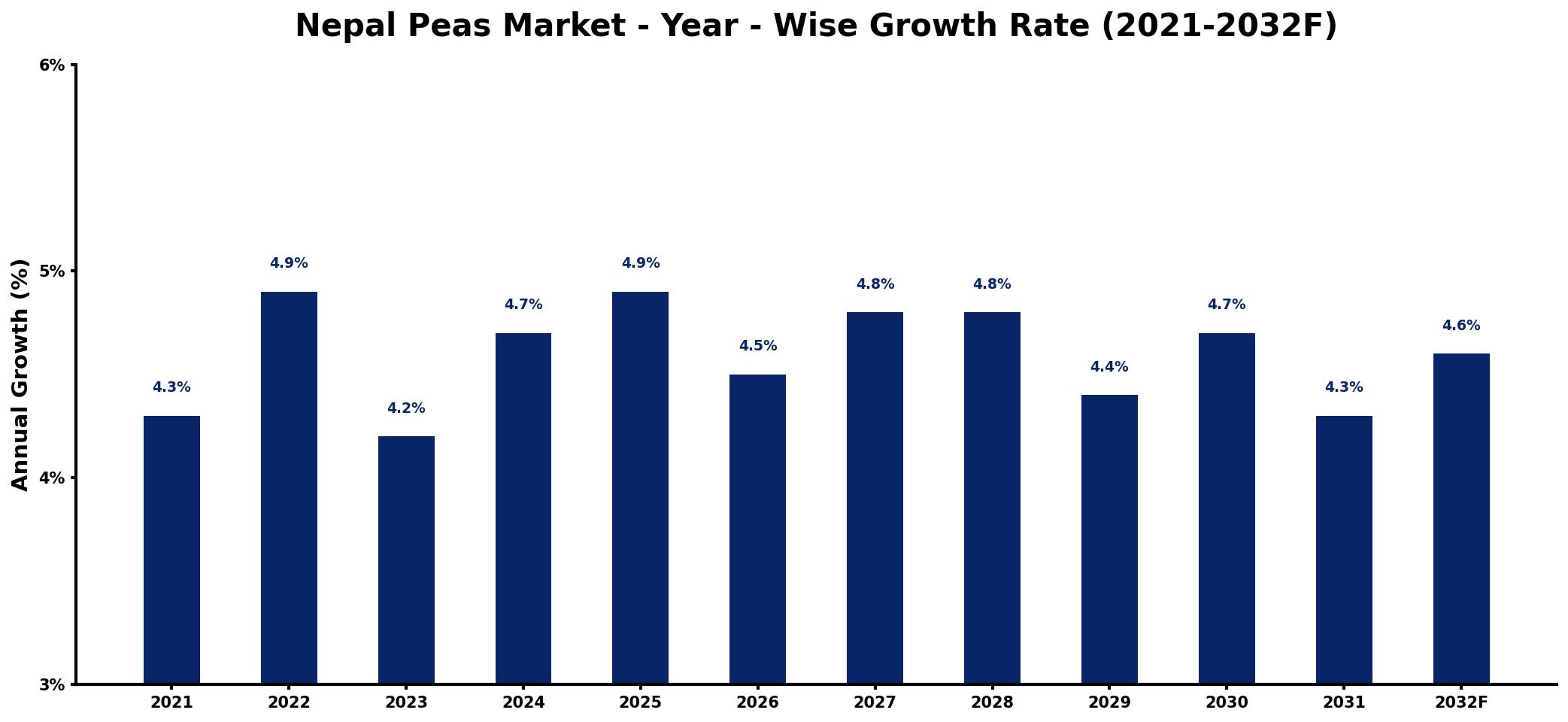
The table below presents the year‑wise growth rates along with the key drivers influencing the market
| Year | Growth Rate | Major Drivers |
| 2021 | 4.3% | Rising consumer health awareness |
| 2022 | 4.9% | Increased demand for plant proteins |
| 2023 | 4.2% | Expansion of organic farming practices |
| 2024 | 4.7% | Growth in export opportunities |
| 2025 | 4.9% | Investment in agro-technology innovations |
| 2026 | 4.5% | Surge in vegetarian meal popularity |
| 2027 | 4.8% | Development of sustainable packaging solutions |
| 2028 | 4.8% | Growing interest in local sourcing |
| 2029 | 4.4% | Enhanced distribution network efficiency |
| 2030 | 4.7% | Strengthening agricultural research initiatives |
| 2031 | 4.3% | Emergence of alternative protein sources |
| 2032 | 4.6% | Rising awareness of nutritional benefits |
Note: Market size estimations and growth projections presented in this report are based on 6Wresearch's proprietary forecasting methodology, utilizing the latest available industry data, government publications, and primary research inputs.
Nepal Peas Market Synopsis
The Nepal peas market is currently witnessing a surge in popularity, driven by health-conscious consumers keen on incorporating more plant-based proteins into their diets. This trend is evident in both urban supermarkets and local markets, where fresh and frozen peas are prominently displayed.
Moreover, the introduction of organic and sustainably sourced peas aligns with modern consumer preferences that prioritize health and environmental impact. With limited local production, the market is increasingly reliant on imports to meet the growing demand, creating a dynamic landscape for both domestic and foreign suppliers.
Nepal Peas Market Key Takeaways
- The increasing focus on health and wellness is propelling the demand for peas as a nutritious food option.
- Organic and sustainably sourced peas are gaining traction, reflecting changing consumer preferences.
- Seasonal cultivation and climate change significantly influence the markets supply consistency.
- Investments in agricultural technology and farming techniques could enhance productivity.
- Government policies aim to bolster domestic production and support local farmers against import competition.
Evaluation of Restraints in Nepal Peas Market
The Nepal peas market faces several significant challenges that hinder its growth potential. The reliance on seasonal cultivation leads to inconsistent supply, often resulting in price fluctuations. Farmers often lack access to advanced agricultural techniques and quality seeds, which can diminish yields. Additionally, inadequate infrastructure for storage and transport compounds these issues, leading to potential wastage of produce. Furthermore, the impacts of climate change present risks to crop viability, while competition from imported peas further complicates the market dynamics.
Nepal Peas Market Trends
Emerging trends in the Nepal peas market highlight a significant shift towards plant-based diets, with peas being integrated into various food products such as meat alternatives and snacks. This incorporation aligns with the rising consumer preference for health-conscious eating. Moreover, the convenience factor of frozen peas is becoming increasingly relevant as busy consumers seek quick meal solutions without sacrificing nutritional quality.
Nepal Peas Market Opportunities
Investment opportunities in the Nepal peas market are abundant, particularly in areas such as pea farming, processing, and distribution. As the demand for nutritious, plant-based foods continues to rise, exploring modern agricultural practices can yield high returns. Establishing processing facilities to produce value-added products like frozen peas and pea protein could be lucrative. Additionally, collaborations with local farmers to establish a reliable supply chain, as well as potential export opportunities, present further avenues for growth.
Government Initiatives in the Nepal Peas Market
Government policies related to the Nepal peas market are focused on enhancing domestic production and ensuring food security for the populace. Initiatives include providing subsidies and technical assistance to local farmers, as well as investing in infrastructure development. Import tariffs have been implemented to protect local growers from foreign competition, while quality standards are enforced to ensure product integrity in the marketplace. Overall, these measures aim to cultivate a robust domestic peas industry.
Future Insights of the Nepal Peas Market
Looking ahead to 2026-2032, the Nepal peas market is poised for significant expansion, driven by escalating demand for plant-based protein and increasing awareness of health benefits associated with pea consumption. Rising disposable incomes and a growing trend towards vegetarian and vegan diets will further propel market growth. Additionally, advancements in agricultural practices and technology hold the potential to enhance production quality and sustainability, making the Nepal peas market an appealing space for investment and development.
Nepal Peas Market Latest Developments (2025 - 2026)
Recent developments within the Nepal peas market indicate an increasing collaboration between agricultural cooperatives and private investors aimed at improving production efficiency. There is a noticeable shift toward promoting locally produced organic peas, as consumer preference for sustainable options gains traction. Furthermore, advancements in logistics and storage capabilities are being prioritized to reduce post-harvest losses, which may significantly benefit producers and suppliers in the near future.
Nepal Peas Market - Key Attractiveness of the Report
- 10 Years of Market Numbers
- Historical Data Starting from 2022 to 2025
- Base Year: 2025
- Forecast Data until 2032
- Key Performance Indicators Impacting the Market
- Major Upcoming Developments and Projects
Key Highlights of the Report:
- Nepal Peas Market Outlook
- Market Size of Nepal Peas Market, 2025
- Forecast of Nepal Peas Market, 2032
- Historical Data and Forecast of Nepal Peas Revenues & Volume for the Period 2022-2032F
- Nepal Peas Market Trend Evolution
- Nepal Peas Market Drivers and Challenges
- Nepal Peas Price Trends
- Nepal Peas Porter's Five Forces
- Nepal Peas Industry Life Cycle
- Historical Data and Forecast of Nepal Peas Market Revenues & Volume By Type for the Period 2022-2032F
- Historical Data and Forecast of Nepal Peas Market Revenues & Volume By Field Peas for the Period 2022-2032F
- Historical Data and Forecast of Nepal Peas Market Revenues & Volume By Garden Peas for the Period 2022-2032F
- Historical Data and Forecast of Nepal Peas Market Revenues & Volume By Others for the Period 2022-2032F
- Historical Data and Forecast of Nepal Peas Market Revenues & Volume By Application for the Period 2022-2032F
- Historical Data and Forecast of Nepal Peas Market Revenues & Volume By Food for the Period 2022-2032F
- Historical Data and Forecast of Nepal Peas Market Revenues & Volume By Others for the Period 2022-2032F
- Historical Data and Forecast of Nepal Peas Market Revenues & Volume By Distribution Channel for the Period 2022-2032F
- Historical Data and Forecast of Nepal Peas Market Revenues & Volume By Online for the Period 2022-2032F
- Historical Data and Forecast of Nepal Peas Market Revenues & Volume By Offline for the Period 2022-2032F
- Historical Data and Forecast of Nepal Peas Market Revenues & Volume By Others for the Period 2022-2032F
- Nepal Peas Import Export Trade Statistics
- Market Opportunity Assessment By Type
- Market Opportunity Assessment By Application
- Market Opportunity Assessment By Distribution Channel
- Nepal Peas Top Companies Market Share
- Nepal Peas Competitive Benchmarking By Technical and Operational Parameters
- Nepal Peas Company Profiles
- Nepal Peas Key Strategic Recommendations






































