Nepal Ploughing and Cultivating Machinery Market Size, Share & Growth Rate
The Nepal Ploughing and Cultivating Machinery Market was estimated at USD 236 Million in 2025 and is projected to reach USD 327 Million by 2032, growing at a CAGR of 4.8% from 2026 to 2032. This growth is primarily driven by the increasing mechanization of agriculture in Nepal, where farmers are increasingly recognizing the benefits of modern equipment. Factors such as government subsidies and a shift towards more efficient farming practices are further contributing to this upward trajectory.
Nepal Ploughing and Cultivating Machinery Market Year-wise Growth Rate and Key Drivers
This graph highlights how the Nepal Ploughing and Cultivating Machinery Market has steadily grown over the years, supported by major growth factors.
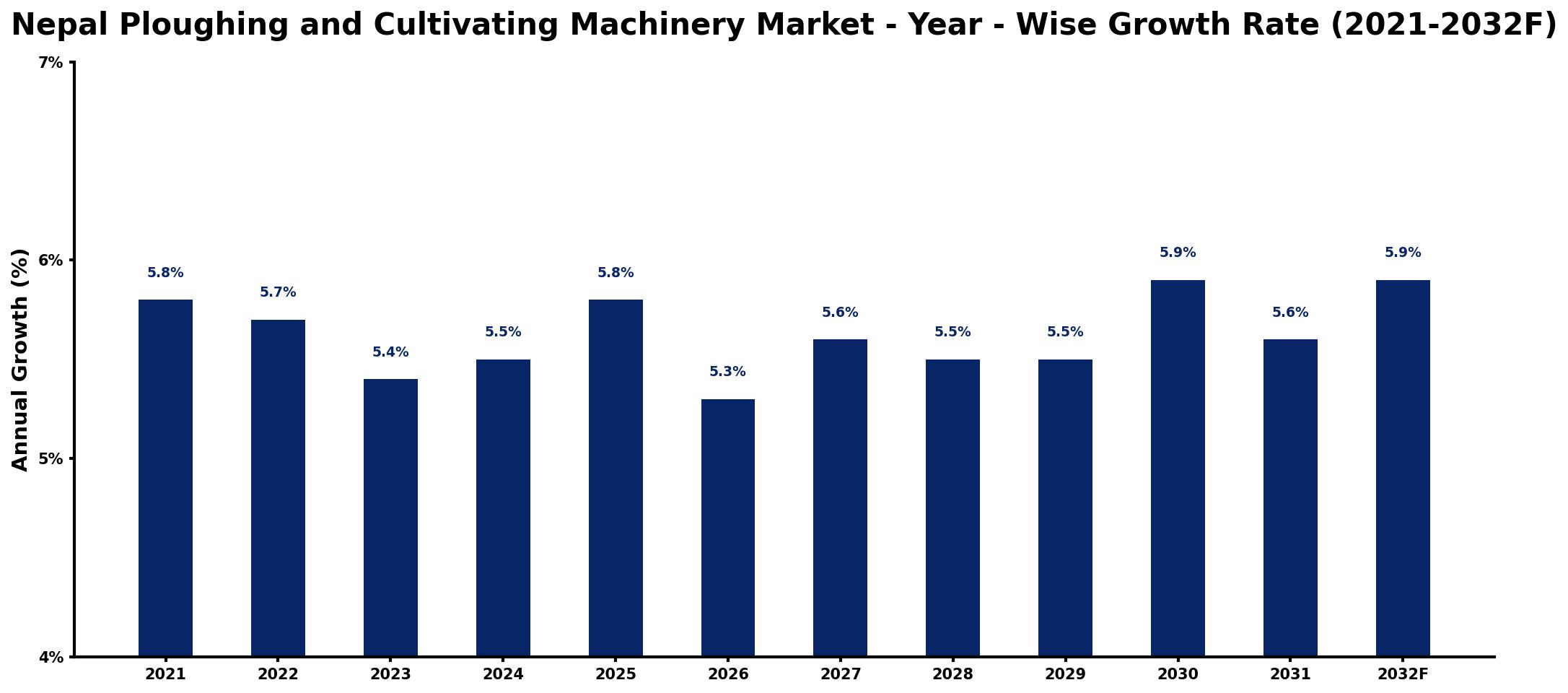
The table below presents the year‑wise growth rates along with the key drivers influencing the market
| Year | Growth Rate | Major Drivers |
| 2021 | 5.8% | Rising agricultural investment levels |
| 2022 | 5.7% | Increased mechanization adoption rates |
| 2023 | 5.4% | Growing demand for efficient farming |
| 2024 | 5.5% | Expansion of rural infrastructure projects |
| 2025 | 5.8% | Higher crop yield expectations |
| 2026 | 5.3% | Emerging technologies in agriculture |
| 2027 | 5.6% | Supportive government policy frameworks |
| 2028 | 5.5% | Surge in export market opportunities |
| 2029 | 5.5% | Growing farmer cooperatives and alliances |
| 2030 | 5.9% | Enhanced access to financing options |
| 2031 | 5.6% | Greater awareness of sustainable practices |
| 2032 | 5.9% | Rising population driving food demand |
Note: Market size estimations and growth projections presented in this report are based on 6Wresearch's proprietary forecasting methodology, utilizing the latest available industry data, government publications, and primary research inputs.
Nepal Ploughing and Cultivating Machinery Market Synopsis
The landscape of agriculture in Nepal is changing, with a noticeable trend towards the adoption of mechanized ploughing and cultivating machinery. This shift is crucial as it enhances productivity and streamlines farming operations, enabling farmers to manage their lands more effectively.
Moreover, the engagement of both local and international manufacturers in this market is noteworthy, as they offer a diverse array of machinery to meet the unique needs of Nepalese farmers. Coupled with supportive government initiatives, the market is set to evolve and cater to the growing demand for modern agricultural solutions.
Nepal Ploughing and Cultivating Machinery Market Key Takeaways
- The market is seeing an increasing adoption of advanced ploughing and cultivating equipment.
- Government incentives are playing a pivotal role in promoting farm mechanization.
- Challenges include high initial costs and limited access to financing for smallholder farmers.
- There is a rising interest in eco-friendly and sustainable machinery options.
- Investment opportunities are abundant for companies introducing affordable, tailored solutions for the local market.
Evaluation of Restraints in Nepal Ploughing and Cultivating Machinery Market
Despite the positive outlook for the Nepal ploughing and cultivating machinery market, several constraints hinder its progress. One major limitation is the high cost of modern machinery, which poses significant financial challenges for many smallholder farmers. Additionally, limited access to credit facilities can restrict their ability to invest in these necessary tools. The geographical ruggedness and poor infrastructure in many rural areas also complicate the transport and maintenance of heavy machinery, making it even more difficult for farmers to adopt modern solutions. These factors create a complex landscape that requires strategic interventions to improve accessibility and education surrounding agricultural mechanization.
Nepal Ploughing and Cultivating Machinery Market Trends
Current trends in the Nepal ploughing and cultivating machinery market highlight a growing preference for mechanization. Farmers are increasingly seeking advanced equipment such as tractor-mounted ploughs and seed drills, recognizing their potential to significantly boost productivity. Furthermore, there is a shift towards sustainable and environmentally friendly machinery as awareness of ecological impacts grows. The integration of smart farming technologies is also gaining traction, promoting precision agriculture and data-driven decision-making, which is essential for optimizing resource use in this diverse terrain.
Nepal Ploughing and Cultivating Machinery Market Opportunities
The evolving landscape of the Nepal ploughing and cultivating machinery market presents several investment opportunities. Companies have the chance to introduce innovative machinery tailored to the specific needs of local farmers, particularly by focusing on affordability and suitability for varied terrains. Enhancing after-sales services and providing training programs can further increase customer satisfaction and brand loyalty. As demand for mechanization continues to rise, investors who strategically position themselves in this market can significantly contribute to the modernization of Nepal's agricultural practices.
Government Initiatives in the Nepal Ploughing and Cultivating Machinery Market
The government of Nepal is actively supporting the ploughing and cultivating machinery market through various initiatives. These include subsidies and financial assistance aimed at helping farmers acquire modern machinery. Additionally, awareness campaigns and training programs promote the benefits of advanced agricultural equipment, which further encourages adoption. The government's focus on improving rural infrastructure, including irrigation systems and roads, is essential for enhancing access to mechanization, ultimately boosting productivity and sustainability in the sector.
Future Insights of the Nepal Ploughing and Cultivating Machinery Market
Looking ahead to the years 2026-2032, the Nepal ploughing and cultivating machinery market is poised for continued growth. The convergence of increasing mechanization trends and government support will likely enhance productivity across the agricultural sector. As farmers increasingly seek to optimize yields and reduce labor, the demand for innovative machinery tailored to local conditions will soar. With the ongoing push for modern agricultural practices and sustainability, stakeholders in the market must remain agile and responsive to the evolving needs of Nepalese farmers.
Nepal Ploughing and Cultivating Machinery Market Latest Developments (2025 - 2026)
Recent developments in the Nepal ploughing and cultivating machinery market indicate a significant shift towards the adoption of smarter, more efficient technologies. The industry is seeing a surge in interest from farmers eager to embrace modern agricultural practices. New training initiatives are being introduced to enhance farmers technical skills, ensuring they can effectively utilize advanced equipment. Additionally, theres a notable increase in collaborations among local and international manufacturers to provide tailored solutions that cater to the unique requirements of the Nepalese agricultural landscape.
Nepal Ploughing and Cultivating Machinery Market - Key Attractiveness of the Report
- 10 Years of Market Numbers
- Historical Data Starting from 2022 to 2025
- Base Year: 2025
- Forecast Data until 2032
- Key Performance Indicators Impacting the Market
- Major Upcoming Developments and Projects
Key Highlights of the Report:
- Nepal Ploughing and Cultivating Machinery Market Outlook
- Market Size of Nepal Ploughing and Cultivating Machinery Market, 2025
- Forecast of Nepal Ploughing and Cultivating Machinery Market, 2032
- Historical Data and Forecast of Nepal Ploughing and Cultivating Machinery Revenues & Volume for the Period 2022-2032F
- Nepal Ploughing and Cultivating Machinery Market Trend Evolution
- Nepal Ploughing and Cultivating Machinery Market Drivers and Challenges
- Nepal Ploughing and Cultivating Machinery Price Trends
- Nepal Ploughing and Cultivating Machinery Porter's Five Forces
- Nepal Ploughing and Cultivating Machinery Industry Life Cycle
- Historical Data and Forecast of Nepal Ploughing and Cultivating Machinery Market Revenues & Volume By Type for the Period 2022-2032F
- Historical Data and Forecast of Nepal Ploughing and Cultivating Machinery Market Revenues & Volume By Ploughs for the Period 2022-2032F
- Historical Data and Forecast of Nepal Ploughing and Cultivating Machinery Market Revenues & Volume By Harrows for the Period 2022-2032F
- Historical Data and Forecast of Nepal Ploughing and Cultivating Machinery Market Revenues & Volume By Others for the Period 2022-2032F
- Historical Data and Forecast of Nepal Ploughing and Cultivating Machinery Market Revenues & Volume By Application for the Period 2022-2032F
- Historical Data and Forecast of Nepal Ploughing and Cultivating Machinery Market Revenues & Volume By Soil Loosening for the Period 2022-2032F
- Historical Data and Forecast of Nepal Ploughing and Cultivating Machinery Market Revenues & Volume By Clod Size Reduction for the Period 2022-2032F
- Historical Data and Forecast of Nepal Ploughing and Cultivating Machinery Market Revenues & Volume By Clod Sorting for the Period 2022-2032F
- Historical Data and Forecast of Nepal Ploughing and Cultivating Machinery Market Revenues & Volume By Others for the Period 2022-2032F
- Nepal Ploughing and Cultivating Machinery Import Export Trade Statistics
- Market Opportunity Assessment By Type
- Market Opportunity Assessment By Application
- Nepal Ploughing and Cultivating Machinery Top Companies Market Share
- Nepal Ploughing and Cultivating Machinery Competitive Benchmarking By Technical and Operational Parameters
- Nepal Ploughing and Cultivating Machinery Company Profiles
- Nepal Ploughing and Cultivating Machinery Key Strategic Recommendations






































