Nepal Polyester Fabric Market Summary
The nepal polyester fabric market was estimated at USD 352 Million in 2025 and is projected to reach USD 496 Million by 2032, growing at a CAGR of 6.2% from 2026 to 2032.
Nepal Polyester Fabric Market Year-wise Growth Rate and Key Drivers
This graph highlights how the Nepal Polyester Fabric Market has steadily grown over the past five years, supported by major growth factors.
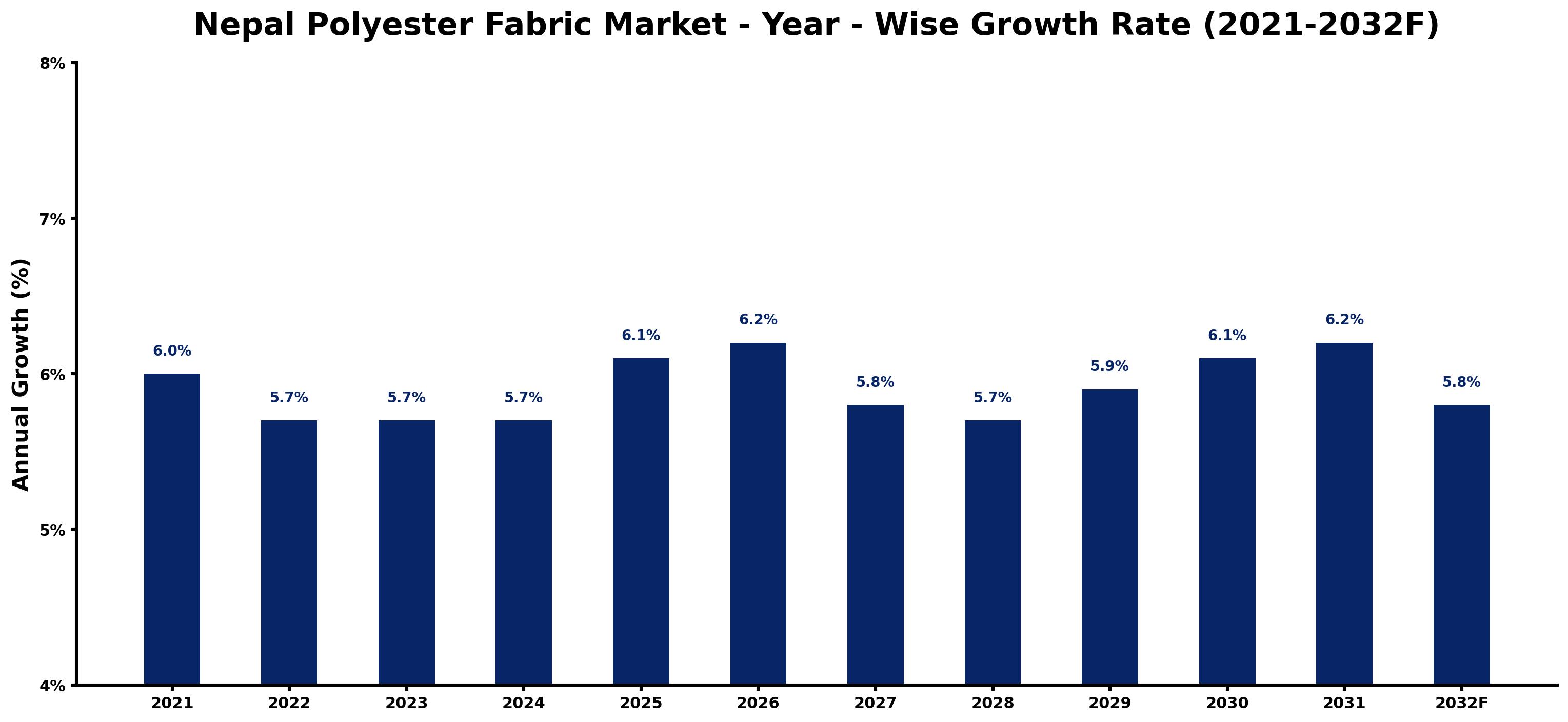
The table below presents the year wise growth rates along with the key drivers influencing the market
| Year | Growth Rate | Major Drivers |
| 2021 | 6.0% | COVID-19 recovery sparked renewed interest in local textile production and sourcing. |
| 2022 | 5.7% | Polyester fabric's lightweight and durability appealed to Nepal's expanding apparel sector. |
| 2023 | 5.7% | Increasing urbanization trends led to higher demand for affordable, fashionable clothing. |
| 2024 | 5.7% | Economic stability encouraged investments in textile manufacturing facilities and infrastructure. |
| 2025 | 6.1% | Sustainable practices in textile production began influencing consumer purchasing decisions. |
| 2026 | 6.2% | International brands entering the market created new supply chain opportunities in Nepal. |
| 2027 | 5.8% | Technological advancements in fabric production improved efficiency and reduced waste significantly. |
| 2028 | 5.7% | The tourism sector's growth boosted demand for local handicrafts and textile variations. |
| 2029 | 5.9% | Young consumers showed preference for innovative designs, impacting market offerings profoundly. |
| 2030 | 6.1% | E-commerce platforms expanded, enabling broader distribution of polyester fabric products. |
| 2031 | 6.2% | Increased global awareness of sustainable materials drove local manufacturers to adapt. |
| 2032 | 5.8% | Local fashion trends began to emerge, showcasing Nepalese culture through polyester fabrics. |
Note - Market size estimations and growth projections presented in this report are based on 6Wresearch's advanced forecasting approach, validated with industry datasets as of June 2026.
Nepal Polyester Fabric Market Synopsis
The Nepal Polyester Fabric Market is projected to reach 6.2% and witness significant growth during the forecast period (2026-2032). This growth trajectory is attributed to various factors, including the rising demand for apparel, upholstery fabrics, and home furnishing products made from polyester. The market is becoming increasingly robust as foreign direct investments in the apparel manufacturing sector continue to rise, further stimulating this growth. Additionally, the consumer shift towards eco-friendly materials, specifically recycled polyester, is set to influence market dynamics positively over the coming years.
Nepal Polyester Fabric Market Growth Drivers
The driving forces behind the expansion of the Nepal Polyester Fabric Market are multifaceted, reflecting both local consumer behavior and global trends. Notably:
- The demand for affordable and durable fabrics in the apparel segment reflects consumer preferences in Nepal, benefitting polyester's market position due to its cost-efficiency.
- Increased urbanization in Nepal contributes to the rising need for modern home furnishing solutions, which often utilize polyester-based fabrics.
- Growing international fashion trends favoring synthetic fabrics are positively influencing local production practices, thereby increasing polyester fabric consumption.
- Government incentives aimed at enhancing the textile industry infrastructure are expected to bolster polyester fabric production capability.
- Heightened awareness regarding sustainability is prompting brands to explore recycled polyester options, further driving innovation in the sector.
Nepal Polyester Fabric Market Trends and Opportunities
The Nepal Polyester Fabric Market exhibits several emerging trends and opportunities that stakeholders should consider:
- There is a notable shift toward sustainable production practices, with more manufacturers exploring the use of recycled polyester to meet consumer demand for eco-friendly options.
- Technological advancements in fabric manufacturing are leading to improved quality and functionality of polyester fabrics, catering to a broader range of applications.
- As e-commerce continues to grow, online sales of polyester apparel and home fabrics are expected to rise, providing new sales channels for businesses.
- Collaborations with international brands offer opportunities for local manufacturers to enhance their market reach and product offerings.
- Increasing investment in local textile technology could pave the way for innovative products, significantly expanding applications in various sectors.
Nepal Polyester Fabric Market Challenges and Restraints
Despite the positive outlook, challenges persist in the Nepal Polyester Fabric Market that may hinder growth:
- Fluctuating prices of raw materials could pose a significant risk to profitability for manufacturers, affecting production costs.
- The competition from cheaper imported fabrics may threaten local producers, urging the need for differentiation and quality focus.
- Environmental concerns regarding plastic waste and its impact on sustainability may affect consumer perception of polyester as a fabric choice.
- Limited access to advanced technology in manufacturing may impede the ability of local manufacturers to compete effectively.
- Changes in trade policies and tariffs could impact the cost dynamics for import and export of polyester fabrics.
Nepal Polyester Fabric Market Government Investment and Initiatives
The government of Nepal recognizes the significance of the textile sector, particularly the polyester fabric market, and has introduced various initiatives to foster growth:
- Investment in infrastructure development, including textile parks, aims to create an enabling environment for manufacturers.
- Public policies encouraging foreign direct investment are designed to attract international players into the local apparel manufacturing sector.
- Support programs targeting the professional training of workers in the textile industry are being implemented to enhance skill levels.
- Incentives for companies adopting sustainable practices are being considered as part of broader environmental policy frameworks.
- The government is actively engaging stakeholders to develop a long-term strategy for the textile industry, ensuring alignment with global market trends.
Nepal Polyester Fabric Market Latest Developments (May 2025 - June 2026)
In the period from May 2025 to June 2026, the Nepal Polyester Fabric Market has experienced significant developments:
- Market participants have increasingly focused on integrating sustainability into their operations, with a growing number of initiatives aimed at promoting recycled polyester fabrics.
- Research and development efforts have intensified, leading to the introduction of new polyester blends that enhance performance attributes.
- Public exhibitions and trade fairs have provided platforms for local manufacturers to showcase innovations and connect with potential buyers and partners.
- Government-backed funding programs have been launched to support modernization efforts within the textile manufacturing sector.
- A rise in collaborations between local and international textile companies has fostered knowledge transfer and improved production techniques.
Nepal Polyester Fabric Market - Key Attractiveness of the Report
- 10 Years of Market Numbers
- Historical Data Starting from 2022 to 2025
- Base Year: 2025
- Forecast Data until 2032
- Key Performance Indicators Impacting the Market
- Major Upcoming Developments and Projects
Key Highlights of the Report:
- Nepal Polyester Fabric Market Outlook
- Market Size of Nepal Polyester Fabric Market, 2025
- Forecast of Nepal Polyester Fabric Market, 2032F
- Historical Data and Forecast of Nepal Polyester Fabric Revenues & Volume for the Period 2022-2032F
- Nepal Polyester Fabric Market Trend Evolution
- Nepal Polyester Fabric Market Drivers and Challenges
- Nepal Polyester Fabric Price Trends
- Nepal Polyester Fabric Porter's Five Forces
- Nepal Polyester Fabric Industry Life Cycle
- Historical Data and Forecast of Nepal Polyester Fabric Market Revenues & Volume By Type for the Period 2022-2032F
- Historical Data and Forecast of Nepal Polyester Fabric Market Revenues & Volume By PET for the Period 2022-2032F
- Historical Data and Forecast of Nepal Polyester Fabric Market Revenues & Volume By PCDT for the Period 2022-2032F
- Historical Data and Forecast of Nepal Polyester Fabric Market Revenues & Volume By Applications for the Period 2022-2032F
- Historical Data and Forecast of Nepal Polyester Fabric Market Revenues & Volume By Carpets & Rugs for the Period 2022-2032F
- Historical Data and Forecast of Nepal Polyester Fabric Market Revenues & Volume By Non-Woven Fabrics Fiberfill for the Period 2022-2032F
- Historical Data and Forecast of Nepal Polyester Fabric Market Revenues & Volume By Apparels for the Period 2022-2032F
- Historical Data and Forecast of Nepal Polyester Fabric Market Revenues & Volume By Home Textiles for the Period 2022-2032F
- Historical Data and Forecast of Nepal Polyester Fabric Market Revenues & Volume By Others? for the Period 2022-2032F
- Nepal Polyester Fabric Import Export Trade Statistics
- Market Opportunity Assessment By Type
- Market Opportunity Assessment By Applications
- Nepal Polyester Fabric Top Companies Market Share
- Nepal Polyester Fabric Competitive Benchmarking By Technical and Operational Parameters
- Nepal Polyester Fabric Company Profiles
- Nepal Polyester Fabric Key Strategic Recommendations






































